
Skip to content

What is Agentic AI in Customer Support? The Complete Guide (2026)

What is Agentic AI in Customer Support? The Complete Guide (2026)

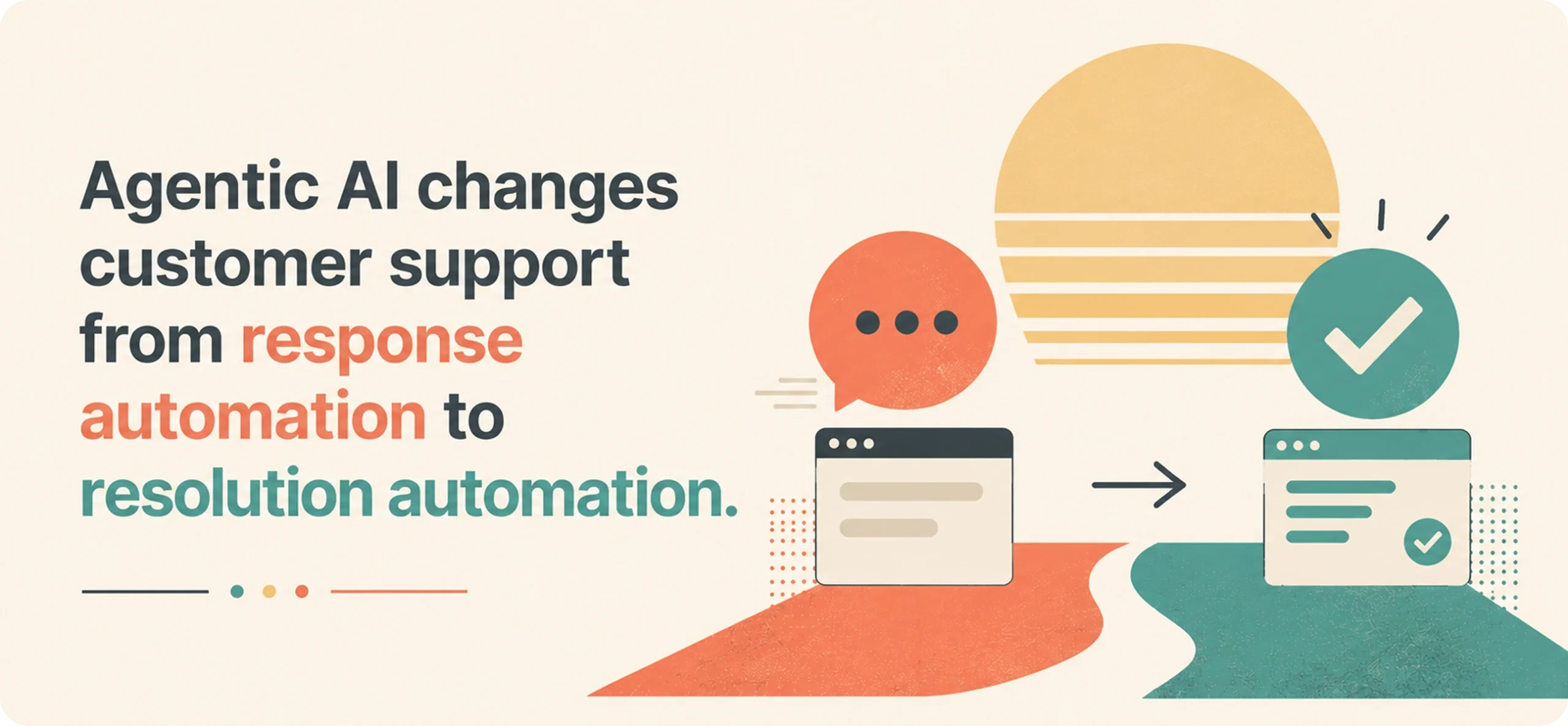
Agentic AI in customer support is an artificial intelligence system that can understand customer requests, reason through business context, make policy-driven decisions, execute actions across enterprise systems, and verify successful resolution with minimal human intervention.

Unlike traditional chatbots that primarily answer questions or AI copilots that assist human agents, Agentic AI works toward completing the customer’s objective by interacting with business applications, automating workflows, and resolving support issues from start to finish.

For example, if a customer requests a refund, Agentic AI can verify eligibility, retrieve order details, apply company policies, initiate the refund, update the CRM, notify the customer, and document every action automatically.

Instead of stopping after generating a response, Agentic AI continues working until the issue is resolved or routes the request to a human agent when additional expertise or approval is required.

As customer expectations continue to rise and support operations become increasingly complex, enterprises are adopting Agentic AI to improve first-contact resolution, reduce operational costs, deliver consistent omnichannel experiences, and scale customer support without proportionally increasing support teams.
How Agentic AI Works in Customer Support

From the outside, an AI-powered customer support interaction may look similar to a chatbot conversation. A customer asks a question, the AI responds, and the issue appears to move forward.

Behind the scenes, however, Agentic AI follows a far more sophisticated process.

Let’s look at each stage in detail.

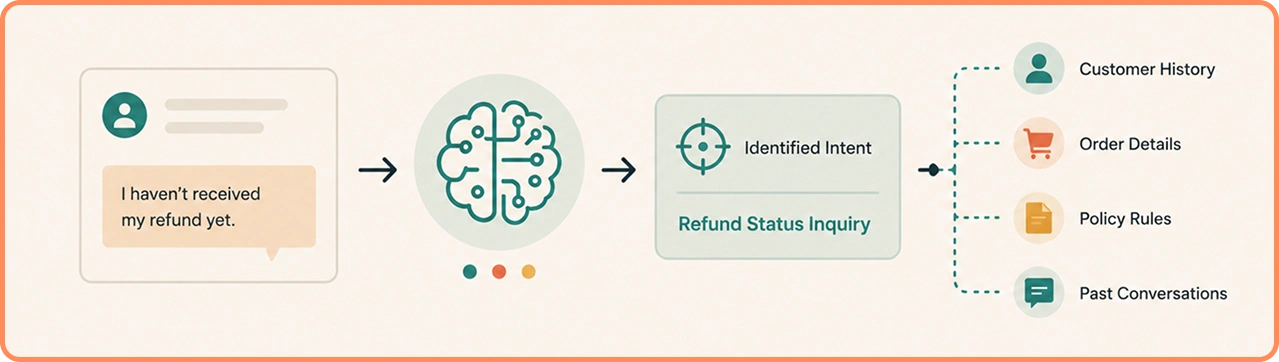
Step 1: Understand Customer Intent

Every customer interaction begins with understanding the actual objective behind the request.

Customers rarely explain issues in a perfectly structured way. They often provide incomplete information or describe symptoms instead of the underlying problem.

Understand Customer Intent

For example:

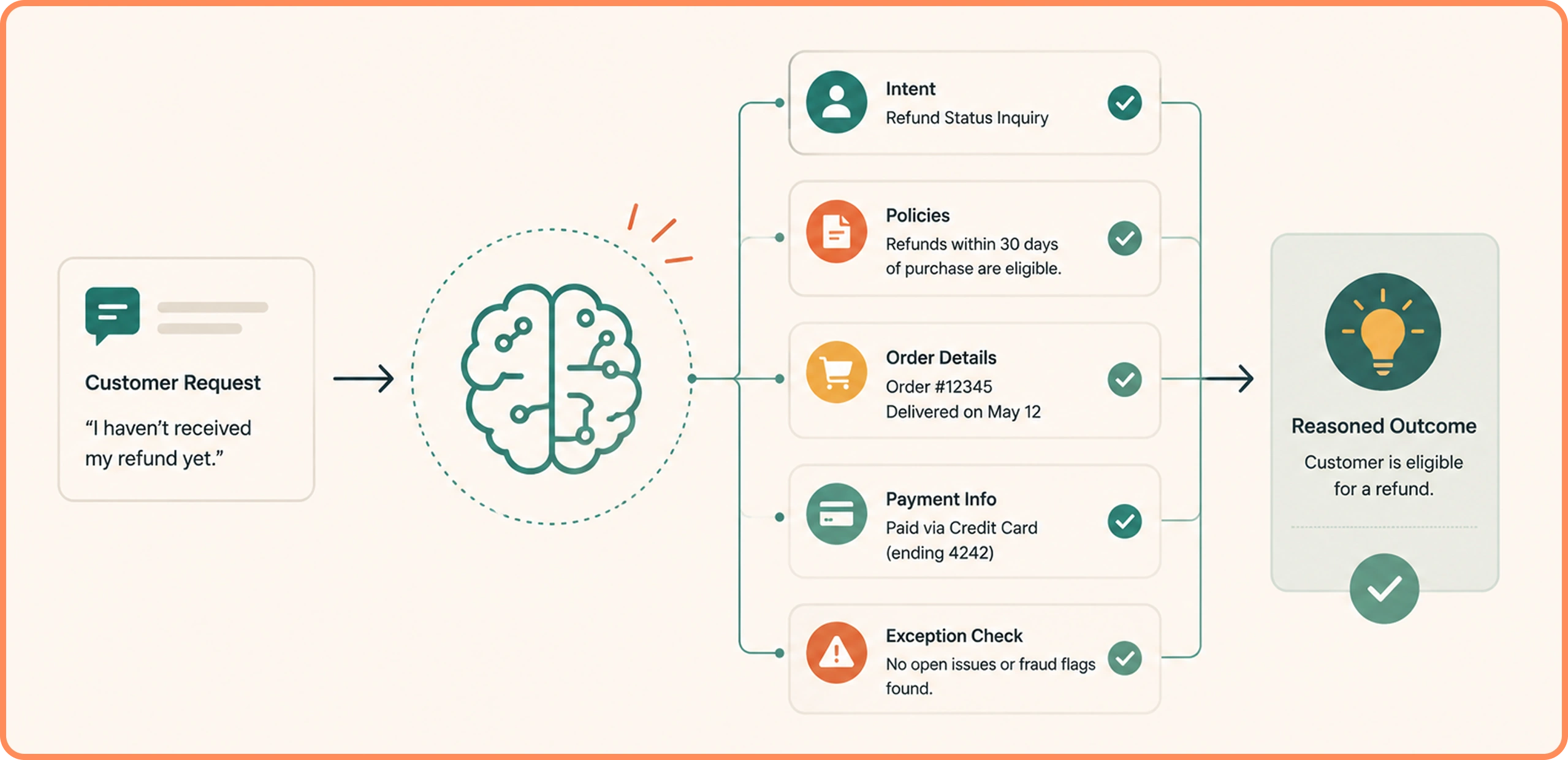
“I haven’t received my refund yet.”

This single message could involve several scenarios:

  • The refund has already been processed.
  • The refund request is still awaiting approval.
  • The payment failed.
  • The refund was issued to a different payment method.
  • The customer isn’t eligible under company policy.

Agentic AI analyzes the conversation using natural language understanding, customer history, previous interactions, account details, and business context to identify the customer’s true intent before taking action.

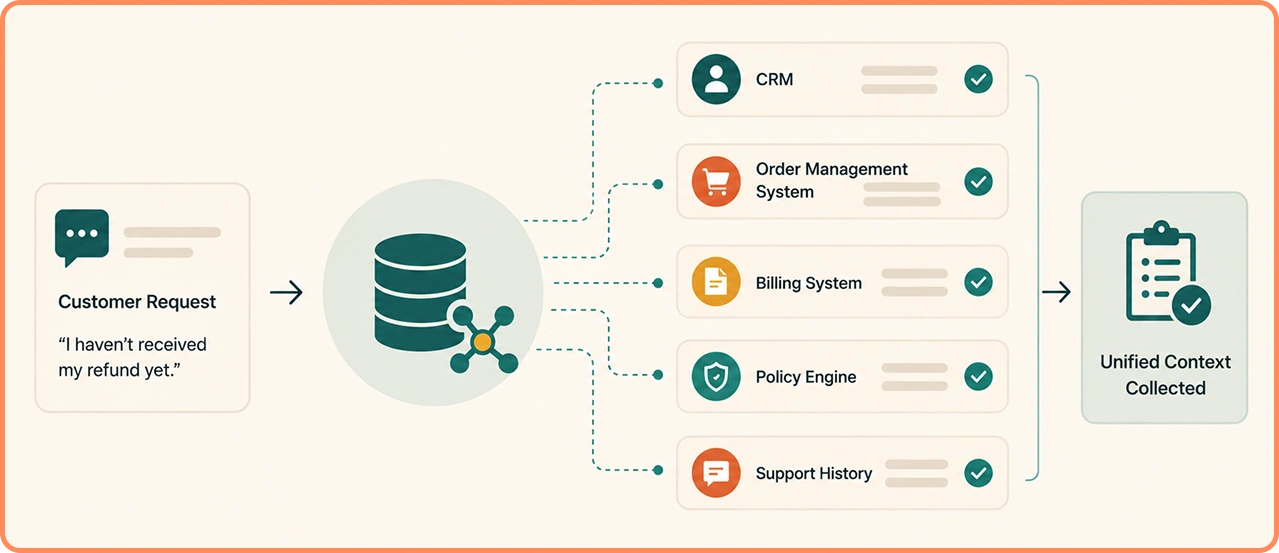
Step 2: Collect Context Across Business Systems

Once the customer’s objective is clear, Agentic AI gathers information from the systems involved in resolving the issue.

Collect Context Across Business Systems

Depending on the request, this may include:

  • CRM platforms
  • Order management systems
  • Billing software
  • ERP solutions
  • Inventory databases
  • Shipping providers
  • Identity verification services
  • Knowledge bases
  • Previous support tickets

Rather than asking customers to repeat information they have already shared, the AI assembles a complete picture before making a decision.

This contextual awareness helps deliver more accurate resolutions while reducing repetitive conversations.

Step 3: Reason Through the Situation

Every customer request must align with business policies, operational procedures, and compliance requirements.

This is where reasoning becomes essential.

Instead of applying a single predefined workflow to every request, Agentic AI evaluates multiple conditions before deciding the next action.

Reason Through the Situation

For example, before approving a refund, the AI may verify:

  • Is the customer within the return window?
  • Has the product already been shipped?
  • Does the refund require manager approval?
  • Is there evidence of fraud?
  • Has the customer exceeded refund limits?

Only after evaluating these conditions does the AI determine the appropriate path.

This reasoning process enables consistent decision-making across thousands of customer interactions.

Step 4: Create an Action Plan

Many support requests require multiple coordinated tasks.

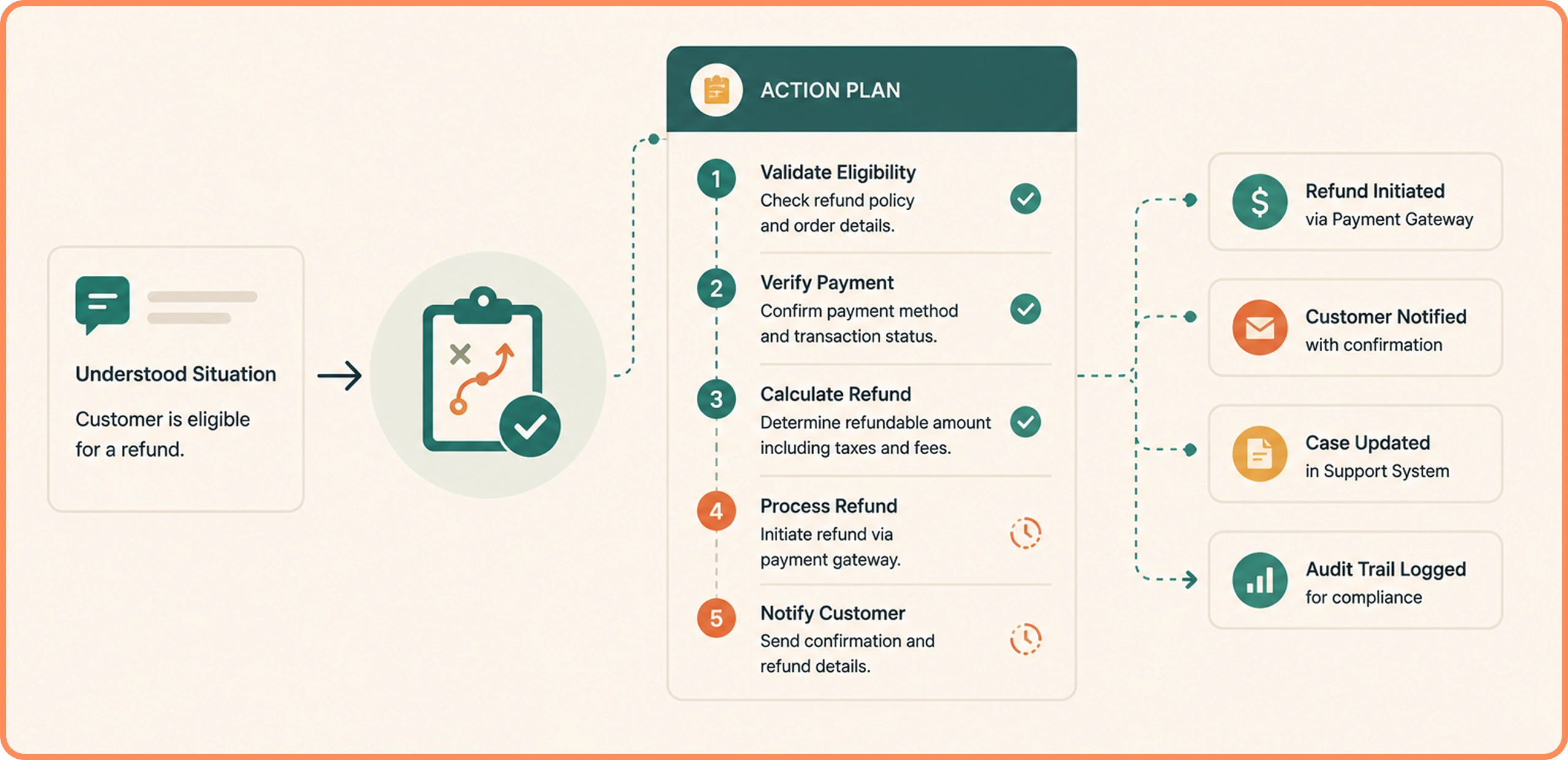
Agentic AI creates an execution plan that outlines the steps needed to achieve the customer’s objective.

Create an Action Plan

Consider a subscription upgrade request.

Instead of responding with instructions, the AI may plan to:

  • Verify account ownership
  • Review the customer’s current subscription
  • Calculate pricing differences
  • Process payment authorization
  • Activate the upgraded plan
  • Update billing records
  • Notify connected applications
  • Send a confirmation email
  • Record the activity in the CRM

Each action contributes toward completing the request successfully.

Step 5: Execute Business Workflows

This stage represents one of the biggest differences between conversational AI and Agentic AI.

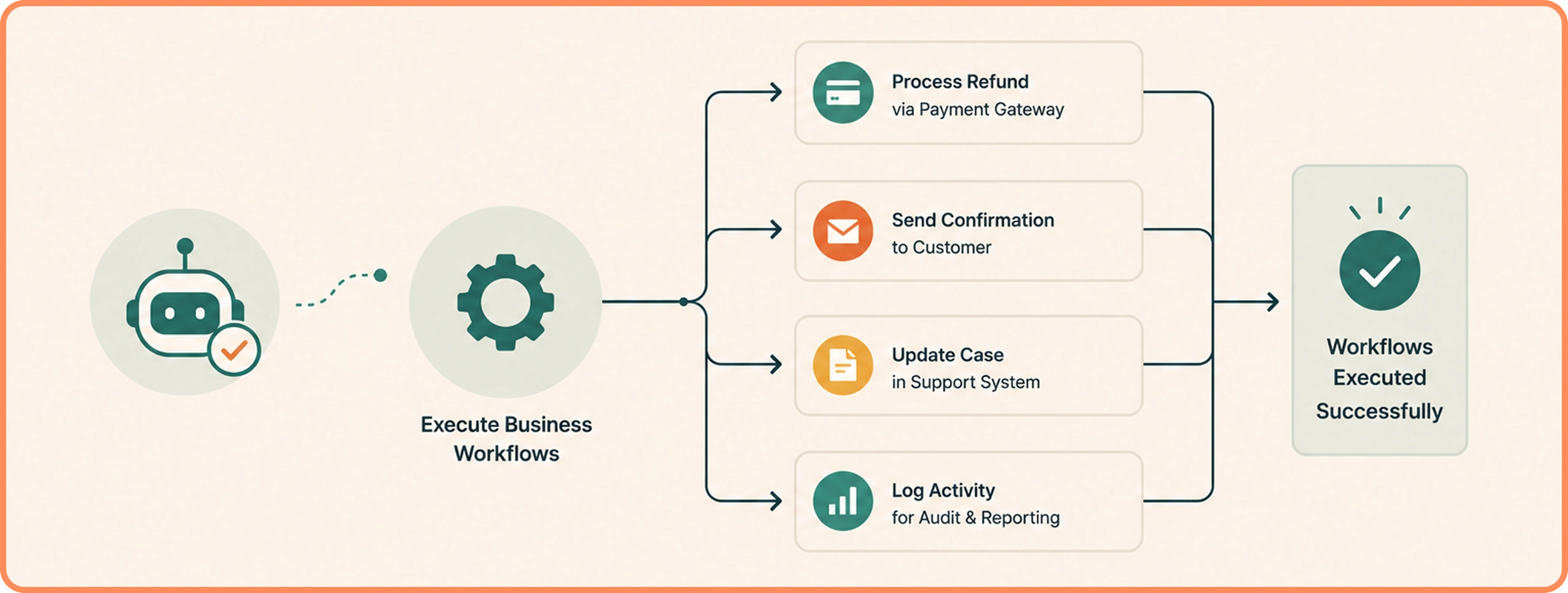
Rather than suggesting actions to a support representative, Agentic AI interacts directly with enterprise applications.

Executre Business Workflows

It can:

  • Update customer records
  • Modify subscriptions
  • Process refunds
  • Generate invoices
  • Reset passwords
  • Create replacement orders
  • Schedule appointments
  • Open or close support cases
  • Trigger approval workflows
  • Notify internal teams

These actions are performed according to predefined business rules and organizational policies.

As a result, support teams spend less time on repetitive operational work and more time addressing complex customer needs.

Step 6: Verify Resolution

Completing an action does not automatically mean the customer’s issue has been resolved.

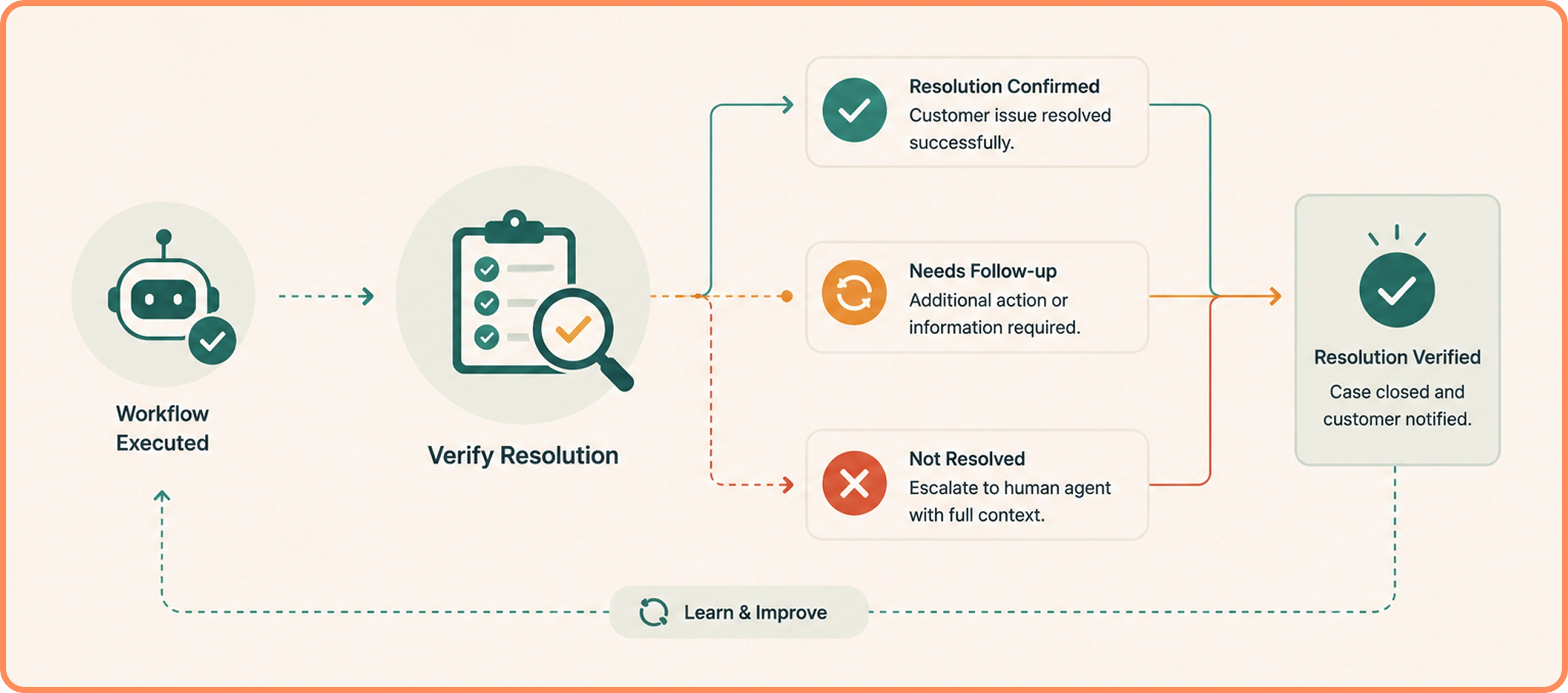
Agentic AI checks whether the intended outcome has been achieved.

Verify Resolution

For example:

  • Was the payment processed successfully?
  • Was the order updated correctly?
  • Did the customer receive confirmation?
  • Did every connected system synchronize properly?

If additional work is required, the AI continues the workflow until resolution is achieved or routes the request to the appropriate human expert.

Read our guide on AI in Support Ticket Resolution to see how AI improves resolution accuracy, speed, and operational efficiency.

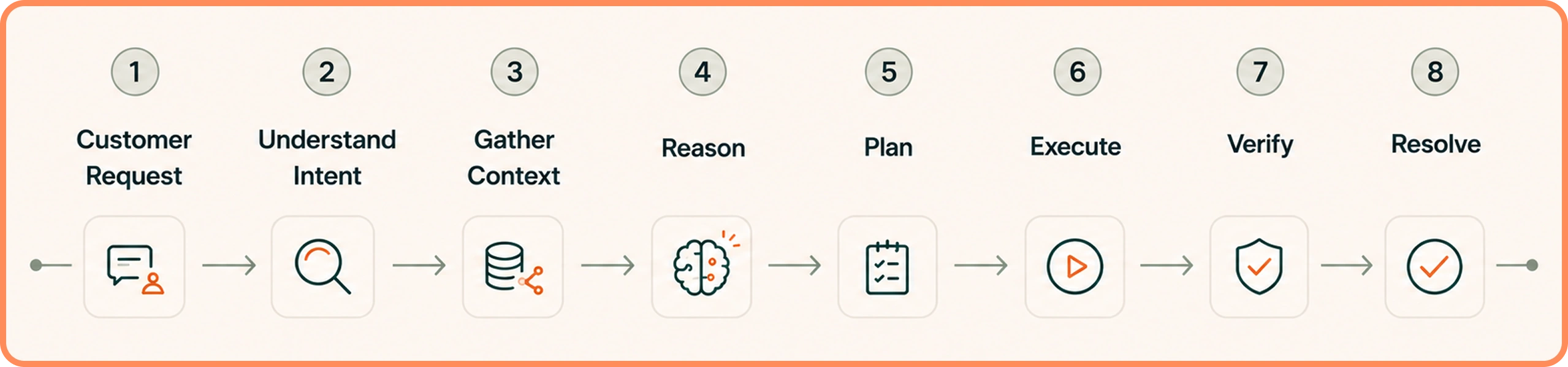
The Agentic AI Customer Support Workflow

A simplified workflow looks like this:

Agentic AI Customer Support Workflow

Unlike traditional automation, every stage of Agentic AI in customer support contributes toward solving the customer’s problem rather than simply generating another response.

Agentic AI vs Chatbots vs AI Copilots

AI has evolved through multiple stages within customer support. While chatbots and AI copilots continue to deliver value, Agentic AI introduces a broader operational capability.

Understanding these differences helps organizations choose the right technology for their support strategy.

Capability Traditional Chatbots AI Copilots Agentic AI
Primary Purpose Answer common customer questions Assist support agents with recommendations and responses Autonomously resolve customer issues from start to finish
Primary User Customers Support agents Customers and support teams
Understand Customer Intent Basic keyword or intent matching Advanced natural language understanding Advanced understanding with customer and business context
Customer Context Limited session context Conversation history and customer details Unified customer context across every connected system
Reasoning Ability Rule-based logic Suggests next-best actions Performs multi-step reasoning before taking action
Workflow Execution Very limited Requires agents to execute actions Executes workflows across enterprise applications
Decision Making Predefined rules Provides recommendations Policy-driven autonomous decision making
Enterprise System Access Basic integrations Retrieves information from business systems Reads and updates data across enterprise systems
Multi-Step Requests Limited support Guides agents through multiple steps Plans, executes, and completes complex workflows
Human Involvement Required for complex issues Required throughout the interaction Required only for approvals, exceptions, or escalations
Customer Memory Session-based or limited Partial customer history Persistent shared customer memory across channels
Omnichannel Continuity Basic Supports multiple channels Maintains context across chat, email, voice, and messaging
Business Impact Reduces repetitive inquiries Improves agent productivity and response quality Increases resolution rates, lowers support costs, and improves customer experience
Best Suited For FAQs and simple customer inquiries Agent assistance and knowledge retrieval End-to-end customer support automation and issue resolution

Key Capabilities of Agentic AI in Customer Support

Organizations evaluating AI agents for customer support should look beyond conversational quality. The greatest value comes from the capabilities that enable AI to resolve customer issues efficiently, securely, and consistently.

The following capabilities define a mature Agentic AI customer support platform like Azeon.

Autonomous Reasoning

Autonomous reasoning enables Agentic AI to evaluate customer requests, analyze available information, apply business policies, and determine the most appropriate course of action without relying on predefined conversation scripts.

This allows it to manage exceptions, prioritize requests, and make consistent operational decisions across a wide range of support scenarios.

Workflow Orchestration

Workflow orchestration enables Agentic AI to coordinate multiple business processes required to resolve a customer request.

A single support interaction may involve updating customer records, retrieving billing information, processing payments, creating service requests, notifying internal teams, and synchronizing changes across enterprise applications.

Rather than treating these as separate tasks, Agentic AI manages them as a connected workflow, executing each step in the correct sequence while maintaining business logic and operational consistency.

Context Awareness

Context awareness allows Agentic AI to make decisions based on the complete customer journey instead of an isolated conversation.

It continuously combines information from previous interactions, account details, purchases, support history, active subscriptions, product usage, organizational policies, and live business data to establish a comprehensive understanding of each request.

This broader context supports more accurate decisions, reduces unnecessary follow-up questions, and enables personalized customer experiences.

Shared Customer Memory

Shared customer memory provides a persistent record of customer interactions, preferences, and operational history across every support channel.

Unlike session-based memory that resets after each conversation, shared memory allows Agentic AI to preserve continuity between chat, email, voice, messaging platforms, and future interactions.

This persistent understanding enables customers to continue conversations naturally while helping support teams maintain a unified view of every customer relationship.

Enterprise System Integrations

Integrations allow Agentic AI to interact directly with the applications that power business operations.

Through APIs and enterprise connectors, the platform can retrieve information, update records, trigger workflows, execute transactions, and synchronize data across CRM platforms, ERP systems, payment gateways, knowledge bases, helpdesk platforms, inventory systems, and internal business applications.

Omnichannel Orchestration

Omnichannel orchestration enables Agentic AI to manage customer interactions consistently across every communication channel.

Whether a customer begins a conversation through live chat, continues by email, and completes the interaction over voice, the AI maintains conversation history, customer context, and workflow progress throughout the entire journey.

Human-in-the-Loop Governance

This capability introduces controlled oversight into autonomous decision making.

Agentic AI independently resolves routine requests while automatically routing high-risk, high-value, policy-sensitive, or exceptional cases to human agents for review or approval.

This governance model balances operational efficiency with accountability, helping organizations maintain quality, compliance, and customer trust.

Auditability

Auditability provides complete visibility into every decision, action, workflow, approval, and system interaction performed by the AI.

Each customer interaction generates a traceable record that supports operational reporting, compliance requirements, security reviews, and continuous process improvement.

Continuous Optimization

Agentic AI continuously improves through updated business knowledge, workflow enhancements, policy changes, and operational feedback.

As organizations introduce new products, revise procedures, or expand service offerings, the platform adapts its reasoning, workflows, and decision models without disrupting customer support operations.

Top Use Cases of Agentic AI in Customer Support

Below are some of the most impactful use cases of Agentic AI across modern customer support operations.

Financial Services

  • Credit card replacement
  • Payment dispute resolution
  • Duplicate transaction investigation
  • Loan repayment queries
  • EMI schedule modifications
  • Account verification
  • Fraud reporting
  • Interest and fee clarification
  • Beneficiary updates
  • Refund processing

Retail and eCommerce

  • Order tracking
  • Address modifications
  • Product exchanges
  • Returns
  • Refund approvals
  • Delivery rescheduling
  • Inventory availability
  • Loyalty program support
  • Coupon validation
  • Warranty registration

SaaS Companies

  • Subscription upgrades
  • License management
  • User provisioning
  • Password resets
  • Account recovery
  • Billing updates
  • Product onboarding
  • Usage inquiries
  • Feature access requests
  • Technical issue routing

FMCG and Consumer Goods

  • Warranty registration
  • Product information
  • Complaint handling
  • Replacement requests
  • Dealer support
  • Product availability
  • Recall communication
  • Installation assistance
  • Service scheduling

Telecommunications

  • SIM activation
  • Plan upgrades
  • Network troubleshooting
  • Number portability
  • Billing disputes
  • Service activation
  • Device financing
  • Roaming support

Healthcare

  • Appointment scheduling
  • Insurance verification
  • Prescription refill requests
  • Billing inquiries
  • Patient record requests
  • Care coordination
  • Follow-up reminders

Benefits of Agentic AI in Customer Support

The impact of Agentic AI extends beyond automation. It improves customer experiences, empowers support teams, and creates measurable business value.

Let’s examine these benefits from different perspectives.

Benefits for Customers

Agentic AI helps organizations deliver experiences that feel more connected, personalized, and efficient.

  • Faster Resolution: Instead of waiting for tickets to move between departments, customers receive completed resolutions during the conversation whenever policies allow.
  • Personalized Experiences: By combining customer history, preferences, previous interactions, and account information, Agentic AI tailors each interaction to the individual customer.
  • Consistent Support Across Channels: Customers receive the same experience whether they contact support through chat, email, phone, or messaging applications.
  • Higher First-Contact Resolution: More issues can be resolved during the initial interaction, reducing customer effort and increasing satisfaction.

Benefits for Support Agents

Agentic AI complements human expertise by handling repetitive operational work.

  • Less Repetitive Work: Routine activities such as updating records, resetting passwords, processing standard requests, and retrieving customer information become automated.
  • Faster Access to Information: Rather than searching multiple applications, agents receive complete customer context in one place.
  • Better Decision Support; For complex situations, Agentic AI recommends actions based on organizational policies and historical data.
  • Reduced Administrative Burden: Documentation, CRM updates, and workflow tracking happen automatically, allowing agents to focus on customer conversations.

Benefits for Customer Support Leaders

Support leaders measure success through operational efficiency, service quality, and customer satisfaction.

  • Improved Resolution Rates: AI completes more customer requests independently, increasing the percentage of successfully resolved cases.
  • Reduced Operational Costs: Automation decreases manual effort while enabling support teams to manage growing ticket volumes without proportional staffing increases.
  • Better Resource Allocation: Support specialists spend more time on strategic, high-value customer interactions rather than repetitive operational tasks.
  • Improved Customer Satisfaction: Customers appreciate quicker resolutions, fewer transfers, and more consistent experiences.

Explore practical strategies in our guide on How to Reduce Customer Support Costs with AI.

How Much Does Agentic AI Customer Support Cost?

The answer depends on several factors, including the size of your support operation, the complexity of your workflows, the number of business systems involved, and the level of automation you want to achieve.

For example, a company looking to automate FAQ responses through a simple chatbot will have very different implementation costs than an enterprise deploying Agentic AI to resolve customer issues, orchestrate workflows, integrate with CRM and ERP systems, and support omnichannel customer service.

Some of the biggest factors that influence implementation cost include:

  • Number of customer support channels
  • Existing CRM and helpdesk integrations
  • Knowledge base readiness
  • Workflow automation requirements
  • Security and compliance needs
  • AI governance requirements
  • Support ticket volume
  • Custom business logic and approvals

Organizations should also consider the total cost of ownership rather than only the initial implementation cost.

If you’re evaluating implementation budgets, our detailed guide explains everything that influences pricing, hidden costs, build-versus-buy considerations, and expected ROI for software companies.

Recommended Reading: Cost to Implement AI Customer Support for a Software Startup

How to Evaluate an Agentic AI Platform for Customer Support

Many vendors describe their solutions as “AI-powered” or “agentic.” In practice, their capabilities vary significantly.

Below are the key areas every enterprise should consider.

1. Resolution Capability

Resolution rate is a stronger indicator of platform value than response quality alone because it directly reflects business outcomes.

Hence, during evaluation, assess whether the platform can independently complete end-to-end support workflows.

Review how the platform manages multi-step workflows, verifies outcomes, and determines when an issue has been successfully resolved.

2. Enterprise Integrations

The effectiveness of an Agentic AI platform depends on how seamlessly it integrates with this ecosystem.

Evaluate the availability of native integrations, API support, workflow connectors, and the ability to exchange data securely between systems.

3. Workflow Execution

Instead of recommending next steps, the platform should automate operational tasks.

Assess how workflows are designed, configured, and monitored. Enterprise platforms should support multi-step orchestration, conditional logic, exception handling, and integration with existing business processes while maintaining consistency across every execution.

4. Context Management and Shared Customer Memory

Evaluate whether the platform preserves conversation history, customer preferences, account information, and previous actions.

Shared customer memory enables more accurate decisions, reduces repetitive questioning, and improves the continuity of customer experiences across chat, email, voice, and other channels.

5. Reasoning and Decision-Making

Review how the platform applies business logic, handles exceptions, prioritizes competing conditions, and adapts workflows to different customer scenarios.

Strong reasoning capabilities improve decision consistency while reducing unnecessary escalations.

6. Governance and Human Oversight

Evaluate how the platform manages approval workflows, role-based permissions, escalation policies, audit requirements, and operational boundaries.

The platform should support configurable human intervention for high-value transactions, policy exceptions, or regulated workflows while allowing routine requests to proceed autonomously.

7. Security and Compliance

Review the platform’s approach to authentication, authorization, data encryption, access management, API security, and information handling.

Organizations operating in regulated industries should also verify support for audit logs, compliance reporting, data residency requirements, and alignment with standards such as SOC 2, GDPR, HIPAA, or other industry-specific regulations.

8. Outcome-Based Pricing and ROI

Many AI vendors charge based on seats, conversations, tokens, or API usage, which may not accurately represent business impact.

Evaluate pricing alongside measurable operational outcomes such as resolution rate, cost per resolution, automation coverage, customer satisfaction improvements, and return on investment.

A pricing model aligned with business outcomes provides greater visibility into the long-term value of the platform.

For more insights, read our blog on: How to Compare AI Vendors for Customer Support Automation

How Azeon Delivers Agentic Customer Support

Azeon is an AI agent for customer support.

It works with your existing support ecosystem to automate customer resolutions, streamline operations, and improve service quality without requiring a complete technology replacement.

Azeon can:

  • Understand customer intent and business context
  • Access enterprise systems to retrieve relevant information
  • Execute workflows across CRM, helpdesk, ERP, and other business applications
  • Maintain shared customer memory across every support channel
  • Escalate policy-sensitive requests to human agents when required
  • Verify outcomes before completing customer interactions

If you’re exploring Agentic AI for customer support, Azeon can help you evaluate where autonomous workflows create the greatest impact and how they fit within your existing support operations.

Experience Azeon for Resolution-Focused Customer Support

Explore AI that reasons, executes, and resolves customer issues at scale.

Book a Demo →

David works closely with enterprise organizations to help them modernize customer support operations through AI-driven automation. With experience in strategic account management, customer engagement, and technology consulting, David focuses on aligning business objectives with scalable support solutions that improve efficiency, customer experience, and operational performance.

David Pridgen
Solution Consultant

Questions about Azeon?

Connect with our team to explore use cases, workflows, and deployment possibilities.