Skip to content

Agentic AI vs Traditional Chatbots for Customer Service

Agentic AI vs Traditional Chatbots for Customer Service

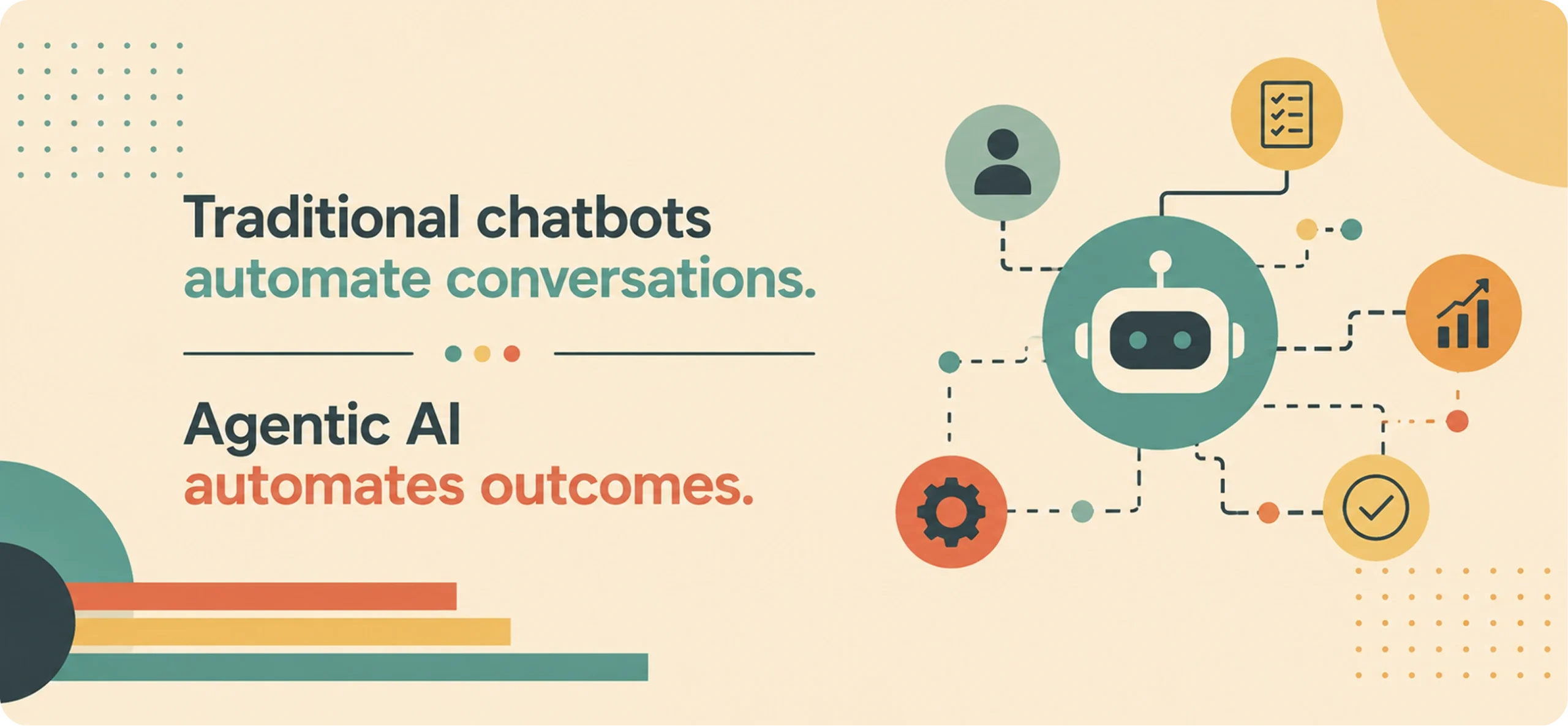
Customer service chatbots have existed for nearly two decades. They helped businesses automate repetitive conversations, answer frequently asked questions, and reduce agent workloads.

Yet many support leaders discovered a common problem: conversations increased, but resolutions did not.

That’s the reason the demand for Agentic AI is increasing rapidly.

Rather than simply responding to customers, agentic AI can understand requests, reason through problems, access business systems, execute workflows, and complete tasks.

This guide compares traditional customer service chatbots and agentic AI platforms across architecture, capabilities, customer experience, and business outcomes.
What are Traditional Customer Service Chatbots?

Traditional customer service chatbots are conversational systems designed to answer questions using predefined rules, decision trees, or intent-based workflows.

Most chatbots operate using:

  • Predefined conversation flows
  • Intent classification
  • Keyword matching
  • FAQ responses
  • Scripted actions
  • Escalation rules

These systems help businesses reduce simple support requests and improve response times.

However, they primarily focus on conversations rather than outcomes.

What is Agentic AI in Customer Service?

Agentic AI refers to AI systems that can understand customer requests, make decisions, take actions, and complete tasks across business systems.

Unlike traditional chatbots, agentic AI can:

  • Maintain customer memory
  • Understand context
  • Reason through multiple steps
  • Access enterprise systems
  • Execute workflows
  • Collaborate with human agents
  • Resolve customer issues

The goal shifts from answering questions to resolving requests.

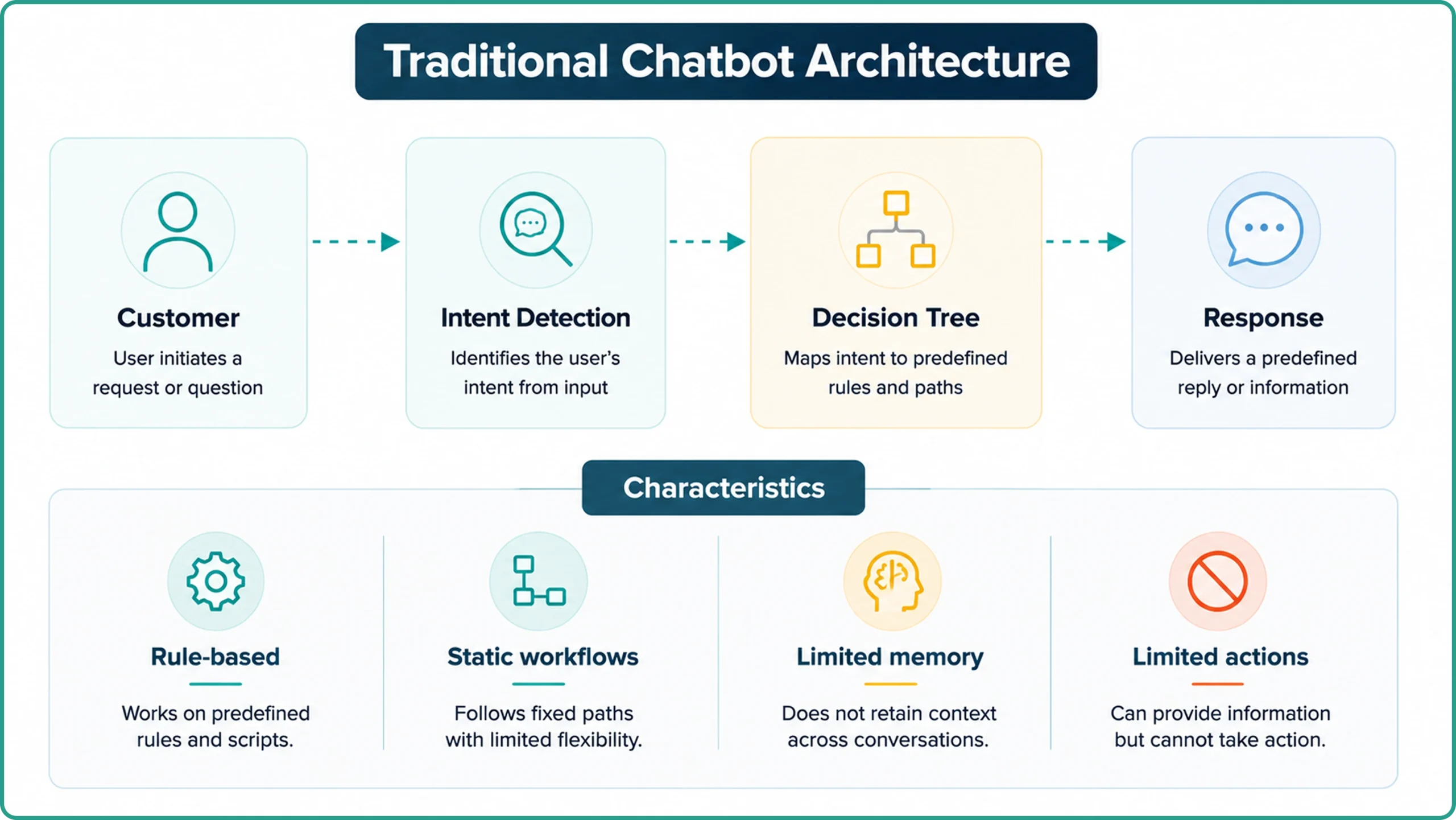
How Traditional Chatbots Work?

Most traditional chatbots follow a simple flow:

Customer Question → Intent Detection → Decision Tree → Response

Traditional Chatbot Architecture

The interaction ends after providing information.

If the customer needs to change the delivery address, request compensation, or resolve a delivery issue, the conversation often moves to a human agent.

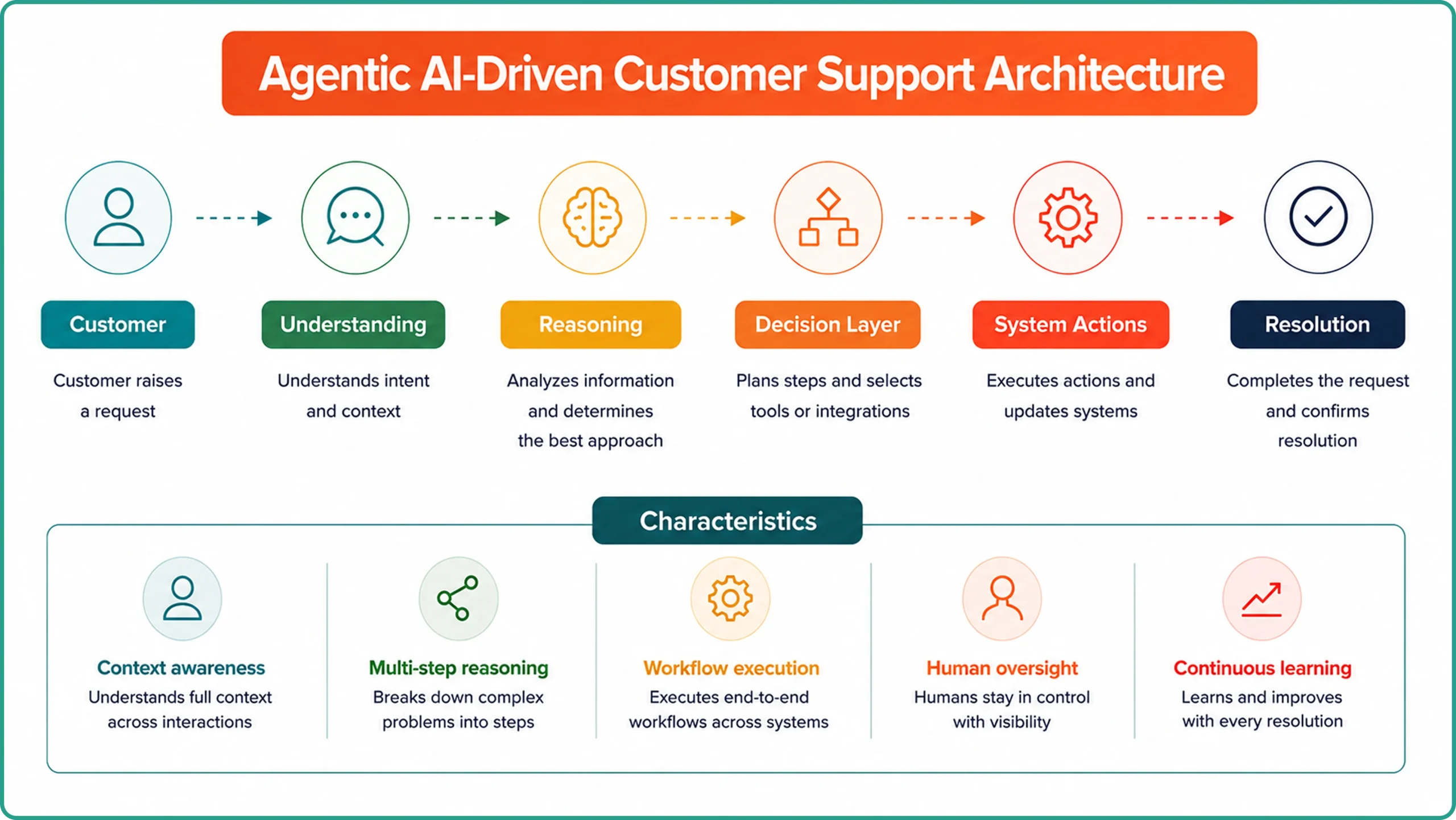
How Agentic AI in Customer Support Works?

Agentic AI introduces additional layers:

Customer Request → Understanding → Reasoning → System Actions → Resolution

Agentic AI Architecture in Customer Support Operations

The system can:

  • Analyze customer history
  • Understand urgency
  • Access multiple systems
  • Evaluate policies
  • Execute workflows
  • Request human approval when needed

This allows AI to handle more complex customer requests.

Agentic AI vs Chatbots for Customer Service: Side-by-Side Comparison

Traditional chatbots and agentic AI platforms both use artificial intelligence to support customer service operations. However, their capabilities, architecture, and business outcomes differ significantly.

The table below highlights the major differences.

Capability Traditional Chatbots Agentic AI
Primary Purpose Answer customer questions Resolve customer issues
Interaction Model Scripted conversations Goal-oriented execution
Customer Memory Session-based or limited Persistent customer memory
Context Awareness Limited Extensive
Reasoning Ability Minimal Multi-step reasoning
Workflow Execution Limited Native execution
Business System Access Basic integrations Deep integrations
Decision Making Rule-based Context-driven
Multi-Step Requests Difficult Supported
Exception Handling Limited Adaptive
Personalization Basic Dynamic
Human Collaboration Escalation only Human-in-the-loop
Learning Capability Limited Continuous improvement
Resolution Rate Lower Higher
Operational Impact Moderate Significant

Why Traditional Chatbots Struggle with Modern Customer Support

Lack of Customer Context

Most chatbots treat every interaction independently.

Customers often repeat account information, previous issues, order details, and past conversations.

This creates frustration and increases effort.

Script Dependency

Traditional bots rely heavily on predefined conversation paths.

When customers ask unexpected questions, the system struggles to continue.

Limited System Access

Many chatbots provide information but cannot update accounts, process refunds, modify subscriptions, execute transactions, etc.

As a result, human agents complete the actual work.

High Escalation Rates

Complex issues frequently move to support agents, creating longer wait times, higher support costs, and increased workloads.

Customer Service Scenarios: Agentic AI vs Chatbots

The following side-by-side comparison demonstrates how these approaches differ in everyday support operations.

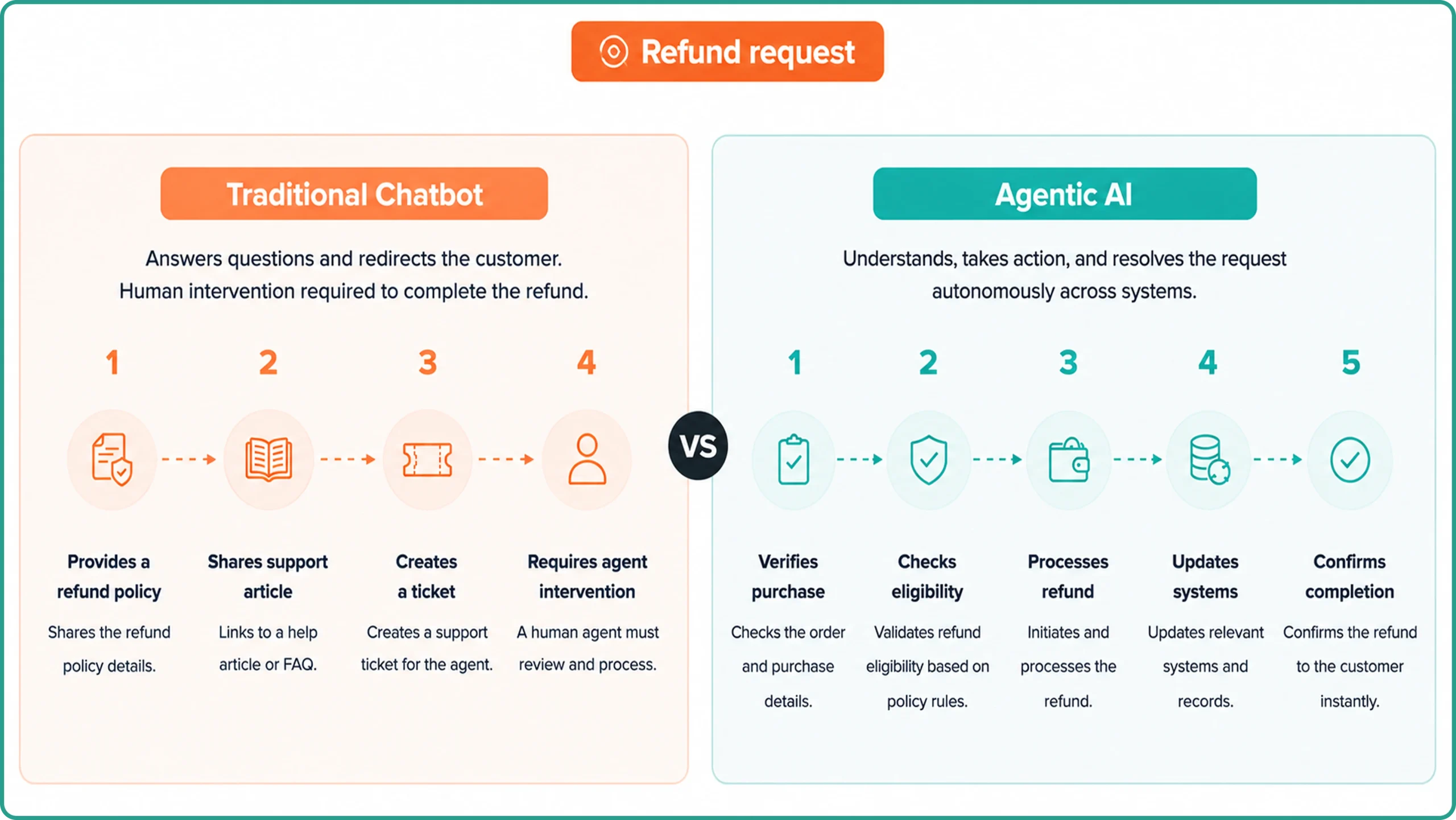
Scenario 1: Refund Request

Refund Request

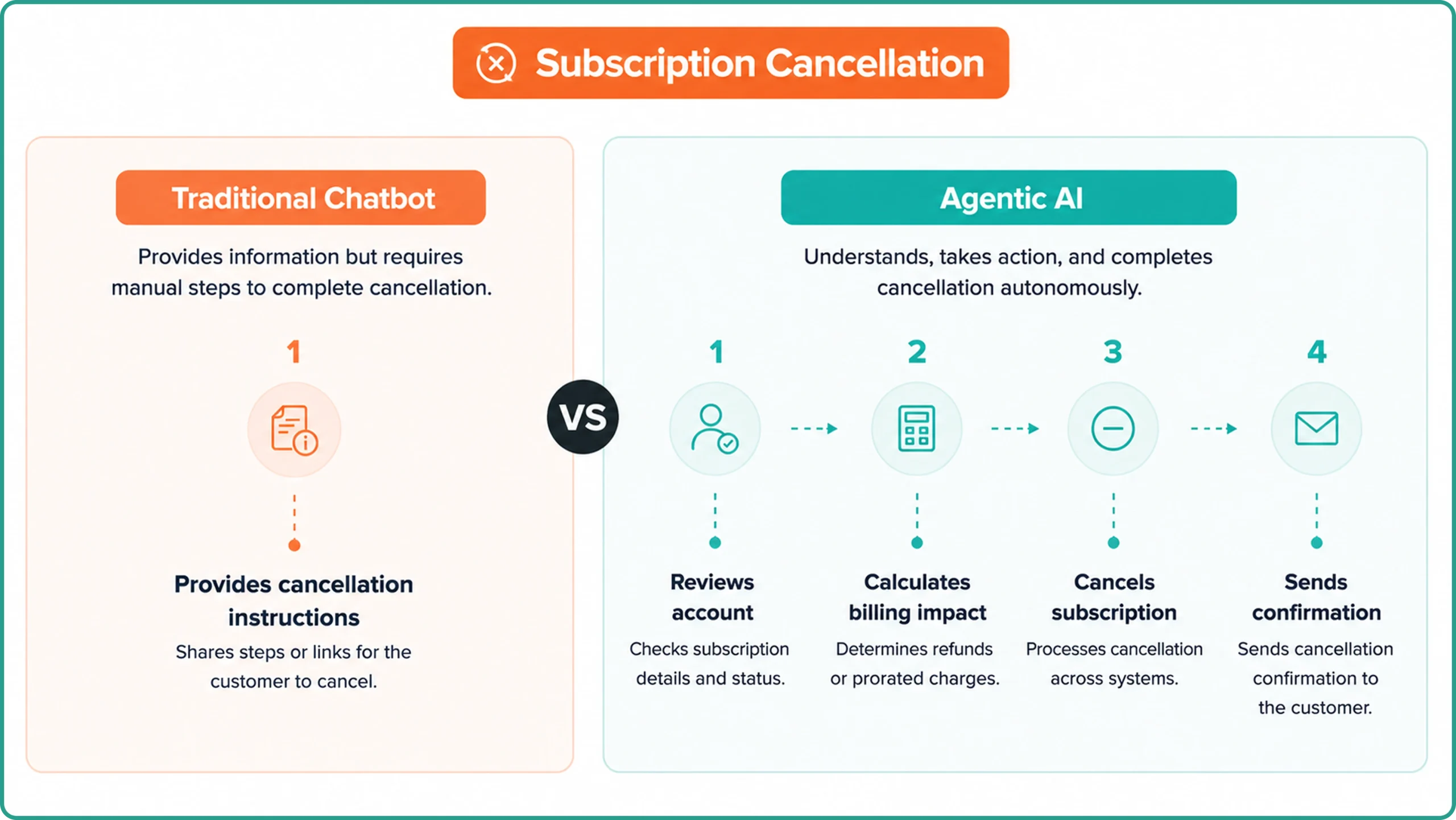
Scenario 2: Subscription Cancellation

Subscription Cancellation

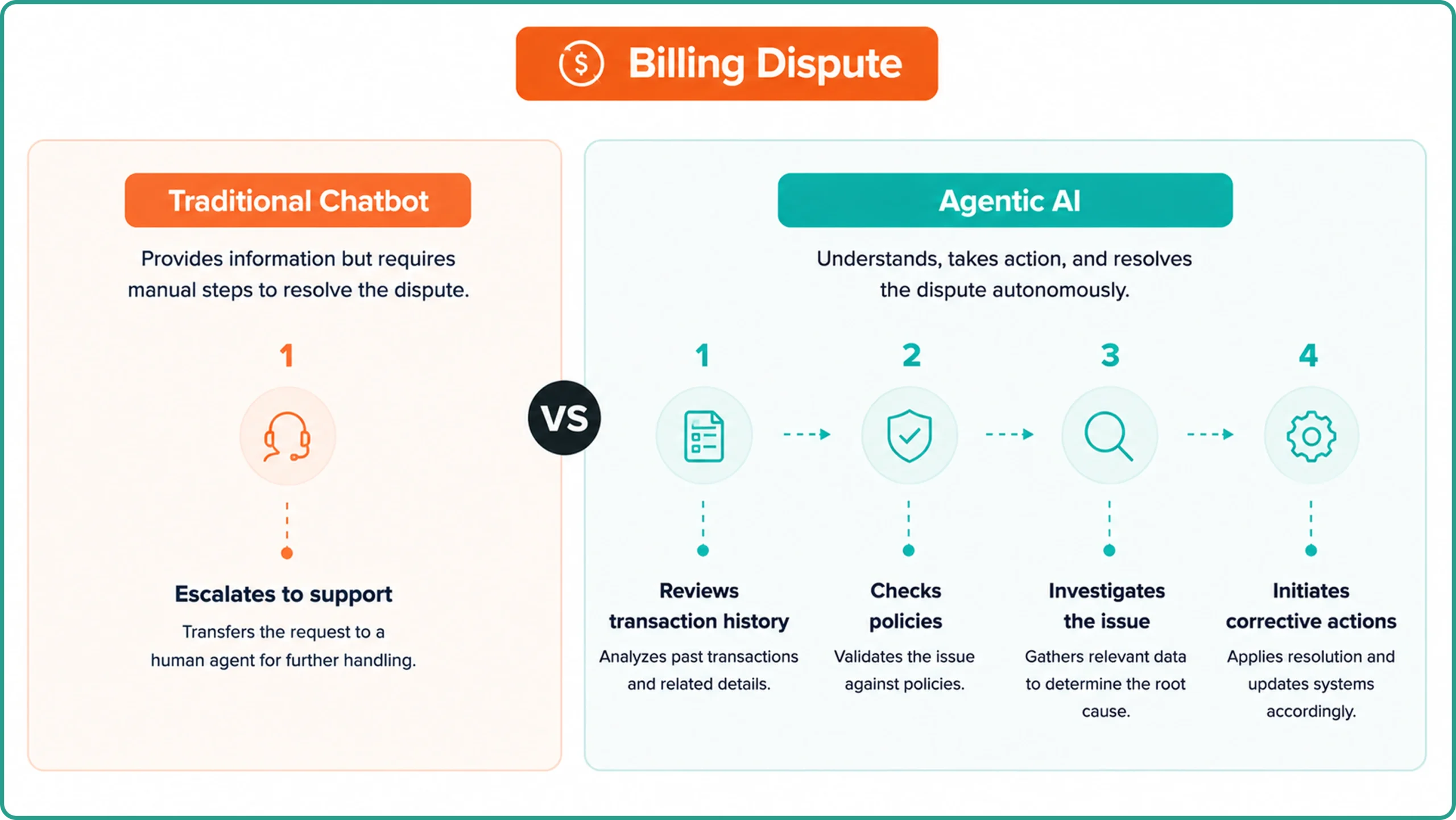
Scenario 3: Billing Dispute

Billing Dispute

Measuring Success: Old Metrics vs New Metrics

Traditional support automation focused on response time, chat volume, containment rate, and average handle time (AHT).

Modern support teams increasingly focus on:

  • Resolution rate
  • Task completion rate
  • Cost per resolution
  • Repeat contact reduction
  • Customer effort score
  • Escalation reduction

These metrics better reflect business outcomes and customer satisfaction.

Agentic AI vs Chatbots: Cost Savings and ROI Comparison

The value of AI in customer service ultimately comes down to economics.

The following comparison shows how traditional chatbots and agentic AI impact support costs, productivity, and return on investment.

Business Metric Traditional Chatbots Agentic AI
FAQ Automation High High
Ticket Deflection Moderate High
Autonomous Resolution Low High
Escalation Reduction Limited Significant
Repeat Contacts Moderate reduction Major reduction
Agent Productivity Moderate improvement Significant improvement
Cost per Resolution Small improvement Large improvement
Support Team Capacity Slight increase Major increase
Customer Effort Moderate Low
ROI Timeline Longer Faster

Resolution Rate Directly Impacts ROI

Traditional chatbots perform well when customers ask simple questions, such as password resets, order tracking, business hours, basic FAQs, etc.

However, many customer issues still require human intervention.

Agentic AI in support ticket resolution extends automation into:

  • Refund processing
  • Subscription management
  • Billing inquiries
  • Account updates
  • Payment disputes
  • Order modifications

The more issues AI resolves, the greater the financial impact.

Lower Cost Per Resolution

Support organizations increasingly track cost per resolution rather than cost per conversation.

Consider the following example.

Metric Human-Assisted Support Traditional Chatbot Agentic AI
Average Cost per Resolved Case $8–$15 $6–$12 $1–$4
Human Involvement High Moderate Low
Resolution Ownership Agents Shared AI-driven

Reduced Escalation Costs

Traditional chatbots frequently transfer complex issues to support teams because they cannot execute actions or handle exceptions.

Agentic AI can:

  • Access customer information
  • Evaluate policies
  • Perform system actions
  • Complete workflows

This reduces the number of tickets requiring human intervention.

Increased Agent Productivity

Support agents spend a significant amount of time performing repetitive operational tasks, including updating customer accounts, processing refunds, verifying information, updating CRM records, etc.

Agentic AI automates these activities.

Hence, human agents can focus on:

  • High-value conversations
  • Complex issues
  • Escalations
  • Relationship management
  • Revenue-generating opportunities

As repetitive work decreases, support teams become more productive without increasing headcount.

Calculate Your Support Savings with Agentic AI

Estimate how autonomous resolution, lower escalation rates, and reduced agent workloads can impact your support costs.

Calculate Your Agentic AI ROI →

Signs Your Organization Has Outgrown Chatbots

Your support organization may have outgrown traditional chatbots if:

  • Customers frequently escalate issues
  • Agents handle repetitive requests
  • Customers repeat information
  • Multiple systems are involved in the resolution
  • Support costs continue to increase
  • Existing bots deliver limited ROI
  • Customers expect personalized experiences

These challenges often indicate that conversational automation alone is no longer sufficient.

What to Look for in an Agentic AI Platform

When evaluating agentic AI solutions, consider:

  • Shared customer memory
  • Business system integrations
  • Workflow execution capabilities
  • Human approval workflows
  • Security and compliance controls
  • Auditability
  • Analytics and reporting
  • Industry-specific knowledge

The ability to execute actions often creates the largest business impact.

Final Verdict

Traditional chatbots changed how businesses respond to customers.

Agentic AI changes how businesses resolve customer issues.

As support operations become more complex, organizations increasingly require AI systems that can understand context, reason through problems, execute workflows, and deliver outcomes.

The next generation of customer support will rely less on scripted conversations and more on intelligent systems that can complete customer requests.

For organizations evaluating the future of customer service automation, the question is no longer whether AI should answer customers.

The question is whether AI can resolve their problems.

How Azeon Approaches Agentic Customer Support

Azeon is an agentic AI platform designed to help customer support teams automate resolutions across existing support operations.

The platform combines:

  • AI reasoning
  • Shared customer memory
  • Business system integrations
  • Workflow execution
  • Human-in-the-loop governance

Azeon integrates with existing support systems, allowing organizations to introduce agentic AI without replacing their CRM, ticketing, or customer service infrastructure. This enables support teams to extend automation across existing workflows while maintaining operational control.

What makes Azeon, one of the best AI agents for customer support, is its resolution-based pricing model.

Rather than charging for seats, conversations, or token usage, the platform aligns pricing with successfully resolved customer outcomes.

Experience How Azeon Resolves Customer Requests

See how Azeon uses AI reasoning, workflow execution, and shared customer memory to resolve customer issues.

Book a Demo →

David works closely with enterprise organizations to help them modernize customer support operations through AI-driven automation. With experience in strategic account management, customer engagement, and technology consulting, David focuses on aligning business objectives with scalable support solutions that improve efficiency, customer experience, and operational performance.

David Pridgen
Solution Consultant

Questions about Azeon?

Connect with our team to explore use cases, workflows, and deployment possibilities.