Skip to content

How to Reduce Customer Support Costs With AI? [9 Proven Strategies]

How to Reduce Customer Support Costs With AI? [9 Proven Strategies]

Customer support costs can be reduced with AI by:

  • Automating repetitive customer requests
  • Reducing average handling time
  • Increasing first-contact resolution
  • Lowering escalation rates
  • Automating workflows
  • Provide 24/7 customer support
  • Improving agent productivity
  • Reducing training costs
  • Increasing resolution rates

In many organizations, these improvements reduce support costs by 20% to 50%.

This article explains exactly how these strategies work using practical examples and operational metrics.
Throughout this article, we use examples from Azeon, an agentic AI platform for customer operations, to demonstrate how modern AI systems reduce customer support costs in practice. The screenshots and workflows show how organizations improve automation rates, increase resolution rates, reduce escalations, and shorten resolution times – all of which directly contribute to lower support costs and higher operational efficiency.

9 Proven Strategies to Reduce Customer Support Costs With AI

Reducing support costs does not come from a single AI implementation. The strongest results come from a combination of automation, faster resolutions, lower escalations, and improved operational efficiency.

1. Automate High-Volume Customer Requests

Many support teams spend a significant portion of their time answering repetitive questions.

Examples include:

  • Order status
  • Balance inquiries
  • Password resets
  • Statement downloads
  • Account verification
  • Transaction explanations

Consider a support organization receiving 40,000 requests each month.

If 20,000 requests are repetitive and require four minutes of agent time: 80,000 support minutes.

If AI resolves 80% of these requests:

  • 16,000 requests require no agent involvement.
  • More than 1,000 support hours become available.

For many organizations, this represents annual savings between $250,000 and $400,000.

Retail Banking Operations

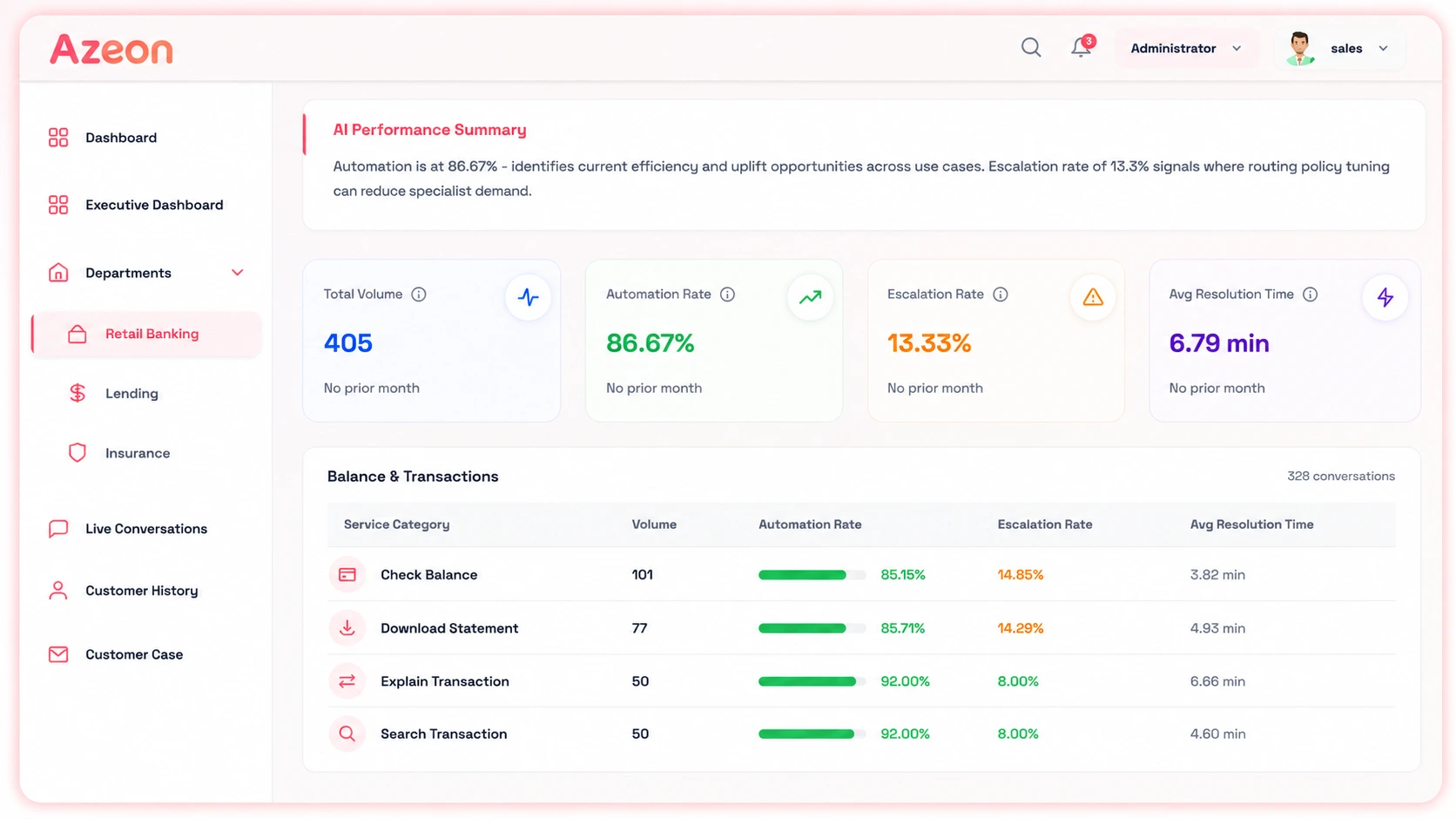
Azeon tracks automation rates across high-volume service categories such as balance inquiries, transaction explanations, and statement requests.

The dashboard shows:

  • 86.67% automation rate
  • 13.33% escalation rate
  • 6.79-minute average resolution time

These operational metrics directly influence support costs.

2. Reduce Average Handling Time

Agents often spend several minutes collecting information before solving the issue.

Common activities include:

  • Reviewing previous interactions
  • Searching customer records
  • Understanding account history
  • Identifying previous cases

Suppose a SaaS company handles 15,000 tickets every month.

Average handling time: 12 minutes.

Total support effort: 180,000 minutes.

If AI provides customer history and interaction context before the conversation begins, handling time can decrease to seven minutes.

That saves:

  • 75,000 minutes
  • 1,250 support hours every month

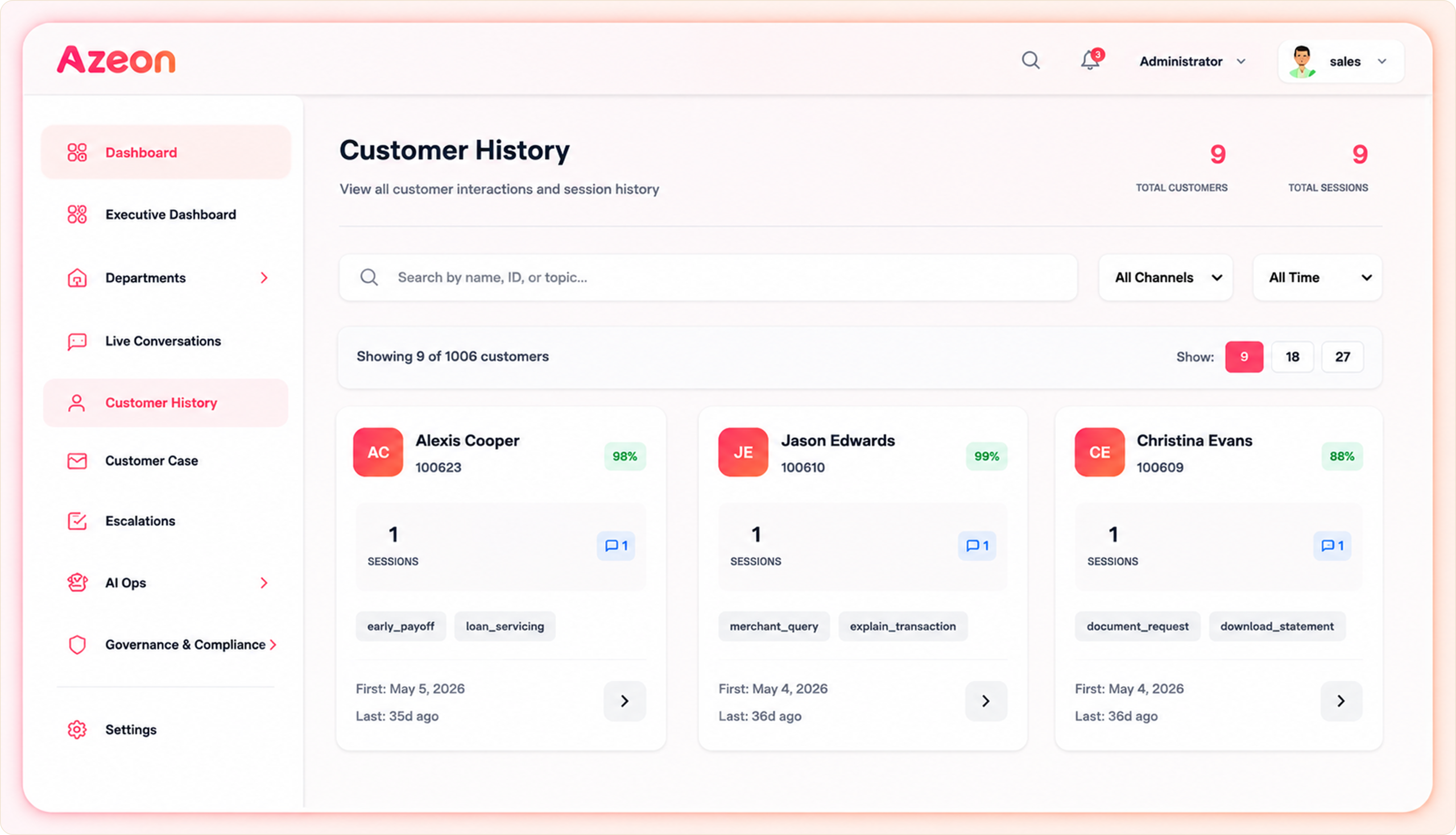
Customer History

Azeon’s shared customer memory gives agents access to previous interactions, topics, and customer context before responding.

Agents spend less time searching and more time solving.

3. Increase First Contact Resolution

Every additional interaction increases support costs.

Assume a company handles 25,000 monthly requests with First-contact resolution rate of 62%.

This means 9,500 customers require additional interactions.

If each additional interaction takes eight minutes, 76,000 additional support minutes are created.

AI improves first-contact resolution by:

  • Understanding intent
  • Retrieving customer data
  • Providing accurate information
  • Executing approved actions

If first-contact resolution improves from 62% to 82%:

  • 5,000 fewer follow-up interactions occur every month
  • More than 650 support hours are saved.

4. Reduce Ticket Escalations

Escalations are expensive.

A financial services company processing 20,000 support cases every month may experience:

  • Escalation rate: 35%
  • Escalated cases: 7,000
  • Average escalation cost: $12 per case

Monthly escalation costs may reach $84,000.

However, AI can verify:

  • Customer identity
  • Transaction history
  • Account status
  • Business rules
  • Eligibility requirements

This can reduce escalation rates from 35% to 18%, which lowers costs significantly.

Potential monthly savings may exceed $40,000.

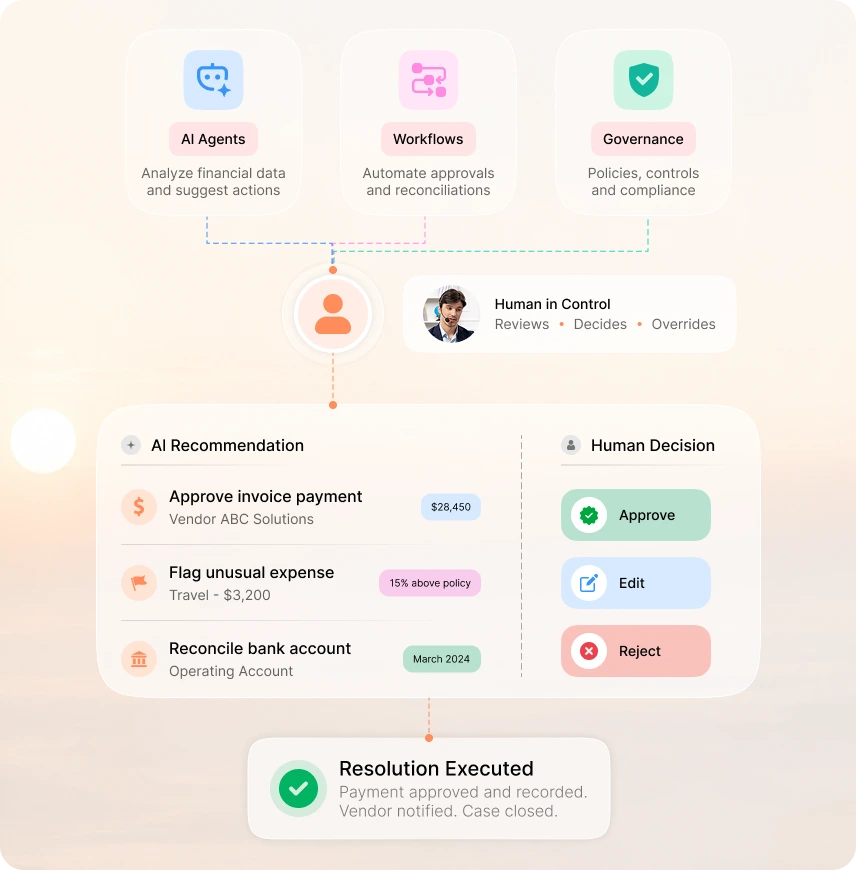
You can see how Azeon combines AI, workflows, and governance with human oversight built in.

Azeon's Unified Support System with Human in Control

In fact, Azeon also allows organizations to define approval rules, transfer conditions, and action policies for AI operations.

Examples:

  • Refund approval
  • Fee waiver
  • Card blocking
  • Human transfer

These rules help AI resolve issues safely while reducing specialist workload.

5. Automate Customer Support Workflows

Many support interactions require actions instead of answers.

For examples, refund processing, subscription changes, address updates, statement requests, card blocking, etc.

Consider a company receiving 6,000 refund requests every month.

Current process:

  • Average handling time: 10 minutes
  • Total effort: 1,000 support hours

Now, AI enters the picture. It can:

  • Verify eligibility
  • Check order information
  • Execute business rules
  • Process the request
  • Notify the customer

If workflow execution takes 90 seconds instead of 10 minutes, more than 850 support hours are saved monthly.

This is where AI produces the largest operational impact.

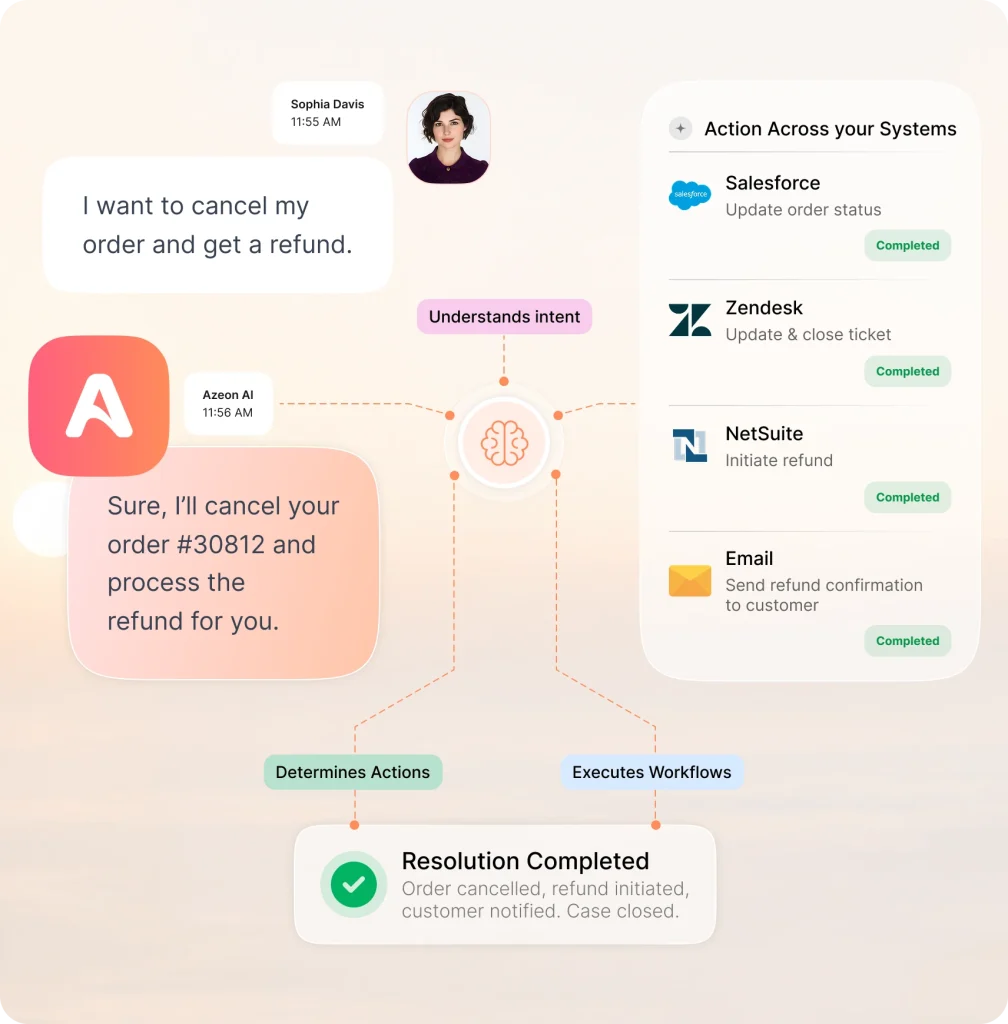
Here’s an example of Azeon. You can see how it triggers the workflow and closes the loop.

Azeon Triggers Workflows. Closes the Loop.

6. Provide 24/7 Support Without Expanding Teams

Many organizations rely on night shifts, outsourced teams, and weekend staffing.

Suppose a company employs six after-hours agents.

Annual staffing cost: $45,000 per employee × 6 = $270,000

However, with AI agents, you can automate:

  • Order tracking
  • Account requests
  • Password resets
  • Billing questions
  • Delivery updates

This way, human teams focus on complex issues.

Organizations often reduce after-hours support costs by 40% to 60%.

7. Improve Agent Productivity

AI also increases the productivity of existing support teams.

Capabilities include:

  • Conversation summaries
  • Suggested responses
  • Knowledge recommendations
  • Next-best actions

Consider a support team with 100 agents.

Current productivity: 22 cases per day

AI-assisted productivity: 31 cases per day

The organization gains capacity for approximately 20,000 additional cases every month.

This productivity increase equals the output of 35 to 40 additional agents.

8. Measure Cost Per Resolution

Many organizations track:

  • Ticket volume
  • Response time
  • Average handling time

AI-assisted support teams increasingly monitor:

  • Automation rate
  • Resolution rate
  • Escalation rate
  • Cost per resolution

Let’s take an example here.

Metric Before AI After AI
Monthly tickets
20,000 20,000
Resolution rate
58% 88%
Cost per resolution
$13.79 $5.68

9. Reduce Training and Onboarding Costs

New support agents require:

  • Product training
  • Process training
  • System training
  • Policy education

Training periods often last several weeks.

However, AI provides:

  • Guided responses
  • Context recommendations
  • Policy assistance
  • Workflow guidance

Organizations frequently reduce onboarding time by 30% to 50%.

Agents become productive faster while senior staff spend less time on training activities.

The Hidden Cost of Partial Automation with AI

Many support teams already use AI.

They have:

  • Chatbots on their websites
  • AI-generated responses
  • Knowledge base recommendations
  • Ticket classification tools

Yet support costs remain high.

The reason lies in the difference between traditional automation and agentic automation.

Traditional Automation Agentic Automation
Answers questions Resolves requests
Routes tickets Completes workflows
Assists agents Executes actions
Provides information Delivers outcomes
Generates responses Closes cases

Many organizations discover that chatbot projects reduce conversations while operational costs remain largely unchanged.

Agentic AI focuses on the actual unit of support value: the resolved customer issue.

Platforms such as Azeon combine reasoning, system access, workflow execution, and business rules to deliver autonomous resolution rather than partial automation.

Questions to Ask Before Investing in Customer Support AI Solution

Customer support leaders evaluating AI often compare features.

The more important discussion focuses on outcomes.

Before investing in AI, ask these questions:

Can the AI access business systems?

AI should retrieve customer information, account details, orders, subscriptions, or transaction history without requiring an agent.

Can the AI execute workflows?

Refunds, account updates, address changes, cancellations, and approvals often drive support costs. AI should complete these actions.

How many issues can the AI resolve autonomously?

Resolution rate matters far more than chatbot containment rates.

How are business rules enforced?

AI decisions should follow policies, approvals, compliance requirements, and operational rules.

How does the platform measure success?

Look beyond number of conversations, response times, or tickets handled.

Measure:

  • Resolution rate
  • Escalation reduction
  • Cost per resolution
  • Customer effort

Can the AI support complex support environments?

Financial services, retail, SaaS, and regulated industries require AI that can work safely across multiple systems and workflows.

Does the pricing model align with business outcomes?

Many customer support platforms charge based on agent seats, user licenses, conversation volumes, API usage, and AI interactions.

As support volumes grow, costs often grow alongside them.

Instead, prefer customer AI solution that offers resolution-based pricing just like Azeon.

Because with resolution-based pricing, you pay for successfully resolved issues rather than the number of agents or conversations.

As AI handles more customer issues autonomously, operational costs decrease while support efficiency improves.

The Future of Cost-Efficient Customer Support is Resolution

Reducing customer support costs with AI involves much more than faster responses or automated conversations.

Organizations achieve meaningful savings by:

  • Automating repetitive requests
  • Reducing handling times
  • Increasing first-contact resolution
  • Lowering escalation rates
  • Executing support workflows
  • Improving agent productivity
  • Resolving customer issues autonomously

The greatest opportunity lies in reducing the “cost of resolution.”

Platforms such as Azeon help organizations move beyond chatbot automation by combining AI reasoning, workflow execution, business rules, and system actions to deliver measurable reductions in support costs.

For support leaders, the next step is simple:

Measure your current support costs, identify repetitive workflows, and calculate how autonomous resolution could impact your operation.

Because every issue resolved without agent intervention directly improves efficiency, reduces operational costs, and creates a better customer experience!

Calculate Your Support Savings With Azeon

Measure how autonomous resolution can reduce operational costs, improve resolution rates, and increase support capacity.

FAQs

How much can AI reduce customer support costs?

AI can reduce customer support costs by 20% to 50% depending on ticket volume, automation rates, and support processes. Organizations achieve savings by reducing repetitive interactions, lowering escalations, shortening handling times, and increasing first-contact resolution. The largest cost reductions occur when AI resolves customer requests rather than simply answering questions.

What is the best way to reduce customer support costs with AI?

The most effective approach combines automated request handling, workflow execution, intelligent routing, and AI-assisted agents. Organizations that focus on resolution rates, automation rates, and escalation reduction often achieve better outcomes than those implementing basic chatbots or FAQ automation.

How does AI improve first-contact resolution?

AI improves first-contact resolution by understanding customer intent, accessing customer information, retrieving previous interactions, and providing complete responses. Some AI systems can also execute workflows such as refunds, account updates, and verification processes during the first interaction.

What support tasks can AI automate?

AI can automate order tracking, account inquiries, password resets, billing questions, refund requests, appointment scheduling, customer verification, and workflow execution. Modern AI agents can also apply business rules and complete actions across connected systems.

How do AI agents reduce customer support costs?

AI agents reduce customer support costs by automating repetitive interactions, shortening resolution times, reducing escalations, and increasing support capacity. Agentic AI systems can understand customer intent, access business systems, and execute actions that traditionally required human agents.

David works closely with enterprise organizations to help them modernize customer support operations through AI-driven automation. With experience in strategic account management, customer engagement, and technology consulting, David focuses on aligning business objectives with scalable support solutions that improve efficiency, customer experience, and operational performance.

David Pridgen
Solution Consultant

Questions about Azeon?

Connect with our team to explore use cases, workflows, and deployment possibilities.