
Skip to content

Top AI Agent Use Cases in Customer Service [2026 Guide]

Top AI Agent Use Cases in Customer Service [2026 Guide]

Wondering where AI agents create the biggest impact in customer service?

From answering routine questions and tracking orders to processing refunds, resolving billing issues, updating CRM records, and executing support workflows, AI agents are helping enterprises automate customer service far beyond traditional chatbots.

In this guide, we’ll explore the top AI agent use cases in customer service, explain how each one works, and show where businesses achieve the greatest operational and customer experience gains.

Use Case #1: Answering Frequently Asked Questions

Frequently asked questions remain one of the largest sources of inbound customer support requests. Customers regularly seek information about pricing, product features, return policies, shipping timelines, subscription plans, account settings, warranties, and service availability.

How AI Agents Handle It

AI agents understand the customer’s question, retrieve the latest information from approved knowledge sources, personalize the response using customer context, and deliver accurate answers through chat, email, voice, or messaging platforms.

Unlike static FAQ pages, AI agents can tailor responses based on the customer’s account, purchase history, subscription tier, or region.

Business Impact

  • Reduced ticket volume
  • Faster customer responses
  • Higher self-service adoption
  • Consistent information across support channels

Example

A SaaS company receives thousands of pricing and licensing questions every month. Instead of routing these inquiries to support agents, an AI agent instantly answers customer-specific questions based on subscription data and current pricing policies.

Use Case #2: Order Tracking and Delivery Status

Customers frequently contact support to check shipment progress, estimated delivery dates, delayed orders, or package locations.

How AI Agents Handle It

The AI agent retrieves order information from the order management system, checks shipping updates from logistics providers, identifies delivery exceptions, and provides live tracking information. If a shipment is delayed, the agent proactively explains the reason and shares the updated delivery timeline.

Business Impact

  • Lower contact volume
  • Faster resolution times
  • Improved customer satisfaction
  • Reduced workload for human agents

Example

An online retailer allows customers to check order status through its website and mobile app. The AI agent accesses shipping data, identifies courier updates, and answers delivery questions without creating a support ticket.

Use Case #3: Returns and Refund Processing

Return requests often require multiple manual steps, including eligibility verification, return authorization, shipping label generation, and refund processing.

How AI Agents Handle It

The AI agent validates the purchase, confirms return eligibility, generates return instructions, creates shipping labels, updates the CRM, tracks returned products, and initiates the refund after inspection.

Every step occurs within existing enterprise systems without requiring manual intervention for standard cases.

Business Impact

  • Faster refund processing
  • Lower operational costs
  • Consistent policy enforcement
  • Reduced handling time

Example

An apparel retailer automates returns for eligible products. Customers complete the entire return process through chat while the AI agent updates inventory, payment systems, and customer records simultaneously.

Use Case #4: Password Reset and Account Recovery

Account access issues remain one of the highest-volume support requests across SaaS platforms, financial institutions, healthcare providers, and consumer applications.

How AI Agents Handle It

The AI agent verifies customer identity using approved authentication methods, guides users through secure recovery steps, triggers password reset workflows, and confirms successful account access.

If additional verification is required, the AI agent escalates the request with complete authentication history.

Business Impact

  • Faster account recovery
  • Reduced agent workload
  • Improved security compliance
  • Higher customer satisfaction

Example

A cloud software provider automates password recovery for enterprise users while maintaining identity verification requirements before granting account access.

Use Case #5: Billing and Invoice Support

Customers regularly contact support regarding invoices, payment failures, subscription charges, tax calculations, duplicate payments, or billing disputes.

How AI Agents Handle It

AI agents retrieve billing information from financial systems, explain invoice details, validate payment history, process eligible billing adjustments, resend invoices, and initiate escalation for complex financial reviews.

Business Impact

  • Reduced billing-related tickets
  • Faster payment issue resolution
  • Improved billing accuracy
  • Lower support costs

Example

A B2B software company enables customers to download invoices, update payment methods, review subscription charges, and resolve billing questions through an AI-powered support assistant.

Use Case #6: Subscription Management

Managing subscriptions often involves upgrades, downgrades, renewals, cancellations, payment updates, and plan comparisons.

How AI Agents Handle It

The AI agent identifies the customer’s current subscription, recommends available plans, executes upgrades or downgrades, adjusts billing schedules, updates entitlements, and confirms changes across connected systems.

Business Impact

  • Faster account changes
  • Reduced administrative effort
  • Improved customer retention
  • Accurate subscription management

Example

A streaming platform allows customers to switch subscription plans instantly through an AI agent without contacting a support representative.

Use Case #7: Appointment Scheduling and Rescheduling

Organizations across healthcare, financial services, field services, and professional consulting spend considerable time coordinating appointments.

How AI Agents Handle It

The AI agent checks resource availability, identifies preferred time slots, books appointments, sends confirmations, updates calendars, and manages cancellations or rescheduling requests automatically.

Business Impact

  • Reduced scheduling effort
  • Lower no-show rates
  • Improved resource utilization
  • Faster customer service

Example

A financial advisory firm enables customers to schedule consultations through an AI agent that synchronizes directly with advisor calendars.

Use Case #8: Customer Onboarding Support

New customers often require guidance during account setup, document submission, product configuration, and feature adoption.

How AI Agents Handle It

AI agents guide customers through each onboarding stage, answer product questions, verify submitted information, recommend next steps, monitor onboarding progress, and trigger follow-up workflows when required.

Business Impact

  • Faster customer activation
  • Reduced onboarding effort
  • Higher product adoption
  • Improved customer experience

Example

A fintech platform assists new customers with account verification, KYC documentation, and initial product setup through conversational AI integrated with onboarding systems.

Use Case #9: Technical Troubleshooting

Technical issues frequently require customers to complete diagnostic steps before support teams can determine the root cause.

How AI Agents Handle It

AI agents collect device information, review error messages, analyze historical incidents, recommend troubleshooting steps, execute automated diagnostics, and identify whether escalation is required.

For recurring issues, AI agents can surface known solutions directly from enterprise knowledge repositories.

Business Impact

  • Higher first-contact resolution
  • Reduced average handling time
  • Faster issue diagnosis
  • Better support consistency

Example

A software vendor uses AI agents to troubleshoot login failures, API errors, integration issues, and application performance problems before routing advanced cases to engineering teams.

Use Case #10: Intelligent Ticket Routing

Support requests vary in complexity, urgency, language, product category, and customer priority. Incorrect routing increases resolution time and transfers.

How AI Agents Handle It

AI agents analyze customer intent, account history, sentiment, service-level agreements, and issue severity before assigning requests to the most appropriate queue, specialist, or department.

The routing decision includes complete conversation summaries and customer context to reduce repeated information.

Business Impact

  • Faster case assignment
  • Reduced ticket transfers
  • Higher first-contact resolution
  • Improved agent productivity

Example

A global technology company automatically routes enterprise customers, billing requests, technical incidents, and product feedback to specialized support teams while preserving full interaction history for every case.

Use Case #11: Workflow Automation and Task Execution

Many customer requests require support teams to perform repetitive tasks across multiple business systems. Updating CRM records, creating service requests, processing approvals, assigning cases, and notifying internal teams often consume more time than the customer conversation itself.

How AI Agents Handle It

AI agents execute predefined workflows by connecting with CRM, ERP, ticketing, payment, and internal business applications.

They can create records, update customer information, trigger approvals, assign tasks, and complete operational actions without requiring manual intervention for routine requests.

Business Impact

  • Faster issue resolution
  • Reduced manual work
  • Consistent workflow execution
  • Improved operational efficiency

Example

A customer requests to change their service address. Instead of creating multiple internal tasks, the AI agent updates the CRM, notifies the billing system, creates a service request, and confirms the change with the customer.

Use Case #12: Context-Aware Ticket Escalation

Not every support request can be resolved autonomously. Technical issues, compliance-related requests, and complex customer situations often require human expertise.

How AI Agents Handle It

Instead of simply transferring the conversation, AI agents determine when escalation is necessary, summarize the issue, collect supporting information, attach previous interactions, and route the case to the right specialist.

This eliminates the need for customers to repeat the same information multiple times.

Business Impact

  • Faster escalations
  • Better agent productivity
  • Reduced customer effort
  • Improved first-response quality

Example

A banking customer reports an unusual transaction. After verifying account information and gathering transaction details, the AI agent routes the case to the fraud investigation team with complete context.

Use Case #13: Omnichannel Customer Support

Customers expect consistent support whether they contact a business through chat, email, social media, messaging apps, voice, or a mobile application.

How AI Agents Handle It

AI agents maintain conversation history and customer context across every channel.

If a customer starts a conversation through live chat and continues later by email, the AI agent resumes the interaction without asking the customer to explain the issue again.

Business Impact

  • Consistent customer experiences
  • Reduced duplicate conversations
  • Higher customer satisfaction
  • Better continuity across channels

Example

A retail customer begins tracking an order through chat and later replies to an email regarding the same shipment. The AI agent recognizes the ongoing conversation and continues from the previous interaction.

Use Case #14: Customer Identity Verification

Before processing sensitive requests, organizations must confirm customer identity while maintaining security and compliance.

How AI Agents Handle It

AI agents guide customers through approved verification methods such as one-time passwords (OTP), multi-factor authentication (MFA), knowledge-based verification, or identity document validation before executing account-related actions.

Business Impact

  • Improved account security
  • Faster verification
  • Reduced fraud risk
  • Consistent compliance

Example

A financial institution verifies customer identity before updating personal information or processing account-related requests.

Use Case #15: Payment Issue Resolution

Failed transactions, duplicate payments, pending charges, and payment confirmations generate a significant number of support requests.

How AI Agents Handle It

The AI agent retrieves payment records, validates transaction status, identifies failure reasons, confirms successful payments, and initiates predefined workflows for eligible corrections or escalations.

Business Impact

  • Faster payment support
  • Reduced billing inquiries
  • Improved payment transparency
  • Lower operational costs

Example

A subscription customer reports a failed payment. The AI agent checks the payment gateway, explains the failure, recommends the next step, and updates the subscription after payment succeeds.

Use Case #16: Loan and Banking Support

Banks and financial institutions manage thousands of routine service requests every day, including EMI schedules, loan balances, interest calculations, repayment options, and account servicing.

How AI Agents Handle It

AI agents securely retrieve customer information, explain loan details, provide repayment schedules, calculate outstanding balances, answer account-related questions, and initiate approved servicing workflows.

Business Impact

  • Reduced call volumes
  • Faster account servicing
  • Improved customer experience
  • Higher operational efficiency

Example

A customer asks for the remaining balance on a personal loan and requests an updated repayment schedule. The AI agent retrieves the information and delivers it instantly.

Use Case #17: Insurance Claim Assistance

Insurance claims involve document collection, eligibility verification, claim status updates, and customer communication.

How AI Agents Handle It

AI agents guide customers through the claims process, verify required information, collect supporting documents, create claim requests, provide status updates, and coordinate communication between policyholders and claims teams.

Business Impact

  • Faster claims processing
  • Reduced administrative effort
  • Better customer communication
  • Improved process consistency

Example

After a vehicle accident, a customer submits claim details through an AI agent, uploads supporting documents, and receives automatic updates throughout the review process.

Use Case #18: Inventory Availability and Product Information

Retail and eCommerce customers often contact support to check product availability, store inventory, delivery timelines, or alternative product options.

How AI Agents Handle It

AI agents access inventory systems in real time, verify stock levels, recommend nearby locations or alternative products, and provide estimated delivery dates.

Business Impact

  • Higher self-service rates
  • Increased sales opportunities
  • Reduced support inquiries
  • Better shopping experience

Example

A customer searches for a product that’s unavailable online. The AI agent checks inventory across nearby stores and recommends the closest available location.

Use Case #19: Delivery Exception Management

Delayed shipments, damaged packages, incorrect deliveries, and failed delivery attempts require immediate customer communication.

How AI Agents Handle It

The AI agent monitors delivery events, detects exceptions, informs customers about delays, recommends available delivery options, and initiates replacement or investigation workflows when necessary.

Business Impact

  • Faster issue resolution
  • Fewer customer complaints
  • Reduced support workload
  • Improved delivery visibility

Example

A shipment is delayed because of severe weather. Before the customer contacts support, the AI agent sends an update explaining the delay and provides a revised delivery estimate.

Use Case #20: Loyalty Program and Rewards Support

Customers frequently request assistance with reward points, membership status, redemption rules, promotional offers, and account benefits.

How AI Agents Handle It

AI agents retrieve loyalty information, explain reward eligibility, update membership details, process eligible redemptions, and answer questions about ongoing promotions or benefits.

Business Impact

  • Increased customer engagement
  • Reduced loyalty-related support tickets
  • Faster reward redemption
  • Better customer retention

Example

A customer wants to redeem reward points before making a purchase. The AI agent verifies eligibility, applies the available rewards, updates the loyalty account, and confirms the transaction.

Use Case #21: Warranty Registration and Service Requests

Manufacturers and consumer brands receive a high volume of warranty-related inquiries, including product registration, warranty validation, repair requests, and service appointments.

How AI Agents Handle It

AI agents verify product details, validate warranty eligibility, register products, create service requests, schedule repair visits, and keep customers updated throughout the service lifecycle.

Business Impact

  • Faster warranty processing
  • Reduced administrative workload
  • Improved service coordination
  • Better customer experience

Example

A customer reports an issue with a home appliance. The AI agent verifies the warranty, creates a repair request, schedules a technician visit, and shares service updates automatically.

Use Case #22: Internal Agent Assistance

AI agents don’t just support customers – they also assist human support teams by providing information and recommendations during live interactions.

How AI Agents Handle It

The AI agent retrieves knowledge base articles, summarizes previous conversations, recommends next-best actions, drafts responses, and surfaces relevant policies while the support representative handles the conversation.

Business Impact

  • Reduced average handling time
  • Faster agent onboarding
  • Consistent customer responses
  • Improved productivity

Example

A support representative handling a complex software issue receives recommended troubleshooting steps and related documentation in real time, allowing them to resolve the issue more efficiently.

Use Case #23: Proactive Customer Support

Many customer issues can be identified before they result in a support ticket.

How AI Agents Handle It

AI agents monitor operational events, detect service disruptions, delayed deliveries, payment failures, subscription expirations, or system outages, and proactively notify customers with updates or recommended actions.

Business Impact

  • Lower inbound ticket volume
  • Higher customer satisfaction
  • Faster issue communication
  • Reduced support costs

Example

A SaaS platform experiences a temporary service interruption. Instead of waiting for customers to report the issue, the AI agent informs affected users, explains the impact, and shares estimated recovery timelines.

Use Case #24: Customer Feedback Collection and Analysis

Customer feedback helps organizations improve products, services, and support operations. Collecting and reviewing this information manually often delays action.

How AI Agents Handle It

AI agents automatically request feedback after interactions, analyze customer sentiment, categorize recurring issues, identify trends, and share insights with support and product teams.

Business Impact

  • Higher survey completion rates
  • Better customer insights
  • Faster identification of recurring issues
  • Continuous service improvement

Example

After resolving a support request, the AI agent collects customer feedback, detects repeated complaints about a new feature, and shares the findings with the product team.

Use Case #25: SLA Monitoring and Priority Management

Meeting Service Level Agreements (SLAs) is essential for enterprise support teams, especially when handling high-priority customers and time-sensitive requests.

How AI Agents Handle It

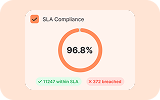
AI agents continuously monitor ticket age, response deadlines, customer priority, and escalation rules. They alert support teams before SLA breaches occur, reprioritize requests when necessary, and automate escalation workflows.

Business Impact

  • Higher SLA compliance
  • Reduced missed deadlines
  • Better workload management
  • Improved customer trust

Example

A Platinum customer submits a high-priority support request. The AI agent recognizes the SLA requirements, prioritizes the case, and alerts the appropriate support team before response targets are missed.

AI Agent Use Cases in Customer Service by Industry

While many customer service workflows are common across industries, every sector has unique support requirements.

AI agents in customer service can be tailored to industry-specific processes, compliance requirements, and customer expectations.

Financial Services

AI agents help banks, credit unions, fintech companies, and lenders automate customer support while maintaining security and compliance.

Common use cases include:

  • Account balance inquiries
  • Loan servicing
  • EMI schedule requests
  • Card activation and blocking
  • Payment disputes
  • Transaction history
  • Identity verification
  • Fraud reporting
  • KYC assistance
  • Credit card support

Retail and eCommerce

Retailers use AI agents to manage high customer interaction volumes across online and offline channels.

Common use cases include:

  • Order tracking
  • Returns and exchanges
  • Refund processing
  • Product recommendations
  • Inventory availability
  • Delivery updates
  • Loyalty program support
  • Coupon and promotion inquiries
  • Store locator assistance

FMCG and Consumer Goods

AI agents help automate high-volume support requests while improving post-purchase experiences and reducing response times.

Common use cases include:

  • Product information and ingredient inquiries
  • Order tracking and delivery updates
  • Product availability checks
  • Warranty registration and claims
  • Returns and replacement requests
  • Complaint management
  • Loyalty program support
  • Customer feedback collection

SaaS and Technology

Software companies use AI agents to reduce support costs while improving customer onboarding and technical assistance.

Common use cases include:

  • Account setup
  • Password recovery
  • Subscription management
  • License activation
  • API troubleshooting
  • Product onboarding
  • Technical diagnostics
  • Billing support
  • Feature guidance

Healthcare

Healthcare organizations use AI agents to improve patient communication and administrative efficiency.

Common use cases include:

  • Appointment scheduling
  • Appointment reminders
  • Prescription refill requests
  • Patient onboarding
  • Insurance verification
  • Billing inquiries
  • Medical record requests

Telecommunications

Telecom providers automate routine customer support while reducing call center volumes.

Common use cases include:

  • SIM activation
  • Plan upgrades
  • Data usage inquiries
  • Network outage updates
  • Device troubleshooting
  • Bill payments
  • Service requests

Travel and Hospitality

Travel companies use AI agents to manage booking-related requests and provide timely travel assistance.

Common use cases include:

  • Booking modifications
  • Flight status updates
  • Hotel reservations
  • Cancellation requests
  • Refund processing
  • Check-in assistance
  • Travel itinerary support

Manufacturing and Consumer Goods

Manufacturers use AI agents to streamline after-sales support and service operations.

Common use cases include:

  • Product registration
  • Warranty verification
  • Repair requests
  • Service scheduling
  • Spare parts inquiries
  • Product documentation
  • Dealer support
  • Installation guidance

How to Choose the Right AI Agent Platform for Customer Service

Not every AI platform offers the same capabilities. While some solutions focus on answering customer questions, enterprise AI agents should be able to understand requests, access business data, execute workflows, and resolve customer issues across multiple systems.

When evaluating an AI agent platform, look for the following capabilities:

  • Omnichannel support across chat, email, voice, messaging apps, and web
  • Seamless integration with CRM, help desk, ERP, payment, and business applications
  • Workflow automation to complete operational tasks instead of only generating responses
  • Shared customer context across every interaction
  • Context-aware escalation to human agents when required
  • Enterprise-grade security, governance, and auditability
  • Analytics and reporting to measure resolution rates, response times, and operational efficiency
  • Scalability to support growing customer interactions without compromising performance

The right platform should fit into your existing support ecosystem while helping your team resolve more customer issues with less manual effort.

How Azeon Helps Enterprises Automate Customer Service

Azeon is a resolution-focused AI agent for customer service.

It works alongside your existing support stack to automate customer interactions, execute operational workflows, and improve resolution rates without requiring a complete platform replacement.

With Azeon, enterprises can:

  • Resolve customer requests across chat, email, voice, and messaging channels
  • Retrieve information from enterprise knowledge sources in real time
  • Execute workflows across CRM, help desk, payment, and business systems
  • Maintain shared customer memory across every interaction
  • Route complex requests with complete customer context
  • Support industry-specific workflows for financial services, retail, eCommerce, and consumer goods
  • Measure outcomes through resolution-focused analytics

Instead of limiting AI to conversations, Azeon enables organizations to automate the work required to resolve customer issues from start to finish.

Explore Azeon Through a Live Demo

Discover how Azeon turns the AI agent use cases in this guide into automated, end-to-end customer support workflows.

Book Your Demo →

FAQs

What are AI agents in customer service?

AI agents are intelligent software systems that understand customer requests, retrieve relevant information, interact with enterprise applications, execute workflows, and resolve support issues with minimal human intervention.

How are AI agents different from chatbots?

Traditional chatbots primarily answer predefined questions using scripted conversation flows. AI agents can reason through customer requests, access multiple business systems, execute operational tasks, and complete end-to-end support workflows.

Can AI agents integrate with existing customer support platforms?

Yes. Most enterprise AI agent platforms integrate with CRM systems, help desk software, payment gateways, ERP platforms, knowledge bases, and communication channels to automate customer service workflows without replacing existing infrastructure.

Can AI agents resolve customer issues without human intervention?

Yes. AI agents can independently resolve many routine and repetitive requests such as password resets, order tracking, billing inquiries, subscription changes, and appointment scheduling. More complex cases can be escalated to human agents with complete conversation context.

How do AI agents improve customer service?

AI agents help organizations reduce response times, improve first-contact resolution, automate repetitive work, provide consistent customer experiences, lower operational costs, and enable support teams to focus on higher-value interactions.

David works closely with enterprise organizations to help them modernize customer support operations through AI-driven automation. With experience in strategic account management, customer engagement, and technology consulting, David focuses on aligning business objectives with scalable support solutions that improve efficiency, customer experience, and operational performance.

David Pridgen
Solution Consultant

Questions about Azeon?

Connect with our team to explore use cases, workflows, and deployment possibilities.