

Skip to content

A Guide to AI in Customer Communications for Financial Services

A Guide to AI in Customer Communications for Financial Services

A customer notices a suspicious transaction late at night. 

They immediately open their banking app. Panic kicks in. They start a chat. The chatbot gives a generic answer. Then they call support. After waiting several minutes, the agent asks them to explain everything again. 

At that moment, the customer is thinking: “Why is this so difficult?” 

This is exactly why AI in customer communications for financial services has become one of the biggest priorities for banks, FinTech companies, credit unions, insurance providers, and wealth management firms in 2026. 

Customer expectations have changed dramatically. People expect banking conversations to feel instant, connected, secure, and personalized. 

Meanwhile, financial institutions are dealing with rising digital communication volumes, fraud-related spikes, compliance pressure, staffing limitations, disconnected systems, and growing operational costs – all at the same time. 

This is where AI in customer communication for financial services is changing the scenario. 

And no, this shift is no longer limited to basic chatbots. 

Modern AI systems help financial institutions create faster, more connected customer conversations where workflows stay aligned, context follows across channels, and support teams operate with far better visibility.
What Does AI in Customer Communications for Financial Services Actually Mean?

Let’s simplify this first.

Because many people still think AI customer communication means: “A chatbot answering FAQs.”

That’s only a tiny part of it now.

Modern AI customer communication platforms work more like operational intelligence systems.

They help financial institutions:

  • Understand customer intent
  • Maintain conversation context
  • Coordinate workflows
  • Assist agents
  • Trigger actions
  • Guide resolutions
  • Improve customer journeys across channels

Why Adopt AI in Customer Communications for Financial Services?

This question is becoming much easier to answer in 2026.

Because customer communication challenges are growing faster than traditional support systems can handle.

Why Adopt AI in Customer Communications for Financial Services

Growing AI Adoption in Financial Services

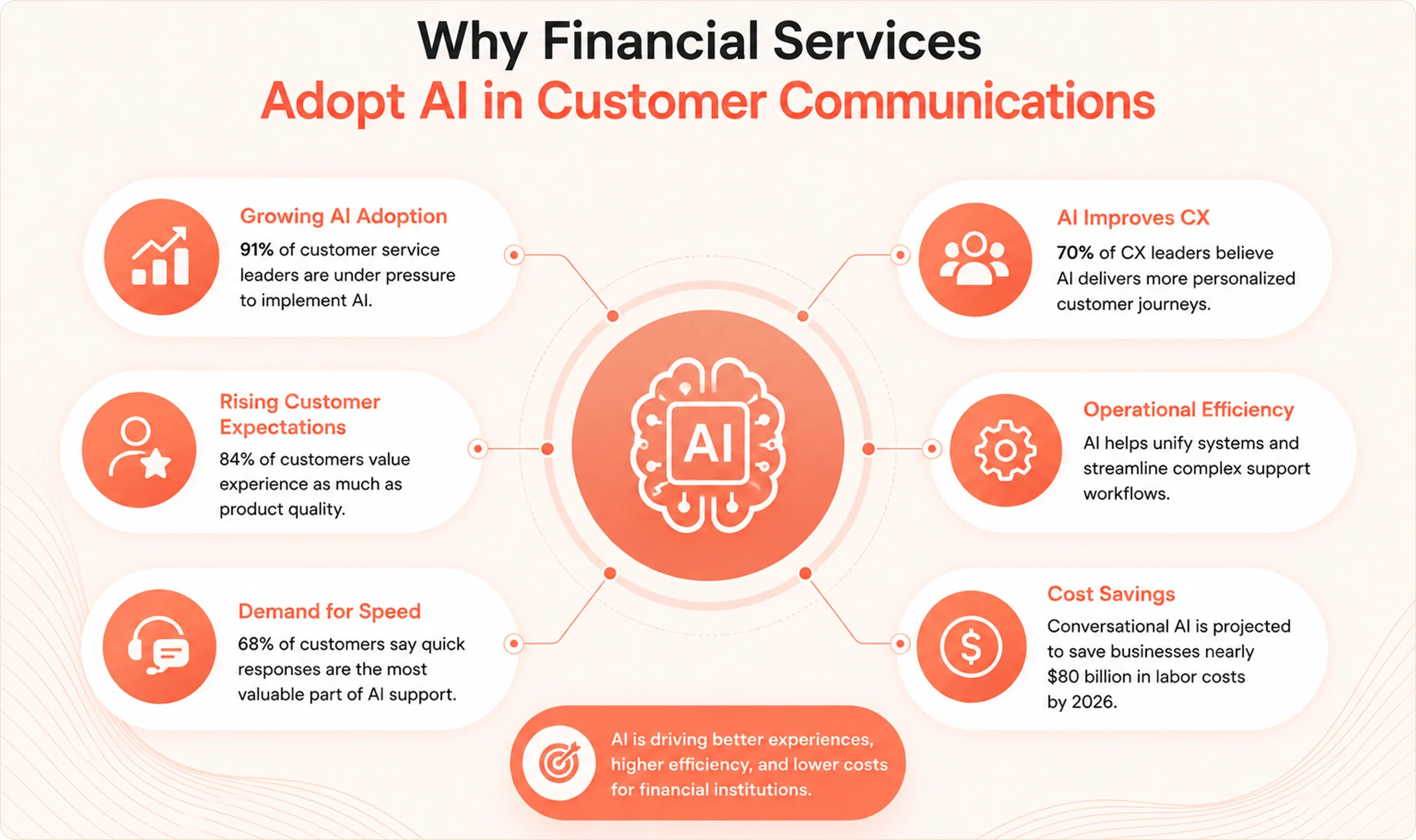
According to recent industry data, 91% of customer service leaders say they are under pressure to implement AI this year, while the global AI customer service market has crossed $15 billion in 2026. North America alone represents more than 37% of the market. (Azumo)

In fact, research shows that 35% of U.S. banks were already using AI for customer service workflows, with adoption growing rapidly across banking operations. (Gitnux)

Rising Customer Expectations and Operational Complexity

Customer expectations are another major driver. Studies show that 84% of customers now value experience as much as product quality itself. (YourGPT)

At the same time, 68% of customers say quick responses are the most valuable part of AI-powered support interactions.

This matters because support teams often work across CRMs, fraud systems, ticketing tools, knowledge bases, and banking platforms that operate separately, creating slower resolution and fragmented customer experiences.

AI’s Impact on Customer Experience

According to Zendesk’s 2026 AI customer service research, 70% of CX leaders believe AI systems are becoming highly effective at delivering personalized customer journeys, while more than two-thirds say generative AI helps create more human and familiar customer interactions.

Operational and Cost Benefits

The operational impact is becoming significant as well. Industry estimates project conversational AI technologies to save businesses nearly $80 billion in labor costs globally by 2026. (NextPhone)

What are the Primary Use Cases of AI in Financial Customer Communications?

This is where things become very practical.

AI in customer communications for financial services is already being used across multiple operational areas.

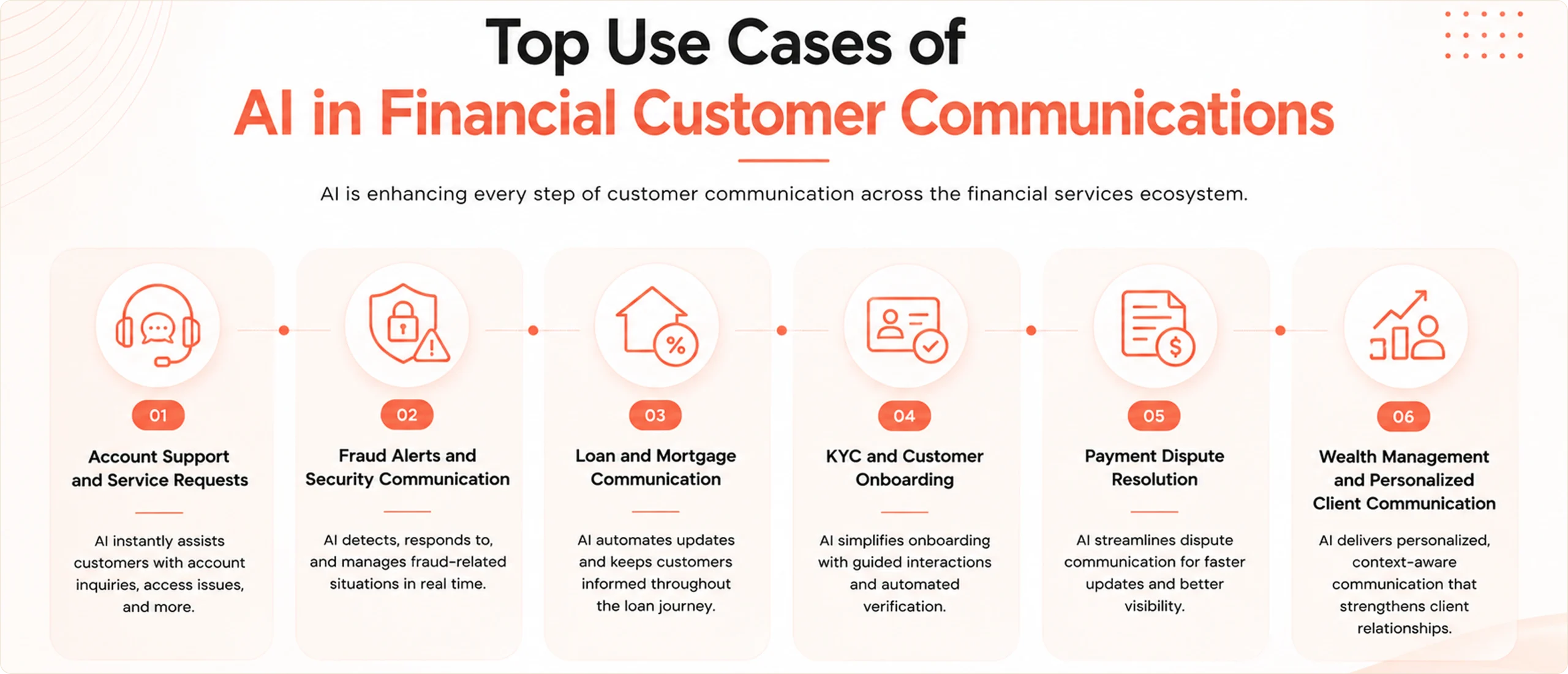
Top Use Cases of AI in Financial Customer Communications

1. Account Support and Service Requests

Customers frequently contact banks for balance inquiries, account access issues, card activation, PIN resets, address changes, transaction clarifications, etc.

AI systems can instantly assist customers while reducing repetitive workload for support teams.

Instead of waiting in queues, customers receive:

  • Faster responses
  • Guided workflows
  • Personalized assistance

2. Fraud Alerts and Security Communication

Fraud-related communication is highly time-sensitive.

Customers often panic when cards get blocked, transactions appear suspicious, and accounts show unusual activity.

AI systems help financial institutions:

  • Respond immediately
  • Verify customer identity
  • Guide customers through the next steps
  • Trigger fraud workflows
  • Escalate critical cases quickly

That creates faster and safer customer communication experiences.

3. Loan and Mortgage Communication

Loan journeys involve continuous communication.

AI can help automate:

  • Status updates
  • Reminder notifications
  • Documentation guidance
  • Workflow coordination

This reduces communication delays significantly.

4. KYC and Customer Onboarding

KYC processes often frustrate customers because they involve multiple steps, document requests, verification delays, and repeated communication.

AI helps simplify onboarding conversations through:

  • Guided interactions
  • Smart document collection
  • Real-time assistance
  • Workflow automation

This improves onboarding completion rates.

5. Payment Dispute Resolution

Dispute handling usually involves multiple teams, long response cycles, and high manual effort.

AI systems help organize and streamline dispute communication workflows.

Customers receive:

  • Faster updates
  • Better visibility
  • More structured interactions

Support teams gain:

  • Workflow visibility
  • Intelligent routing
  • Operational consistency

6. Wealth Management and Personalized Client Communication

High-value clients expect highly personalized experiences.

AI customer support platforms help financial advisors and service teams deliver:

  • Personalized updates
  • Context-aware interactions
  • Investment communication support
  • Client engagement continuity

This strengthens customer relationships significantly.

What Outcomes Does AI Deliver for Financial Customer Communications?

This is where financial leadership teams (and you should) start paying close attention.

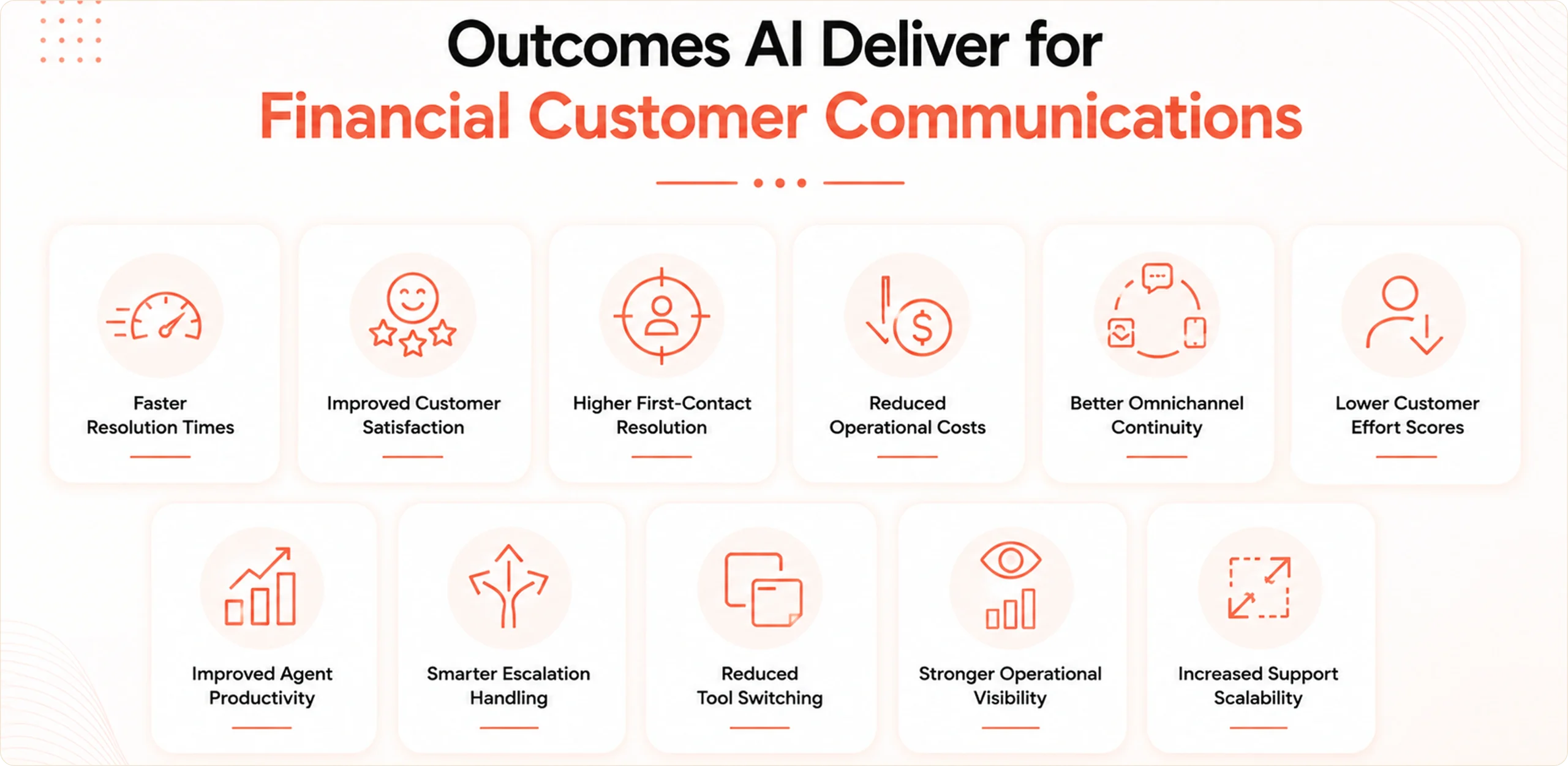
Outcomes AI Deliver for Financial Customer Communications

Faster Resolution Times

AI helps reduce delays by automating routing, retrieving customer context instantly, and coordinating workflows across systems.

Improved Customer Satisfaction

Customers receive quicker, more personalized, and connected support experiences across every communication channel.

Higher First-Contact Resolution

AI systems help agents and customers access the right information immediately, reducing repeated follow-ups and transfers.

Reduced Operational Costs

Financial institutions lower their manual workload by automating repetitive communication tasks and workflow coordination.

Better Omnichannel Continuity

Customer context stays connected across chat, email, voice, and mobile interactions, creating smoother customer journeys.

Lower Customer Effort Scores

Customers spend less time repeating information, waiting for updates, or navigating disconnected support systems.

Improved Agent Productivity

AI assists agents with summaries, recommendations, response drafting, and knowledge retrieval during live interactions.

Smarter Escalation Handling

Escalations become more efficient because AI passes conversation history, sentiment, and workflow context to support teams.

Reduced Tool Switching

AI communication platforms unify fragmented workflows, helping agents operate from a more connected environment.

Stronger Operational Visibility

Leadership teams gain better insight into customer issues, workflow bottlenecks, escalation trends, and service performance.

Increased Support Scalability

AI helps financial institutions handle growing communication volume without proportionally increasing support headcount.

What Should Financial Institutions Evaluate Before Adopting AI Support Platforms?

This is one of the most important sections.

Because not every AI platform is built for regulated financial environments.

Evaluation Area Why It Matters in Financial Services
Governance & Compliance Financial institutions need audit logs, approval controls, and traceable workflows to support regulated operations.
Deterministic Workflows Business-critical actions should follow controlled operational logic instead of uncontrolled AI-generated decisions.
Omnichannel Continuity Customers expect conversations to stay connected across chat, email, voice, and mobile banking interactions.
Integration Capability AI platforms should integrate with CRMs, banking systems, fraud tools, and support platforms without large migration efforts.
Security Standards Enterprise-grade encryption, role-based access, and secure data handling are essential for financial customer communication.
Human-in-the-Loop Support Sensitive workflows such as fraud disputes or account closures often require human approval and oversight.
Scalability & Operational Visibility The platform should support high communication volume while giving leadership teams visibility into workflows, escalations, and support performance.

How Does Azeon Support AI Customer Communications for Financial Services?

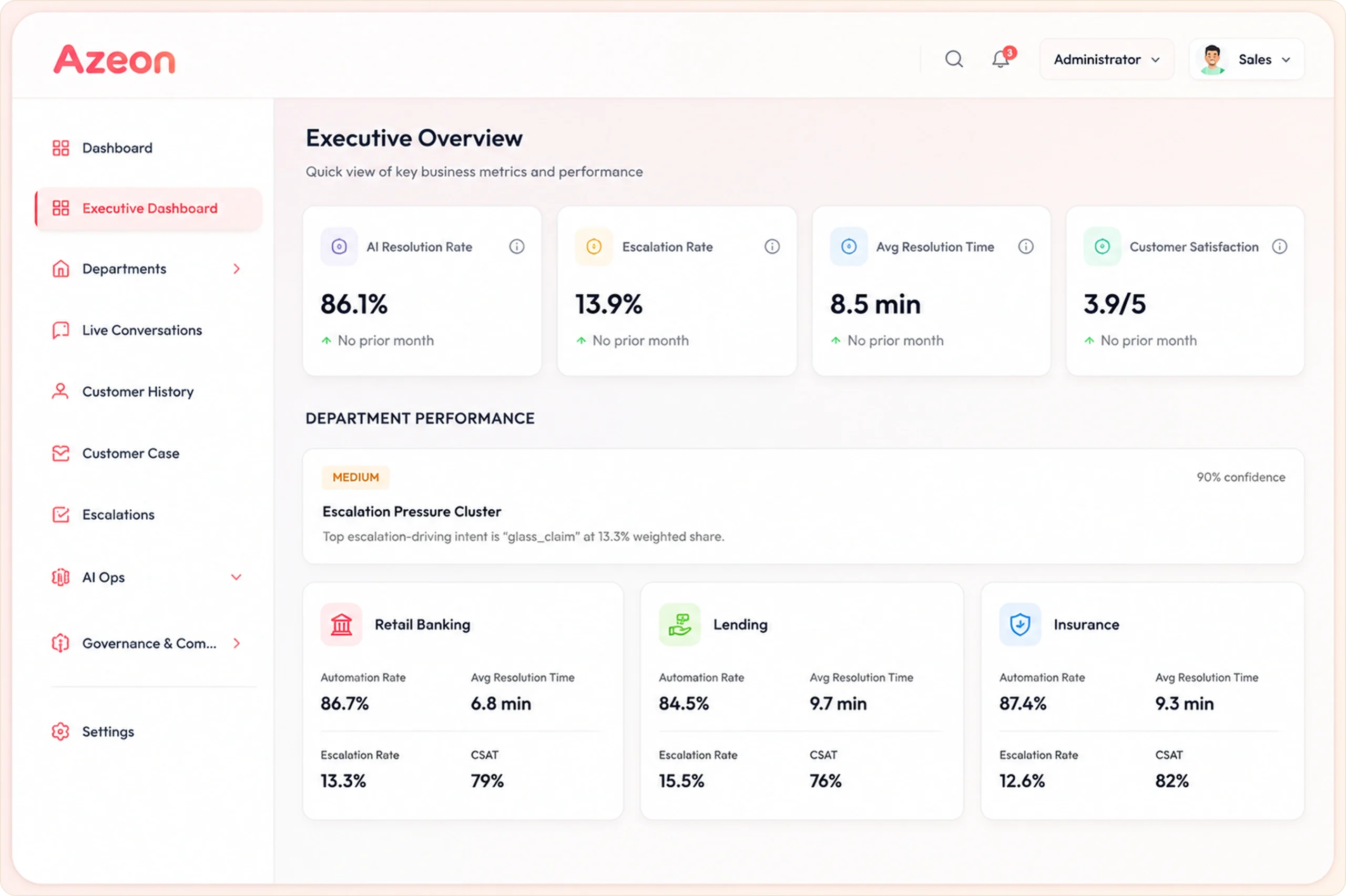
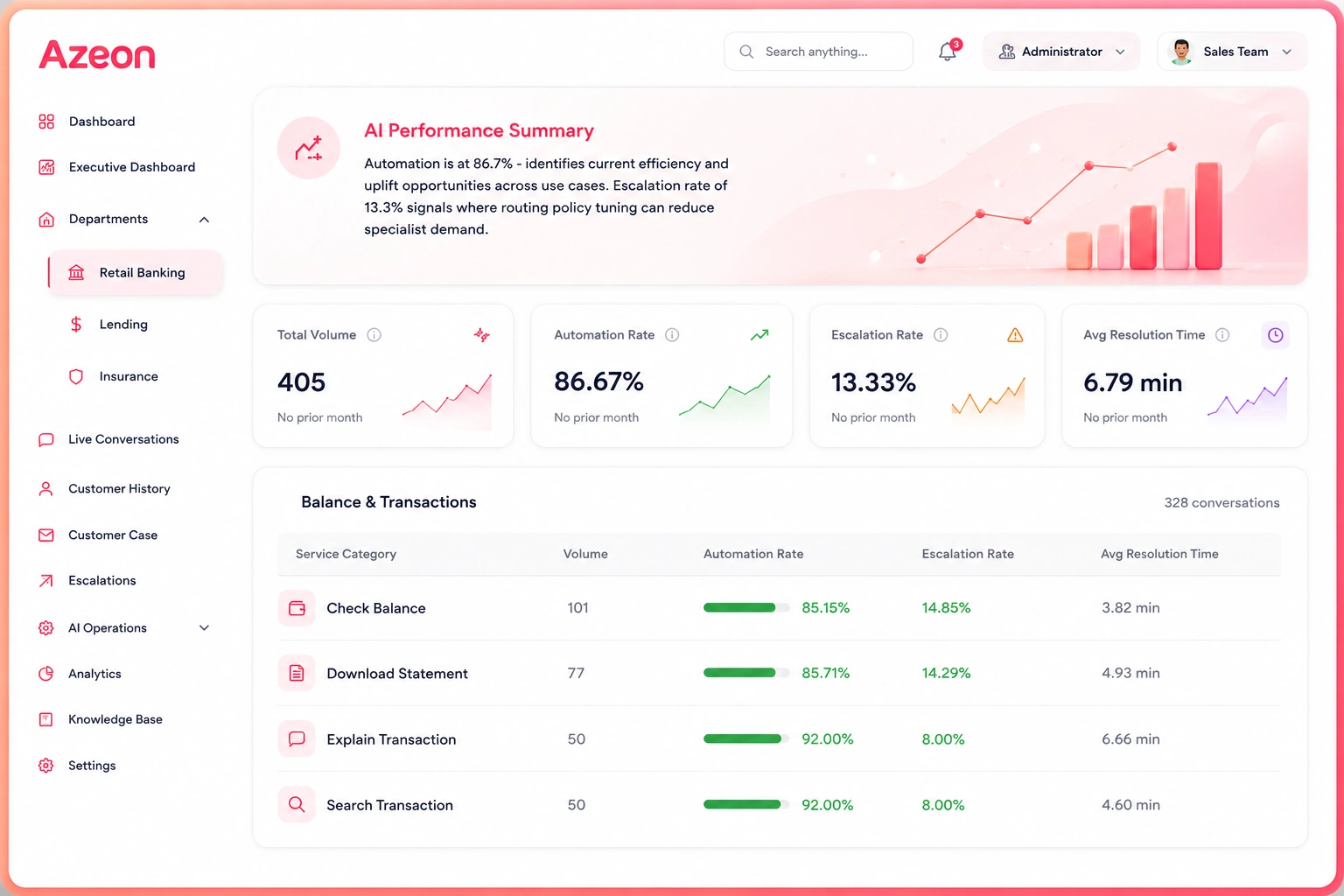
Azeon is an agentic AI platform for customer support.

It helps financial institutions modernize customer communication across chat, email, voice, and support tickets without forcing major system migration.

Instead of operating as another standalone support tool, Azeon works as an AI-powered operational layer that connects customer conversations, workflows, and enterprise systems together.

The platform is designed to help banks, FinTech companies, insurers, and financial service providers improve customer experience while maintaining operational control, compliance alignment, and scalability.

Some of the key capabilities include:

  • Omnichannel support
  • Smart knowledge engine
  • Customer context and history
  • Workflow automation
  • Human-in-the-loop controls
  • AI email drafting and smart replies
  • Real-time monitoring and analytics
  • CRM and enterprise integrations
  • Compliance and security support

Azeon also follows a deterministic execution approach where AI helps with conversation intelligence while operational workflows remain controlled, traceable, and auditable.

So, looking to modernize customer communications across your financial operations?

Connect with our team to explore how AI-powered workflows, omnichannel support, and intelligent customer interactions can help your organization deliver faster, more connected financial service experiences.

Experience Azeon in a Live Financial Support Environment

Discover how it helps resolve customer issues faster and smarter.

Book a Demo

FAQs: AI in Customer Communications for Financial Services

What is AI in customer communications for financial services?

AI in customer communications for financial services refers to using artificial intelligence to improve how banks, fintech companies, insurers, and financial institutions interact with customers across chat, email, voice, mobile apps, and support systems. Modern AI platforms help organizations automate workflows, maintain customer context, improve response speed, and deliver more personalized customer experiences while supporting compliance and operational control.

How are banks using AI for customer communication in 2026?

Banks are using AI to automate customer support workflows, handle fraud-related communication, improve loan servicing interactions, support onboarding journeys, and deliver omnichannel customer experiences. AI systems also assist agents with real-time recommendations, conversation summaries, and knowledge retrieval to help reduce operational workload and improve customer satisfaction.

What are the benefits of AI in financial customer communications?

AI helps financial institutions improve response times, reduce operational costs, increase first-contact resolution, and deliver more connected customer experiences. It also helps support teams manage high communication volume more efficiently while improving escalation quality, customer engagement, workflow visibility, and service consistency across channels.

How does AI improve customer experience in financial services?

AI improves customer experience by helping financial institutions deliver faster, more personalized, and context-aware communication. Customers receive quicker responses, smoother support journeys, and connected conversations across chat, voice, email, and mobile banking channels without repeatedly explaining the same issue.

Can AI customer communication platforms integrate with existing banking systems?

Yes, enterprise AI customer communication platforms are designed to integrate with CRMs, core banking systems, fraud platforms, payment infrastructure, helpdesk tools, and knowledge systems. This allows financial institutions to modernize customer communication workflows without replacing their entire technology stack.

Glossary

1. AI (Artificial Intelligence): Artificial Intelligence refers to computer systems that can analyze data, understand patterns, automate tasks, and support decision-making across customer communication and operational workflows.

2. Agentic AI: Agentic AI refers to AI systems capable of understanding goals, coordinating workflows, triggering actions, and supporting operational tasks beyond basic conversational responses.

3. Omnichannel Support: Omnichannel support is a customer communication approach where conversations remain connected across multiple channels such as chat, email, voice, mobile banking apps, and support portals.

4. Conversational AI: Conversational AI refers to AI systems designed to communicate naturally with customers through text or voice interactions while understanding intent and conversation flow.

5. Workflow Automation: Workflow automation refers to using AI and predefined logic to automate operational tasks such as ticket routing, notifications, approvals, onboarding workflows, and customer updates.

Questions about Azeon?

Connect with our team to explore use cases, workflows, and deployment possibilities.