Skip to content

What is the ROI of Agentic Conversational AI in Customer Support?

What is the ROI of Agentic Conversational AI in Customer Support?

For years, scaling customer support followed a simple formula: More customers → More tickets → More agents.

There is nothing wrong with this approach. In fact, support teams are often highly efficient and capable of handling significant workloads. The challenge lies elsewhere – maintaining speed, consistency, and service quality as demand continues to rise.

Today, as AI finds its place across nearly every business function, customer support stands at an interesting crossroads.

Agentic Conversational AI in customer support promises a future where support systems can understand intent, take actions, and solve problems with minimal human intervention.

The opportunity sounds compelling: lower costs, faster resolutions, and greater scalability.

But one question matters more than all the others:

Can Agentic Conversational AI deliver greater ROI without compromising the very foundation of customer support – quality and resolution?

Let’s find out.
The Hidden Economics of Traditional Customer Support

Many organizations underestimate how expensive support operations become at scale.

Consider a company with:

  • 10,000 support tickets per month
  • 25 support agents
  • Average annual agent cost of $65,000

Annual support payroll becomes:

25 × $65,000 = $1.625 million per year

At first glance, the number may appear manageable. The challenge emerges when support demand increases.

If ticket volume grows by 10% annually, the support organization processes:

Year Annual Tickets
Year 1 120,000
Year 2 132,000
Year 3 145,200
Year 4 159,720
Year 5 175,692

Without operational improvements, support costs typically rise alongside ticket volume.

Hiring more agents solves the problem temporarily, yet it also increases payroll, training costs, management overhead, and operational complexity.

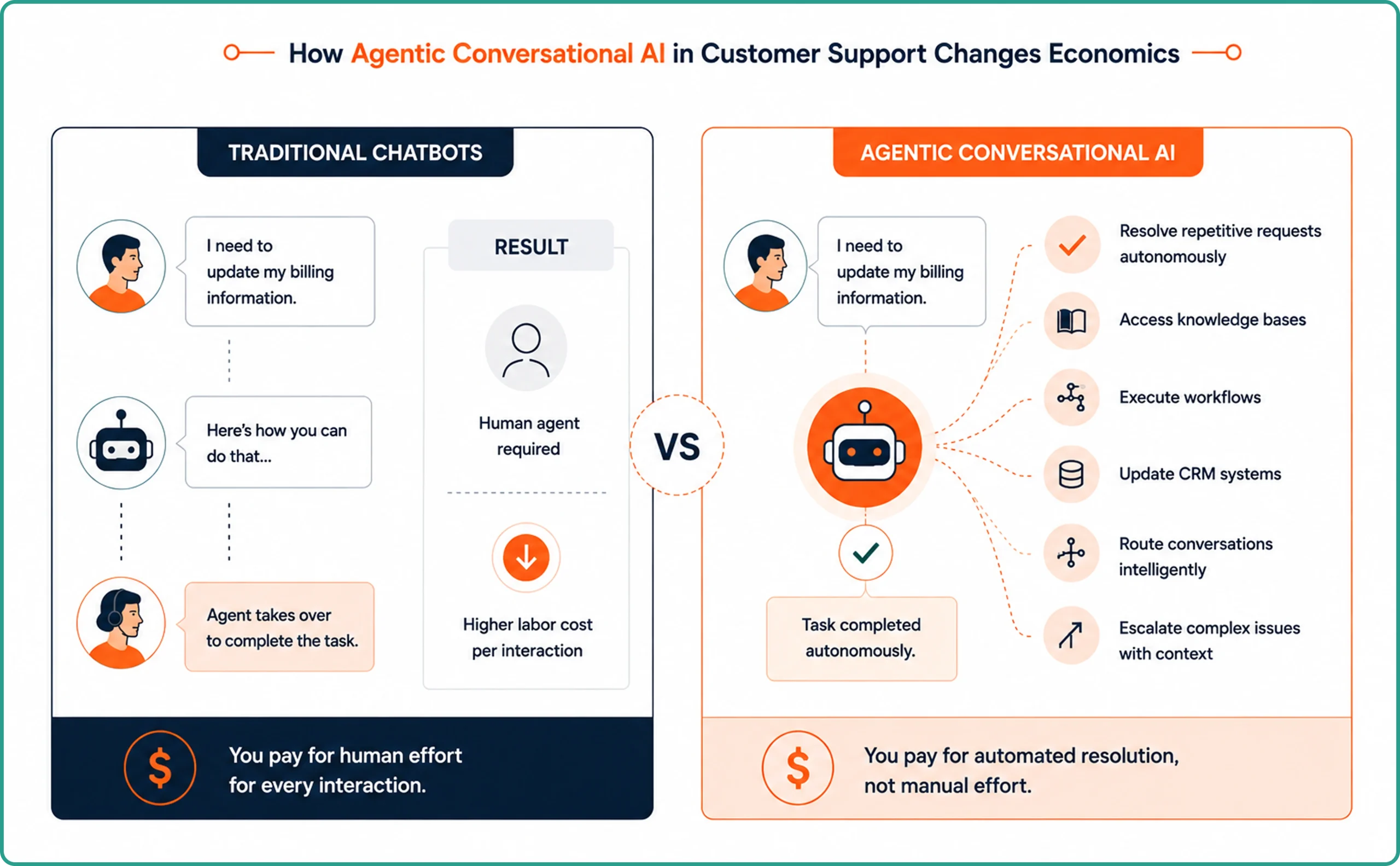
How Agentic Conversational AI in Customer Support Changes Economics?

Traditional Chatbot vs Agentic Conversational AI

Traditional chatbots answer questions. Agentic Conversational AI completes tasks.

They can:

  • Resolve repetitive requests autonomously
  • Access knowledge bases
  • Execute workflows
  • Update CRM systems
  • Route conversations intelligently
  • Escalate complex issues with context

This is impactful because companies stop paying human labor costs for every customer interaction.

Instead, they pay for automated resolution.

The Customer Support Metric That Determines ROI

Support teams often focus on metrics such as CSAT, first response time, or average handling time.

These are important.

However, one metric ultimately determines support efficiency: Cost Per Resolution (CPR)

The formula is straightforward:

CPR = Total Support Cost ÷ Total Tickets Resolved

If we calculate it using our previous example:

$1,625,000 ÷ 120,000 tickets = $13.54 per resolution

In other words, every resolved customer interaction costs the company approximately $13.54.

Now imagine an Agentic AI system capable of resolving a large portion of tickets at $0.85 per resolution.

The economics change immediately.

Explore such metrics that affect your overall ROI: Customer Support KPIs

The ROI Calculation of Agentic Conversational AI in Customer Support

Suppose an organization implements Agentic Conversational AI with a target automation rate of 70%.

Annual ticket volume: 120,000 tickets

Tickets handled by AI: 84,000 tickets

Assume the average resolution time is 15 minutes, and operational overhead adds an additional 25% to support effort.

The total support hours recovered become:

84,000 × 15 minutes × 1.25 ÷ 60 = 26,250 hours saved annually

To put this into perspective:

26,250 hours ÷ 2,080 working hours per employee = 12.6 full-time employee equivalents (FTEs)

This does not necessarily mean reducing headcount.

It means creating capacity.

Support teams can absorb growth, improve quality, and focus on complex customer interactions without continuously expanding the team.

Converting Time into Financial Value

If the average agent costs $65,000 annually, the approximate hourly cost becomes:

$65,000 ÷ 2,080 = $31.25/hour

The labor value recovered is:

26,250 hours × $31.25 = $820,312 annually

Next, calculate the AI operating cost.

At $0.85 per automated resolution:

84,000 × $0.85 = $71,400 annually

The net savings become:

$820,312 − $71,400 = $748,912 per year

This is the economic value of automation.

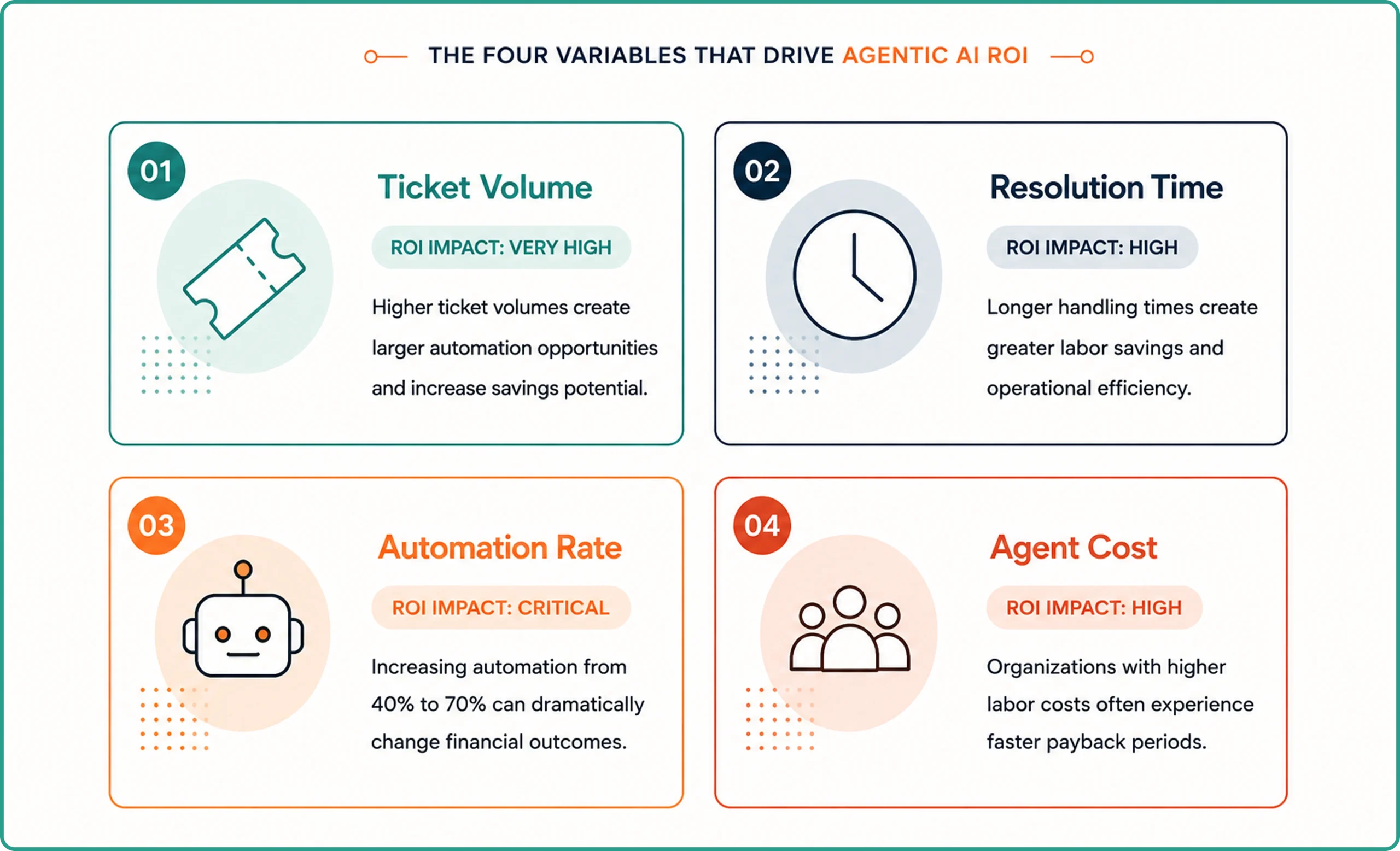
The Four Variables That Drive Agentic AI ROI in Customer Support

The ROI of Agentic Conversational AI in customer support is primarily influenced by four factors:

Variables that Affect Agentic AI ROI for Customer Support

1. Ticket Volume

Higher ticket volumes create larger automation opportunities.

2. Resolution Time

Longer handling times increase labor savings.

3. Automation Rate

Moving from 40% automation to 70% automation can significantly change financial outcomes.

4. Agent Cost

Organizations with higher labor costs often experience faster payback periods.

ROI depends not only on adopting AI, but on selecting the right platform.

Explore our guide on comparing AI vendors for customer support automation before making a decision.

How Quickly Does Agentic Conversational AI Reach Break-Even?

The answer depends on ticket volume, automation rates, and support costs.

Consider a support team handling 120,000 tickets annually with 70% automation. If AI automates 84,000 tickets and recovers over 26,000 support hours, the business could unlock nearly $750,000 in annual savings after accounting for AI operating costs.

That’s more than $62,000 in value generated every month.

For many organizations, this means reaching break-even in months rather than years.

Of course, every organization is different. Break-even timelines vary based on support complexity, automation rates, and operational costs.

ROI is only one side of the equation. Organizations evaluating AI adoption should also understand implementation costs, integrations, and operational considerations.

Read our guide on the cost of implementing AI customer support for software startups.

Calculate Your Own Customer Support ROI

There is no universal answer to the true ROI of Agentic Conversational AI in customer support.

The business impact varies based on your support environment.

To help organizations build data-driven business cases, we created the Azeon Agentic AI ROI Calculator.

The calculator estimates:

  • Annual savings
  • Five-year ROI
  • Break-even period
  • Cost-per-resolution reduction
  • Support hours recovered

By entering your support metrics, you can generate a customized business case tailored to your organization.

Measure the ROI of Agentic AI for Customer Support

Discover potential savings, automation opportunities, and long-term impact based on your support operations.

FAQs

What is Agentic Conversational AI in Customer Support?

Agentic Conversational AI in customer support refers to AI systems that can understand customer intent, execute workflows, access knowledge bases, and resolve issues autonomously. Unlike traditional chatbots, agentic AI acts on behalf of users to deliver faster and more accurate support experiences.

How does Agentic Conversational AI improve customer support ROI?

Agentic Conversational AI improves ROI by automating repetitive interactions, reducing support costs, and increasing agent productivity. Businesses can lower their cost per resolution while maintaining service quality and faster response times. The ROI becomes more significant as ticket volume grows over time.

Can Agentic Conversational AI replace human support agents?

Agentic Conversational AI is designed to augment support teams rather than replace them entirely. AI handles repetitive and high-volume queries, while human agents focus on complex, sensitive, or high-value interactions. This creates operational efficiency and allows support teams to scale without proportional hiring.

How quickly can businesses achieve break-even with customer support AI?

The break-even period depends on factors such as ticket volume, automation rate, and support costs. Organizations with higher support volumes often realize value within months because AI scales efficiently while reducing operational expenses. Many businesses see measurable ROI much faster than expected.

What metrics should businesses track when measuring AI ROI in customer support?

Key metrics include cost per resolution, automation rate, first-contact resolution, customer satisfaction (CSAT), support hours saved, and break-even period. Tracking these metrics helps organizations quantify the financial and operational impact of AI-driven support initiatives.

David works closely with enterprise organizations to help them modernize customer support operations through AI-driven automation. With experience in strategic account management, customer engagement, and technology consulting, David focuses on aligning business objectives with scalable support solutions that improve efficiency, customer experience, and operational performance.

David Pridgen
Solution Consultant

Questions about Azeon?

Connect with our team to explore use cases, workflows, and deployment possibilities.