
Skip to content

How to Compare AI Vendors for Customer Support Automation?

How to Compare AI Vendors for Customer Support Automation?

Imagine you’re evaluating two vendors.

Both vendors demonstrate a chatbot.

Both answer customer questions.

Both show analytics dashboards.

Both claim high automation rates.

Then you launch a pilot.

Three months later, one platform is resolving customer issues independently while the other is creating more work for agents through escalations, corrections, and manual intervention.

What happened?

The answer usually comes down to the evaluation criteria used during vendor selection.

That is why selecting a customer support AI platform requires a deeper evaluation framework.

The right solution should understand customer intent, reason through complex situations, access business systems, take action, maintain context, work alongside human agents, and consistently resolve issues at scale.

In this guide, we’ll explore the ten most important criteria for comparing AI vendors for customer support automation and how each one directly impacts business results.
10 Criteria for Comparing AI Vendors for Customer Support Automation

The best AI vendors are distinguished by their ability to resolve customer issues efficiently while maintaining context, accuracy, governance, and operational control.

These criteria provide a framework for evaluating those capabilities.

1. Intelligence and Reasoning

A customer sends the following message:

“My package hasn’t arrived, I think the shipping address is wrong, and I need it delivered before Friday because it’s a gift.”

For a human agent, this request is straightforward.

For AI, it involves multiple tasks.

Hence, when evaluating vendors, assess how well the platform:

  • Understands intent
  • Handles ambiguity
  • Maintains conversational context
  • Identifies urgency and sentiment
  • Reasons through multi-step requests
  • Reduces hallucinations

Ask vendors to demonstrate difficult support scenarios rather than scripted FAQ examples.

The difference becomes obvious very quickly.

2. Resolution Capability

This is arguably the most important criterion.

A chatbot that answers questions is useful.

A platform that resolves issues creates business value.

So, when comparing AI vendors for customer support automation, focus on:

  • Autonomous resolution rates
  • First-contact resolution (FCR)
  • Escalation rates
  • Resolution accuracy
  • Resolution confidence scoring

3. Memory and Customer Context

Most customers have experienced this frustration.

They explain an issue. Get transferred. Explain it again. Switch channels. Explain it again. Days later they contact support once more. And explain it again.

Every repetition creates friction.

The best AI tools for customer support maintain customer context across interactions.

They understand:

  • Previous conversations
  • Purchase history
  • Support history
  • Product usage
  • Account information
  • Current case status

Ask vendors how memory works across channels and whether context persists between conversations.

The answer reveals a lot about the maturity of the platform.

4. Business System Integration

Imagine a customer wants to update their shipping address, check order status, and request a refund. The AI understands the request perfectly and provides accurate answers.

But can it actually complete those actions?

Without access to business systems, AI becomes another layer between the customer and resolution. Strong customer support automation requires deep integration with CRM, ecommerce, billing, helpdesk, ERP, and internal systems so the AI can retrieve information, execute actions, and resolve issues without handing customers off to an agent.

The deeper the integration, the closer the platform gets to true autonomous resolution.

5. Omnichannel Support

Customers rarely stay within a single channel.

A conversation might begin on chat. Continue through email. Move to WhatsApp. Finish with a human agent.

From the customer’s perspective, it is one journey.

Many AI platforms treat every channel as a separate experience. The result is fragmented support.

Evaluate whether vendors provide:

  • Shared customer memory
  • Unified conversation history
  • Consistent responses
  • Cross-channel continuity

6. Human-in-the-Loop Capabilities

Even the most capable AI cannot resolve every situation.

When comparing AI vendors for customer support automation, examine:

  • Escalation workflows
  • Context transfer quality
  • Approval mechanisms
  • Agent collaboration tools
  • Supervisory controls

A great handoff should feel like a continuation of the conversation.

The customer should never need to start over.

7. Analytics and Reporting

One of the first questions executives ask after deployment is simple:

“Is this actually working?”

Without meaningful analytics, answering that question becomes difficult.

The best platforms provide operational insights rather than basic activity reports.

Understanding why issues are resolved – or why they aren’t – is often more valuable than volume metrics alone.

8. Security, Governance, and Compliance

As AI gains access to customer data and operational systems, governance becomes increasingly important.

Support teams handle sensitive information every day.

AI Vendor evaluation for customer support should include:

  • Access controls
  • Audit trails
  • Data encryption
  • Compliance certifications
  • Data residency options
  • Privacy controls

Security teams will eventually review these requirements.

Including them early in the evaluation process saves time later.

9. Scalability and Operational Readiness

The platform must support:

  • Seasonal demand spikes
  • Rapid ticket growth
  • Multiple support teams
  • Expanding knowledge bases
  • New business processes

Ask vendors how customers scale from pilot programs to enterprise-wide deployments.

Their answer often reveals how mature the platform really is.

10. Commercial Model and ROI

At the end of every evaluation, business value becomes the deciding factor.

Evaluate:

  • Licensing costs
  • Usage costs
  • Implementation effort
  • Ongoing management requirements
  • Expected savings
  • Time to value

The right vendors can clearly connect automation capabilities to business outcomes such as reduced support costs, higher resolution rates, improved customer satisfaction, and increased operational efficiency.

Looking Beyond Chatbots

The customer support AI market is crowded.

Many platforms sound similar. Many demos look similar. And many websites make similar promises.

The differences emerge when customers bring complex problems, when support volumes increase, and when businesses expect measurable results.

The most successful AI initiatives focus on one question:

Can the platform consistently resolve customer issues while maintaining context, accuracy, governance, and operational control?

Every criterion discussed in this guide ultimately supports that outcome.

This is also where platforms such as Azeon take a different approach.

Meet Azeon: An Agentic AI OS for Customer Support

Rather than focusing solely on conversations, Azeon is designed around customer resolution.

It combines intelligence, shared memory, workflow orchestration, business system integration, and human oversight into a unified customer support operation.

The result is an AI platform that can understand context, take action across systems, collaborate with support teams, and help organizations move toward high levels of autonomous resolution.

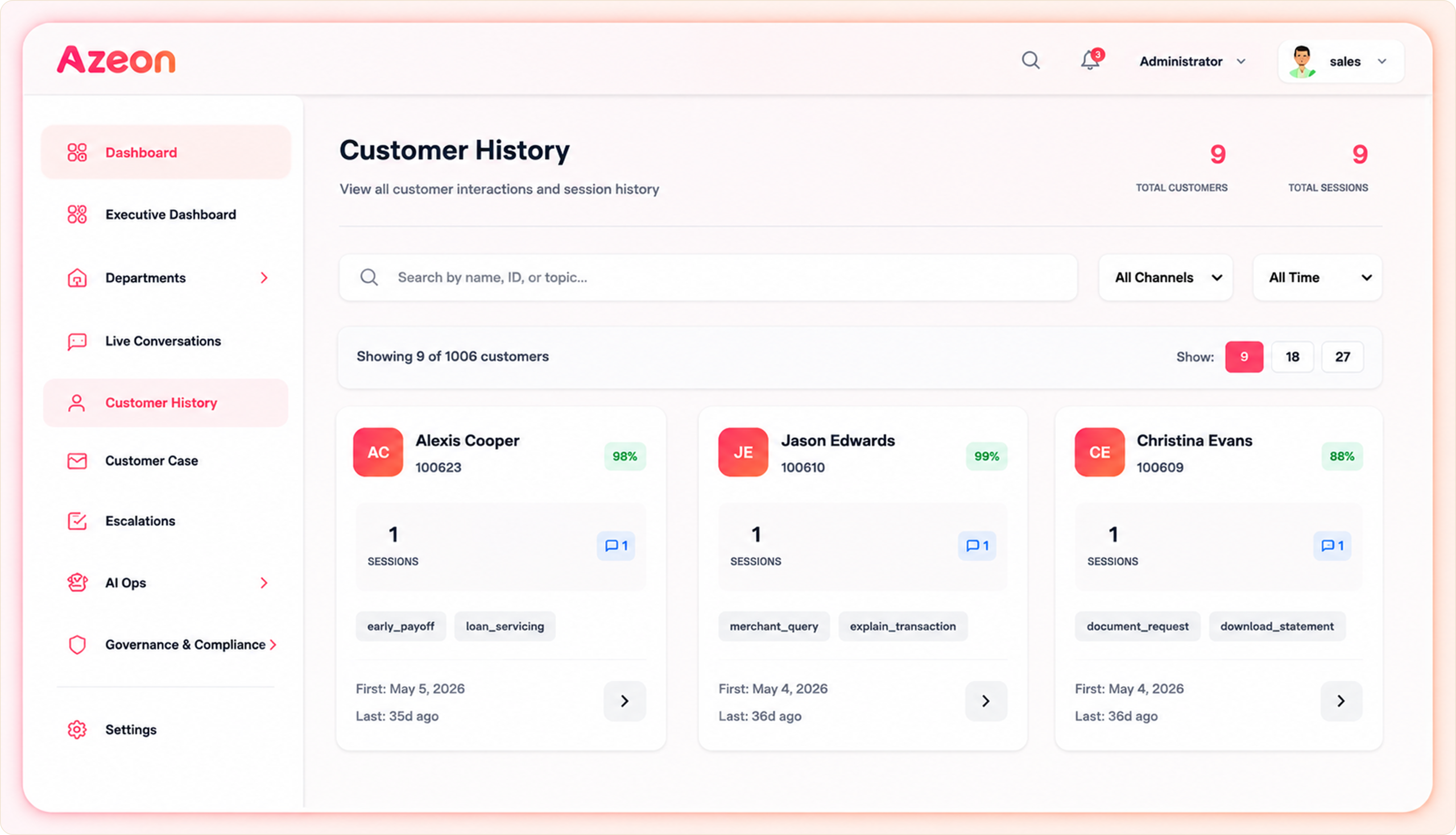
Customer History → Memory & Context

The Customer History view gives AI and support teams a unified view of every customer interaction, conversation, and support session.

Instead of treating each interaction as a new request, Azeon maintains context across the entire customer journey, enabling more personalized support and helping customers get answers without repeating information.

Customer History

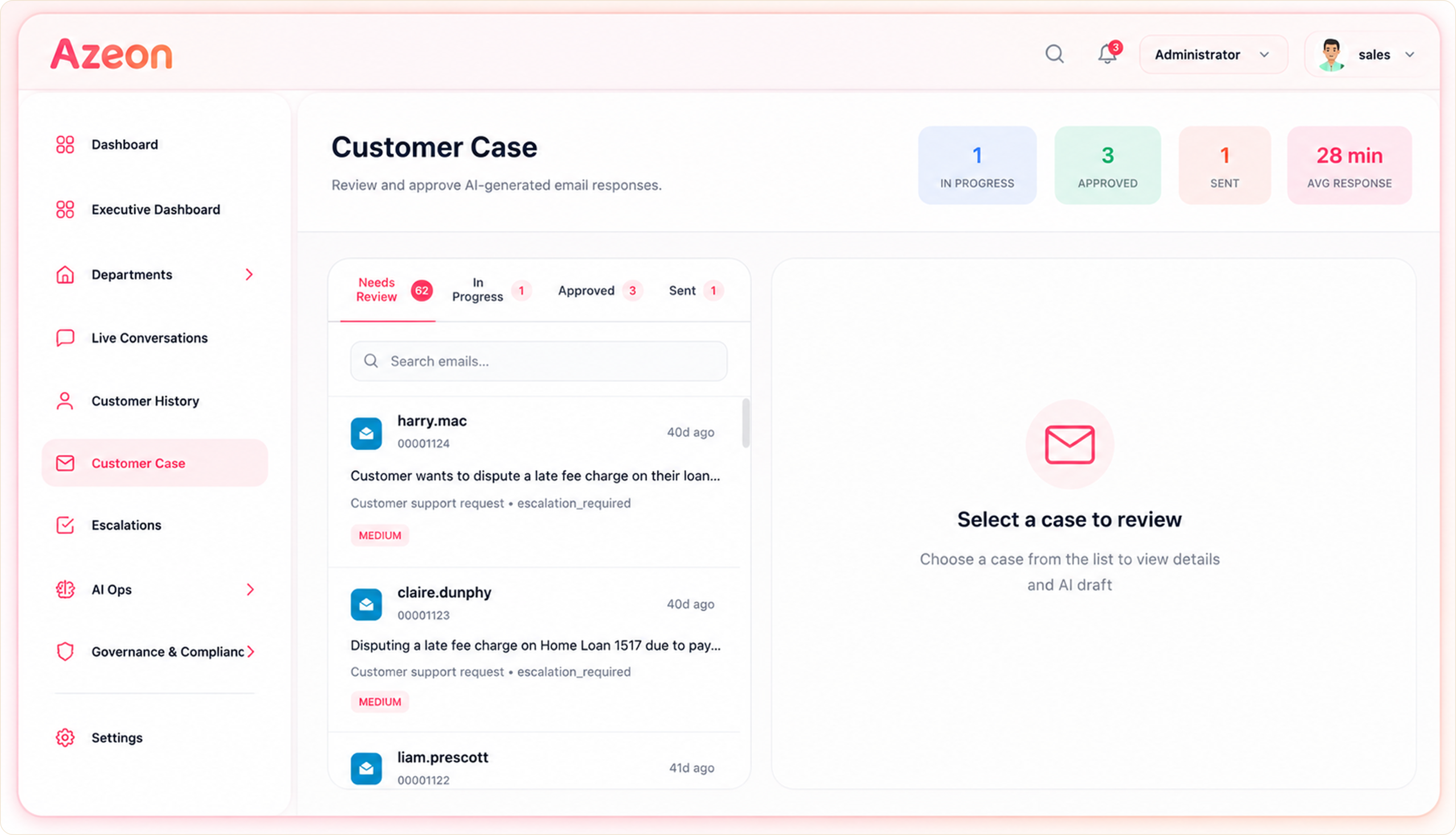
Customer Case → Resolution Capability

The Customer Case workspace helps teams review, manage, and resolve customer issues from a single location.

AI can identify customer intent, generate recommended responses, and organize cases based on status and priority, allowing support teams to move issues toward resolution faster.

Customer Case

Escalations → Human-in-the-Loop

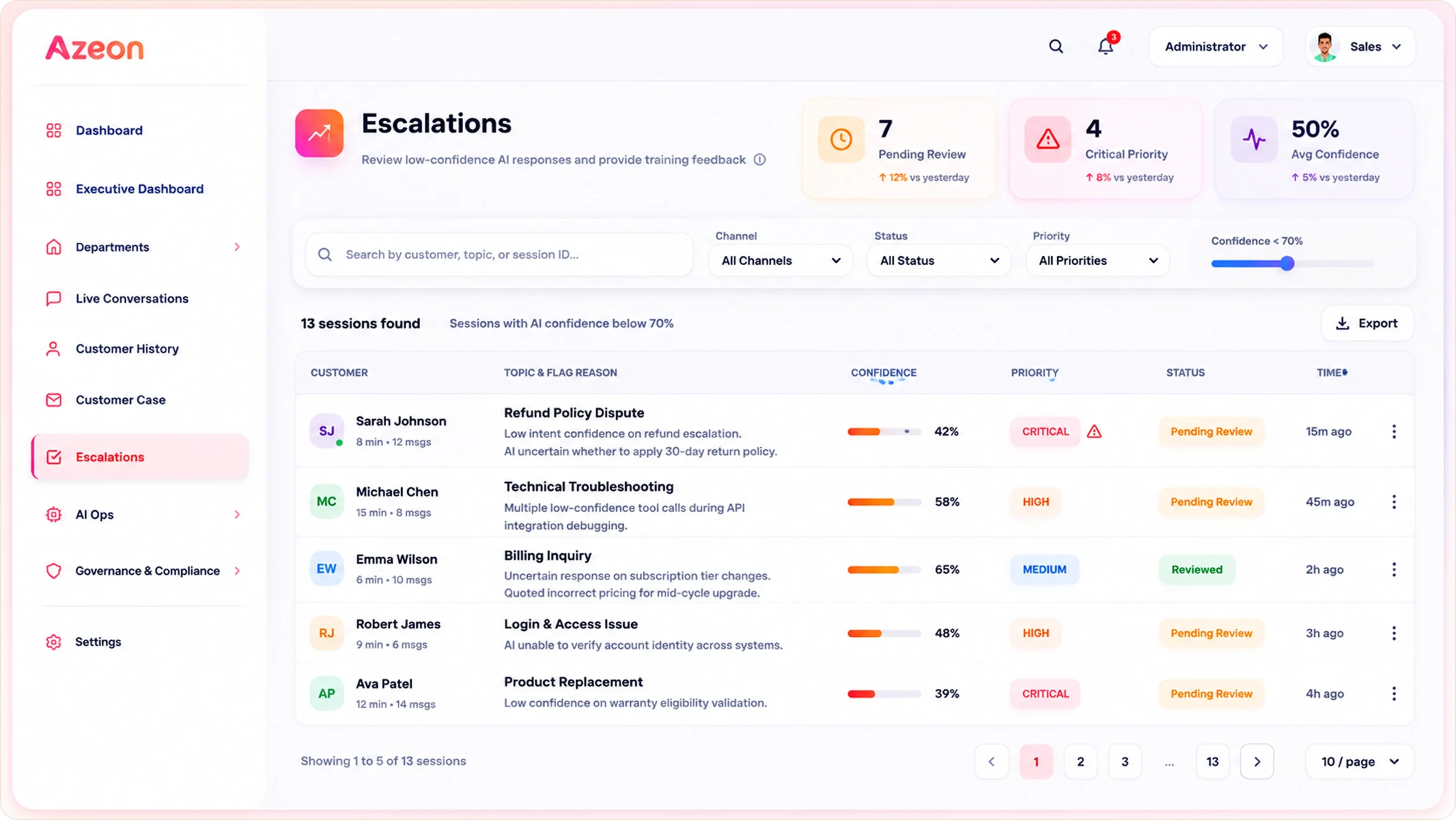
The Escalations feature provides visibility into low-confidence responses, high-priority cases, and interactions that require additional review.

Support teams can quickly identify where intervention is needed, provide guidance, and ensure customers receive accurate and appropriate resolutions.

Manage Escalations

See How Azeon Measures Up Against These Criteria

Explore how Azeon delivers the intelligence, context, integrations, governance, and resolution capabilities.

FAQs

How do I evaluate AI vendors for customer support automation?

Evaluating AI vendors requires looking beyond chatbot capabilities and feature lists. Organizations should assess factors such as intelligence and reasoning, resolution capability, customer memory, business system integrations, human oversight, analytics, governance, and scalability. The best platforms combine these capabilities to help customers reach resolution faster and more efficiently.

What is the most important criterion when comparing AI vendors for customer support?

Resolution capability is often the most important factor. While many AI platforms can answer customer questions, the strongest solutions can also execute actions, access business systems, and resolve customer issues without requiring human intervention. Measuring outcomes rather than conversations provides a clearer view of business value.

Why are integrations important in customer support automation?

Integrations allow AI to interact with CRM systems, helpdesk platforms, ecommerce solutions, billing systems, and other business applications. Without these connections, AI can provide information but may struggle to complete actions such as updating accounts, processing refunds, or managing subscriptions. Strong integrations help move support operations from assistance to resolution.

What is customer memory in AI-powered customer support?

Customer memory enables AI to retain context across conversations, channels, and support interactions. This allows customers to continue conversations without repeating information while helping support teams deliver more personalized experiences. Shared memory also improves resolution accuracy and overall customer satisfaction.

What should enterprises look for in an AI customer support platform?

Enterprises should prioritize intelligence, customer context, security, governance, integrations, analytics, scalability, and workflow automation. A platform that combines these capabilities can support long-term growth while helping organizations deliver consistent and efficient customer experiences across channels.

David works closely with enterprise organizations to help them modernize customer support operations through AI-driven automation. With experience in strategic account management, customer engagement, and technology consulting, David focuses on aligning business objectives with scalable support solutions that improve efficiency, customer experience, and operational performance.

David Pridgen
National Account Manager

Questions about Azeon?

Connect with our team to explore use cases, workflows, and deployment possibilities.