Skip to content

Top AI Customer Service Tools for High Volume Support in 2026

Top AI Customer Service Tools for High Volume Support in 2026

With dozens of platforms in the market, choosing the right solution can be challenging. Some tools specialize in conversational AI, while others focus on workflow automation, agent assistance, or end-to-end issue resolution.

To help you narrow down your options, we’ve compared the top AI customer service tools for high volume support based on AI capabilities, integrations, scalability, governance, pricing, and enterprise readiness.

Whether you’re an eCommerce brand, financial institution, SaaS company, or enterprise support organization, this guide covers the best AI customer service tools for high volume support to help you find the right platform for your business.

Criteria We Used to Evaluate Top AI Customer Service Tools

To identify the best AI customer service tools for high volume support, we evaluated platforms using the following criteria:

Automation Capabilities

We assessed whether the platform can do more than answer FAQs. The evaluation included intent understanding, contextual responses, workflow automation, and autonomous issue resolution.

Scalability

High-volume support environments require platforms that can consistently handle thousands of customer interactions across channels without compromising performance.

Omnichannel Support

We looked at support across chat, email, voice, messaging apps, and other customer touchpoints to ensure seamless customer experiences.

Integrations

AI customer support software becomes more valuable when connected to CRMs, help desks, billing systems, order management platforms, and internal applications.

Human Oversight & Governance

For enterprises, approval workflows, audit trails, and controlled escalations are often essential for maintaining compliance and service quality.

Analytics & Reporting

We evaluated each platform’s ability to provide insights into customer interactions, automation performance, and support operations.

Deployment Flexibility

Organizations have different infrastructure requirements. We considered cloud, hybrid, and on-premise deployment options where applicable.

Pricing Model

Pricing structures vary significantly across vendors. We reviewed whether platforms charge by seats, usage, conversations, or customer outcomes.

Top 10 AI Customer Service Tools for High Volume Support

Platform Best For AI Capabilities Integrations Pricing Model
Azeon Enterprise high-volume customer support operations Agentic AI, deterministic execution, shared customer memory, intelligent workflows CRM, help desk, billing systems, ERP, custom APIs Result-as-a-Service (Pay per resolved ticket)
Intercom Fin AI SaaS companies seeking conversational AI support AI chatbot, agent assistance, knowledge retrieval Intercom ecosystem and third-party apps Usage-based pricing
Zendesk AI Organizations already using Zendesk Ticket automation, AI assistance, workflow automation Extensive marketplace integrations Subscription + add-ons
Salesforce Einstein for Service Large enterprises using Salesforce Predictive AI, case routing, agent assistance Native Salesforce ecosystem Enterprise pricing
Freshdesk Freddy AI SMBs and mid-market customer support teams Chatbots, summarization, agent productivity Freshworks ecosystem and apps Tier-based subscription
Ada Customer self-service automation Conversational AI and automated resolutions CRM and support platform integrations Custom pricing
Yellow.ai Omnichannel enterprise customer support Voice AI, chat AI, workflow automation Enterprise systems and business applications Custom pricing
Forethought Ticket deflection and agent productivity Generative AI and support automation Popular help desk integrations Custom pricing
Gladly Customer-centric support organizations Unified conversations and AI assistance CRM and commerce integrations Custom pricing
Kore.ai Large enterprises and regulated industries Conversational AI and virtual assistants Enterprise integrations and APIs Enterprise pricing

1. Azeon

Best for: Enterprises and SaaS companies looking to scale high-volume customer support with AI while maintaining governance, context, and operational control.

Overview:

Azeon is an Agentic AI customer service platform built for organizations handling large volumes of customer interactions across chat, email, voice, and ticketing systems. Unlike traditional AI chatbots that primarily answer questions, Azeon acts as an intelligence layer on top of existing support infrastructure, enabling businesses to automate resolutions without replacing their current systems.

The platform combines AI reasoning with deterministic execution, allowing support teams to access customer data, retrieve account context, execute workflows, and coordinate actions across business systems. This enables organizations to reduce manual effort, improve customer experience, and scale support operations without proportionally increasing headcount.

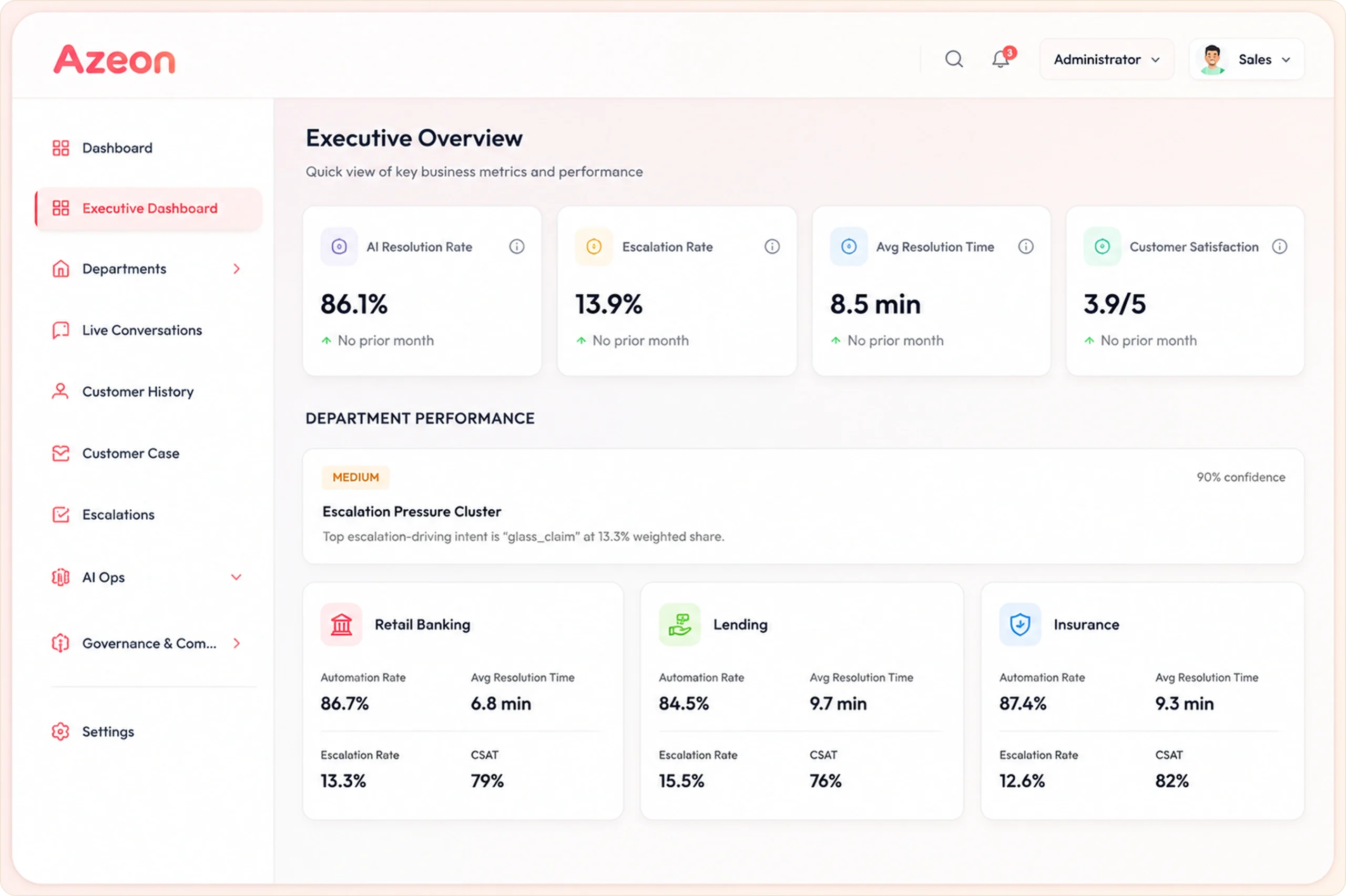
Azeon Executive Dashboard

Key Features:

  • Omnichannel Support: Supports customer conversations across chat, email, voice, and ticketing channels.
  • Shared Customer Memory: Maintains customer history, previous interactions, and account context across conversations.
  • Human-in-the-Loop Governance: Enables approvals and oversight for sensitive customer actions.
  • Context-Aware Escalations: Transfers conversation history, customer information, and recommended next steps during handoffs.
  • Workflow Automation & Execution: Performs actions across CRM, billing, subscription management, support, and operational systems.
  • AI Reasoning Engine: Understands customer intent, urgency, and business context before responding.
  • Knowledge Integration: Connects product documentation, knowledge bases, policies, and internal resources.
  • Root Cause Analytics: Identifies recurring support issues, product friction points, and operational bottlenecks.
  • Auditability & Traceability: Provides visibility into AI actions, decisions, and workflows.
  • Flexible Deployment Options: Supports enterprise deployment requirements across various environments.
  • Extensive Integrations: Connects with CRM platforms, help desks, SaaS applications, communication channels, and business systems.
| Proven Results from Live Environments |

Measured Outcomes Across Production Deployments

Metric
Outcome
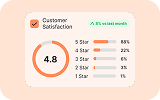
CSAT improvement (Retail case study)
3.7 → 4.8
Reduction in repeat contact rate
35%
Reduction in Average Handle Time (Logistics)
32%
Common queries resolved annually
250,000+
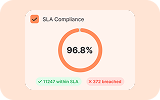
Ticket automation without SLA risk (SaaS)
96%
Customer Lifetime Value improvement
2X
Goal Completion Rate (GCR)
95%+
Semantic Accuracy
>92%
Guardrail Adherence
99.999%
Annual OpEx Reduction
Up to $250K

Pros:

  • Built specifically for high-volume customer support operations
  • Works with existing support infrastructure and business systems
  • Combines AI reasoning with workflow execution
  • Strong governance, auditability, and visibility controls
  • Supports enterprise-scale deployments and integrations
  • Outcome-based pricing aligned with business results

Cons:

  • Enterprise capabilities may exceed the needs of very small teams
  • Advanced workflows typically benefit from implementation planning

Pricing:

Azeon follows a Result-as-a-Service pricing model where businesses pay based on successfully resolved customer issues rather than seats, AI consumption, tokens, or conversation volume.

David Pridgen
David Pridgen
Solution Consultant

Discover What Azeon AI Agents Can Do

Experience how Azeon AI agents understand intent, access customer context, and take action across your support operation.

Book a Personalized Demo →

2. Intercom Fin AI

Best for: SaaS companies and digital businesses seeking AI-powered customer support with conversational automation and agent assistance.

Overview:

Intercom Fin AI is an AI customer service solution built on top of Intercom’s customer messaging platform. Fin AI focuses on resolving customer inquiries across chat, email, and other support channels using generative AI. The platform is designed to answer questions using company knowledge bases while maintaining brand voice and conversation quality.

One of Fin AI’s key differentiators is its outcome-based pricing model, where businesses pay per successful AI resolution rather than token usage. Fin can integrate with existing help desks such as Salesforce and Freshdesk, enabling organizations to deploy AI without completely changing their support operations. The platform also supports agent handoffs and action execution in connected systems.

Key Features:

  • AI agent for chat and email support
  • Knowledge-base powered responses
  • Customizable tone and response length
  • Agent handoff capabilities
  • Support for WhatsApp and SMS
  • Action execution in external systems
  • Shared inbox and ticketing
  • Reporting and analytics dashboard

Pros:

  • Transparent outcome-based pricing
  • Fast deployment and setup
  • Strong conversational experience
  • Native integration with Intercom
  • Supports multiple communication channels
  • Can work with external help desks

Cons:

  • Additional seat costs may increase total spend
  • Primarily optimized for digital-first businesses
  • Advanced functionality may require higher plans

Pricing:

  • Essential Plan: Starts at $29 per seat/month
  • Advanced Plan: Starts at $85 per seat/month
  • Expert Plan: Starts at $132 per seat/month
  • Fin AI Agent: Approximately $0.99 per successful resolution

3. Zendesk AI

Best for: Organizations already using Zendesk that want AI-powered automation inside their customer service operations.

Overview:

Zendesk AI extends the company’s customer service platform with AI agents, generative responses, intelligent routing, and automation capabilities. The platform supports messaging, email, web forms, and voice channels while bringing customer conversations into a unified workspace.

Zendesk has expanded its AI strategy toward outcome-based service and agentic AI experiences. Its AI agents can automate customer interactions, provide generative assistance to agents, and integrate with external systems. Recent developments such as Model Context Protocol (MCP) support further strengthen interoperability across enterprise ecosystems.

Key Features:

  • AI agents across chat, email, and voice
  • Intelligent ticket routing
  • Generative replies for agents
  • Omnichannel customer support
  • Knowledge base and self-service
  • Analytics and reporting dashboards
  • Workflow automation
  • AI-powered customer context

Pros:

  • Deep integration with Zendesk ecosystem
  • Strong omnichannel capabilities
  • Enterprise-grade scalability
  • Extensive marketplace integrations
  • Mature ticket management system
  • Built-in AI features across plans

Cons:

  • Advanced AI capabilities may require add-ons
  • Pricing can become expensive at scale
  • Some enterprise features require higher tiers

Pricing:

  • Support Team: Starts at $25/agent/month
  • Suite Team: Starts at $69/agent/month
  • Suite Professional: Starts at $149/agent/month
  • Suite Enterprise: Custom pricing

4. Salesforce Einstein for Service

Best for: Large enterprises already operating within the Salesforce ecosystem.

Overview:

Salesforce Einstein for Service brings AI capabilities into Salesforce Service Cloud, helping organizations automate workflows, assist agents, and personalize customer interactions. The platform leverages customer data stored across Salesforce applications to deliver contextual support experiences.

Einstein combines predictive AI, generative AI, and automation features to improve service efficiency. Organizations can use AI-generated summaries, recommendations, and workflows while maintaining enterprise governance and security controls.

Key Features:

  • AI-generated case summaries
  • Agent assistance and recommendations
  • Workflow automation
  • Predictive analytics
  • Omnichannel service management
  • Customer 360 integration
  • Knowledge article suggestions
  • Enterprise security controls

Pros:

  • Native Salesforce integration
  • Rich customer data access
  • Highly customizable workflows
  • Enterprise-grade governance
  • Extensive ecosystem support
  • Scalable for global businesses

Cons:

  • Higher implementation complexity
  • May require Salesforce expertise
  • Premium pricing for advanced capabilities

Pricing:

Requires Salesforce Service Cloud subscription

5. Freshdesk Freddy AI

Best for: SMBs and mid-market organizations seeking AI-assisted customer support.

Overview:

Freshdesk Freddy AI is Freshworks’ AI solution that helps support teams automate tasks, improve productivity, and enhance customer experiences. Freddy AI assists agents with recommendations, ticket summaries, and response suggestions while supporting self-service experiences.

The platform integrates closely with Freshdesk and other Freshworks products, enabling organizations to unify support operations across channels. Freddy AI is designed to reduce manual work while improving response efficiency.

Key Features:

  • AI-generated responses
  • Ticket summarization
  • Agent assistance tools
  • Knowledge base suggestions
  • Automated ticket routing
  • Omnichannel support
  • Analytics dashboards
  • Workflow automation

Pros:

  • User-friendly interface
  • Strong value for SMBs
  • Good Freshworks integration
  • Faster onboarding process
  • Flexible deployment options
  • Scalable support operations

Cons:

  • Advanced enterprise features may be limited
  • Deep customization may require upgrades
  • AI capabilities vary by plan

Pricing:

  • Growth: Starts at $15/agent/month
  • Pro: Starts at $49/agent/month
  • Enterprise: Starts at $79/agent/month
  • Freddy AI Copilot: Approximately $29/agent/month

6. Ada

Best for: Businesses prioritizing self-service automation and conversational AI.

Overview:

Ada provides AI-powered customer support automation designed to help organizations automate customer interactions across multiple channels. The platform emphasizes no-code bot building and personalized customer experiences.

Ada integrates with business systems to provide contextual responses while escalating complex cases to human agents when necessary. Its AI capabilities help organizations improve customer experiences while reducing support workload.

Key Features:

  • Conversational AI automation
  • No-code bot builder
  • Multilingual support
  • CRM integrations
  • Omnichannel deployment
  • Knowledge base integration
  • Human handoff workflows
  • Analytics and reporting

Pros:

  • Strong self-service capabilities
  • Easy bot creation
  • Multilingual support
  • Enterprise scalability
  • Flexible integrations
  • Supports multiple channels

Cons:

  • Pricing is not publicly available
  • Advanced workflows may require setup
  • Enterprise deployment can take time

Pricing:

Pricing based on support volume, channels, and business requirements.

7. Yellow.ai

Best for: Enterprises seeking conversational AI across customer support, employee experience, and voice automation.

Overview:

Yellow.ai is an enterprise AI platform that provides conversational automation across chat, voice, and messaging channels. The platform helps organizations automate customer interactions while maintaining consistent experiences across digital touchpoints. It serves industries such as retail, banking, healthcare, and telecom.

The platform combines generative AI, multilingual capabilities, and workflow orchestration to manage high support volumes. Yellow.ai supports integrations with CRMs, help desks, and business systems, enabling enterprises to automate repetitive tasks and improve service efficiency.

Key Features:

  • AI-powered chat and voice agents
  • Multilingual support across numerous languages
  • Omnichannel customer engagement
  • Workflow automation engine
  • CRM and help desk integrations
  • Knowledge base integration
  • Analytics and performance monitoring
  • Human agent escalation workflows

Pros:

  • Strong voice AI capabilities
  • Enterprise-grade scalability
  • Extensive channel support
  • Multilingual experiences
  • Flexible integrations
  • Suitable for global operations

Cons:

  • Enterprise implementation can be complex
  • Pricing is not publicly available
  • Advanced customization may require professional services

Pricing:

Custom pricing only.

8. Forethought

Best for: Support teams focused on ticket deflection and agent productivity.

Overview:

Forethought is an AI customer support platform designed to automate customer interactions and assist support agents. The platform uses generative AI to resolve common inquiries, suggest responses, and surface relevant knowledge articles.

Forethought integrates with existing support systems to improve efficiency while reducing ticket volumes. Its AI capabilities focus heavily on customer self-service and agent augmentation, making it particularly useful for organizations looking to streamline support operations.

Key Features:

  • AI-powered customer support automation
  • Agent assistance capabilities
  • Knowledge base search
  • Ticket deflection workflows
  • Generative AI responses
  • CRM integrations
  • Analytics dashboard
  • Human handoff support

Pros:

  • Strong automation capabilities
  • Improves agent productivity
  • Integrates with existing tools
  • Reduces repetitive tickets
  • AI-assisted knowledge retrieval
  • Enterprise support features

Cons:

  • Enterprise onboarding may require setup time
  • Advanced functionality may need customization

Pricing:

Pricing is not available.

9. Gladly

Best for: Customer-centric brands looking to unify support conversations across channels.

Overview:

Gladly is a customer service platform built around people rather than tickets. The platform provides a unified conversation history that enables support teams to deliver personalized customer experiences across multiple channels.

Gladly supports voice, email, chat, SMS, and social messaging while giving agents complete customer context. Its approach to customer service makes it particularly attractive for brands prioritizing customer loyalty and long-term relationships.

Key Features:

  • Unified customer conversations
  • Omnichannel support
  • Voice and messaging support
  • Customer timeline view
  • Self-service capabilities
  • Agent workspace
  • Analytics and reporting
  • CRM integrations

Pros:

  • Customer-centric architecture
  • Unified conversation history
  • Omnichannel experiences
  • Intuitive agent interface
  • Strong personalization capabilities
  • Supports customer loyalty initiatives

Cons:

  • May require process changes during adoption
  • Enterprise deployment can take time

Pricing:

Pricing is not publicly available.

  • Premium: Custom pricing

10. Kore.ai

Best for: Large enterprises requiring conversational AI and workflow automation across departments.

Overview:

Kore.ai provides enterprise conversational AI solutions for customer service, employee experience, and process automation. The platform supports AI agents, virtual assistants, and workflow orchestration across multiple use cases.

Organizations can deploy Kore.ai across customer support channels while integrating with enterprise applications and backend systems. Its flexible architecture supports highly customized AI deployments for large enterprises.

Key Features:

  • Conversational AI platform
  • AI virtual assistants
  • Workflow automation
  • Omnichannel deployment
  • Enterprise integrations
  • Low-code development tools
  • Analytics and monitoring
  • Security and governance controls

Pros:

  • Highly customizable platform
  • Enterprise-grade security
  • Extensive integration capabilities
  • Scalable architecture
  • Supports multiple use cases
  • Flexible deployment options

Cons:

  • Requires technical expertise
  • Pricing is not publicly available
  • Complex implementations for large deployments

Pricing:

Enterprise pricing model. Custom quotes based on requirements.

How to Choose the Right AI Customer Service Tool for High Volume Support?

Here are some key considerations:

1. Look Beyond Chatbots

Modern customer support requires more than scripted conversations. Evaluate whether the platform can reason, take actions, and resolve issues autonomously.

2. Prioritize Integration Capabilities

The best AI customer service tools integrate with CRMs, billing systems, help desks, and internal applications. Strong integrations reduce manual work and improve customer experiences.

3. Evaluate Governance and Compliance

Industries such as financial services and healthcare often require auditability, approval workflows, and security controls. Human oversight remains critical for sensitive operations.

4. Consider Omnichannel Support

Customers expect consistent experiences across chat, email, voice, and messaging platforms. A unified support system improves continuity and reduces customer effort.

5. Analyze Pricing Models

Some vendors charge based on seats or usage. Others align pricing with customer outcomes. Evaluate which model best fits your support economics.

6. Measure Scalability

High-volume support environments require systems that maintain performance as interactions increase. Assess enterprise readiness before deployment.

Final Verdict

Platforms such as Intercom Fin AI and Zendesk AI work well for organizations already invested in their ecosystems. Salesforce Einstein delivers powerful capabilities for enterprises using Salesforce, while Ada and Yellow.ai provide strong conversational AI experiences.

However, enterprises managing complex support operations often need more than conversational AI. They require systems that can reason, take actions, maintain compliance, and integrate with existing infrastructure.

This is where Azeon stands apart.

Azeon combines agentic AI, deterministic execution, shared memory, omnichannel orchestration, and human-in-the-loop governance in a single platform. Rather than charging for usage or seats, its Result-as-a-Service pricing aligns directly with business outcomes.

For organizations seeking the best AI customer service tool for high volume support, Azeon offers a compelling combination of enterprise control, scalability, and measurable ROI.

Ready to Modernize Customer Support?

Discover how Azeon helps teams automate customer support while maintaining visibility and control.

FAQs

What are AI customer service tools?

AI customer service tools use artificial intelligence to automate customer interactions, assist support teams, and improve service efficiency across channels like chat, email, and voice. These platforms can answer questions, retrieve information, route tickets, and, in advanced systems, execute actions across business applications. Modern AI customer support software helps organizations manage high ticket volumes while maintaining customer satisfaction.

How do AI customer service tools work?

AI customer service tools combine technologies such as natural language processing (NLP), machine learning, and generative AI to understand customer requests and provide responses. Many platforms integrate with CRMs, knowledge bases, and help desks to access customer data and context. Advanced AI systems can also automate workflows, escalate cases intelligently, and complete tasks without manual intervention.

What are the benefits of using AI for customer support?

AI customer support helps businesses improve response times, reduce operational costs, increase agent productivity, and deliver 24/7 customer assistance. By automating repetitive inquiries, support teams can focus on more complex issues that require human expertise. AI also enables organizations to scale customer service operations efficiently as support volumes grow.

What features should businesses look for in AI customer service software?

Businesses should evaluate AI customer service tools based on automation capabilities, omnichannel support, integrations, analytics, governance controls, and scalability. Features such as shared customer memory, intelligent routing, human-in-the-loop workflows, and enterprise security are increasingly important for high-volume support environments.

Can AI customer service tools integrate with existing systems?

Yes, most modern AI customer service platforms integrate with existing business systems such as CRMs, help desks, billing platforms, and knowledge bases. Strong integrations help create a unified customer experience while reducing manual work for support teams. Organizations should prioritize platforms that fit into their existing technology stack without requiring major migrations.

David works closely with enterprise organizations to help them modernize customer support operations through AI-driven automation. With experience in strategic account management, customer engagement, and technology consulting, David focuses on aligning business objectives with scalable support solutions that improve efficiency, customer experience, and operational performance.

David Pridgen
Solution Consultant

Questions about Azeon?

Connect with our team to explore use cases, workflows, and deployment possibilities.