Skip to content

10 Best AI Agents for Customer Support in 2026

10 Best AI Agents for Customer Support in 2026

AI agents are everywhere in customer support right now.

And every platform claims faster resolutions, lower support costs, better automation, and smarter customer experiences.

Hence, support teams are trying to figure out which platforms actually deliver value. Because some AI agents are built to resolve tickets end-to-end. Some work better as agent assistants. Others focus heavily on voice, omnichannel support, or enterprise workflow automation.

We spent time exploring the market, comparing platforms, reviewing capabilities, and identifying the tools businesses are actually adopting in 2026.

In this guide, we cover the best AI agents for customer support, what each platform does well, where they fit best, and what you should evaluate before investing in one.

The 6 Criteria We Used to Evaluate Every AI Agent for Customer Support

Every customer support AI agent in this guide was evaluated on:

  • Resolution Depth – Does it actually close tickets end-to-end, or just respond?
  • System Action Capability – Can it trigger real workflows in your existing tools?
  • Channel Coverage – Does it work across chat, email, voice, and ticketing?
  • Deployment Speed – How fast can you go live without migration risk?
  • Pricing Transparency – Is pricing fair, outcome-aligned, and predictable at scale?
  • Enterprise Readiness – Security, compliance, scalability, and auditability

10 Best AI Agents for Customer Support in 2026

Based on platform capabilities, enterprise adoption, workflow depth, scalability, integrations, and overall customer support experience, here are the top AI agents for customer support businesses are evaluating in 2026.

#1. Azeon.ai – Best Overall for Outcome-Driven Enterprise Support

Best for: Mid-market and enterprise teams in Finance, Retail, FMCG, and SaaS who need a genuine system of action – not just a smarter chatbot.

Overview:

Azeon is an agentic AI platform built from the ground up for high-volume customer support operations. It doesn’t replace your existing stack – it sits on top of it as an intelligence and execution layer, turning your CRM, helpdesk, and business tools into a coordinated support machine that doesn’t just respond but resolves.

The philosophy behind Azeon is simple but rare: most AI platforms stop at the response layer. Azeon is engineered to go all the way to resolution – and it does this through an architecture that separates conversational intelligence from deterministic execution. That separation is what makes Azeon the most enterprise-safe and audit-ready platform in this entire list.

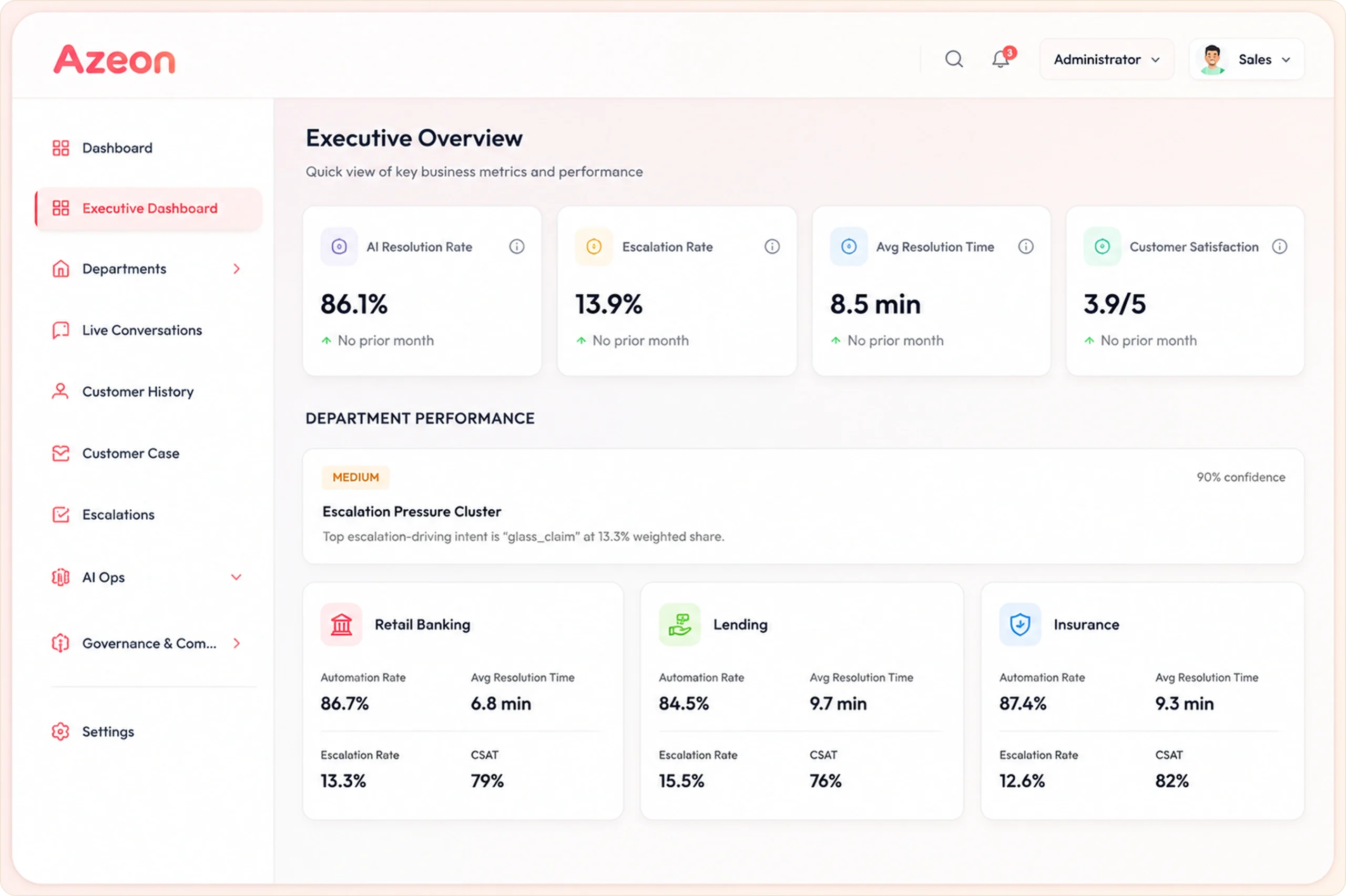
Azeon Dashboard

Key Features:

Omnichannel Support: Chat, email, voice, and tickets unified in one view. Context carries across every channel switch.

System of Action, Not Just Record: Azeon triggers real workflows, updates CRM records, processes refunds, modifies subscriptions – in real time, inside your existing stack.

Zero Migration Required: Plugs into your existing CRM, helpdesk, and tools. No data migration. No workflow rebuilds. Your team keeps working exactly as they do; Azeon adds the intelligence layer on top.

Smart Knowledge Engine: Indexes your documentation, FAQs, product guides, and historical tickets. Surfaces the most relevant answer directly inside every conversation.

Customer Context & History: A living timeline of every customer’s full history, sentiment trends, past issues, and preferences – surfaced automatically the moment a conversation opens.

Human-in-the-Loop Controls: Granular rules for when AI acts autonomously and when it pauses for approval. Set by issue type, customer tier, action risk level, or any other criteria. Sensitive actions like large refunds always wait for human approval.

Seamless Human Handoff: Complete context package delivered to human agents at escalation: conversation history, issue summary, customer sentiment, and recommended next steps.

Email Drafting & Smart Replies: Reads each email, identifies intent, pulls customer context, and drafts a complete reply before the agent even opens the ticket.

Live Monitoring & Command Center: Real-time visibility across every active conversation. Managers can monitor agent performance and intervene instantly before issues escalate.

Analytics & Insights: Spot trends, identify failure points, measure AI performance, track CSAT, and get actionable recommendations across every channel.

18+ Native Integrations: CRMs, helpdesks, billing systems, payment gateways, ERPs, and messaging platforms. Works with custom-built systems via APIs. Multiple systems queried in a single workflow.

// Proven Results from Live Environments

Measured Outcomes Across Production Deployments

Metric
Outcome
CSAT improvement (Retail case study)
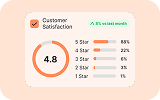
3.7 → 4.8
Reduction in repeat contact rate
35%
Reduction in Average Handle Time (Logistics)
32%
Common queries resolved annually
250,000+
Ticket automation without SLA risk (SaaS)
96%
Customer Lifetime Value improvement
2X
Goal Completion Rate (GCR)
95%+
Semantic Accuracy
>92%
Guardrail Adherence
99.999%
Annual OpEx Reduction
Up to $250K

Pricing – Result-as-a-Service (The Industry’s Most Honest Model):

Azeon’s pricing model is called Result-as-a-Service – you pay per successfully resolved ticket, not per seat, per agent, per token, or per action.

While every other AI agent for customer support in this guide bills you for consumption, Azeon bills you for outcomes.

Azeon Pricing

#2. Intercom Fin – Best for SaaS Teams Already on Intercom

Best for: SaaS companies embedded in Intercom’s ecosystem seeking fast time-to-value.

Overview:

Intercom’s Fin AI agent is one of the most widely deployed AI customer support agents on the market. Fin has resolved over 40 million conversations, claims a 67% average resolution rate across 7,000+ customers, and improves approximately 1% per month. It trains on your knowledge base, replies as a tier-1 agent, and escalates to humans when needed. Fin works both as a standalone agent (compatible with Zendesk, Salesforce, and HubSpot) and natively within Intercom’s helpdesk platform.

Key Features:

✦ Omnichannel support: chat, email, SMS, voice

✦ Trains on knowledge base, help articles, and FAQs

✦ Copilot mode for agent-assist (paid add-on)

✦ Multi-language support

✦ Human handover with conversation context

✦ Works with external helpdesks without requiring platform migration

Where Fin Stands Out:

The per-resolution pricing model ($0.99/resolution) is simple: you pay only when Fin successfully resolves a conversation. At 67% resolution rate, the ROI case is strong for high-volume teams. Fin’s deep integration within Intercom’s broader platform (inbox, automation, proactive support) creates genuine CX continuity for teams fully committed to the Intercom ecosystem.

Where Fin Falls Short:

The total cost gets complicated fast. Fin requires an active Intercom seat plan (starting at $29/seat/month) to function within Intercom, before a single resolution is billed. Copilot (agent-assist mode) is a separate add-on at ~$35/agent/month. At scale, 2,000 AI-resolved conversations per month equals $1,980 in Fin fees alone – nearly $24,000 annually, before platform costs. Intercom’s per-seat + per-resolution stacking has been frequently cited across Reddit communities as unpredictable at volume. Fin is also primarily a conversational agent – for teams needing deep workflow execution, deterministic business logic, or strict audit trails, its scope is more limited.

Pricing:

Fin AI Agent: $0.99 per resolution

Intercom seat plans: $29–$139/seat/month (required for Intercom integration)

Copilot add-on: ~$35/agent/month

Standalone (external helpdesks): $49.50 minimum monthly charge

#3. Zendesk AI – Best for Large Enterprises Already on Zendesk

Best for: Large support organizations deeply invested in the Zendesk ecosystem.

Overview:

Zendesk is one of the most established names, and its AI agents for customer support represent a mature evolution of their platform. Their agentic AI is designed to reason, adapt, and resolve complex issues. Zendesk’s Advanced AI tier claims 80%+ interaction resolution capability, with intelligent triage, AI-generated replies, and connections to internal APIs for action-taking beyond just answering questions.

Key Features:

✦ AI agent builder for custom, multi-step conversation flows

✦ Intelligent triage – auto-classifies tickets by intent, language, and sentiment

✦ AI-generated replies, summaries, and knowledge article suggestions

✦ Connection to internal APIs for system-level actions

✦ Advanced reporting and analytics

✦ Full human handover with ticket context and history

Where Zendesk Stands Out:

For organizations already invested in Zendesk, the AI capabilities are a natural, low-disruption extension. The intelligent triage feature is particularly strong, reducing manual classification time significantly. Their 2025 acquisition of Forethought (now being integrated into the Zendesk product) further strengthens the platform’s AI triage and routing capabilities for existing customers.

Where Zendesk Falls Short:

Zendesk’s AI capabilities are locked behind the Advanced AI add-on, which costs an additional $50/agent/month on top of your Suite plan. Enterprise contracts typically run $150–$200+/agent/month and require $50,000+ annual commitments. The outcome-based pricing adds further variability: $1.50/automated resolution (committed) or $2.00 pay-as-you-go. Since January 2026, Zendesk has introduced automatic overage billing without prior notification – a significant risk for budget-conscious operations teams. G2 reviewers consistently cite steep learning curves and complex initial configuration for teams not already on the platform.

Pricing:

Suite plans: Starting ~$55/agent/month (billed annually)

Advanced AI add-on: ~$50/agent/month (required for true AI automation)

Automated resolutions: $1.50 committed / $2.00 pay-as-you-go per resolution

Enterprise contracts: $50,000+ annual minimum typical

#4. Salesforce Agentforce – Best for Enterprises Living in the Salesforce Ecosystem

Best for: Enterprise organizations standardized on Salesforce for CRM, service, and marketing.

Overview:

Salesforce Agentforce became generally available in October 2025 as part of the Agentforce 360 release. It’s not just a customer service tool – it’s an enterprise-wide agentic AI platform spanning service, sales, marketing, HR, and IT. For customer support specifically, Agentforce for Service enables autonomous agents to handle inquiries, route cases, summarize interactions, and take meaningful action within Salesforce Service Cloud and the broader Salesforce data model.

Key Features:

✦ 24/7 multi-channel support: SMS, WhatsApp, Apple Messages, Facebook Messenger, voice

✦ Deep integration with Salesforce Service Cloud, CRM, and Data 360

✦ AI-generated case summaries, interaction summaries, and work order summaries

✦ Seamless handoff to human agents with full transcript and customer history

✦ Multi-agent orchestration across service, sales, and marketing functions

✦ Native voice data capture synced directly to CRM records

✦ Intelligent Context extracts and structures information from unstructured data sources

Where Agentforce Stands Out:

Agentforce provides the most complete customer view of any platform – because it draws from the entire Salesforce customer 360 data model. Agents know every interaction across sales, marketing, and service. Salesforce deployed Agentforce internally and cut $100 million in support costs while handling 3 million customer conversations – a credible proof point. The multi-agent orchestration capability is genuinely enterprise-grade and unique among platforms in this list.

Where Agentforce Falls Short:

Agentforce requires Salesforce at the Enterprise Edition level or higher. G2 reviewers consistently note a steep learning curve and significant initial configuration burden. For businesses not already operating within the Salesforce ecosystem, the total cost of AI agents for customer support adoption – including licenses, implementation, customization, and training – is substantially higher than the $2/conversation headline suggests. It is not a realistic option for teams on other platforms without significant migration investment.

Pricing:

✦ $2 per conversation / $500 per 100,000 Flex Credits

✦ Salesforce Enterprise Edition or higher is required as a foundation

✦ Full implementation and professional services costs vary significantly by organization

#5. Ada CX – Best for High-Volume Enterprise Brands Needing Omnichannel Reach

Best for: Large enterprise brands in SaaS, fintech, and ecommerce with dedicated AI ops resources.

Overview:

Ada is one of the best AI agents for customer support, having powered more than 5.5 billion interactions since 2016. It serves global brands including monday.com, Pinterest, Square, Cebu Pacific, and IPSY. Ada positions itself under the category it coined – ACX (Agentic Customer Experience) – with a core promise of autonomously resolving the majority of support tickets across every channel.

Key Features:

AI Voice: phone support with no IVR menus – natural, fast resolutions

AI Messaging: always-on support across social, web, mobile, and SMS

AI Email: claims to resolve 70% of emails instantly

✦ Multi-LLM reasoning engine

✦ Deep integration with 13+ helpdesk platforms

✦ SOC 2 Type II certified

✦ No-code agent management with strong control and transparency features

✦ Supports 50+ languages

Where Ada Stands Out:

Ada’s longevity in the market (since 2016) and its 5.5 billion conversation track record provide real enterprise credibility. The omnichannel depth – voice, chat, email, messaging, social – is among the widest in this list. Ada’s control and transparency features are strong, giving enterprise teams the governance tools they need. Claims of up to 83% autonomous resolution are among the highest in the industry.

Where Ada Falls Short:

Ada’s pricing is opaque. No public pricing is available – contracts start around $30,000/year for some plans, with enterprise deals commonly reaching $100,000–$300,000+/year. Per-resolution pricing estimates from third-party sources range from $1–$3.50 per AI resolution, which can scale significantly at high volumes. Ada is explicitly built for large enterprises – teams looking for agility, fast rollout, and predictable ROI often find the lengthy setup (frequently 3–6+ months), heavy services dependency, and opaque pricing model difficult to navigate. Users have also reported that complex or unusual queries can trap customers in repetitive response loops.

Pricing:

No public pricing: Quote-based only

Estimated starting point: ~$30,000/year

Enterprise contracts: commonly $100,000–$300,000+/year

Per-resolution estimates: $1.00–$3.50 per AI-resolved conversation

#6. Freshdesk Freddy AI – Best for Mid-Market Teams on the Freshworks Stack

Best for: Mid-market teams already using Freshdesk or Freshchat who want to add AI automation without switching platforms.

Overview:

Freddy AI is Freshworks’ generative AI suite for Freshdesk and Freshchat. The Freddy AI Agent – Freshworks’ most advanced AI capability – launched in June 2025 and targets Tier-1 volume resolution for teams already in the Freshworks ecosystem. It covers auto-triage, response drafting, knowledge base generation, and conversational resolution.

Key Features:

✦ AI-generated ticket summaries and response drafts

✦ Auto-triage by category, priority, and sentiment

✦ Freddy AI Copilot for agent-assist ($35/agent/month)

✦ Multilingual support across 40+ languages

✦ Automated knowledge base article generation from conversations

✦ Session-based pricing for the AI Agent tier

✦ Included in higher-tier Freshdesk plans (no separate add-on fee, unlike Zendesk)

Where Freddy Stands Out:

Unlike Zendesk, which gates AI capabilities behind a $50/agent/month add-on, Freddy AI features are bundled into higher-tier Freshdesk plans – a meaningful cost advantage for teams already on those tiers. The multilingual support (40+ languages) is a genuine differentiator for global support operations. Auto-triage and classification are solid, with accuracy comparable to Zendesk’s intelligent triage.

Where Freddy Falls Short:

Real-world resolution rates vary widely – customers report anywhere from 23% to 75%, against Freddy’s claimed 80%. A critical functional limitation: Freddy AI only replies to the first email in a support thread, not subsequent messages, making it limited for multi-turn email support workflows. Training is limited to Freshworks’ own knowledge base – it cannot natively ingest content from Google Drive, Notion, Confluence, or other common tools. The platform is entirely locked to Freshservice: your AI investment doesn’t travel if you switch helpdesks.

Pricing:

Freddy AI Copilot: $35/agent/month

Freddy AI Agent: $0.12–$0.49 per session (depending on plan)

✦ Available on Pro and Enterprise plans only

#7. Yellow.ai – Best for Global Enterprises Needing Multilingual, Multi-Channel Scale

Best for: Large enterprises operating across multiple regions and languages needing broad channel coverage.

Overview:

Yellow.ai is a generative AI-powered customer support automation platform trusted by over 1,100 enterprises across 85+ countries, including Sony, Domino’s, Hyundai, Papa John’s, and Volkswagen. Headquartered in San Mateo, California, Yellow.ai is built on a proprietary multi-LLM architecture and is continuously trained on 16 billion+ conversations annually. It supports 35+ channels and 135+ languages – making it one of the widest-reach platforms available.

Key Features:

✦ 35+ channel support: chat, voice, SMS, email, social media, WhatsApp, and more

✦ 135+ languages with native multilingual AI

✦ DynamicNLP™ proprietary multi-LLM engine

✦ 150+ plug-and-play integrations (CRMs, ERPs, helpdesks, messaging platforms)

✦ No-code Dynamic Automation Platform (DAP) – build agents without deep engineering

✦ Knowledge management connects to data hubs: SharePoint, AWS S3, and document cognition

✦ Nexus: Universal Agentic Interface for building and operating agents within guardrails

✦ Custom integrations available when pre-built connectors don’t exist

✦ No rip-and-replace required – augments existing tech stacks

Where Yellow.ai Stands Out:

The sheer breadth of Yellow.ai’s language and channel coverage is unmatched in this list. For global enterprises dealing with customers across dozens of countries and languages simultaneously, few platforms can match the operational reach. The 150+ native integrations and no-code automation builder reduce implementation friction. Yellow.ai has raised over $102 million from blue-chip investors and has strong Gartner Peer Insights recognition.

Where Yellow.ai Falls Short:

Pricing is entirely custom and not publicly available – a “contact sales” model that makes upfront ROI modeling difficult. Some users report that NLP capabilities, while broad, can still struggle with nuanced or highly contextual queries. Support responsiveness has also been flagged in user reviews as an area for improvement. Like many other AI agents for customer support, setup and configuration can take significant time, particularly for complex multi-channel deployments.

Pricing:

No public pricing: Custom quotes based on conversations, channels, and seats

Tiered model: Monthly or annual billing options

Enterprise plans: Available with advanced modules priced separately

#8. Kore.ai – Best for Regulated Enterprises with Complex Contact Center Deployments

Best for: Large regulated enterprises with complex omnichannel contact center environments and procurement-driven buying processes.

Overview:

Kore.ai is an enterprise-grade agentic AI platform recognized as a Leader in the Everest Group AI Agents for CXM PEAK Matrix Assessment Q4 2025. It is designed to balance structured workflows with AI-driven conversations, combining traditional intent-based automation with advanced LLM capabilities. Kore.ai excels in complex, multi-agent orchestration across enterprise contact center environments – including voice, chat, IVR modernization, and back-office automation.

Key Features:

✦ Multi-agent orchestration across customer-facing and back-office functions

✦ Advanced natural language processing and dialog management

✦ Deep enterprise system integration: CRM, ERP, ITSM, and industry-specific platforms

✦ Strong voice automation and IVR modernization capabilities

✦ Robust analytics and conversation intelligence

✦ Compliance frameworks for regulated industries (BFSI, healthcare, telecom)

✦ No-code/low-code builder for non-technical teams

✦ Available in cloud, on-prem, and hybrid deployment models

Where Kore.ai Stands Out:

Kore.ai’s depth in structured workflow automation, combined with LLM conversational capability, gives it a unique position for enterprises that need both reliability and intelligence. Its recognition across analyst reports (Everest Group, Gartner) reflects genuine enterprise maturity. The platform’s flexibility across deployment models (cloud, on-prem, hybrid) is valuable for regulated industries with strict data sovereignty requirements.

Where Kore.ai Falls Short:

Kore.ai is explicitly not suited for self-serve buyers or teams who need to pilot fast. The platform is designed for enterprises with a procurement team, technical resources for deployment, and the patience for complex configuration. Implementation timelines of 8–16 weeks are common. Pricing is custom and typically falls into six-figure annual contracts. The platform’s structured flow architecture can feel less flexible when building highly dynamic autonomous agent behaviors compared to newer AI-native startups.

Pricing:

✦ Custom enterprise contracts; no public pricing

✦ Typically, six-figure annual engagements

✦ Implementation requires professional services investment

#9. Gorgias – Best AI Agent for Shopify-Centric eCommerce Brands

Best for: DTC and ecommerce brands running on Shopify who need AI tightly integrated with order management and shopping workflows.

Overview:

Gorgias is one of the dominant AI agents for customer support, specifically for Shopify brands, serving 12,000+ online stores in 2026. Its AI Agent is native to the Gorgias helpdesk and has direct, real-time access to Shopify order data and customer history – giving it a speed and accuracy advantage for ecommerce-specific queries that horizontal platforms can’t easily match. The AI Agent performs two roles: Shopping Assistant (pre-sale, product recommendations, deal-closing) and Support Agent (post-sale, order tracking, returns, refunds).

Key Features:

✦ Native Shopify integration with real-time order data access

Shopping Assistant: product recommendations, sizing questions, pre-sale support

Support Agent: order tracking, returns, refunds, exchanges

Vision feature: analyzes customer images (e.g., damaged product identification)

Guidance feature: custom instructions for AI tone and brand voice

✦ Trains on Help Center articles, Shopify product catalog, and uploaded documents

Bundled pricing: helpdesk plan + AI resolution add-on

Where Gorgias Stands Out:

For Shopify-native ecommerce teams, Gorgias offers the tightest integration available. The direct hookup to Shopify data means the AI can answer order-specific questions – status, delivery estimates, return eligibility – without needing to query a separate system through an API. Setup is fast relative to enterprise platforms, and the “only pay when resolved” model ($0.90/automated conversation on annual billing) is straightforward.

Where Gorgias Falls Short:

Gorgias is deeply Shopify-specific. Brands on other commerce platforms (Magento, BigCommerce, WooCommerce, and custom builds) will find significantly less native functionality. The dual pricing model – helpdesk ticket fees + AI resolution fees – can stack unexpectedly: automated resolutions still count as tickets, so both meters run simultaneously. Knowledge base training is limited to Gorgias’s own ecosystem; it cannot natively connect to external knowledge management tools.

Pricing:

Helpdesk plans: Starting at basic tier; Pro plan at $360/month (includes 2,000 tickets)

AI Agent: $1.00/automated resolution (monthly) / $0.90/automated resolution (annual)

Automation bundles: Sized by helpdesk plan tier (30–2,500 interactions/month)

Overage packs: ~$36–$40 per 100 extra tickets

#10. Sierra AI – Best for Conversational Depth and Autonomous Workflows

Best for: Mid-to-large consumer brands with dedicated CX engineering resources and a budget for premium enterprise AI.

Overview:

Sierra is a newer entrant to the enterprise AI customer service market but has established itself quickly, positioned as a Strong Performer in the Forrester Wave™: Conversational AI Platforms For Customer Service, Q2 2026. Sierra focuses on persistent, context-aware customer-facing agents with strong governance and supervision layers. Its Agent Data Platform (ADP) stores long-term customer context, enabling agents to maintain continuity across interactions and personalize responses based on deep historical data.

Sierra excels in workflows like refunds, account updates, and subscription changes – common, high-value actions that benefit from genuine autonomous handling rather than scripted deflection.

Key Features:

✦ Persistent customer agents with long-term context via Agent Data Platform (ADP)

✦ Multi-channel deployment: chat, voice, and SMS

✦ Strong governance and supervision layers for agent behavior control

✦ Policy-driven agent configuration – set rules for what agents can and cannot do

✦ Focus on outcome completion rather than conversation volume metrics

✦ Deep integration with commerce and service backends for action execution

Where Sierra Stands Out:

Sierra’s commitment to genuine outcome-based automation – and its transparent focus on measuring whether the customer’s issue was actually resolved, not just whether a conversation happened – aligns with where enterprise buyers are moving. The governance layer gives teams meaningful control over autonomous agent behavior, reducing the risk of unexpected outputs. For consumer brands with complex but high-volume workflows (refunds, subscriptions, loyalty), Sierra is a credible option.

Where Sierra Falls Short:

Forrester notes that Sierra is below par in some capabilities important to traditional contact center teams – including connecting to legacy systems and escalation to live agents. Reporting, administration, and development tools are also flagged as areas still needing strengthening. Implementation runs 8–16 weeks due to workflow design and governance configuration. Pricing is entirely custom with no public rates – third-party estimates put annual contracts at $150,000+ with setup fees of $50,000–$200,000 and outcome-based fees of $2–$5 per resolved conversation. This positions Sierra firmly in the Fortune 500 buyer segment, not mid-market.

Pricing:

No public pricing: Custom enterprise contracts only

Estimated starting: $150,000+/year

Setup fees: ~$50,000–$200,000

Per-resolution estimates: $2.00–$5.00 per resolved conversation

How to Evaluate the AI Agents for Customer Support?

Choose Azeon if:

You want to pay for outcomes, not seats or tokens. You need deep workflow execution, not just AI responses. Compliance, auditability, and zero hallucinations in execution are non-negotiable.

You’re in Finance, Retail, FMCG, or SaaS with real support volume. You want to keep your existing stack and add intelligence on top, immediately, without migration.

Choose Intercom Fin if:

You’re already on Intercom and want the fastest path to AI automation. You’re a SaaS product with a well-structured knowledge base and your ticket volume is manageable enough that the per-resolution costs remain predictable.

Choose Zendesk AI if:

You’re deeply embedded in the Zendesk ecosystem and have a large enough agent team to spread the Advanced AI add-on cost effectively. You need Zendesk’s mature analytics and reporting infrastructure.

Choose Salesforce Agentforce if:

Salesforce is your operating system — CRM, service, and marketing all live there. You have the technical resources and budget for a complex deployment and need multi-agent orchestration across business functions, not just support.

Choose Ada CX if:

You’re a large enterprise in SaaS, fintech, or ecommerce with a dedicated AI ops team, a six-figure annual AI budget, and the patience for a longer implementation runway. You need proven omnichannel depth at massive scale.

Choose Freshdesk Freddy AI if:

Freshdesk or Freshchat is your primary helpdesk and you don’t want to add another platform. You need solid multilingual support within the Freshworks ecosystem’s constraints.

Choose Yellow.ai if:

You operate across multiple countries and languages with genuinely global support volume. You need 35+ channel coverage and 135+ language support, and you have technical resources to configure complex multi-channel deployments.

Choose Kore.ai if:

You’re a regulated enterprise (BFSI, telecom, healthcare) with a complex, voice-heavy contact center environment and a procurement process for enterprise software. You have 8–16 weeks for implementation and a six-figure budget.

Choose Gorgias if:

Your entire commerce operation runs on Shopify, and you want the tightest possible native integration between your AI support agent and your order management data.

Choose Sierra AI if:

You’re a large consumer brand with dedicated CX engineering capacity, a year-one budget north of $150,000+, and a focus on conversational depth and policy-driven agent governance over breadth of integrations.

Final Verdict: Why Azeon Leads in 2026

Every platform in this guide does something well. But the measure of AI agents for customer support isn’t the best demo – it’s the most consistent, auditable, measurable outcomes across real enterprise operations.

On that measure, Azeon is the standout in 2026.

The combination of:

✦ A deterministic execution core beneath the LLM layer

✦ Unified CX Memory across all channels and systems

✦ Zero-migration deployment into your existing stack

✦ Outcome-based pricing – pay per resolved ticket, nothing else

✦ Deep industry workflows for Finance, Retail, FMCG, and SaaS

✦ ISO 27001, SOC 2 Type II, GDPR, and HIPAA compliance out of the box

…is a package no other platform in this market currently matches.

Other platforms are building toward this. Azeon is already there.

If your business is handling thousands of support interactions per month, tired of paying for conversations instead of resolutions, tired of AI that responds but doesn’t act, and tired of compliance reviews blocking deployment, Azeon is the platform to evaluate first.

Book a Demo with Azeon

Questions about Azeon?

Connect with our team to explore use cases, workflows, and deployment possibilities.