Skip to content

10 Best AI Agents for Financial Customer Support in 2026

10 Best AI Agents for Financial Customer Support in 2026

Whether you’re a bank, NBFC, fintech company, insurer, or wealth management firm, the right AI agent should integrate with your existing systems, understand customer context, maintain audit trails, and support seamless human handoffs when needed.

To help you evaluate your options, we’ve compared the top AI agents for financial customer support based on financial-services capabilities, compliance readiness, integrations, deployment flexibility, and enterprise scalability.

In this guide, you’ll find a detailed comparison of the leading AI platforms, including their features, pros and cons, pricing, and best-fit use cases for financial institutions.

Criteria We Used to Evaluate AI Agents for Financial Customer Support

Financial services operate differently from many other industries. Customer support platforms must handle sensitive financial data while maintaining security, traceability, and regulatory compliance.

We evaluated each platform using the following criteria:

Compliance & Security

  • Audit trails
  • Encryption
  • Role-based access controls
  • Regulatory readiness

Banking & Financial Integrations

  • CRM integrations
  • Core banking systems
  • Payment platforms
  • Ticketing systems

Omnichannel Support

  • Chat
  • Email
  • Voice
  • Mobile support

Human-in-the-Loop Controls

  • Approval workflows
  • Agent escalation
  • Risk management

AI Capabilities

  • Context awareness
  • Memory
  • Reasoning
  • Workflow execution

Deployment Flexibility

  • Cloud deployment
  • Private cloud
  • On-premises options

Scalability

  • Enterprise workloads
  • High ticket volumes
  • Multi-region operations

10 Best AI Agents for Financial Customer Support

Platform Best For Compliance Omnichannel Human Approval Deployment
Azeon Banks, NBFCs, and fintechs seeking agentic AI customer support Strong Yes Yes Cloud & On-Prem
Cognigy Large banking contact centers Strong Yes Yes Cloud
Kore.ai Enterprise banking automation Strong Yes Yes Hybrid
Amelia Conversational banking experiences Strong Yes Limited Cloud
IBM watsonx Assistant Highly regulated financial institutions Strong Yes Yes Hybrid
Salesforce Agentforce CRM-centric financial services Strong Yes Yes Cloud
Yellow.ai Omnichannel banking support Moderate Yes Limited Cloud
Zendesk AI Existing Zendesk users Moderate Yes Limited Cloud
Intercom Fin AI Digital-first fintech companies Moderate Yes Limited Cloud
NICE CXone Mpower Enterprise financial contact centers Strong Yes Yes Cloud

1. Azeon

Best for: Banks, NBFCs, fintech companies, and financial institutions looking to scale customer support with AI while maintaining compliance, governance, and operational control.

Overview:

Azeon is an Agentic AI platform built for high-volume customer support operations in regulated industries such as financial services. Designed to work across chat, email, voice, and ticketing channels, Azeon enables banks and financial institutions to automate customer resolutions while maintaining security, auditability, and human oversight.

What differentiates Azeon from many AI platforms is its combination of AI reasoning with deterministic execution. The platform can understand customer intent, retrieve account information, access knowledge sources, and execute workflows across business systems while keeping critical actions governed and traceable.

This makes Azeon particularly well-suited for financial customer support use cases involving account servicing, payment inquiries, disputes, onboarding, and compliance-sensitive interactions.
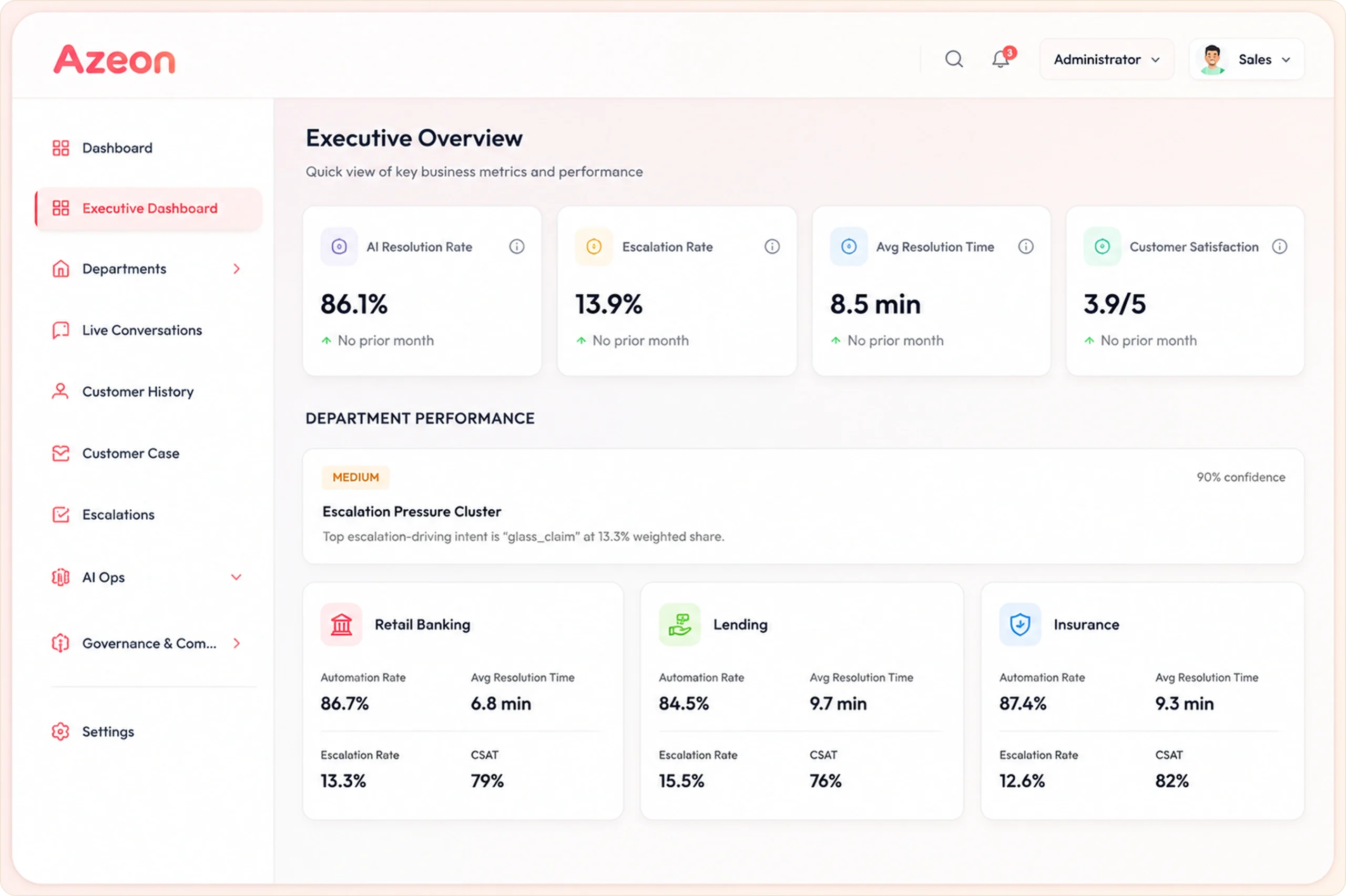
Azeon Executive Dashboard

Key Features:

  • Omnichannel Support: Support customer interactions across chat, email, voice, and ticketing channels.
  • Shared Customer Memory: Maintain customer history, previous interactions, and account context across conversations.
  • Human-in-the-Loop Governance: Enable approvals and oversight for sensitive financial actions.
  • Context-Aware Escalations: Transfer conversation history, customer information, and recommended next steps during handoffs.
  • Workflow Automation & Execution: Perform actions across CRM, billing, support, and operational systems.
  • AI Reasoning Engine: Understand customer intent, urgency, and business context before responding.
  • Knowledge Integration: Connect product documentation, policies, FAQs, and internal knowledge sources.
  • Root Cause Analytics: Identify recurring customer issues, product gaps, and operational bottlenecks.
  • Auditability & Traceability: Maintain visibility into AI actions, decisions, and workflows.
  • Flexible Deployment Options: Support cloud, private cloud, and on-premises deployment requirements.
  • Extensive Integrations: Connect with CRM platforms, help desks, communication channels, and enterprise systems.
| Proven Results from Live Environments |

Measured Outcomes Across Production Deployments

Metric
Outcome
CSAT improvement (Retail case study)
3.7 → 4.8
Reduction in repeat contact rate
35%
Reduction in Average Handle Time (Logistics)
32%
Common queries resolved annually
250,000+
Ticket automation without SLA risk (SaaS)
96%
Customer Lifetime Value improvement
2X
Goal Completion Rate (GCR)
95%+
Semantic Accuracy
>92%
Guardrail Adherence
99.999%
Annual OpEx Reduction
Up to $250K

Pros:

  • Built for financial services and other high-volume support environments
  • Works with existing support infrastructure without replacing systems
  • Strong governance and auditability for regulated industries
  • Supports cloud and on-prem deployment requirements
  • Enables context-aware customer experiences across channels
  • Outcome-based pricing aligned with business value

Cons:

  • Enterprise deployments may require implementation planning
  • Advanced workflows benefit from integration with existing systems

Pricing:

Azeon follows a Result-as-a-Service pricing model, where organizations pay based on successfully resolved customer issues rather than seats, AI tokens, conversation volume, or API consumption.

This aligns costs directly with business outcomes and customer resolutions.

David Pridgen
David Pridgen
Solution Consultant

Bring Agentic AI to Your Financial Support Operations

Modernize customer support across chat, email, voice, and ticketing channels with Azeon's enterprise-grade AI platform.

Book a Personalized Demo →

2. Cognigy

Best for: Large-scale banking contact centers and enterprise customer service operations.

Overview:

Cognigy is an enterprise conversational AI platform used by organizations seeking automation across customer support channels. The platform supports voice and chat experiences while integrating with enterprise systems and contact center infrastructure.

Financial institutions often choose Cognigy for large-scale deployments where customer interactions span multiple channels and languages. Its AI capabilities support automation while maintaining escalation paths to human agents when required.

Key Features:

  • Conversational AI workflows
  • Voice automation
  • Omnichannel support
  • CRM integrations
  • Contact center integrations
  • Analytics dashboard
  • Multilingual capabilities
  • Workflow orchestration

Pros:

  • Strong enterprise capabilities
  • Good contact center integrations
  • Supports voice AI
  • Scalable deployments
  • Multilingual support
  • Mature platform

Cons:

  • Enterprise implementation can be complex
  • Pricing may be high for smaller teams
  • Requires configuration expertise

Pricing:

Pricing is not publicly available.

3. Kore.ai

Best for: Enterprise banking automation and digital transformation initiatives.

Overview:

Kore.ai offers conversational AI and virtual assistant capabilities designed for enterprises across industries, including financial services. The platform supports customer service automation, employee experiences, and workflow orchestration.

Banks and financial institutions often adopt Kore.ai for use cases such as account servicing, customer onboarding, and digital support channels. Its enterprise focus and compliance features make it a strong option for regulated industries.

Key Features:

  • Conversational AI platform
  • Virtual assistants
  • Workflow automation
  • Omnichannel support
  • Analytics and reporting
  • Enterprise integrations
  • Low-code tools
  • Security controls

Pros:

  • Strong enterprise presence
  • Broad automation capabilities
  • Supports regulated industries
  • Flexible deployment options
  • Extensive integrations
  • Advanced analytics

Cons:

  • Learning curve for administrators
  • Enterprise pricing structure
  • Implementation may require specialist teams

Pricing:

Custom pricing based on deployment requirements.

4. Amelia

Best for: Financial institutions seeking conversational banking experiences and customer self-service automation.

Overview:

Amelia has long been recognized in the enterprise AI market for its conversational AI capabilities across regulated industries. The platform enables banks, insurance companies, and financial institutions to automate customer interactions while maintaining consistent service experiences across digital channels.

Financial organizations often use Amelia for customer onboarding, account inquiries, payment assistance, and support automation. Its conversational capabilities help institutions handle high interaction volumes while allowing human agents to focus on complex cases that require specialized expertise.

Key Features:

  • Conversational AI for banking workflows
  • Natural language understanding capabilities
  • Customer self-service automation tools
  • Omnichannel communication support
  • Enterprise system integration framework
  • Automated customer authentication workflows
  • AI-powered knowledge retrieval engine
  • Real-time customer interaction analytics

Pros:

  • Strong conversational banking capabilities
  • Supports enterprise-scale deployments globally
  • Enables customer self-service journeys
  • Integrates with business systems
  • Suitable for regulated industries
  • Reduces repetitive support workloads

Cons:

  • Custom implementations can be lengthy
  • Enterprise pricing may be expensive
  • Advanced features require configuration

Pricing:

Custom enterprise pricing available upon request.

5. IBM watsonx Assistant

Best for: Highly regulated financial institutions requiring enterprise-grade AI governance.

Overview:

IBM watsonx Assistant is designed for organizations operating under strict regulatory environments where explainability, security, and governance are critical. Financial institutions frequently leverage IBM’s enterprise AI ecosystem for customer support and workflow automation initiatives.

The platform supports AI-driven customer interactions while allowing organizations to maintain control over data, infrastructure, and model deployment. Banks with complex compliance requirements often prefer IBM because of its enterprise heritage and extensive security capabilities.

Key Features:

  • Enterprise-grade AI governance controls
  • Hybrid cloud deployment flexibility
  • Advanced security and encryption features
  • Banking workflow automation capabilities
  • Natural language processing engine
  • Integration with enterprise systems
  • AI analytics and reporting tools
  • Customizable conversational experiences

Pros:

  • Strong compliance and security posture
  • Trusted enterprise technology provider
  • Supports hybrid deployment models
  • Extensive enterprise integration ecosystem
  • Scalable for large institutions
  • Strong governance and monitoring

Cons:

  • Can require significant implementation effort
  • Complex for smaller organizations
  • Pricing varies by deployment

Pricing:

Custom pricing based on enterprise requirements.

  • Freddy AI Copilot: Approximately $29/agent/month

6. Salesforce Agentforce

Best for: Financial institutions already using Salesforce ecosystems.

Overview:

Salesforce Agentforce extends AI capabilities across CRM-driven customer support workflows. Organizations using Salesforce Financial Services Cloud can leverage Agentforce to automate support interactions while maintaining customer context and relationship history.

Financial institutions benefit from the platform’s native CRM integration, enabling support teams to access customer information, case history, and financial data from a unified environment. This approach helps improve service consistency and operational efficiency.

Key Features:

  • Native Salesforce ecosystem integration
  • Customer data unification capabilities
  • AI-driven support automation workflows
  • Case management and routing
  • Omnichannel customer engagement support
  • Workflow automation and approvals
  • Enterprise analytics and reporting
  • Secure financial services deployment

Pros:

  • Deep integration with Salesforce products
  • Unified customer data visibility
  • Strong workflow automation capabilities
  • Enterprise-grade security framework
  • Familiar interface for teams
  • Extensive partner ecosystem support

Cons:

  • Best suited for Salesforce customers
  • Licensing costs may increase
  • Customization can become complex

Pricing:

Enterprise pricing based on Salesforce licensing.

7. Yellow.ai

Best for: Organizations seeking omnichannel customer engagement across financial services.

Overview:

Yellow.ai provides conversational AI solutions that support customer engagement across multiple communication channels. Financial institutions use the platform to automate customer service interactions while maintaining continuity across chat, voice, and messaging platforms.

The platform’s omnichannel capabilities make it attractive for organizations serving diverse customer bases across regions and languages. Its automation capabilities help improve responsiveness and support efficiency.

Key Features:

  • Omnichannel customer engagement platform
  • AI-powered voice automation tools
  • Multilingual customer support capabilities
  • CRM and enterprise integrations
  • Workflow automation and routing
  • Customer analytics and insights
  • No-code bot building tools
  • AI-assisted agent productivity features

Pros:

  • Strong omnichannel communication support
  • Supports multiple global languages
  • Flexible deployment for enterprises
  • Good automation capabilities overall
  • User-friendly interface and tools
  • Broad integration ecosystem available

Cons:

  • Financial-specific capabilities may vary
  • Enterprise pricing requires consultation
  • Complex workflows need configuration

Pricing:

Custom pricing based on business requirements.

8. Zendesk AI

Best for: Organizations already using Zendesk customer support infrastructure.

Overview:

Zendesk AI extends the Zendesk ecosystem with automation capabilities designed to improve customer support efficiency. Financial institutions using Zendesk can leverage AI features to automate responses, route tickets, and assist support teams.

The platform is often selected by organizations seeking to enhance existing customer support operations without replacing established workflows and support processes.

Key Features:

  • AI-powered ticket routing automation
  • Customer support workflow management
  • Omnichannel customer communication tools
  • Knowledge base integration capabilities
  • Agent assistance and recommendations
  • Reporting and analytics dashboards
  • CRM and application integrations
  • Customer self-service experiences

Pros:

  • Easy integration with Zendesk
  • Familiar experience for support teams
  • Fast deployment for existing users
  • Strong ticket management capabilities
  • Good ecosystem of integrations
  • Reliable customer support platform

Cons:

  • Limited banking-specific AI features
  • Enterprise functionality varies by plan
  • Advanced AI may require upgrades

Pricing:

Tiered pricing with enterprise options available.

9. Intercom Fin AI

Best for: Digital-first FinTech companies and SaaS financial platforms.

Overview:

Intercom Fin AI focuses on AI-powered customer support for digital businesses. Fintech organizations often use the platform to automate customer conversations while maintaining fast response times and high customer satisfaction.

Its modern interface and conversational capabilities make it suitable for digital products that prioritize self-service experiences and scalable support operations.

Key Features:

  • AI-powered customer support automation
  • Automated knowledge base retrieval
  • Customer conversation management tools
  • Omnichannel messaging capabilities
  • Workflow automation and routing
  • Customer support analytics platform
  • Agent productivity enhancement features
    Integration with business applications

Pros:

  • Modern and intuitive user experience
  • Fast deployment for digital teams
  • Strong self-service capabilities available
  • Good conversational AI performance
  • Suitable for fintech startups
  • Supports scalable customer support

Cons:

  • Limited enterprise banking focus
  • Advanced features increase costs
  • Complex workflows may need customization

Pricing:

Usage-based pricing with enterprise plans.

  • Premium: Custom pricing

10. NICE CXone Mpower

Best for: Enterprise financial institutions operating large contact centers.

Overview:

NICE CXone Mpower is a customer experience platform designed for large-scale contact center operations. Banks and financial institutions frequently use NICE to manage customer interactions across voice, digital channels, and support operations.

The platform combines AI capabilities with workforce optimization and analytics, making it attractive for organizations seeking comprehensive customer service infrastructure.

Key Features:

  • Enterprise contact center management
  • AI-powered customer interaction routing
  • Workforce optimization and planning
  • Omnichannel customer support capabilities
  • Advanced analytics and reporting
  • Voice and digital channels
  • Compliance monitoring and auditing
  • Enterprise integration capabilities

Pros:

  • Strong enterprise contact center tools
  • Supports complex financial operations
  • Advanced analytics and monitoring
  • Scales for large institutions
  • Comprehensive workforce management features
  • Mature enterprise customer experience platform

Cons:

  • Implementation can be resource-intensive
  • Enterprise pricing may be high
  • Requires dedicated administration teams

Pricing:

Custom enterprise pricing based on deployment size.

How to Choose the Right AI Agent for Financial Customer Support?

Selecting the best AI agent for financial customer support requires more than evaluating automation capabilities.

Financial institutions must balance customer experience, compliance, security, and operational efficiency while choosing a platform that can scale with future needs.

Compliance and Security

Financial institutions handle highly sensitive customer data and operate under strict regulations.

Choose an AI agent that provides encryption, audit trails, role-based access controls, and governance frameworks to support regulatory requirements and customer trust.

Banking and Financial Integrations

An AI agent delivers greater value when it integrates seamlessly with CRMs, core banking systems, payment gateways, and support platforms.

Strong integrations enable faster resolutions by giving AI access to the data and systems it needs.

Human-in-the-Loop Controls

Not every customer interaction should be fully automated.

Look for platforms that support approvals, escalations, and human oversight for high-risk actions such as account changes, refunds, or dispute resolutions.

Omnichannel Customer Experience

Customers interact across chat, email, voice, and mobile apps.

The right AI agent should maintain context across channels so customers receive a consistent and connected support experience.

Deployment Flexibility

Every financial institution has unique infrastructure and security requirements.

Platforms that support cloud, private cloud, or on-prem deployments provide greater flexibility for enterprise adoption.

Scalability and Performance

Support volumes can fluctuate significantly during peak periods.

Choose an AI agent solution that can handle large volumes of interactions while maintaining accuracy, speed, and service quality.

Pricing and Business Value

Evaluate how pricing scales as customer interactions grow.

Transparent pricing models aligned with business outcomes can help organizations achieve stronger long-term returns on their AI investments.

Final Verdict

Many platforms in this list excel in specific areas. Some offer strong conversational AI, others provide contact center capabilities or deep CRM integrations. However, financial institutions operate in highly regulated environments where security, auditability, and governance are just as important as automation.

This is where Azeon differentiates itself.

Rather than functioning as another chatbot layer, Azeon acts as an intelligence layer on top of your existing support ecosystem. It combines agentic AI with deterministic execution, enabling financial institutions to automate customer support while maintaining complete operational control.

Perhaps most importantly, Azeon does this without requiring organizations to replace their existing infrastructure. Financial institutions can modernize support operations, improve customer experiences, and scale efficiently while preserving the systems they already trust.

For banks, NBFCs, and FinTech companies searching for the best AI agents for financial customer support, Azeon offers a rare combination of intelligence, compliance, flexibility, and enterprise readiness.

Ready to Build the Future of Financial Customer Support?

See how Azeon helps banks, NBFCs, and FinTech companies modernize support while maintaining compliance and control.

FAQs

What are AI agents for financial customer support?

AI agents for financial customer support are intelligent systems that can understand customer intent, retrieve information from multiple business systems, and automate support workflows across chat, email, and voice channels. Unlike traditional chatbots, AI agents can maintain context, assist with complex requests, and support human agents.

What is the difference between AI agents and chatbots in banking?

Traditional chatbots typically follow predefined rules and scripted responses, which can limit their ability to handle complex financial interactions. AI agents use reasoning, contextual understanding, and system integrations to resolve customer requests more effectively. In banking environments, AI agents can assist with account inquiries, payment disputes, onboarding processes, and escalations while maintaining continuity across interactions.

How do banks use AI agents for customer support?

Banks use AI agents to automate routine inquiries, support account servicing, manage customer onboarding, assist with payment-related questions, and route complex cases to human agents. AI agents help reduce wait times and improve service quality while enabling support teams to focus on high-value interactions.

Are AI agents compliant with financial regulations?

Enterprise AI platforms often include capabilities such as audit logs, encryption, role-based access controls, and governance frameworks that support compliance requirements. Financial institutions should evaluate each vendor’s security architecture and deployment options based on their regulatory obligations. Human-in-the-loop controls and traceable workflows are particularly valuable in regulated environments.

Can AI agents integrate with existing banking systems?

Yes. Most enterprise AI platforms provide APIs and integrations with CRMs, help desks, payment gateways, core banking systems, and other business applications. Strong integrations enable AI agents to access relevant customer information and execute workflows efficiently. This allows financial institutions to modernize customer support while preserving existing technology investments.

David works closely with enterprise organizations to help them modernize customer support operations through AI-driven automation. With experience in strategic account management, customer engagement, and technology consulting, David focuses on aligning business objectives with scalable support solutions that improve efficiency, customer experience, and operational performance.

David Pridgen
Solution Consultant

Questions about Azeon?

Connect with our team to explore use cases, workflows, and deployment possibilities.