Skip to content

Why Customer Service AI Agents Need Customization?

Why Customer Service AI Agents Need Customization?

Every customer service team follows its own playbook. Refund approvals, escalation paths, SLAs, compliance requirements, and system integrations vary from one organization to another. Yet many AI agent platforms promise a universal solution that works out of the box.

In practice, enterprise AI agents create value when they adapt to existing customer service operations rather than requiring teams to redesign their processes.

This article explores why customization has become a critical capability for enterprise customer service AI and what decision-makers should evaluate before choosing a platform.
Where Generic AI Agents Fall Short?

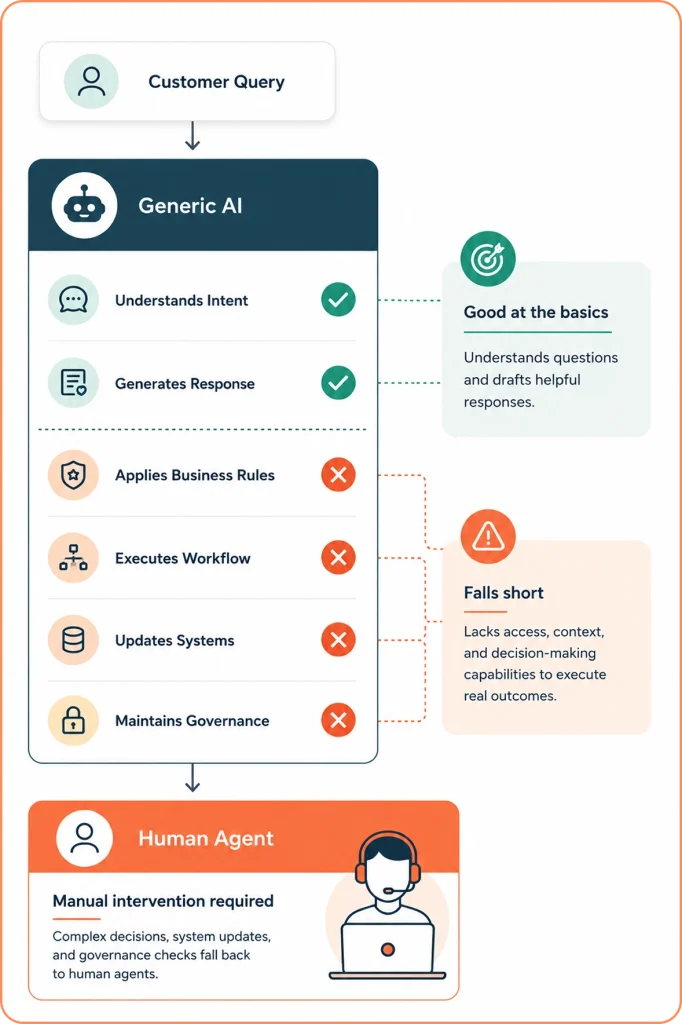
Modern AI agents can understand natural language, summarize interactions, identify customer intent, and provide relevant responses with impressive accuracy.

However, enterprise customer service extends well beyond conversation.

It requires decision-making, execution, and consistency.

This is where many generic AI agents begin to show limitations.

Generic AI Agent

Enterprise Workflows are Dynamic, Not Predefined

Many AI agent platforms rely on predefined intents, static workflows, or low-code orchestration.

While these approaches work for predictable scenarios, enterprise customer service often introduces exceptions that change the execution path in real time.

A refund request may require different actions based on customer lifetime value, regional policies, payment method, fraud signals, or inventory availability.

When these conditions are difficult to model, organizations either simplify their workflows or introduce manual intervention, which reduces the overall automation rate.

Customer Context is Difficult to Standardize

Most enterprise systems expose customer information differently.

CRM platforms, billing systems, ticketing software, ERP applications, and product databases often use different data models, APIs, permissions, and update cycles.

Generic AI agents usually retrieve information from these systems independently rather than reasoning across them.

As a result, the AI may answer using incomplete context or require additional human validation before taking action.

Enterprise Knowledge Changes Faster than AI Models

Customer support knowledge is constantly evolving through new policies, product updates, regulatory requirements, operational playbooks, and exception-handling procedures.

Generic AI agents often depend on periodically updated knowledge sources, making it difficult to reflect these operational changes consistently.

A customizable AI agent in customer service can align with evolving business knowledge without requiring teams to redesign the entire support experience.

Business Logic Cannot be Generalized Across Enterprises

Enterprise customer service decisions depend on organization-specific rules that AI models cannot infer automatically.

Eligibility criteria, approval matrices, SLA calculations, escalation conditions, and compliance requirements are unique to each business.

Unless these rules become part of the AI agent’s decision-making process, the agent remains limited to recommending actions rather than executing them with confidence.

Execution is Where Most AI Agent Projects Lose Momentum

Generating accurate responses has become a baseline capability.

The greater challenge begins when AI needs to execute business operations across enterprise systems while maintaining governance, traceability, and policy compliance.

This execution layer often determines whether AI reduces operational effort or simply shifts work from customers to human agents.

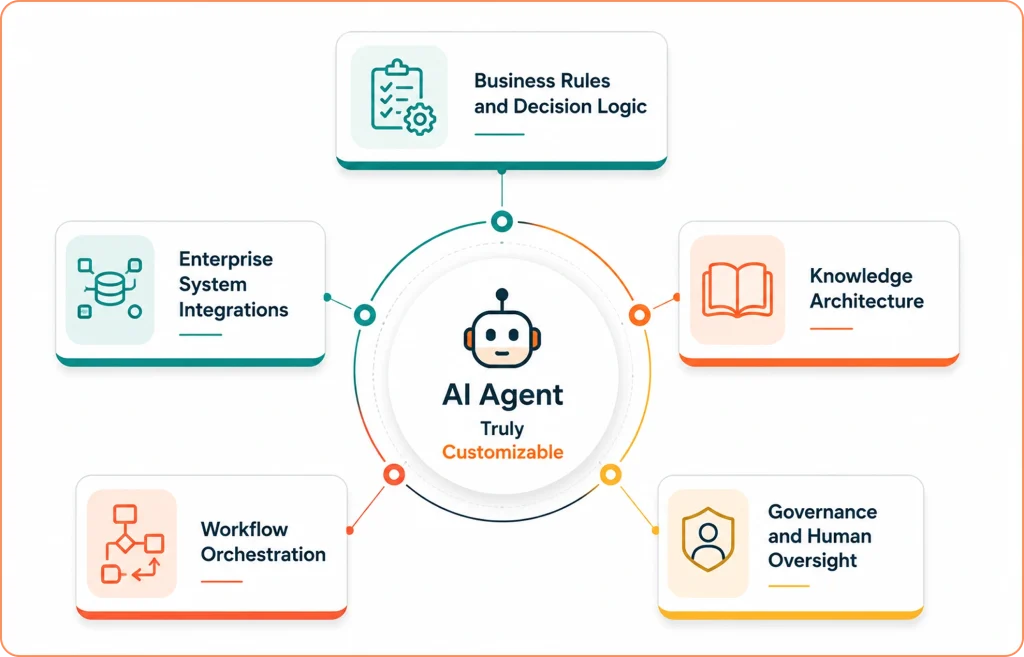
What Makes an AI Agent Truly Customizable?

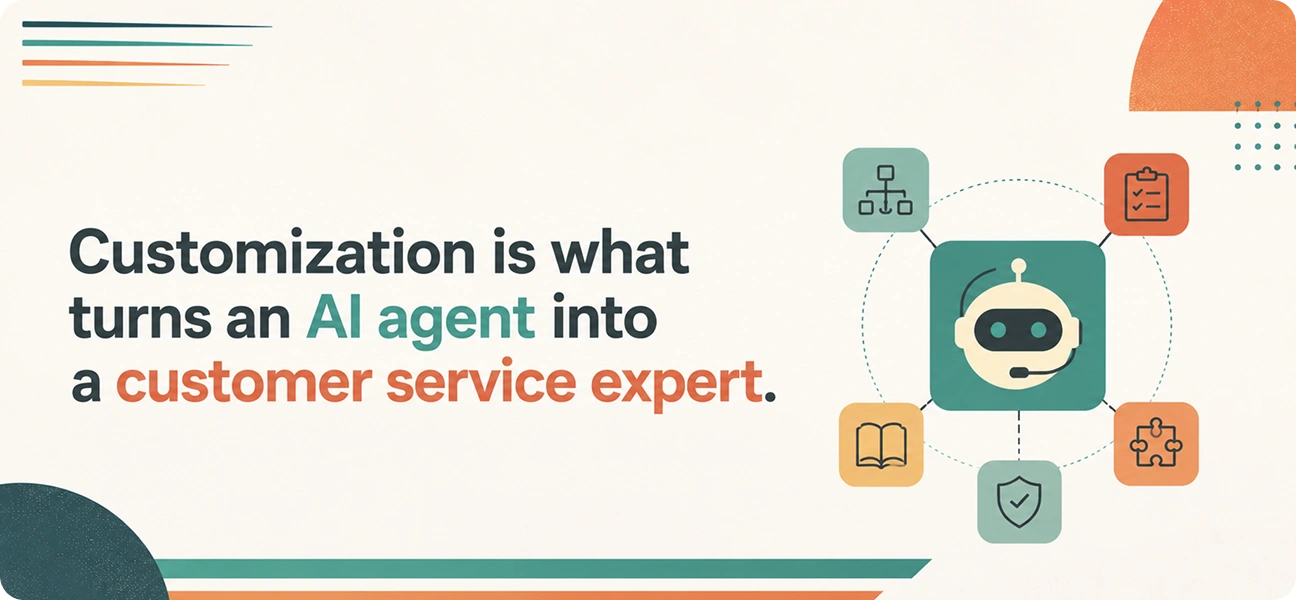
The following capabilities determine whether an AI agent is genuinely customizable or simply configurable.

What Makes an AI Agent Truly Customizable

Business Rules and Decision Logic

Every customer service organization operates on a unique set of business rules.

These rules determine who qualifies for a refund, when an issue should be escalated, how SLAs are calculated, or which approvals are required before taking action.

A customizable AI agent should allow these decision frameworks to become part of its reasoning process, ensuring responses and actions remain consistent with company policies instead of relying solely on model-generated suggestions.

Enterprise System Integrations

Most enterprise platforms expose different APIs, authentication methods, permission models, and data structures.

A CRM may identify a customer using an account ID, while the billing platform references a subscription number and the ERP uses an order ID.

An AI agent must reconcile these differences before it can retrieve context or execute actions.

Customization enables enterprises to define these mappings, allowing the AI agent to operate across systems without creating data inconsistencies or fragmented customer experiences.

Knowledge Architecture

Enterprise knowledge is rarely centralized. Product documentation may reside in a CMS, troubleshooting guides in SharePoint, compliance policies in Confluence, and operational procedures in internal repositories.

These sources follow different update cycles, ownership models, and access controls.

A customizable AI agent should allow organizations to decide which repositories become authoritative for different use cases while preserving governance over sensitive information.

Workflow Orchestration

Enterprise workflows are event-driven rather than conversation-driven.

A customer request often initiates a sequence of API calls, validations, approvals, and downstream updates before the issue is considered resolved.

The execution path changes dynamically based on operational conditions, making rigid workflow templates difficult to scale.

Customization allows organizations to orchestrate these processes using their existing operational logic instead of redesigning workflows around the limitations of the AI platform.

Governance and Human Oversight

Not every decision carries the same operational or regulatory risk. An address update and a loan restructuring request require completely different levels of oversight.

Enterprises therefore need the ability to define confidence thresholds, approval checkpoints, exception handling, and audit requirements that determine when AI can act autonomously and when human intervention becomes mandatory.

These governance policies should be configurable independently of the underlying language model.

Looking for Customizable AI Agents for Customer Service?

Explore how Azeon can fit into your workflows, integrations, and operational goals.

Book Your Demo →

What Should Enterprises Customize in Customer Service AI Agents?

Below are the capabilities enterprises should evaluate before deploying AI agents in production.

Decision Layer

The first thing to customize isn’t the AI’s tone or prompts – it’s the decision-making criteria behind every customer request.

Define when refunds should be approved, which customer tiers qualify for exceptions, how SLA priorities are calculated, what conditions trigger approvals, and which policies take precedence when rules conflict.

If these business rules remain outside the AI agent, human teams will continue validating every important decision.

Context Layer

Don’t rely on a single customer profile.

Configure the AI agent to retrieve only the information required for each use case, whether that’s recent orders, subscription status, open tickets, warranty details, payment history, or previous interactions.

Equally important is deciding which system becomes the source of truth when different applications return conflicting customer data.

Knowledge Layer

Instead of exposing every document to the AI, determine which knowledge repositories should be used for different types of requests.

For example, product troubleshooting may come from technical documentation, while refund decisions should reference internal policy documents.

Separating authoritative knowledge sources improves response quality and reduces the risk of AI relying on outdated or irrelevant information.

Execution Layer

Don’t stop at deciding what the AI should do – define how it should do it.

Specify which APIs should be called, in what sequence, which validations must complete first, when actions should be retried, and what should happen if one system fails during execution.

These operational details determine whether an AI agent resolves issues autonomously or hands them back to support teams.

Governance Layer

Different customer requests require different levels of autonomy.

Allow the AI to complete low-risk actions such as updating contact details automatically, while routing high-value refunds, financial adjustments, or compliance-sensitive requests through predefined approval workflows.

Customizing governance ensures automation expands without compromising operational control.

Deployment Layer

Deployment shouldn’t force infrastructure changes.

Choose where the AI agent runs based on security, compliance, latency, and data residency requirements.

Whether deploying in the cloud, private cloud, or on-premises, the architecture should integrate with existing enterprise environments rather than introducing unnecessary operational complexity.

The Business Benefits of Customizable AI Agents for Customer Service

Customization offers multiple advantages for all involved in the customer service operations.

Faster Time-to-Value

AI agents aligned with existing workflows require fewer operational workarounds after deployment, helping organizations achieve production readiness faster.

Higher Resolution Rates

When AI understands business rules, customer context, and operational workflows, it can resolve a larger percentage of customer requests without requiring unnecessary escalations.

Consistent Policy Execution

Embedding organizational policies into AI decision-making helps deliver consistent resolutions across teams, channels, and customer interactions while reducing variability caused by manual processes.

Greater Operational Efficiency

Customizable AI agents eliminate repetitive coordination between disconnected systems, allowing support teams to focus on higher-value customer interactions instead of administrative work.

Long-Term Scalability

Customer service operations evolve continuously. A customizable AI architecture enables organizations to introduce new products, workflows, integrations, and policies without replacing their AI platform or redesigning existing automations.

Custom AI Agents vs Configurable AI Agents: What’s the Difference?

Many AI vendors use the terms configurable and customizable interchangeably. While they may sound similar, they represent two very different implementation approaches.

A configurable AI agent typically allows organizations to adjust predefined settings such as prompts, FAQs, conversation flows, or basic integrations. These capabilities are valuable for straightforward support operations where customer interactions follow predictable patterns.

A customizable AI agent goes much deeper. It adapts to the organization’s operational model by incorporating business rules, enterprise workflows, system integrations, governance policies, customer journeys, and deployment preferences. Instead of asking the business to fit the platform, the platform fits the business.

For enterprise customer service teams, this distinction becomes increasingly important as AI takes on more operational responsibility.

Capability Configurable AI Agents Customizable AI Agents
Business Rules Supports predefined conditions with limited flexibility. Adapts to organization-specific policies, approval logic, SLAs, and operational rules.
Knowledge Primarily relies on uploaded FAQs and knowledge articles. Learns from internal documentation, playbooks, product guides, policies, and enterprise knowledge sources.
Workflow Automation Automates predefined workflows with minimal variation. Executes dynamic workflows based on business conditions, customer context, and operational logic.
Enterprise Integrations Retrieves information from connected systems. Retrieves, updates, and executes actions across CRM, ERP, ticketing, billing, and enterprise applications.
Escalation Logic Uses standard routing or confidence-based escalation. Supports custom escalation paths based on customer value, policies, risk, or business priorities.
Governance Provides basic access controls and permissions. Supports custom approval workflows, audit trails, role-based governance, and compliance policies.
Deployment Options Often limited to SaaS deployment. Supports cloud, private cloud, and on-premises deployments based on enterprise requirements.
Long-Term Scalability Requires additional configuration or redesign as business processes evolve. Easily adapts to new products, workflows, regulations, and operational changes without rebuilding the AI agent.

Questions to Ask Before Choosing a Customer Service AI Agent Platform

Selecting an AI agent platform is a long-term operational decision. While product demonstrations often highlight conversational capabilities, enterprise success depends on how well the platform fits your business environment.

Here are several questions every decision-maker should ask during the evaluation process.

Can the AI Agent Adapt to Our Business Rules?

Your AI agent should be able to follow organization-specific eligibility criteria, approval processes, SLAs, and operational policies without requiring teams to simplify existing workflows.

How Much Customization is Available Beyond Prompts?

Evaluate whether the platform supports business logic, workflow orchestration, integrations, governance policies, customer journeys, and operational decision-making.

Can It Work with Our Existing Technology Stack?

Look for platforms that integrate with your CRM, ticketing software, ERP, billing systems, knowledge repositories, identity platforms, and communication channels while supporting both data retrieval and operational execution.

Which Deployment Options are Available?

Deployment flexibility has become increasingly important for organizations operating under security, privacy, or regulatory requirements.

If your organization has data residency obligations or strict governance policies, confirm whether the vendor provides on-premises AI agents deployment without compromising functionality.

How is Governance Managed?

Ask how approvals are handled, how decisions are audited, what permissions can be configured, and how the platform maintains transparency throughout the customer journey.

Who is Responsible for Implementation and Ongoing Optimization?

Many organizations underestimate the effort required to customize, train, integrate, test, and optimize AI agents.

Understanding who owns implementation, operational tuning, and continuous improvement can significantly influence both deployment timelines and long-term ROI.

How Azeon Delivers Customizable AI Agents for Customer Service

Azeon is an resolution-first AI agent for customer service.

Instead of offering a one-size-fits-all AI agent, Azeon delivers customizable AI agents that align with existing support operations.

Organizations can tailor AI agents to:

  • Business rules and operational policies
  • Customer service workflows
  • CRM, ERP, ticketing, and enterprise systems
  • Knowledge sources and internal documentation
  • Escalation paths and approval logic
  • Security, governance, and compliance requirements
  • Deployment preferences, including cloud and on-premises environments

What sets Azeon apart is that it aligns both the AI agent and the pricing model with business outcomes.

You get AI agents customized to your customer service operations and pricing tied to successful resolutions rather than platform consumption.

Connect with our team to explore how Azeon can deliver customizable AI agents tailored to your customer service workflows, enterprise systems, and business goals.

Discover Customizable AI Agents with Azeon

Explore AI agents designed for your workflows, integrations, and customer service goals.

Book Your Demo →

FAQs

Why are customizable AI agents important for customer service?

Customer service operations differ across every organization. Customizable AI agents allow businesses to tailor workflows, business rules, integrations, governance policies, and customer journeys so AI can operate according to existing processes rather than generic templates.

What can organizations customize in an AI agent for customer service?

Depending on the platform, organizations can customize business rules, workflow automation, CRM integrations, knowledge sources, escalation policies, governance controls, deployment models, and brand communication standards.

What is the difference between configurable and customizable AI agents?

Configurable AI agents usually support prompt editing, FAQs, and basic workflow settings. Customizable AI agents extend much further by adapting to enterprise workflows, operational logic, business systems, governance requirements, and organization-specific processes.

Can customizable AI agents integrate with existing customer service platforms?

Yes. Enterprise AI agents can integrate with CRM systems, ticketing platforms, ERP applications, billing software, knowledge bases, identity providers, and communication tools to retrieve customer context and execute operational workflows.

Can customizable AI agents be deployed on-premises?

Many enterprise AI platforms support multiple deployment options, including cloud, private cloud, and on-premises environments. This flexibility helps organizations meet security, compliance, and data residency requirements while maintaining control over customer information.

David works closely with enterprise organizations to help them modernize customer support operations through AI-driven automation. With experience in strategic account management, customer engagement, and technology consulting, David focuses on aligning business objectives with scalable support solutions that improve efficiency, customer experience, and operational performance.

David Pridgen
Solution Consultant

Questions about Azeon?

Connect with our team to explore use cases, workflows, and deployment possibilities.