
Skip to content

How On-Premises AI Agents in Customer Service Keep Data Secure?

How On-Premises AI Agents in Customer Service Keep Data Secure?

Customer service AI agents cannot resolve issues without customer data.

Whether an AI agent is checking an order status, processing a refund, verifying an account, or updating a customer profile, it requires access to multiple systems that contain sensitive information.

So, how is customer data protected while AI resolves those requests?

The answer depends largely on deployment architecture.

While cloud deployments are the right choice for many businesses, organizations operating under strict security policies, regulatory requirements, or data residency obligations frequently evaluate on-premises AI agents as part of their customer service strategy.

Let’s look at how on-premises AI agents in customer service protect data and why they have become an important choice.
Why AI Agents Need Access to Customer Data?

Imagine a customer contacts your support team because a payment has failed.

In a single interaction, the AI agent may securely access:

  • Customer profile
  • CRM records
  • Order history
  • Previous support tickets
  • Payment status
  • Product or subscription details
  • Internal knowledge articles
  • Business workflows

This access is what makes AI agents useful.

Without context, they become little more than question-answering tools.

With context, they can resolve customer issues from start to finish.

As AI agents become more capable, the amount of customer information they interact with also grows. That naturally brings greater responsibility for protecting that information.

Cloud is Secure. It Simply isn’t the Right Fit for Every Organization.

Cloud AI has helped thousands of organizations modernize customer service. It offers fast deployment, continuous updates, scalability, and lower infrastructure management.

For many businesses, especially those with distributed teams or fast-growing support operations, cloud deployment is an excellent choice.

Cloud providers also invest heavily in security, encryption, certifications, monitoring, and compliance programs.

There is nothing inherently less secure about cloud deployments.

The difference comes from business requirements.

Some organizations operate under regulations that define where customer information can be processed or stored. Others have internal security policies that require sensitive systems to remain within their own infrastructure. Some industries simply prefer greater operational control because of the type of customer information they manage every day.

In these situations, on-premises deployment becomes less about preference and more about meeting organizational requirements.

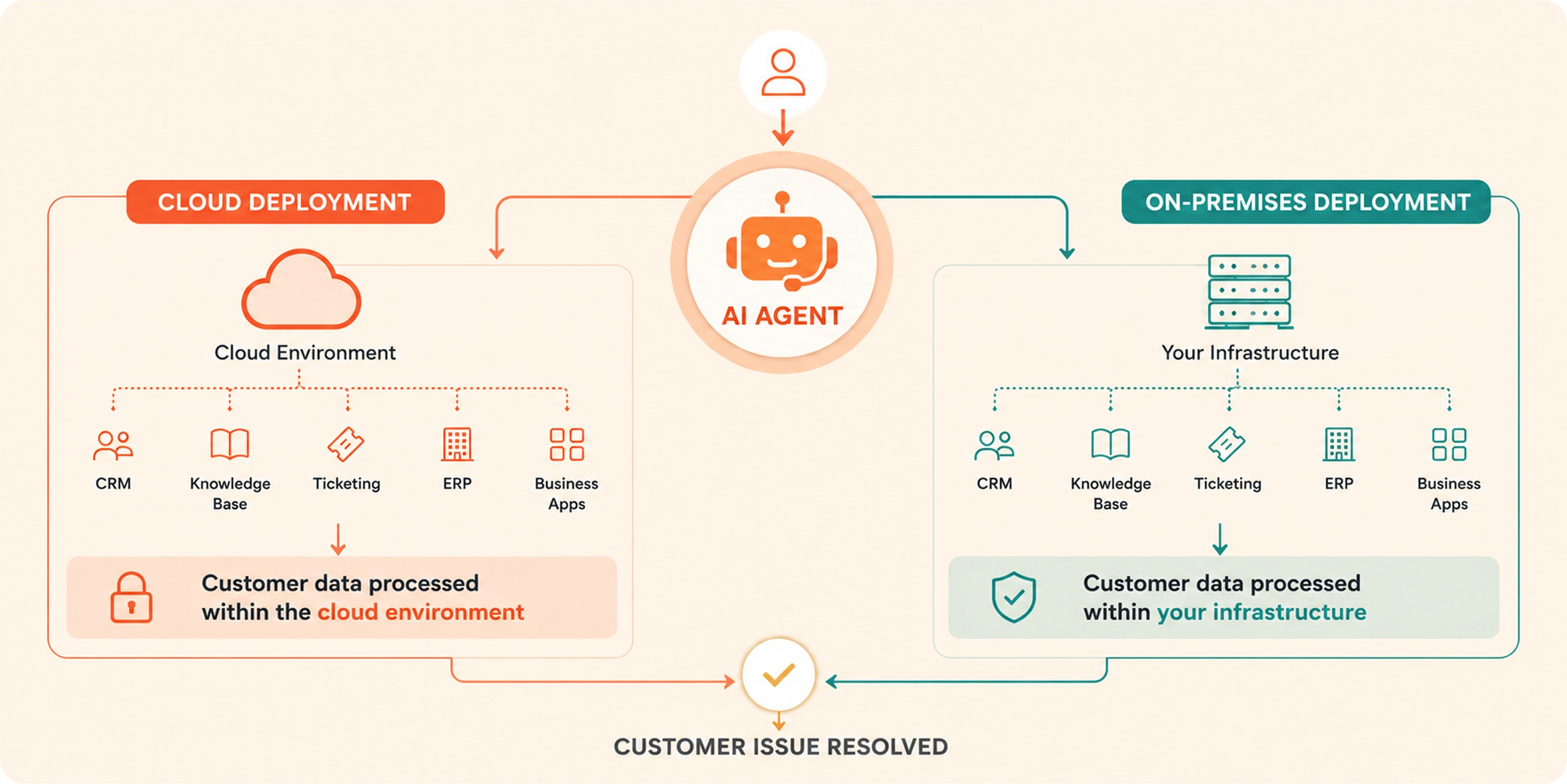
Here’s a simple demonstration of cloud vs on-premises.

Cloud vs On-premises AI agent for customer service

How On-Premises AI Agents in Customer Service Protect Data?

An on-premises deployment protects customer data by keeping AI operations inside the security boundaries your organization already manages.

Instead of introducing a separate environment for processing customer requests, the AI agent operates within your existing infrastructure and follows the same security controls already protecting your business applications.

Here are the key ways that happens.

Customer Data Stays Within Your Security Boundary

When an on-premises AI agent needs customer details, it retrieves them from systems that already exist inside your environment.

Your customer records, ticket history, payment information, and internal documentation remain under your organization’s governance.

For organizations with strict data residency or privacy requirements, this level of control is often essential.

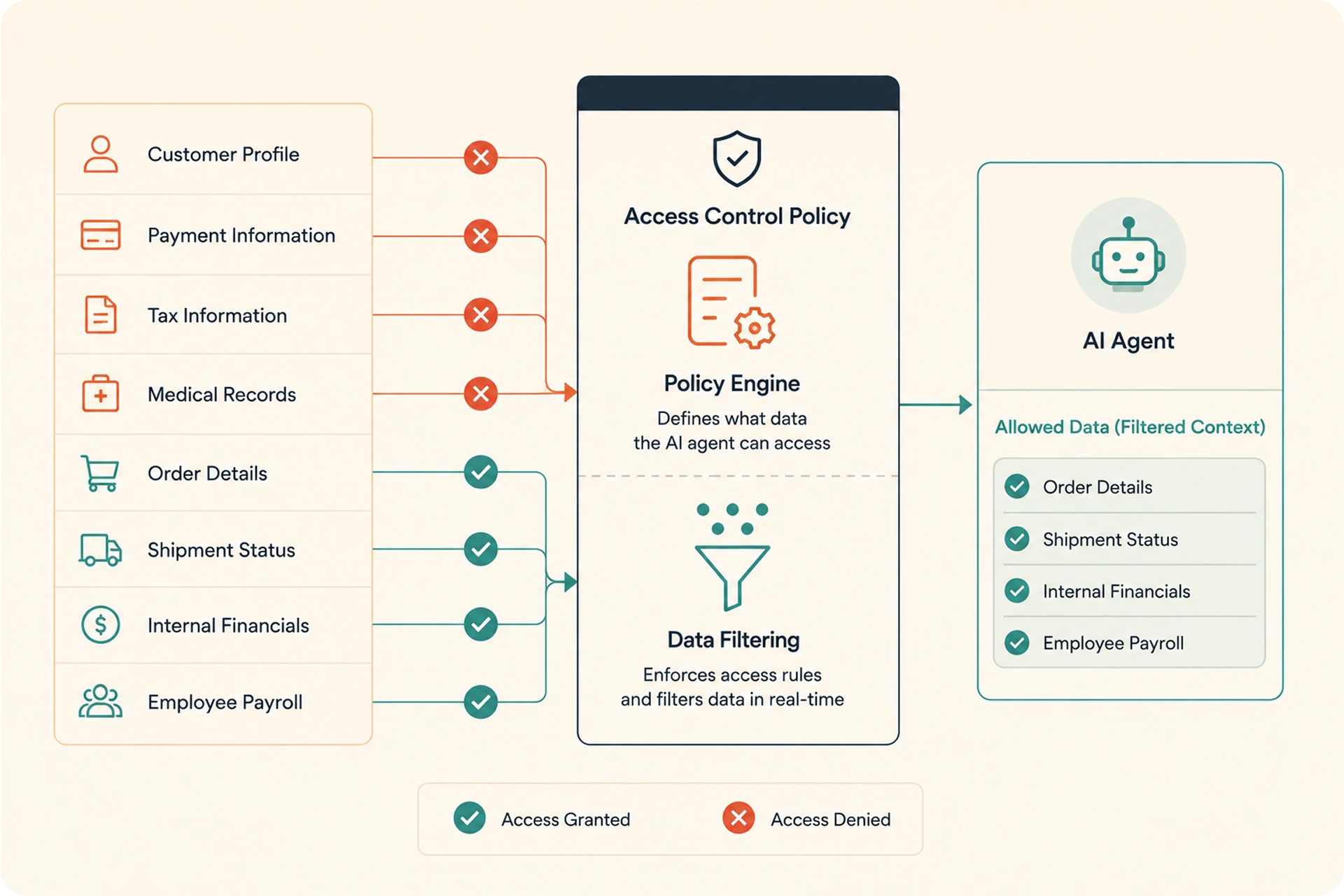
AI Access can be Restricted to Only the Data it Needs

An AI agent doesn’t need unrestricted access to every customer record.

Organizations can define exactly which systems, databases, APIs, or data fields the AI agent is allowed to access.

AI Access can be Restricted to Only the Data it Needs

For example, an AI agent handling delivery status may only retrieve:

  • Order ID
  • Shipment status
  • Estimated delivery date
  • Employee payroll

It doesn’t need access to payment information, customer tax records, or other sensitive data.

Applying the principle of least privilege reduces unnecessary exposure while allowing the AI agent to complete its task.

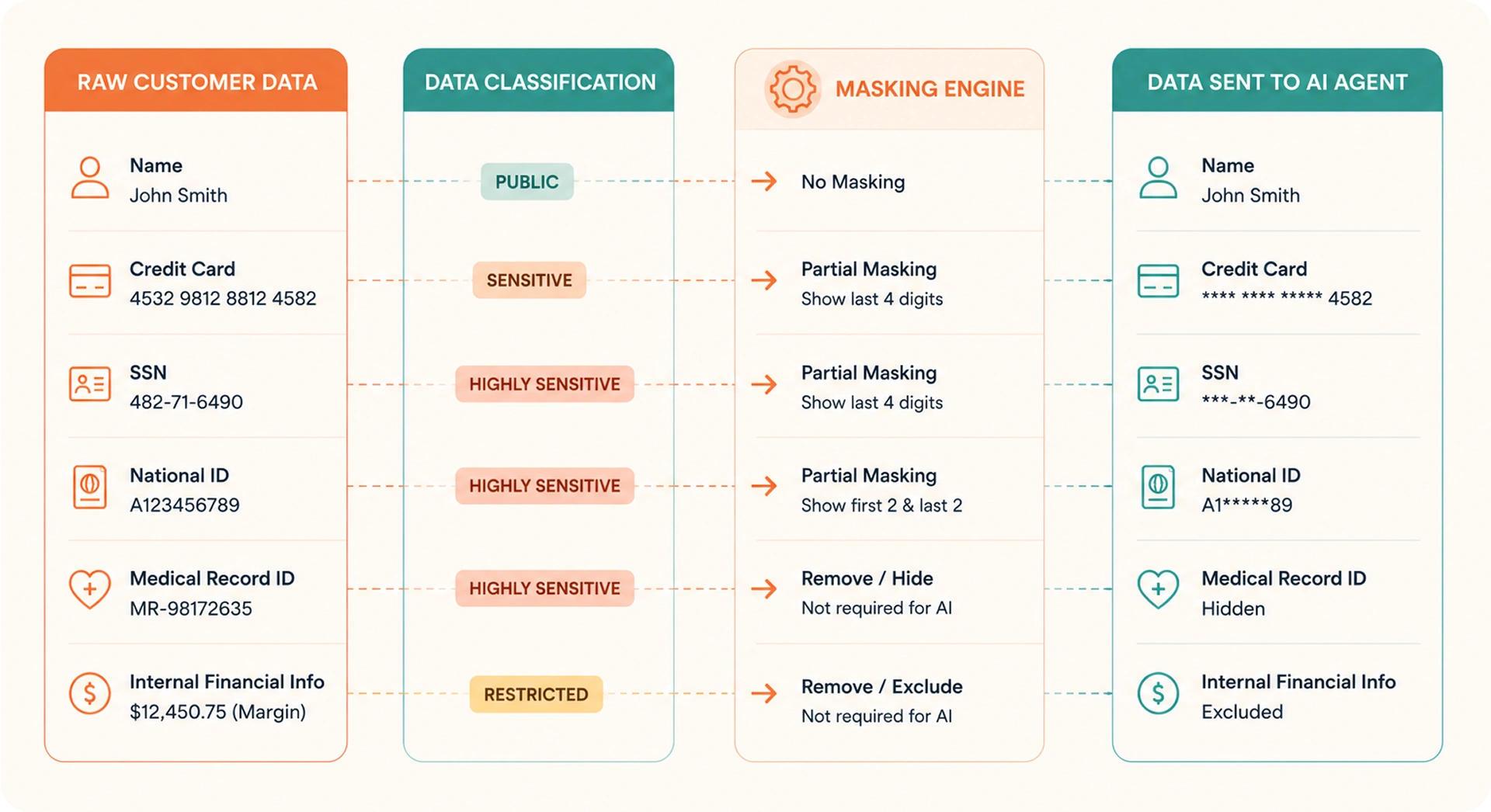
Sensitive Information can be Masked Before AI Processing

Not every piece of customer information is required to resolve a request.

Organizations can mask or redact sensitive fields before they reach the AI agent.

Sensitive Information can be Masked Before AI Processing

For example:

  • Credit card numbers become **** **** **** 4582
  • Social Security numbers remain hidden
  • National IDs are partially masked
  • Medical identifiers are removed
  • Internal financial information is excluded

The AI agent still has enough context to resolve the issue while reducing exposure to highly sensitive information.

Customer Data can be Encrypted Throughout the Entire Interaction

Enterprise environments already encrypt customer information when it is stored and when it moves between systems.

An on-premises AI agent in customer service operates within the same encrypted infrastructure.

This means customer information exchanged between the AI agent, CRM, ticketing platform, knowledge base, and other internal systems continues to follow the organization’s existing encryption standards rather than introducing separate communication paths.

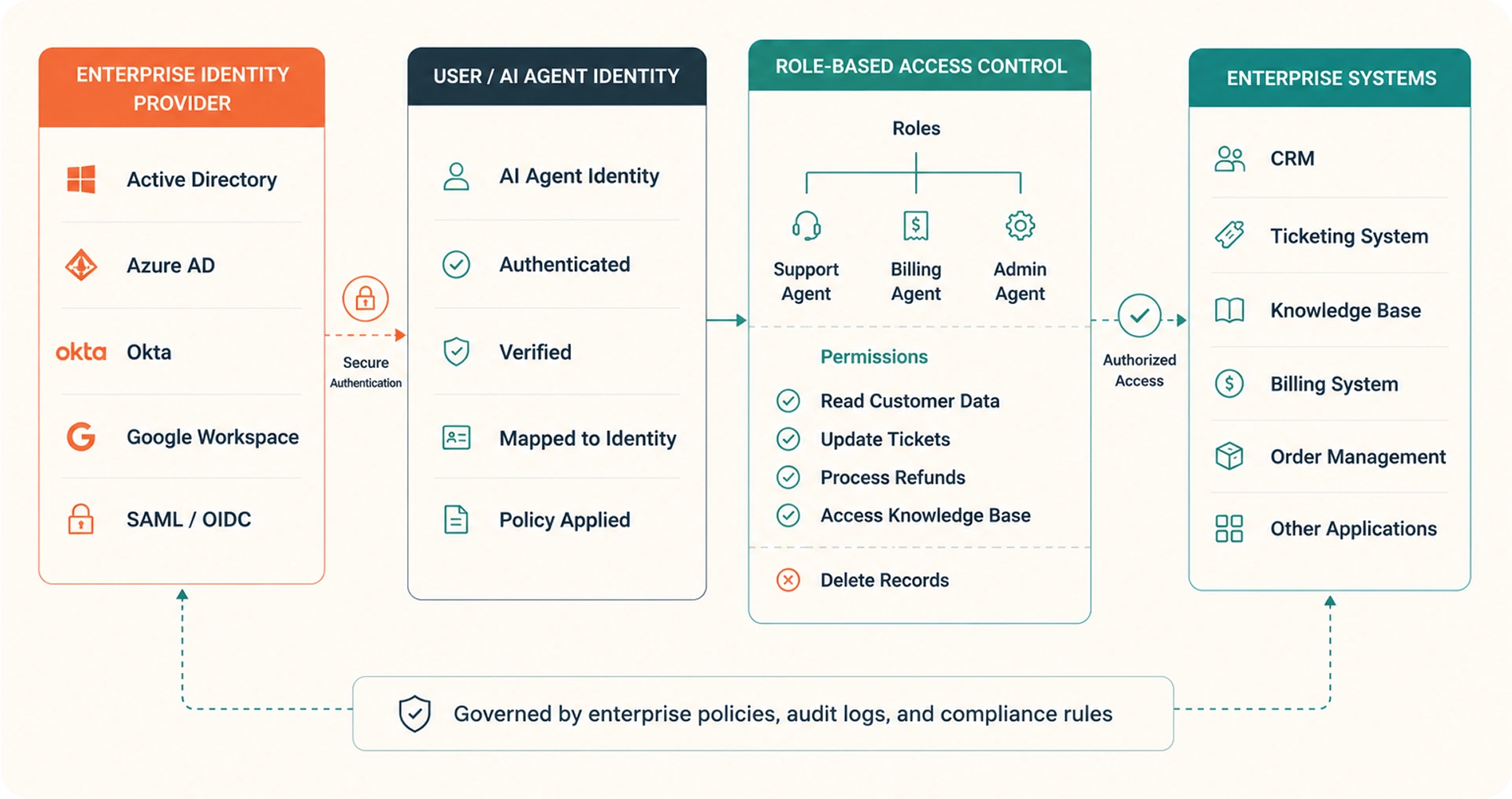
AI Operates Under Existing Identity and Access Policies

Every employee already authenticates through enterprise identity systems.

AI agents can follow the same approach.

Organizations can integrate AI agents with existing identity providers and role-based access controls so the AI only performs actions that align with approved permissions.

Rather than creating a separate security model for AI, organizations extend their existing identity framework to include AI agents.

Here’s a simple demonstration.

AI Operates Under Existing Identity and Access Policies

Security Teams Keep Full Operational Visibility

Because the AI agent operates within enterprise infrastructure, security teams can continue using existing monitoring, logging, vulnerability management, and incident response processes.

Instead of introducing another environment to monitor, AI activity becomes part of the organization’s existing security operations.

What Leaves Your Infrastructure – and What Doesn’t?

One of the biggest misconceptions about on-premises AI agents is that nothing ever leaves the organization’s infrastructure.

In reality, that depends on how the platform is designed and deployed.

A well-architected on-premises AI agent keeps sensitive customer information within your environment while giving your organization control over any data that may be shared externally.

For example, customer records, CRM data, ticket history, payment details, internal knowledge articles, authentication systems, and business workflows can all remain inside your infrastructure. The AI agent retrieves this information locally when it needs context to resolve a request.

Other components, such as software updates, model downloads, or anonymized telemetry, can be configured according to your organization’s security policies. Some enterprises allow these services to connect externally, while others manage updates through isolated networks or offline deployment packages.

The key difference is control.

Instead of relying on predefined vendor policies, your organization decides what leaves the environment, when it leaves, and under which security controls.

Where Does the AI Model Actually Run?

The answer depends on the deployment architecture.

In an on-premises deployment, the language model itself can run inside your organization’s own infrastructure using:

  • Dedicated servers
  • GPU clusters
  • Private AI environments

Customer requests are processed locally, which allows the AI agent to generate responses without sending customer conversations to external AI services.

Some organizations deploy open-weight models such as Llama or Mistral within their environment. Others choose commercially licensed models hosted in private infrastructure. Large enterprises may even support multiple models for different business units or customer service scenarios.

The important point is that the AI model becomes part of your enterprise architecture rather than an external service.

That gives your organization greater flexibility over model selection, upgrades, performance tuning, and security policies while maintaining control over where customer interactions are processed.

How do On-Premises Customer Service AI Agents Connect with Existing Systems?

Instead of storing customer data inside the AI model, an on-premises AI agent securely connects to the systems your business already uses.

That may include CRM platforms, ticketing systems, ERP applications, identity providers, billing platforms, internal APIs, document repositories, or knowledge bases.

When a customer asks a question, the AI agent retrieves only the information required for that request through secure APIs or database connections. Once the task is complete, the response is generated using that live business context.

This approach has two important advantages.

  • Customer information remains the single source of truth inside existing enterprise systems instead of being copied into multiple AI databases.
  • AI responses always reflect the latest customer information available rather than relying on outdated training data.

Can On-Premises AI Agents Use Multiple LLMs?

Choosing an on-premises deployment doesn’t limit organizations to a single AI model.

In fact, many enterprise architectures are designed to support multiple large language models depending on business requirements.

For example, one model may handle customer conversations, while another specializes in document summarization or multilingual support. Some organizations also maintain a private model for highly sensitive customer interactions while using another approved model for general service requests.

The AI agent acts as the orchestration layer.

Instead of exposing customer service teams to different AI models, it routes each request to the most appropriate model based on predefined policies.

This provides flexibility as AI technology continues to evolve. Organizations can evaluate new models, replace existing ones, or introduce specialized models without redesigning their customer service operations.

How are AI Models Updated in On-Premises Deployments?

Unlike cloud platforms where updates are often applied automatically, on-premises deployments give organizations control over when and how AI models are upgraded.

New model versions can be evaluated in staging environments before they are introduced into production. Security teams can validate the update, customer service teams can test response quality, and IT teams can confirm compatibility with existing integrations.

Only after these reviews are complete does the organization decide whether to deploy the new version.

This controlled update process reduces operational risk, particularly for customer service environments where even small changes in AI behavior can affect customer experience.

It also allows organizations to maintain version consistency across business units while meeting internal change management policies.

What Infrastructure is Required to Run an On-Premises AI Agent?

Running an AI agent on-premises doesn’t necessarily require building an AI data center from scratch.

The infrastructure requirements depend on the size of the deployment, the AI models being used, and the expected customer service volume.

Most enterprise deployments include:

  • Compute resources for AI inference
  • Secure storage for enterprise knowledge
  • Internal networking
  • Identity and access management
  • Monitoring and logging platforms
  • API gateways for enterprise integrations
  • Container orchestration platforms such as Kubernetes for scalability

These components often already exist within enterprise environments, which allows organizations to extend existing infrastructure rather than replacing it.

Where On-Premises AI Delivers the Greatest Value?

On-premises AI agents in customer service are particularly valuable when operations regularly process highly sensitive information.

Examples include:

  • Financial services handling payment information and account data.
  • Insurance organizations managing claims and policy information.
  • Healthcare providers processing patient communications.
  • Government agencies delivering citizen services.
  • Telecommunications providers managing subscriber information.
  • Large enterprise B2B support teams working with confidential customer records.

In these environments, infrastructure control often becomes part of broader operational governance.

Questions Buyers Should Ask Before Selecting an AI Agent Platform

Before selecting any AI agent platform for customer service, ask these questions.

  • Can the AI agent be deployed on-premises, in a private cloud, or in the public cloud?
  • Where is customer data processed during every interaction?
  • How does the platform integrate with our existing customer service systems?
  • Can our existing identity, access control, and security policies remain in place?
  • How are audit logs generated and retained?
  • Does the deployment model support our regulatory requirements?
  • Can the platform scale across multiple business units without changing our governance model?

These questions often reveal more about a platform’s readiness than a feature comparison alone.

Deploy Azeon AI Agents Without Compromising Customer Data

Azeon is a resolution-first AI agent platform built specifically for customer service.

It helps organizations automate customer interactions, execute support workflows, and resolve issues across existing support channels while meeting enterprise requirements for security, governance, and deployment flexibility.

Key capabilities of Azeon includes:

  • Deploy where your business requires – on-premises, private cloud, hybrid, or cloud deployment options.
  • Works with your existing support stack.
  • Supports role-based access control, encryption, audit logging, and identity providers.
  • Designed to align with your security, compliance, and data residency requirements.
  • Configure workflows, business rules, approvals, integrations, and escalation paths.
  • No seat-based pricing. No token-based pricing. Pay for only successful resolved outcomes.

If you’re evaluating on-premises AI agents for customer service or comparing deployment models, we’d be happy to discuss your requirements.

Experience Azeon with a Personalized Demo

Explore how Azeon helps automate customer service while keeping your data under your control.

Book Your Demo →

Operational FAQs About On-Premises AI Agents in Customer Service

Can an on-premises AI agent support multiple customer service channels?

Yes. An on-premises deployment does not limit communication channels. AI agents can support web chat, email, mobile apps, customer portals, messaging platforms, voice assistants, and contact center software while keeping customer data within the organization’s controlled environment.

Can enterprises customize on-premises AI agents for their own workflows?

Yes. Enterprise AI agents can be configured around existing customer service processes, approval workflows, business rules, escalation paths, and integrations. This allows organizations to adapt the AI agent to their operations instead of redesigning established support processes.

Can on-premises AI agents support multilingual customer service?

Yes. Most enterprise AI platforms support multiple languages using one or more language models. Organizations can provide localized customer experiences while applying the same security, governance, and deployment policies across every region.

Can an on-premises AI agent be deployed in a hybrid environment?

Yes. Many enterprises combine on-premises infrastructure with private or public cloud services. This allows organizations to keep sensitive customer data on-premises while using cloud resources for less sensitive workloads, analytics, or model development based on internal policies.

Can on-premises AI agents scale during seasonal spikes in customer support?

Yes. Organizations can scale compute resources and AI inference capacity based on expected demand. Many deployments use container orchestration and load balancing to maintain response times during periods of high customer activity without changing the deployment architecture.

David works closely with enterprise organizations to help them modernize customer support operations through AI-driven automation. With experience in strategic account management, customer engagement, and technology consulting, David focuses on aligning business objectives with scalable support solutions that improve efficiency, customer experience, and operational performance.

David Pridgen
Solution Consultant

Questions about Azeon?

Connect with our team to explore use cases, workflows, and deployment possibilities.