Skip to content

10 Leading AI Agents Solutions for Customer Support in 2026

10 Leading AI Agents Solutions for Customer Support in 2026

The market for AI-powered customer support is growing rapidly, with platforms offering everything from conversational automation to fully agentic support operations.

If you’re evaluating the leading AI agents solutions for customer support, this guide compares the top platforms based on capabilities, integrations, scalability, pricing, and overall fit for modern support teams.

Let’s explore the solutions leading the market in 2026.

Criteria We Used to Evaluate AI Agents Solutions for Customer Support

Every platform on this list offers AI-powered customer support capabilities, but their strengths vary significantly.

To identify the best AI agents solutions for customer support, we evaluated each platform based on the following criteria:

Agentic Intelligence

Can the platform understand customer intent, reason through requests, and take action rather than simply generating responses?

Customer Context & Memory

Does the solution maintain context across conversations, channels, and business systems to deliver more personalized support experiences?

Integration Ecosystem

How well does the platform connect with CRMs, help desks, billing systems, eCommerce platforms, communication channels, and internal tools?

Automation & Workflow Execution

Can the AI agent perform actions such as updating accounts, processing requests, triggering workflows, or coordinating across systems?

Human Oversight & Governance

Does the platform support approvals, escalations, monitoring, and human intervention when needed?

Scalability & Enterprise Readiness

Can the solution support growing support operations while meeting security, compliance, and reliability requirements?

Pricing & Business Value

Does the pricing model align with the value delivered, and can organizations scale adoption without unpredictable costs?

10 Leading AI Agents Solutions for Customer Support in 2026

Platform Best For Agentic Actions Shared Memory Human Oversight Enterprise Ready
Azeon End-to-end support resolution Yes Yes Yes Yes
Salesforce Agentforce Salesforce ecosystems Yes Moderate Yes Yes
Intercom Fin Conversational automation Limited Moderate Yes Yes
Zendesk AI Zendesk users Moderate Moderate Yes Yes
Ada Self-service support Moderate Limited Limited Yes
Forethought Ticket deflection Moderate Moderate Yes Yes
Freshworks Freddy AI Freshworks customers Moderate Moderate Yes Yes
Kore.ai Enterprise conversational AI Yes Yes Yes Yes
Cognigy Workflow-heavy enterprises Yes Moderate Yes Yes
Yellow.ai Omnichannel engagement Yes Moderate Yes Yes

1. Azeon

Best for: Organizations seeking an agentic AI customer support platform that can understand customer intent, reason through requests, execute actions across existing systems, and resolve customer issues from start to finish.

Overview:

Azeon is an Agentic AI platform purpose-built for customer support operations. It’s designed to resolve customer issues by combining AI reasoning, shared customer memory, workflow execution, and human oversight within a single platform.

The platform operates as an intelligence layer on top of your existing support ecosystem, allowing businesses to adopt AI agents without replacing their CRM, help desk, communication channels, or operational systems.

What makes Azeon stand out among the leading AI agents solutions for customer support is its ability to combine conversational intelligence with operational execution. Azeon can understand customer intent, access relevant business context, retrieve information from connected systems, initiate workflows, and coordinate actions across support operations.
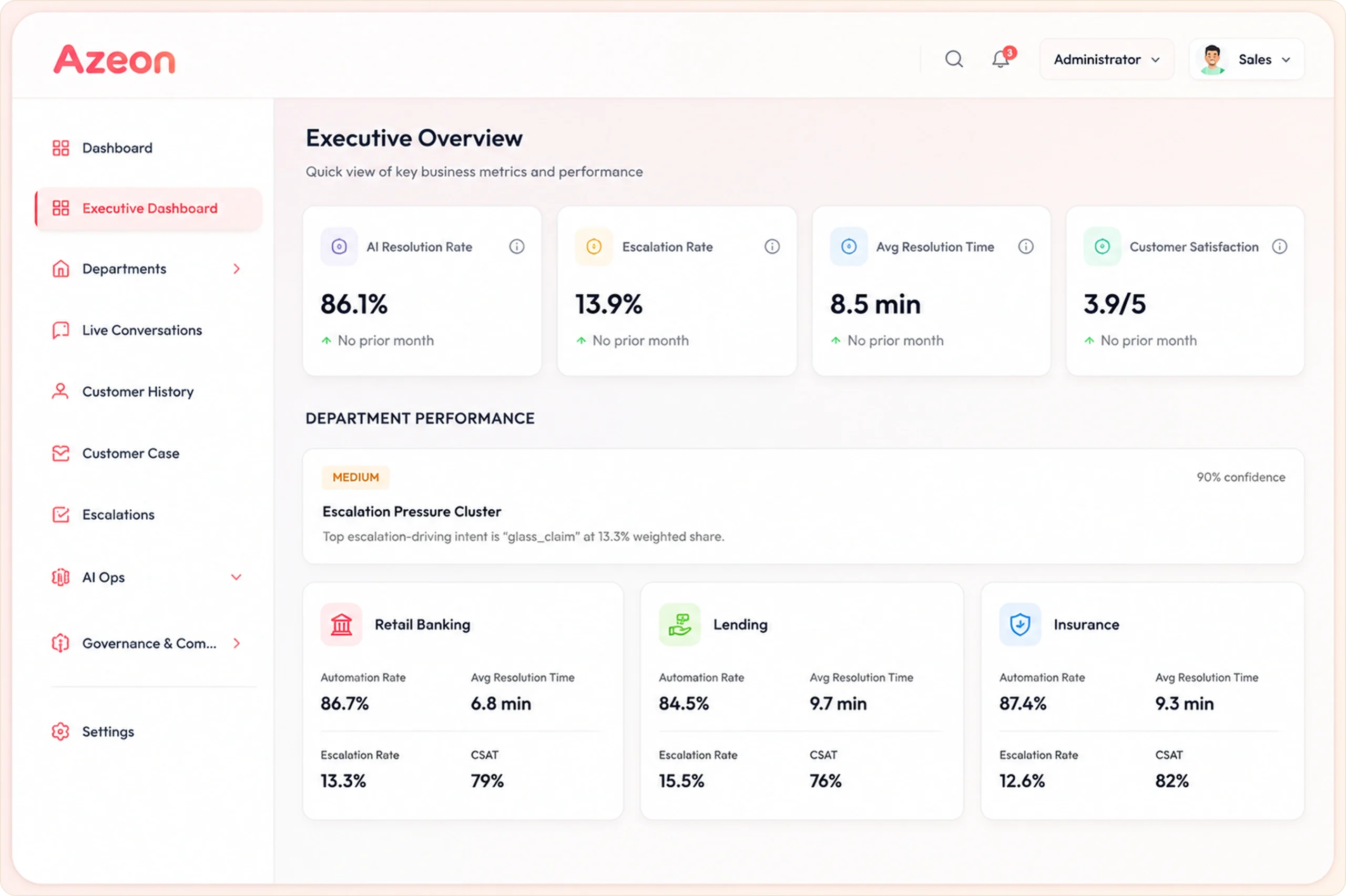
Azeon Executive Dashboard

Key Features:

  • Omnichannel Support: Supports customer interactions across chat, email, voice, and ticketing channels.
  • Human-in-the-Loop Governance: Allows support leaders to approve sensitive actions and maintain operational control.
  • Context-Aware Escalations: Transfers customer history, conversation context, and recommended actions during handoffs.
  • Workflow Execution: Performs actions across CRM, billing, support, and operational systems.
  • Deterministic Execution Framework: Combines AI reasoning with governed workflow execution and enterprise rules.
  • Unified Customer Context: Provides a complete view of customer interactions and historical conversations.
  • Root Cause Analytics: Surfaces trends, recurring issues, and operational gaps affecting customer experience.
  • Auditability & Traceability: Records actions and decisions for transparency and governance.
  • Flexible Deployment: Supports cloud and enterprise deployment requirements.
  • Extensive Integrations: Connects with CRM platforms, help desks, business systems, and custom applications.
  • Result-Based Pricing: Aligns platform costs with successful customer outcomes rather than usage metrics.
| Proven Results from Live Environments |

Measured Outcomes Across Production Deployments

Metric
Outcome
CSAT improvement (Retail case study)
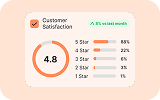
3.7 → 4.8
Reduction in repeat contact rate
35%
Reduction in Average Handle Time (Logistics)
32%
Common queries resolved annually
250,000+
Ticket automation without SLA risk (SaaS)
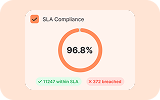
96%
Customer Lifetime Value improvement
2X
Goal Completion Rate (GCR)
95%+
Semantic Accuracy
>92%
Guardrail Adherence
99.999%
Annual OpEx Reduction
Up to $250K

Pros:

  • Purpose-built for customer support operations
  • Strong agentic capabilities beyond conversational automation
  • Shared customer memory across systems and channels
  • Human oversight and approval workflows
  • Enterprise-grade governance and auditability
  • No migration required
  • Extensive workflow automation capabilities
  • Supports complex support environments
  • Outcome-focused pricing model
  • Flexible deployment options

Cons:

  • Enterprise-focused functionality may exceed the needs of very small teams
  • Advanced deployments typically require implementation planning

Pricing:

Azeon uses a Result-as-a-Service pricing model where businesses pay for successfully resolved tickets rather than seats, tokens, actions, integrations, or usage volume.

For organizations evaluating leading AI agents solutions for customer support, this creates a direct alignment between platform investment and measurable support outcomes. While many vendors charge based on consumption, Azeon charges based on customer resolutions.

Pricing of Azeon

David Pridgen
David Pridgen
National Account Manager

Discover What Azeon AI Agents Can Do

Experience how Azeon AI agents understand intent, access customer context, and take action across your support operation.

Book a Personalized Demo →

2. Salesforce Agentforce

Best for: Enterprises already invested in the Salesforce ecosystem and looking to deploy AI agents across customer service operations.

Overview:

Salesforce Agentforce is Salesforce’s AI agent platform designed to help organizations build, deploy, and manage autonomous AI agents across customer service, sales, and business operations. The platform combines Salesforce CRM data, workflows, Data Cloud, and AI capabilities into a unified environment for AI-driven customer interactions.

Agentforce enables organizations to create AI agents capable of understanding requests, reasoning through business processes, and executing actions within Salesforce applications. The platform is deeply integrated with Service Cloud and Data Cloud, making it particularly attractive for enterprises already operating within the Salesforce ecosystem.

Key Features:

  • Autonomous AI agents
  • Service Cloud integration
  • Data Cloud integration
  • AI-powered case management
  • Generative replies
  • Conversation summaries
  • Knowledge article generation
  • Customer Signals Intelligence
  • Workflow automation
  • Next Best Action recommendations

Pros:

  • Deep Salesforce ecosystem integration
  • Enterprise-grade scalability
  • Strong workflow automation capabilities
  • Extensive CRM and customer data access
  • Multiple pricing models available
  • Suitable for large global organizations

Cons:

  • Best suited for Salesforce customers
  • Implementation complexity can be significant
  • Pricing structure can be difficult to forecast
  • Advanced functionality may require multiple Salesforce products

Pricing:

  • Agentforce for Service: $125/user/month
  • Flex Credits: $500 per 100,000 credits
  • Agentforce Actions: approximately $0.10 per action
  • Conversation-based pricing also available
  • Enterprise pricing available upon request

3. Intercom Fin

Best for: SaaS companies and support teams looking to automate customer conversations using an AI agent integrated with their helpdesk.

Overview:

Intercom Fin is Intercom’s AI agent built into its customer service platform. The company positions Fin as a natively integrated AI agent that continuously improves through customer interactions while helping support teams deliver faster resolutions and self-service experiences.

Fin is designed to answer customer questions using company knowledge sources, support documentation, and historical information. It operates across multiple support channels and can be deployed on Intercom or connected to existing helpdesk environments. The platform focuses heavily on AI-powered customer service, agent productivity, and conversation automation.

Key Features:

  • Knowledge base-powered responses
  • Support email automation
  • Live chat support
  • Shared team inbox
  • AI-powered insights
  • Self-improving system architecture
  • Multichannel customer support
  • Fin Voice capabilities
  • Helpdesk integration
  • Conversation routing
  • Agent assistance

Pros:

  • Native integration with Intercom platform
  • Strong conversational AI capabilities
  • Easy deployment for existing Intercom customers
  • Supports multiple support channels
  • Modern user experience
  • Unlimited teammate access for Fin deployments on existing helpdesks

Cons:

  • Primarily focused on conversational automation
  • Workflow execution capabilities are more limited than some agentic platforms
  • Resolution-based pricing can become expensive at scale
  • Best experience is achieved within the Intercom ecosystem

Pricing:

  • Fin AI Agent: $0.99 per resolution
  • Essential: $29/seat/month
  • Advanced: $85/seat/month
  • Expert: $132/seat/month

4. Zendesk AI

Best for: Organizations already using Zendesk and looking to extend their support operations with AI agents and automation.

Overview:

Zendesk AI is integrated throughout the Zendesk customer service platform and includes AI agents, Copilot capabilities, automated resolutions, generative AI features, and intelligent customer support workflows. The company positions AI as a core component of its customer service offering rather than a standalone product.

Zendesk AI agents can operate across messaging, email, web forms, APIs, and voice channels while leveraging customer context, ticket information, and knowledge sources. Recent updates have expanded AI agent capabilities across voice, messaging, ChatGPT, Gemini, and additional customer touchpoints.

Key Features:

  • AI Copilot
  • Generative replies
  • Automated ticket resolution
  • Intelligent triage
  • Ticket summarization
  • Omnichannel support
  • Voice AI agents
  • Knowledge base integration
  • Automated routing
  • Custom AI agent personas

Pros:

  • Mature customer service ecosystem
  • Strong omnichannel support
  • Enterprise-grade deployment options
  • Extensive marketplace and integrations
  • AI available throughout the Zendesk platform
  • Suitable for organizations with large support operations

Cons:

  • AI costs can increase with additional add-ons
  • Most advanced AI features require higher-tier plans
  • Total platform costs can grow significantly as teams scale
  • Maximum value is achieved for organizations already invested in Zendesk

Pricing:

  • Support Team: $19/agent/month
  • Suite Team: $55/agent/month
  • Suite Professional: $115/agent/month
  • Suite Enterprise: Custom pricing
  • Copilot Add-on: $50/agent/month
  • Quality Assurance Add-on: $35/agent/month
  • Advanced Data Privacy Add-on: $50/agent/month

5. Ada

Best for: Enterprises looking to automate customer service across channels using AI agents and self-service experiences.

Overview:

Ada is an AI customer service platform focused on helping organizations automate customer interactions through AI agents. The company positions Ada as an AI-powered customer experience platform capable of handling support requests across channels while maintaining customer context and personalization.

The platform emphasizes automated resolutions, multilingual support, omnichannel experiences, and continuous optimization. Ada is used by organizations such as Canva, Square, Pinterest, and monday.com to manage customer service operations at scale.

Key Features:

  • Omnichannel support
  • Multilingual support
  • Customer identity preservation
  • Conversation continuity
  • Workflow automation
  • Enterprise integrations
  • Performance optimization tools
  • AI testing and evaluation
  • Analytics and reporting
  • Knowledge base integration

Pros:

  • Strong customer service specialization
  • High automated resolution rates
  • Omnichannel deployment capabilities
  • Enterprise-focused optimization tools
  • Multilingual support

Cons:

  • Enterprise-focused implementation model
  • Custom contracts required
  • Cost can become significant at scale

Pricing:

Industry reports estimate deployments starting around $30,000/year. Larger deployments often exceed $70,000/year. Enterprise contracts can reach $300,000+/year depending on scale and requirements

6. Forethought

Best for: Large support organizations seeking AI-powered ticket automation, deflection, and agent assistance.

Overview:

Forethought is an AI-native customer support platform built around agentic AI and multi-agent architectures. The company focuses on helping support teams automate customer interactions, improve resolution rates, and reduce ticket volumes through AI-driven support workflows.

The platform is designed to work alongside existing helpdesks and customer support systems while leveraging historical tickets, support documentation, and organizational knowledge to improve customer service operations. Forethought emphasizes end-to-end issue resolution, intelligent routing, and AI-assisted support experiences.

Key Features:

  • Omnichannel AI support
  • Chat automation
  • Email automation
  • Voice support automation
  • Custom actions
  • Workflow orchestration
  • Ticket triage
  • AI-powered routing
  • Multilingual support
  • AI quality assurance

Pros:

  • Strong focus on customer support operations
  • Multi-agent architecture
  • Omnichannel deployment support
  • Workflow automation capabilities
  • AI-powered ticket deflection
  • Extensive support analytics

Cons:

  • Pricing is not publicly disclosed
  • Enterprise-oriented deployment approach
  • Can require significant implementation effort
  • Best suited for larger support teams

Pricing:

Pricing typically varies based on ticket volume, support channels, and deployment requirements

7. Freshworks Freddy AI

Best for: Growing support teams looking to automate customer service with AI while maintaining a relatively simple deployment experience.

Overview:

Freddy AI is Freshworks’ AI platform embedded across Freshdesk, Freshservice, and the broader Freshworks ecosystem. The platform provides AI-powered customer support, ticket automation, self-service, agent assistance, and workflow automation capabilities.

Freshworks positions Freddy AI as an AI assistant and AI agent platform capable of improving support productivity while reducing manual effort. Recent enhancements have expanded Freddy’s capabilities into autonomous AI agents that can resolve customer requests, automate workflows, and support omnichannel customer service operations.

Key Features:

  • AI-powered ticket automation
  • Knowledge base integration
  • Omnichannel support
  • Workflow automation
  • AI-generated responses
  • Conversation summaries
  • Agent assistance
  • Self-service automation
  • AI insights
  • Sentiment analysis

Pros:

  • Easy adoption for Freshworks customers
  • Strong AI-powered support capabilities
  • Omnichannel support
  • User-friendly interface
  • Flexible deployment options
  • Competitive pricing compared to enterprise-focused platforms

Cons:

  • Most valuable within the Freshworks ecosystem
  • Advanced capabilities may require add-ons
  • Some enterprise requirements may require additional customization
  • Third-party integration depth varies by plan

Pricing:

  • Growth: $15/agent/month
  • Pro: $49/agent/month
  • Enterprise: $79/agent/month

8. Kore.ai

Best for: Large enterprises looking for agentic AI customer service across contact centers, digital channels, and customer support operations.

Overview:

Kore.ai is an enterprise AI platform focused on agentic AI applications. The company positions itself as a provider of AI agents capable of supporting customer service, employee experience, banking, healthcare, retail, and enterprise operations through a unified AI platform.

Its AI for Service offering helps organizations automate customer interactions, improve agent productivity, reduce operational costs, and support customers across voice, chat, messaging, and digital channels. Kore.ai is particularly strong in large-scale enterprise deployments where orchestration, governance, and integrations are critical.

Key Features:

  • Intelligent agent assistance
  • Voice AI support
  • Omnichannel customer support
  • Workflow orchestration
  • Enterprise integrations
  • Pre-built AI agents
  • Agent marketplace
  • Contact center automation
  • Human escalation capabilities
  • Analytics and reporting

Pros:

  • Strong enterprise focus
  • Extensive orchestration capabilities
  • Large marketplace of pre-built agents
  • Suitable for highly regulated industries
  • Strong customer service automation capabilities
  • Broad deployment flexibility

Cons:

  • Enterprise implementation can be complex
  • Typically requires discovery and deployment planning
  • Better suited for mid-market and enterprise organizations

Pricing:

Kore.ai primarily follows a custom enterprise pricing model.

9. Cognigy

Best for: Enterprises seeking advanced AI agents for contact centers, voice automation, and customer experience operations.

Overview:

Cognigy is an enterprise-grade conversational and agentic AI platform built specifically for contact centers and customer experience teams. The platform enables organizations to design, deploy, and manage AI agents across voice, chat, messaging, and digital support channels.

The company positions Cognigy AI Agents as intelligent digital workers capable of human-like reasoning, dynamic decision-making, and contextual customer interactions. Cognigy places a strong emphasis on enterprise contact center transformation, multilingual support, and large-scale AI deployment.

Key Features:

  • Voice AI automation
  • Chat automation
  • AI Copilot for agents
  • Real-time agent assistance
  • Conversation design studio
  • Omnichannel support
  • Human handoff capabilities
  • Multilingual support
  • Real-time translation
  • Workflow automation

Pros:

  • Purpose-built for contact centers
  • Strong voice automation capabilities
  • Extensive language support
  • Advanced enterprise integrations
  • Strong agent assistance tools
  • Scalable enterprise architecture

Cons:

  • Enterprise-focused deployment model
  • May be excessive for smaller support teams
  • Implementation complexity varies by use case

Pricing:

Cognigy uses custom enterprise pricing.

10. Yellow.ai

Best for: Organizations looking for omnichannel AI agents across customer service, engagement, and conversational commerce.

Overview:

Yellow.ai is an AI-powered customer experience automation platform that combines conversational AI, voice AI, and customer service automation. The company focuses heavily on omnichannel customer engagement and enterprise automation across digital and voice channels.

Its AI agents support customer service, lead generation, customer engagement, conversational commerce, and support automation through a unified platform. Yellow.ai is widely used across retail, banking, telecom, travel, and enterprise customer support environments.

Key Features:

  • Omnichannel support
  • WhatsApp automation
  • Website chat automation
  • Email automation
  • Conversational commerce
  • Multilingual support
  • Workflow automation
  • CRM integrations
  • Human handoff capabilities
  • Agent assistance

Pros:

  • Strong omnichannel capabilities
  • Broad channel coverage
  • Enterprise-grade scalability
  • Strong conversational AI capabilities
  • Voice and chat support in one platform
  • Suitable for global customer support teams

Cons:

  • Enterprise implementation often requires customization
  • Advanced deployments may require professional services
  • Cost varies significantly based on scale

Pricing:

Yellow.ai does not publicly disclose pricing.

How to Choose the Right AI Agent Solution for Customer Support?

Selecting the right platform depends on your support goals, operational complexity, and existing technology ecosystem.

Here are the factors that matter most.

Choose Resolution Over Conversations

Many platforms focus on generating responses. The strongest AI agents focus on resolving customer issues from start to finish.

Look for Shared Customer Context

Customers expect continuity. AI agents should maintain context across channels, conversations, and business systems.

Prioritize System Integrations

An AI agent becomes significantly more valuable when it can interact with CRM platforms, billing systems, order management tools, and support software.

Maintain Human Control

The ideal platform supports automation while keeping humans involved in approvals, escalations, and sensitive decisions.

Evaluate Deployment Flexibility

Large organizations often require cloud, private cloud, hybrid, or on-prem deployment options.

Understand Pricing Carefully

Consumption-based pricing can become difficult to predict as support volumes grow. Consider platforms that align pricing with measurable outcomes.

Final Verdict

If your primary goal is answering common customer questions, solutions such as Intercom Fin, Ada, and Zendesk AI may provide a strong starting point.

Organizations operating within Salesforce, Freshworks, or other established ecosystems may benefit from platforms tightly integrated with their existing technology stack.

However, companies seeking a platform that combines agentic reasoning, shared customer memory, workflow execution, governance, and outcome-driven pricing should take a close look at Azeon.

Rather than focusing solely on conversations, Azeon is designed around customer issue resolution. The platform creates a support environment where AI agents understand context, execute actions, collaborate with humans, and continuously improve support operations.

For organizations evaluating leading AI agents solutions for customer support, Azeon offers one of the most comprehensive approaches available today.

See Why Support Teams Are Choosing Azeon

Discover how Azeon helps teams resolve more customer issues, reduce support costs, and improve customer satisfaction without replacing existing systems.

FAQs

What are AI agents for customer support?

AI agents for customer support are intelligent software systems that can understand customer intent, access business information, execute actions, and assist with issue resolution across support channels. Unlike traditional chatbots, modern AI agents can reason through requests, maintain context, and interact with business systems to help resolve customer issues more effectively.

What is the difference between AI agents and chatbots?

Traditional chatbots typically follow predefined rules and scripted conversation flows. AI agents use advanced reasoning capabilities to understand customer requests, retrieve relevant information, take actions across connected systems, and adapt to different situations. This enables AI agents to support more complex customer service scenarios and improve resolution rates.

How do AI agents improve customer support operations?

AI agents help support teams automate repetitive work, reduce response times, improve consistency, and provide customers with faster resolutions. Many organizations use AI agents to handle routine inquiries, support self-service experiences, assist human agents, and reduce operational costs while maintaining customer satisfaction.

What should businesses look for in leading AI agents solutions for customer support?

When evaluating leading AI agents solutions for customer support, businesses should consider agentic capabilities, workflow automation, integrations, shared customer context, human oversight, deployment flexibility, security, and pricing models. The right platform should align with both customer experience goals and operational requirements.

Can AI agents integrate with existing CRM and helpdesk systems?

Yes. Most leading AI agents solutions for customer support offer integrations with CRM platforms, help desks, ticketing systems, payment platforms, eCommerce tools, and enterprise applications. These integrations allow AI agents to access customer information, retrieve context, and perform actions without requiring organizations to replace existing systems.

Questions about Azeon?

Connect with our team to explore use cases, workflows, and deployment possibilities.