Skip to content

How Azeon Executes Multi-System Customer Workflows?

How Azeon Executes Multi-System Customer Workflows?

Resolving a customer issue rarely involves a single system.

  • A password reset requires identity verification, credential updates, audit logging, and customer notification.
  • A subscription upgrade spans CRM platforms, billing systems, help desk software, licensing services, and internal APIs.

The reasoning engine identifies the required actions, but executing them across distributed enterprise systems is a separate engineering problem.

Early versions of Azeon coupled reasoning with execution. Every new integration introduced its own authentication model, retry semantics, latency profile, and failure behavior, gradually increasing the responsibility of the reasoning layer.

We separated those responsibilities.

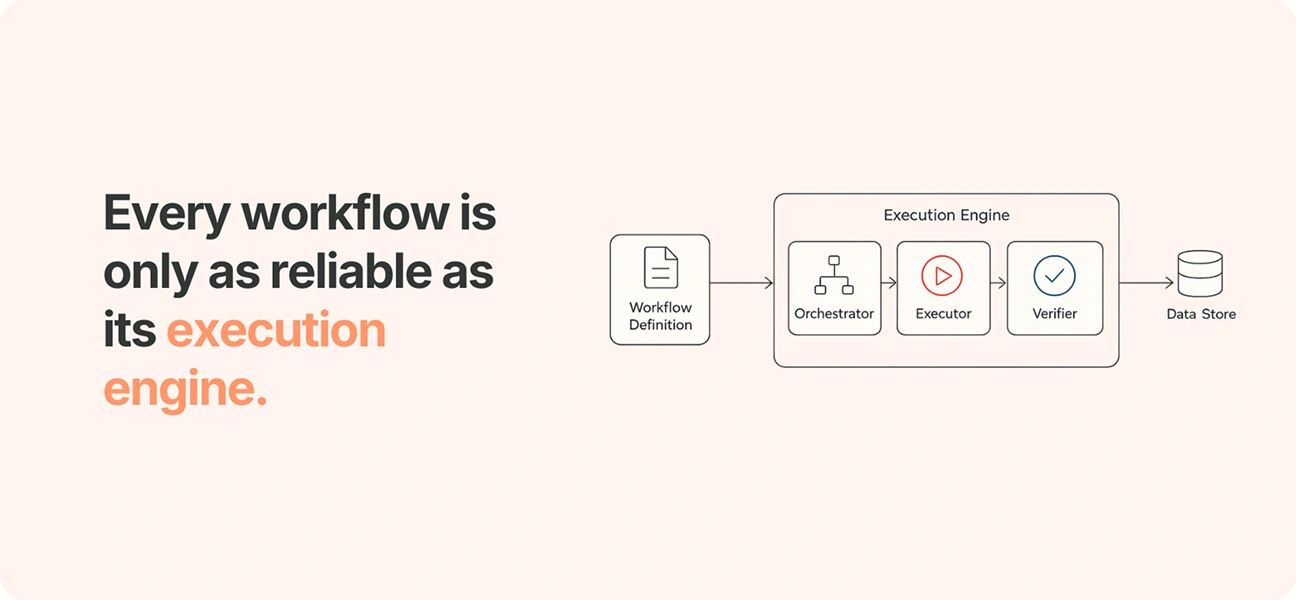
Today, the reasoning engine produces a structured execution plan. A dedicated workflow engine schedules, coordinates, and monitors every operation across enterprise systems through dependency-aware execution, persistent workflow state, and deterministic execution policies.
Execution Plans Become Workflow Graphs

The reasoning engine determines what should happen. The workflow engine determines how those actions execute.

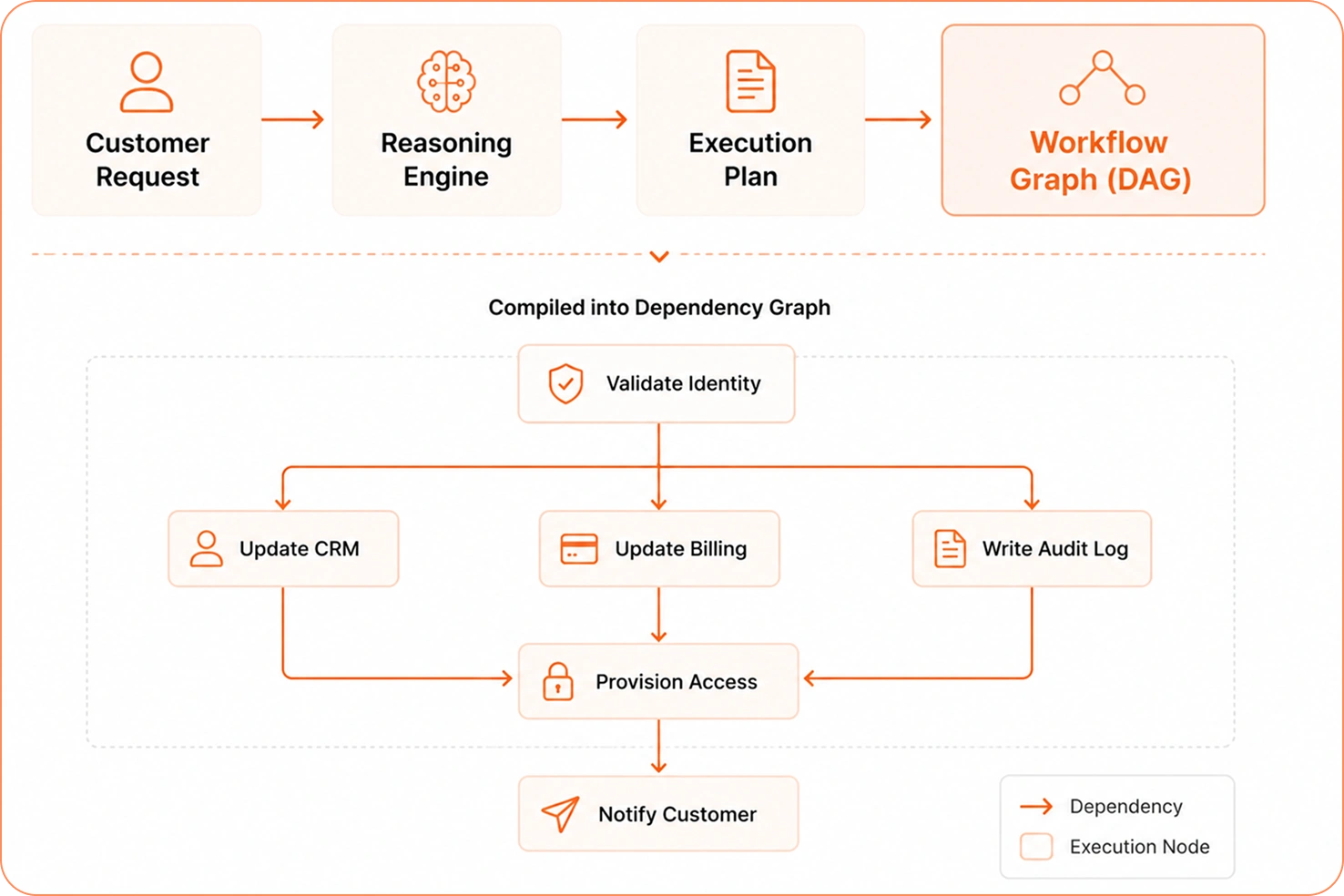
An execution plan may contain operations such as validating customer identity, checking payment status, updating subscription records, creating a support case, generating audit logs, and sending customer notifications. Some operations depend on previous results, while others have no dependency relationship.

Instead of executing tasks sequentially, Azeon compiles every execution plan into a Directed Acyclic Graph (DAG). Each node represents a deterministic operation. Edges define execution dependencies between nodes.

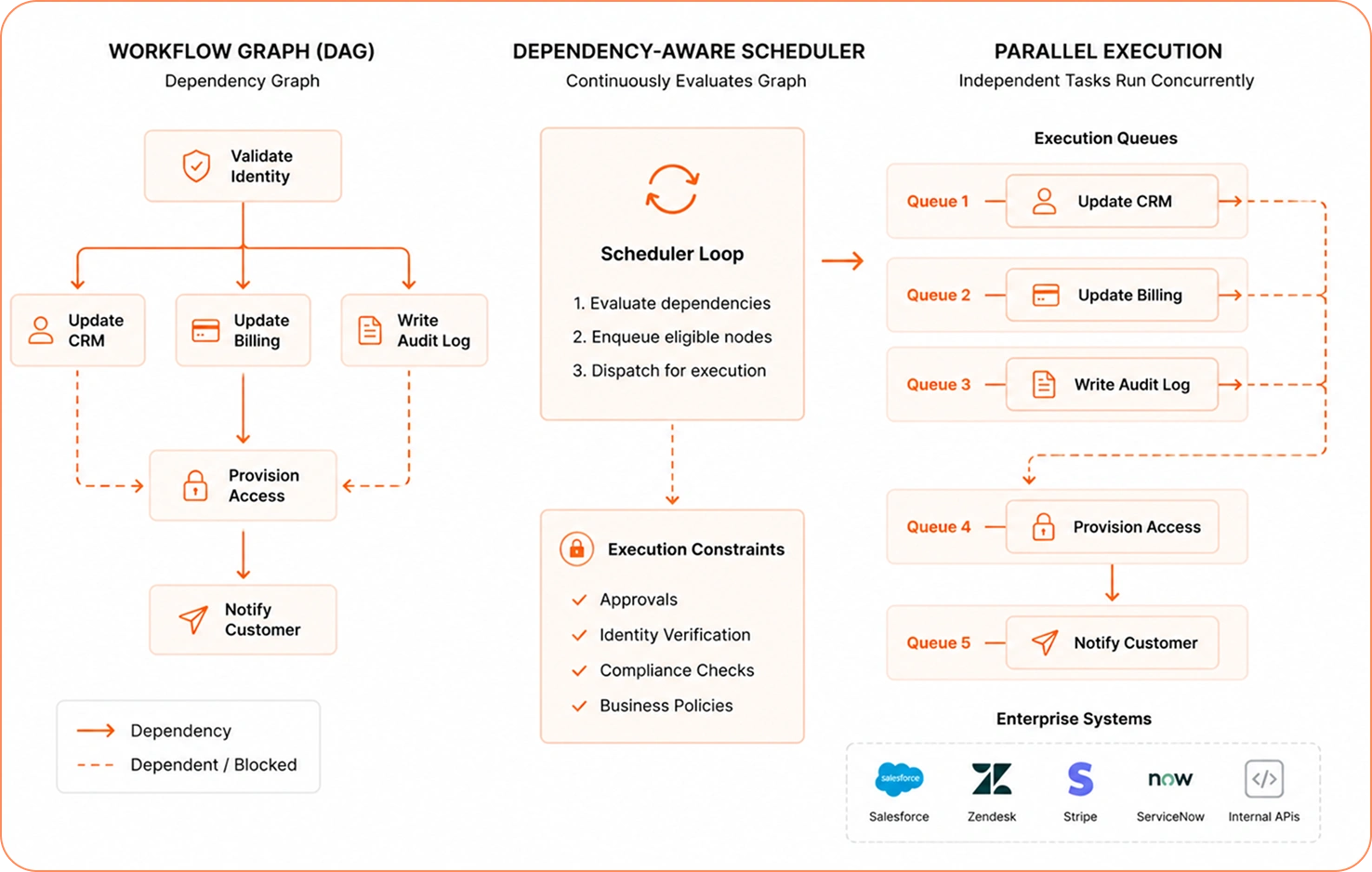
The scheduler evaluates dependency edges continuously during execution. Nodes without unresolved dependencies execute immediately, while dependent nodes remain blocked until prerequisite operations complete successfully.

Workflow graph showing how Azeon converts execution plans into dependency-based tasks.

This execution model reduces workflow latency without increasing reasoning complexity. Parallel operations execute concurrently, while dependent operations preserve execution order through explicit graph relationships instead of hardcoded workflow sequences.

The Scheduler Executes Dependency Graphs

Building the execution graph only defines dependencies. The scheduler determines when every node becomes eligible for execution.

Linear execution forces every operation to wait for the previous task, even when multiple systems can process requests independently. Updating CRM records, writing audit events, and publishing analytics data rarely depend on one another, yet sequential execution unnecessarily extends workflow duration.

Azeon’s scheduler evaluates the graph continuously instead of following a predefined sequence. Once a node satisfies every dependency, it enters the execution queue. Independent branches execute concurrently, while blocked nodes remain suspended until prerequisite state transitions complete.

Business rules become execution constraints within the graph. Approval checkpoints, identity verification, compliance validation, and policy evaluation all appear as dependency nodes rather than conditional logic scattered throughout workflow definitions.

Azeon scheduler executing workflow nodes based on dependency readiness.

The scheduler manages execution timing. The reasoning engine never participates after the execution graph has been generated.

Execution State Lives Outside the Reasoning Engine

Reasoning completes once an execution plan has been produced. Workflow execution may continue for several milliseconds, several minutes, or several hours depending on external systems and business processes.

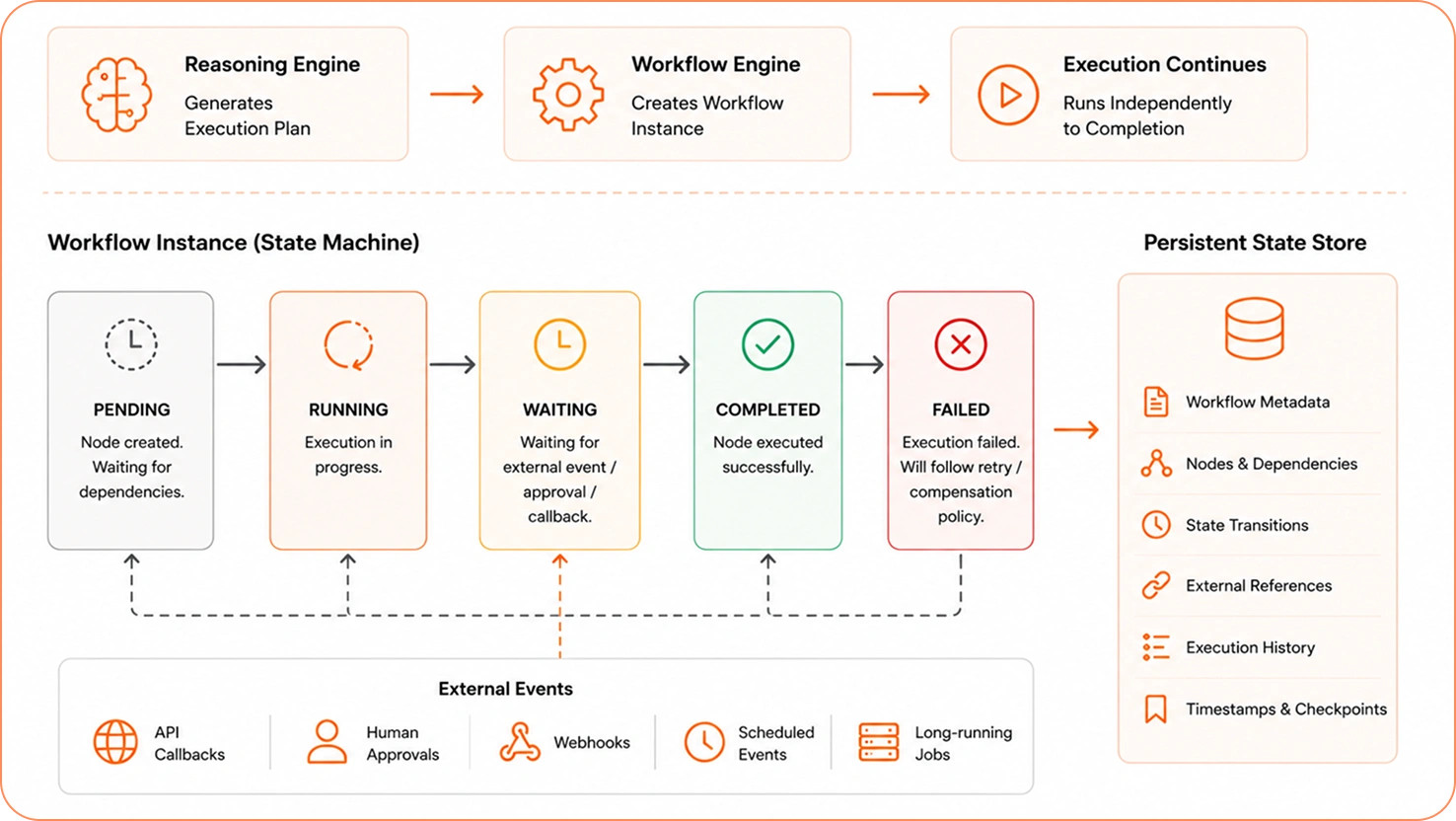
The workflow engine persists every workflow instance as a state machine independent of the reasoning layer.

Each execution node transitions through explicit states including Pending, Running, Waiting, Completed, and Failed.

Every state transition is committed to persistent storage before downstream execution continues.

Azeon workflow state architecture with persistent execution lifecycle.

Persistent workflow state allows execution to survive process restarts, infrastructure failures, asynchronous callbacks, and approval delays. When execution resumes, the scheduler reconstructs the workflow from the last committed checkpoint instead of regenerating the execution plan or repeating completed operations.

Engineering teams can inspect workflow state at any point, identify blocked nodes, trace execution paths, and measure latency across every stage of the workflow lifecycle.

Enterprise Integrations Behave as Execution Adapters

Enterprise platforms expose different APIs, authentication mechanisms, rate limits, timeout behavior, and response formats. Embedding these implementation details directly into workflow definitions couples execution logic to individual vendors.

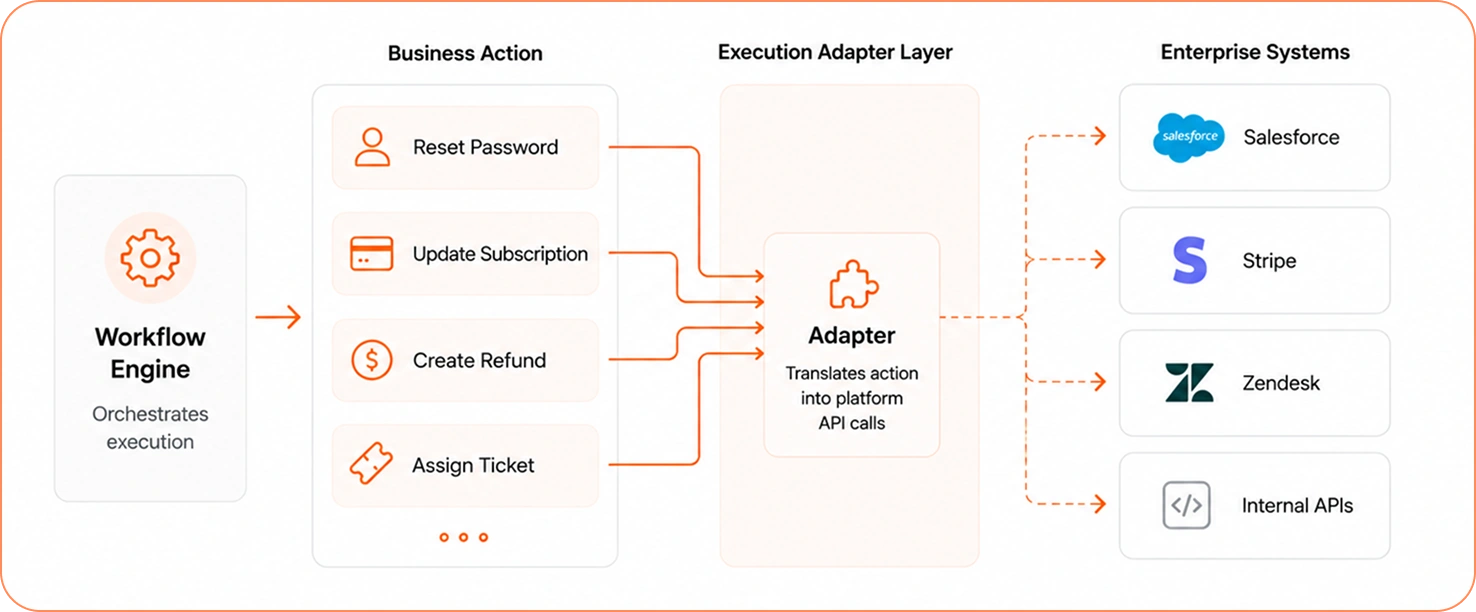
Azeon isolates every integration behind an execution adapter.

Execution nodes reference business actions such as Reset Password, Update Subscription, Create Refund, or Assign Ticket. The adapter resolves each action into platform-specific API requests at runtime.

Azeon execution adapters connecting business actions to enterprise systems.

Every adapter implements the same execution contract regardless of the underlying platform.

Authentication, retries, timeout handling, response validation, and error normalization remain inside the adapter instead of the scheduler.

Adding support for another enterprise platform requires a new adapter implementation without changing reasoning logic, workflow definitions, or scheduling behavior.

Execution Continues Through Failures

Distributed systems fail continuously.

  • APIs return timeouts.
  • Network requests terminate unexpectedly.
  • External services become temporarily unavailable.
  • Webhooks arrive late or are delivered multiple times.

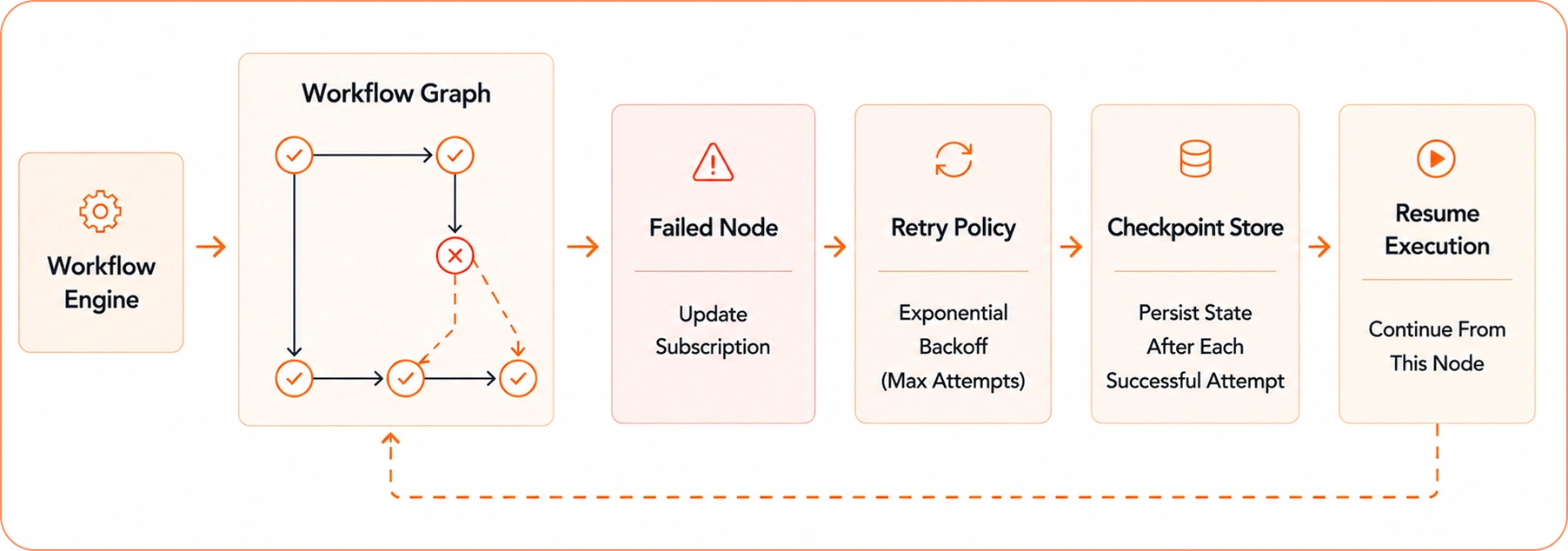
The workflow engine isolates failures at the execution node instead of restarting the entire workflow.

Each node executes independently under configurable retry policies, timeout thresholds, dependency validation, and idempotency guarantees. Failed nodes pause only their dependent branches while unrelated execution continues across the remaining graph.

Once the failed operation succeeds, the scheduler resumes execution from the latest committed checkpoint.

Azeon failure recovery using retries, checkpoints, and workflow resumption.

Previously completed operations never execute twice, reducing recovery time while preserving workflow consistency across connected enterprise systems.

Every Workflow Produces an Execution Trail

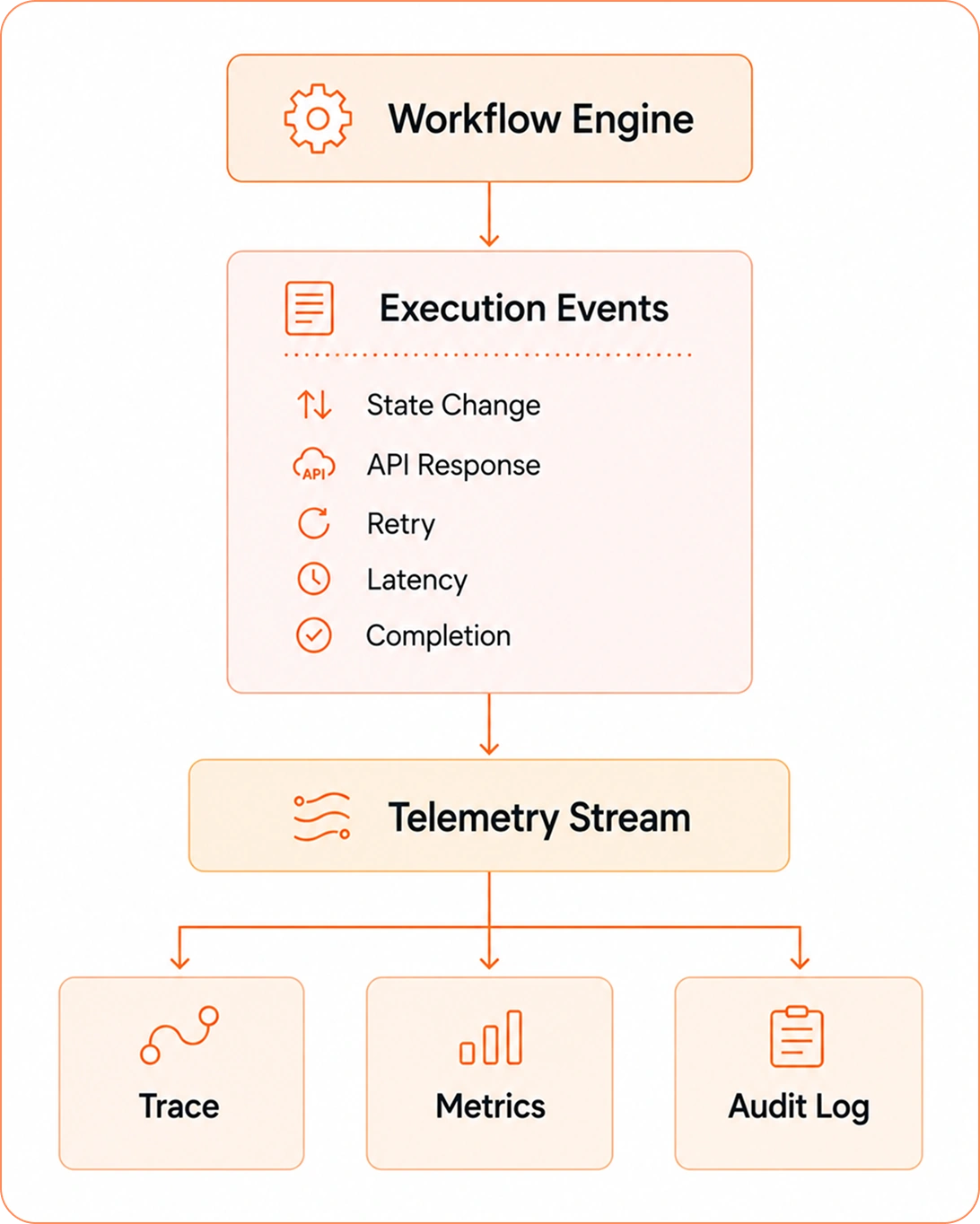
Every workflow generates a continuous stream of execution events.

The workflow engine records task scheduling, state transitions, API responses, retries, approval checkpoints, dependency resolution, execution latency, and workflow completion as structured telemetry.

Azeon execution telemetry pipeline for traces, metrics, and audit logs.

Execution telemetry reconstructs the complete lifecycle of every workflow.

Engineering teams can trace execution paths, identify bottlenecks, measure connector latency, analyze retry behavior, and inspect failed dependency chains without reproducing production traffic.

These execution events also improve the workflow engine itself. Retry patterns, delayed integrations, blocked execution paths, and connector failures become inputs for optimizing scheduling policies, adapter implementations, and workflow definitions.

Closing Thoughts

The workflow engine is responsible for everything that happens after the reasoning engine produces an execution plan.

It compiles execution graphs, schedules dependency-aware tasks, persists workflow state, coordinates execution adapters, applies execution policies, and records every state transition throughout the workflow lifecycle.

As Azeon continues to integrate with more enterprise platforms and support increasingly complex customer operations, this execution model scales without changing its core architecture.

New integrations extend the adapter layer, larger workflows expand the execution graph, and the scheduler continues to coordinate execution through the same deterministic model.

By separating planning from execution, Azeon keeps each subsystem focused on a single responsibility while ensuring customer workflows execute consistently across distributed enterprise systems.

Vinus Akhediya is the Solution Architect at Azeon, where he leads the design and architecture of the platform's Agentic AI engine for customer support. His work focuses on AI reasoning, autonomous agent workflows, enterprise integrations, knowledge orchestration, workflow execution, and scalable AI infrastructure that enables Azeon to resolve customer inquiries with accuracy, speed, and governance.

Vinus Akhediya
Solution Architect

Questions about Azeon?

Connect with our team to explore use cases, workflows, and deployment possibilities.