Skip to content

How Azeon Connects CRM, Help Desk, and Internal Systems into One AI Layer?

How Azeon Connects CRM, Help Desk, and Internal Systems into One AI Layer?

Customer support environments distribute operational state across CRMs, help desks, billing systems, knowledge bases, and internal services.

Each system owns a different representation of the customer, which makes context retrieval a distributed systems problem rather than an integration problem.

During the early development of Azeon, we observed that directly exposing these systems to the reasoning engine increased retrieval latency, duplicated customer entities, and introduced inconsistent enterprise state into inference.

As the number of integrations grew, reasoning quality became increasingly dependent on context consistency instead of model capability.

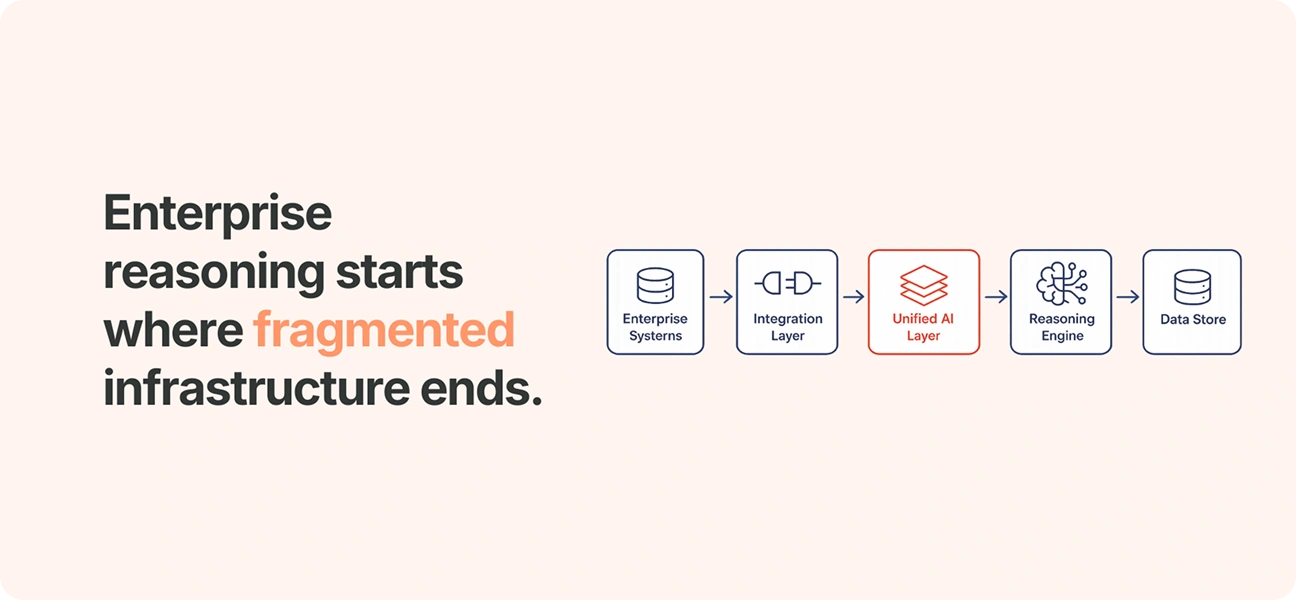
To address this, we introduced a unified AI layer between enterprise systems and the reasoning engine.

Every integration contributes normalized, validated, and ranked enterprise context into a single runtime representation before planning begins.

This article explains the architecture behind that layer and how it enables Azeon to reason across CRM, help desk, and internal systems through one consistent enterprise interface.
Enterprise Connectors Produce Context, Not Prompts

Every connected application exposes different APIs, authentication mechanisms, pagination strategies, response formats, and domain models.

CRM platforms organize customer accounts differently than help desk platforms. Internal operational systems frequently expose proprietary schemas that evolve independently from commercial SaaS applications.

Allowing the reasoning engine to understand every integration creates tight coupling between enterprise infrastructure and planning logic.

Instead, every connector inside Azeon follows a common ingestion pipeline.

Each connector translates platform-specific objects into a canonical entity model before contributing data to the Enterprise Context Layer.

The planner never consumes Salesforce Accounts, Zendesk Organizations, or proprietary JSON payloads directly. Every enterprise object becomes part of a normalized runtime representation shared across the platform.

This separation allows integrations to evolve independently without introducing changes into reasoning or workflow execution.

Context Assembly Operates as a Distributed Retrieval Pipeline

Customer context rarely exists inside a single system. Resolving an authentication issue, subscription request, or billing inquiry requires data retrieval across multiple enterprise services.

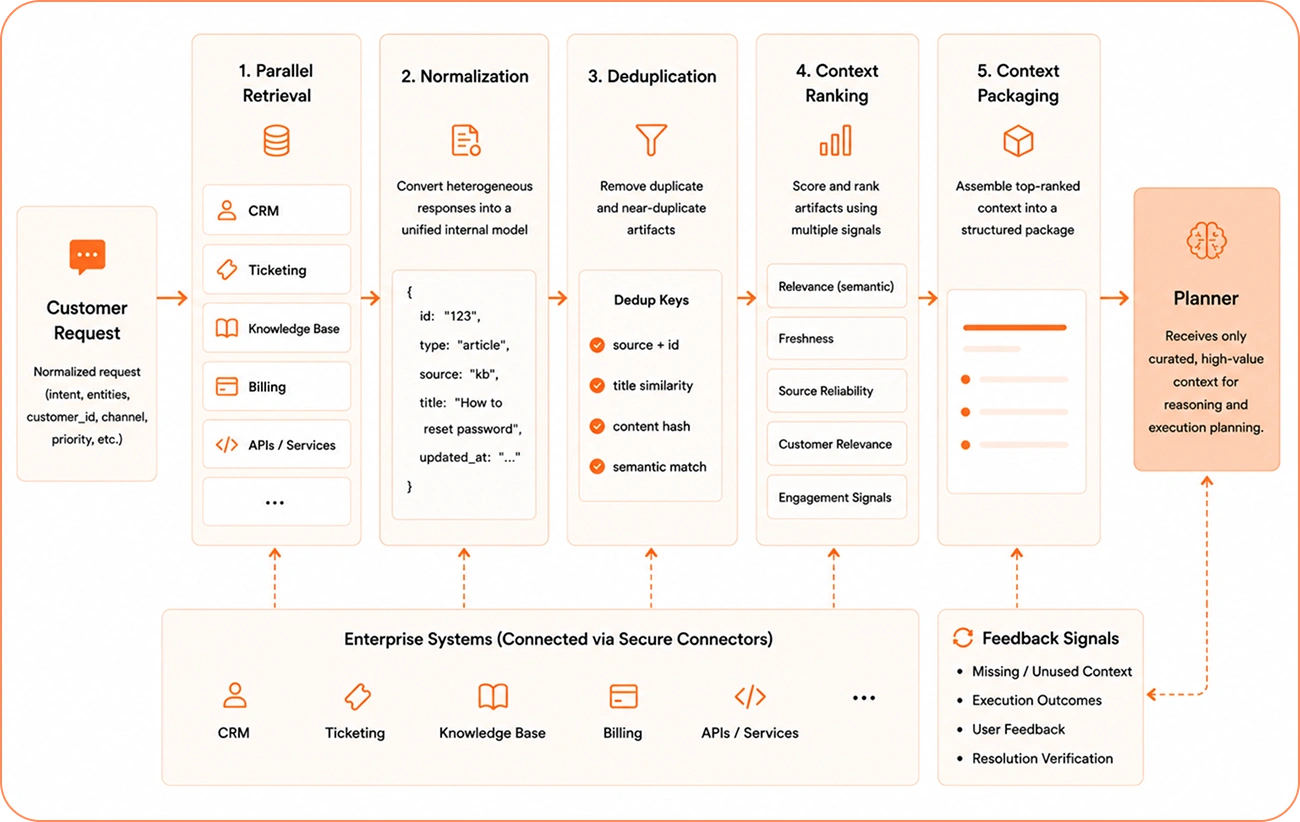
Instead of executing sequential API calls, Azeon performs concurrent retrieval using asynchronous fan-out across connected systems.

Each retrieval operation executes independently within a predefined latency budget while connector-level circuit breakers, retry policies, and timeout thresholds isolate downstream failures from the reasoning pipeline.

The retrieved artifacts are streamed into the Context Assembly Layer where entity resolution, metadata enrichment, duplicate detection, and schema normalization execute before reasoning starts.

Context Assembly Pipeline Architecture

The output is not a collection of documents.

The output is a structured enterprise state representing the customer at inference time.

This architecture reduces cumulative retrieval latency while maintaining deterministic behavior across heterogeneous enterprise systems.

Context Ranking Reduces Reasoning Entropy

Retrieval maximizes coverage. Reasoning requires precision.

Forwarding every retrieved artifact into an LLM increases token consumption, expands context windows, and introduces conflicting information that the planner must reconcile during inference.

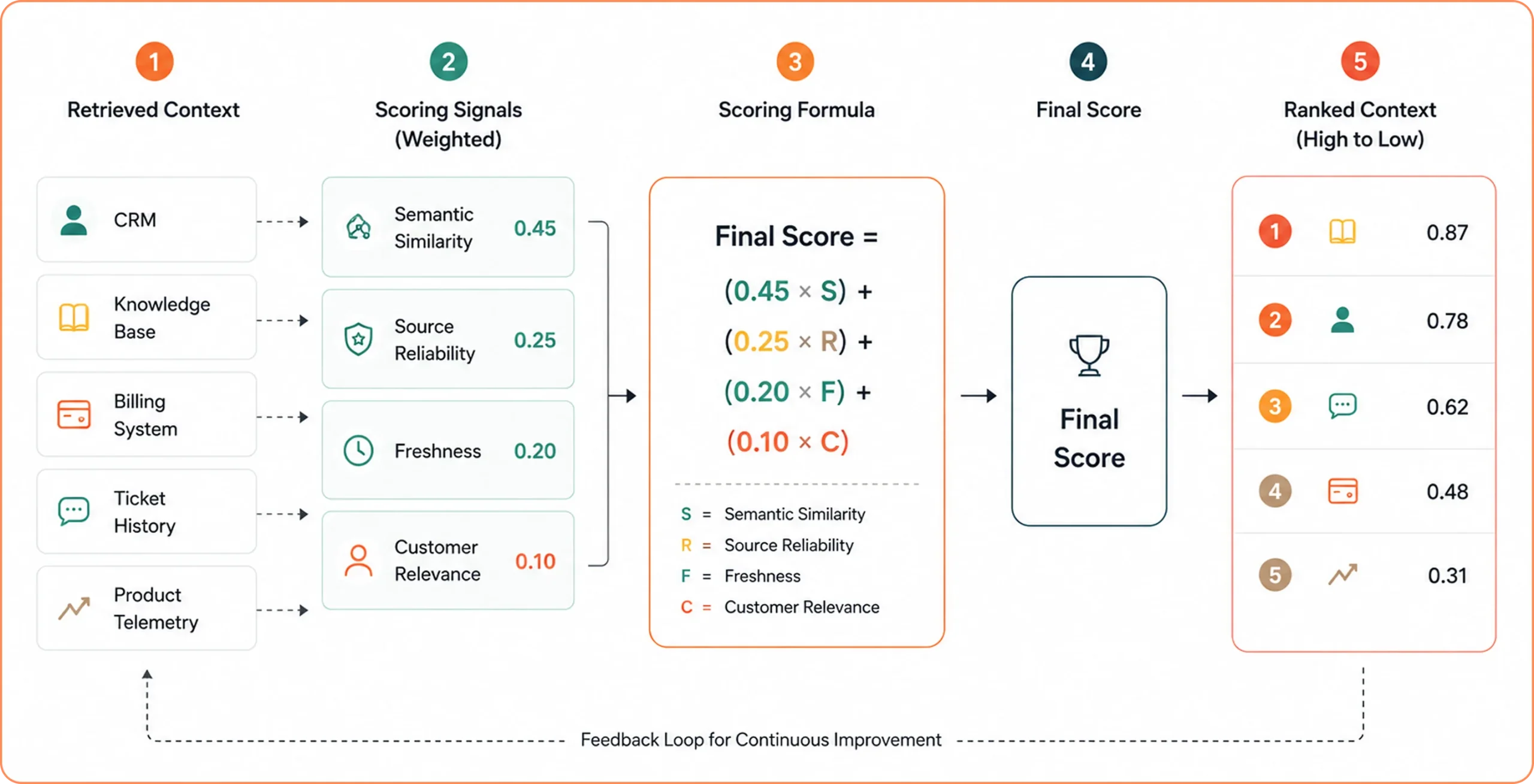
Azeon introduces a Context Ranking Layer between retrieval and reasoning.

Context Ranking Pipeline

Every retrieved entity is evaluated using multiple ranking signals, including semantic relevance, source authority, temporal freshness, entity confidence, operational priority, and relationship strength inside the enterprise context graph.

Rather than optimizing for retrieval volume, the ranking layer optimizes for planning quality.

By the time inference begins, duplicate entities have been merged, stale artifacts have been filtered, conflicting records have been prioritized, and irrelevant context has been excluded from the runtime context package.

The reasoning engine operates on validated enterprise state instead of raw retrieval output.

Runtime Context Becomes a Shared Platform Service

Enterprise context is assembled once for every customer interaction.

Planning, workflow orchestration, policy validation, execution monitoring, analytics, and resolution verification operate against the same runtime context object throughout the resolution pipeline.

This architecture eliminates repeated retrieval across platform components.

Without a shared context layer, every subsystem performs independent enterprise lookups, increasing connector traffic, API latency, token consumption, and infrastructure cost.

A shared runtime context also improves observability.

Every reasoning decision, workflow transition, execution event, and verification outcome references the same enterprise snapshot using a shared correlation identifier, which allows distributed traces to reconstruct the complete lifecycle of a customer request.

Instead of debugging individual integrations, platform telemetry reconstructs reasoning over a consistent enterprise state.

Integrations Scale Without Modifying the Planner

One of the architectural goals behind the unified AI layer was preserving reasoning stability as enterprise ecosystems continue expanding.

Adding Microsoft Dynamics, SAP, Jira, Snowflake, Workday, proprietary ERP platforms, or internal microservices should extend enterprise visibility without introducing planner-specific logic.

Connector implementations remain isolated behind the Enterprise Context Layer.

The reasoning engine consumes one canonical runtime representation regardless of the number of connected systems or the underlying implementation details.

This architectural boundary allows enterprise integrations, connector frameworks, authentication strategies, and synchronization mechanisms to evolve independently while preserving stable reasoning behavior across the platform.

Closing Thoughts

Reasoning quality depends on the quality of enterprise context presented to the planner.

An AI agent should not spend inference cycles interpreting API schemas, reconciling conflicting records, or determining which enterprise application contains the authoritative customer state. Those responsibilities belong to the platform.

Azeon’s unified AI layer separates enterprise connectivity from autonomous reasoning by introducing dedicated layers for connector management, context assembly, entity normalization, context ranking, and runtime state management.

The reasoning engine receives a consistent enterprise representation regardless of how many systems contribute to customer context.

As enterprise environments continue expanding, this architectural model allows Azeon to integrate additional platforms while preserving predictable reasoning, deterministic execution, and consistent resolution quality across the entire customer support pipeline.

Tarak Joshi leads growth strategy and market expansion for agentic AI-powered customer support solutions. With 20+ years of experience in business strategy, IT consulting, and operational excellence, he focuses on helping enterprises improve support outcomes, reduce operational costs, and adopt AI with measurable business impact. His expertise spans customer experience transformation, AI-led service operations, and aligning technology investments with business goals.

Tarak Joshi
VP - Sales

Questions about Azeon?

Connect with our team to explore use cases, workflows, and deployment possibilities.