Skip to content

AI Customer Support Performance Benchmarks for Enterprises in 2026

AI Customer Support Performance Benchmarks for Enterprises in 2026

AI-powered customer support has changed rapidly over the last few years.

What started with basic chatbots and automated replies has now evolved into intelligent support systems that handle customer conversations, execute workflows, assist agents, and improve service operations at scale.

As AI adoption grows, enterprises are paying closer attention to performance.

Leaders no longer evaluate AI customer support based only on chatbot usage or automation volume.

They want measurable outcomes.

That includes faster resolution times, higher containment rates, stronger escalation quality, better customer satisfaction, and lower operational costs.

In 2026, benchmarking has become an important part of an AI automation strategy.

Organizations are using performance benchmarks to understand what good AI support actually looks like and where their systems need improvement.

This article explores the most important performance benchmarks in 2026, the KPI ranges enterprises are targeting, and the factors shaping AI customer service performance across modern enterprises.
The Core AI Customer Support Metrics Enterprises Track

AI-powered customer support performance measurement goes far beyond basic automation reporting.

Here are the primary benchmarks enterprise support leaders monitor in 2026.

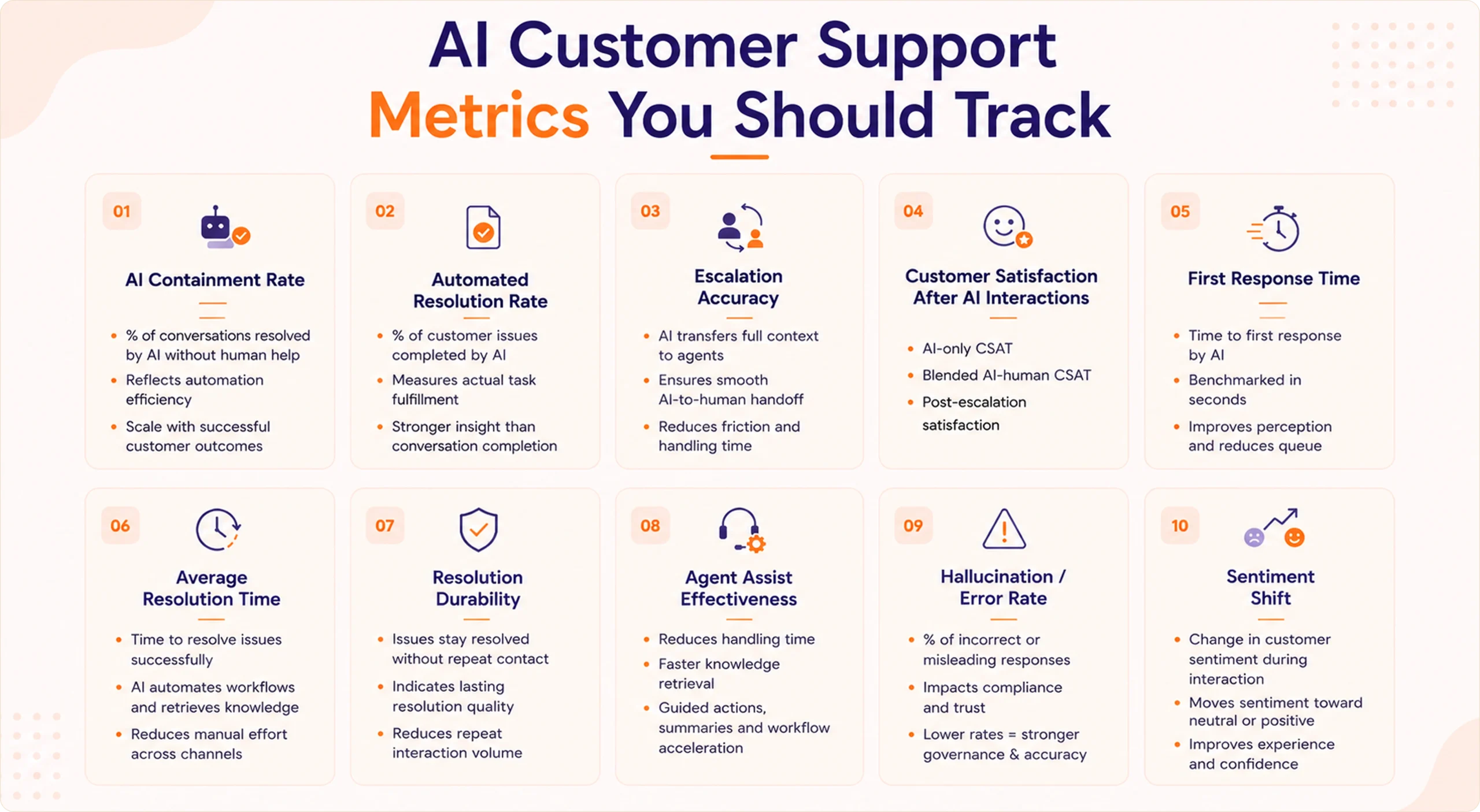
AI Customer Support Metrics You Should Track

AI Containment Rate

AI containment measures the percentage of conversations resolved without human intervention.

This remains one of the most widely tracked AI customer service metrics because it directly reflects automation efficiency and operational scale.

However, mature enterprises evaluate containment carefully. A high containment rate only creates value when customers actually reach successful outcomes.

Containment without resolution often increases frustration and repeat contact volume.

Automated Resolution Rate

Automated resolution measures whether the AI successfully completes the customer’s objective.

For example, resetting passwords, updating account information, processing refunds, scheduling appointments, or resolving technical issues.

This metric provides stronger operational insight than conversation completion alone because it focuses on actual task fulfillment.

Escalation Accuracy

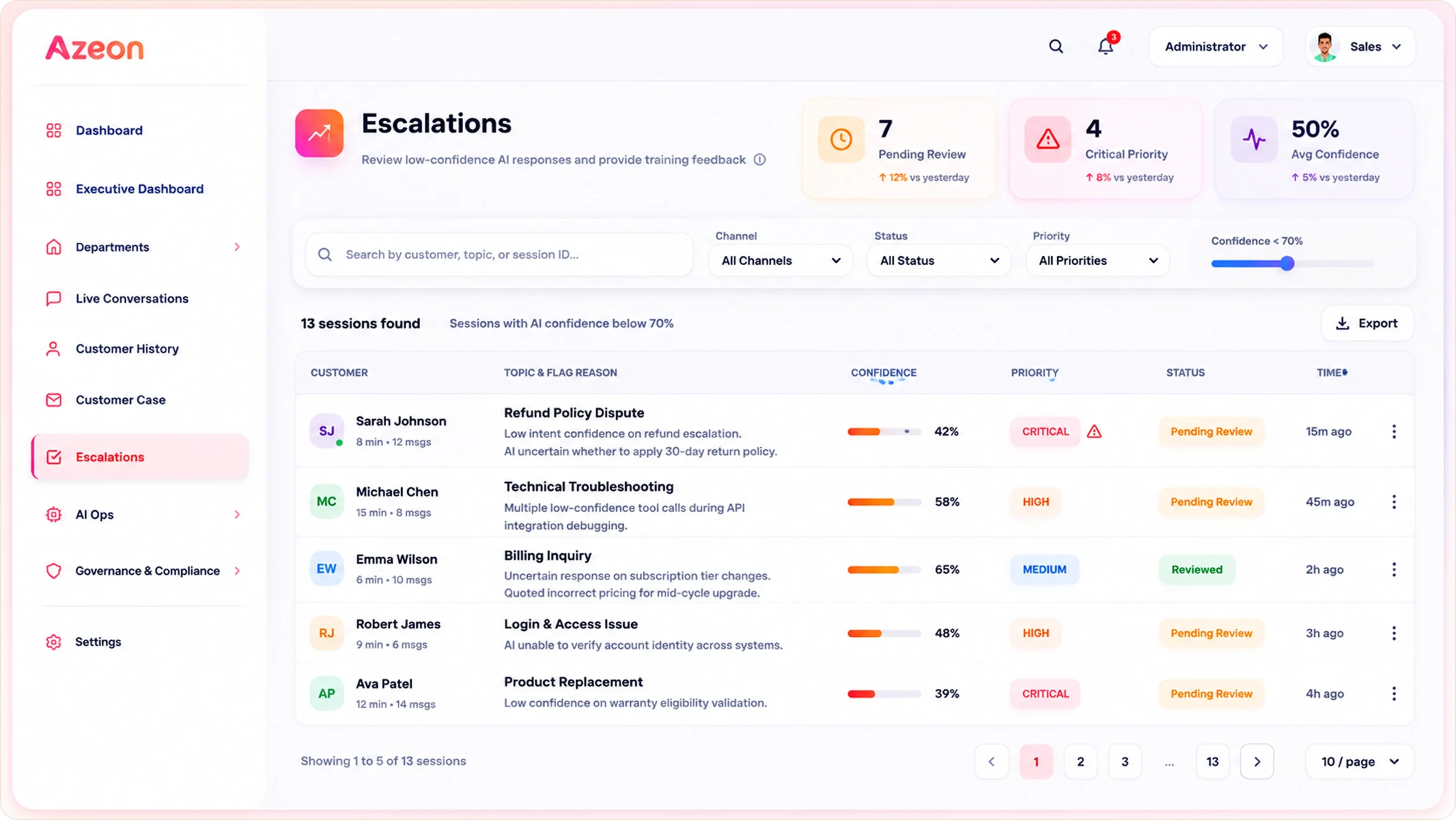
Escalation quality has become one of the most important customer support AI benchmarks in 2026.

Customers expect seamless transitions between AI and human support teams. Poor escalation experiences create friction, repeated explanations, and longer handling times.

High-performing enterprise AI systems transfer conversation context, customer history, intent understanding, sentiment indicators, and workflow status directly into the agent environment.

This reduces customer effort and improves support continuity.

Customer Satisfaction After AI Interactions

CSAT remains a critical benchmark because customer trust directly affects AI adoption success.

Enterprises increasingly measure:

  • AI-only CSAT
  • Blended AI-human CSAT
  • Post-escalation satisfaction

Strong AI performance requires balancing operational efficiency with customer confidence and service quality.

First Response Time

AI dramatically improves response speed across enterprise support channels.

Many organizations now benchmark AI response times in seconds rather than minutes. Faster responses improve customer perception while reducing support queue pressure.

However, response speed alone does not guarantee successful outcomes. Enterprises increasingly balance speed with resolution quality.

Average Resolution Time

Resolution time benchmarks measure how quickly support issues reach successful completion.

AI systems contribute by:

  • Automating repetitive workflows
  • Retrieving knowledge instantly
  • Guiding agents during live interactions
  • Reducing manual effort

Mature enterprise AI implementations often reduce resolution times across both automated and human-assisted interactions.

Resolution Durability

Resolution durability measures whether customers need to reconnect regarding the same issue.

This benchmark has gained significant attention in 2026 because enterprises now prioritize lasting issue resolution over short-term containment metrics.

High durability indicates stronger workflow orchestration, more accurate AI guidance, and better knowledge quality.

Agent Assist Effectiveness

AI is increasingly used alongside support teams rather than replacing them entirely.

Agent assists benchmark measures:

  • Reduced handling time
  • Faster knowledge retrieval
  • Suggested next actions
  • Automated summaries
  • Workflow acceleration

This area has become especially important for enterprises managing large/high-volume customer support operations with distributed teams.

Hallucination/Error Rate

Enterprises increasingly evaluate how often AI systems generate incorrect, misleading, outdated, or non-compliant responses during customer interactions.

Even small accuracy issues can create operational and compliance risks in industries such as healthcare, banking, insurance, and telecommunications.

Lower hallucination rates typically indicate stronger knowledge orchestration, governance controls, and retrieval quality.

Sentiment Shift

Sentiment shift measures how customer emotion changes during an AI-supported interaction.

Instead of only tracking conversation completion, enterprises now analyze whether the interaction improved customer confidence, reduced frustration, or created a smoother support experience.

A successful AI support interaction gradually moves that sentiment toward neutral or positive by providing accurate information, resolving the issue quickly, and reducing customer effort.

Customer Support AI Benchmark Ranges in 2026

Performance benchmarks vary by industry, workflow complexity, compliance requirements, and support maturity.

Still, several benchmark ranges are emerging across enterprise environments.

KPI Emerging AI Programs Mature Enterprise AI Programs
AI Containment Rate 20–40% 60–80%
Automated Resolution Rate 25–45% 55–75%
CSAT After AI Interactions 70–80% 85%+
Average First Response Time Under 2 minutes Under 10 seconds
Escalation Accuracy Partial context transfer Context-aware seamless escalation
Agent Productivity Improvement 10–20% 30–50%
Repeat Contact Reduction Minimal improvement Significant reduction
Hallucination/Error Rate Inconsistent monitoring Continuously governed and optimized
Sentiment Shift Limited visibility Actively measured and optimized

High-performing enterprise AI systems usually share several characteristics.

They are deeply connected with enterprise workflows, knowledge systems, CRM platforms, and support operations.

They also include:

  • Governance controls
  • Orchestration layers
  • Human-in-the-loop workflows
  • Continuous performance monitoring

Enterprises that rely only on standalone chatbot automation often struggle to improve benchmarks consistently across complex support environments.

Operational Challenges That Affect AI Support Performance

The performance depends heavily on operational readiness.

Even advanced AI customer support tools struggle when workflows, knowledge sources, and support operations are disconnected.

Several operational challenges directly affect benchmark performance in 2026.

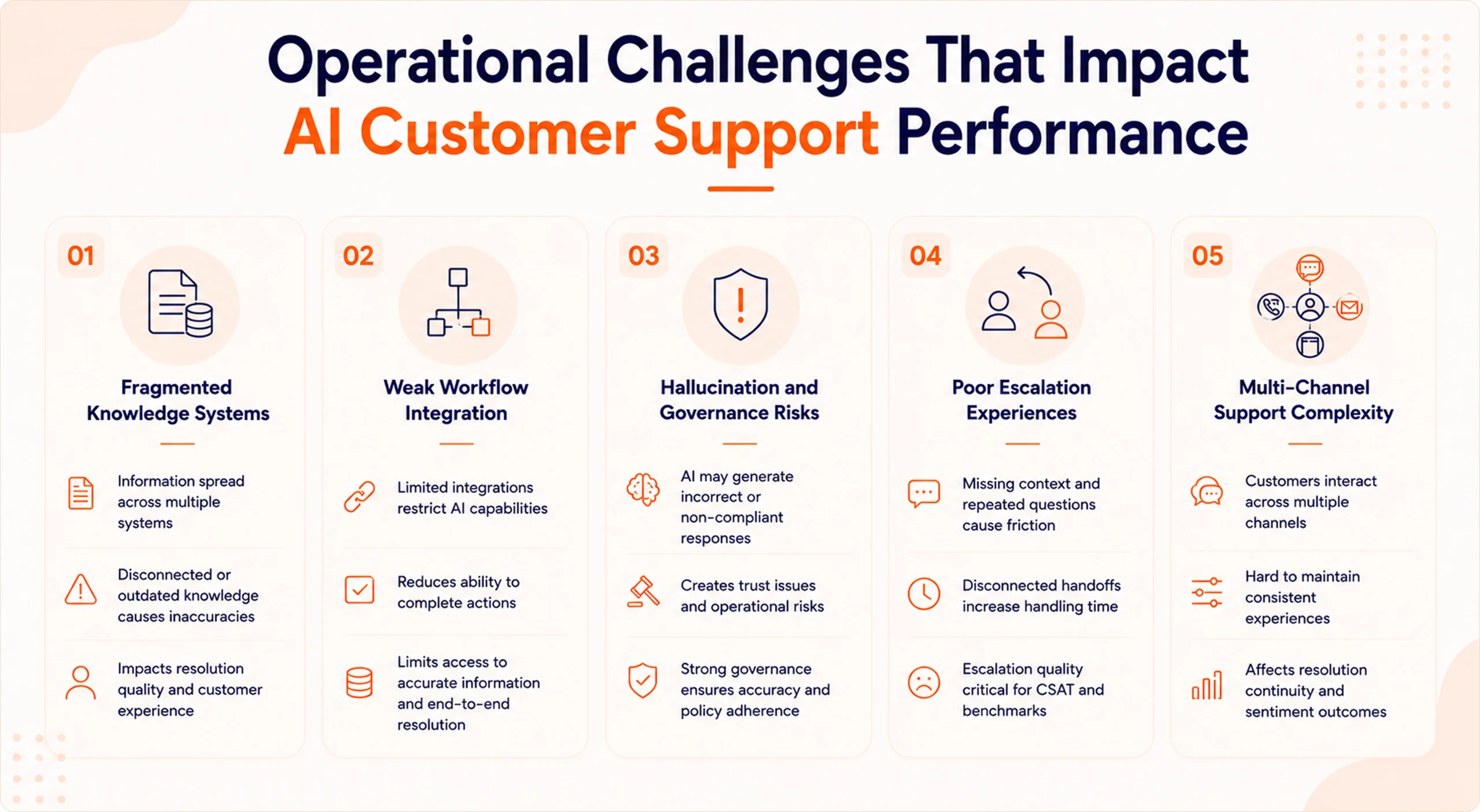
Operational Challenges That Impact AI Customer Support Performance

Fragmented Knowledge Systems

Support information is often spread across multiple systems, documents, and platforms.

When knowledge remains disconnected or outdated, AI systems may generate inconsistent or inaccurate responses.

This directly impacts resolution quality and customer experience.

Weak Workflow Integration

Customer support AI platforms perform better when connected with enterprise workflows and backend systems.

Limited integrations reduce the AI’s ability to:

  • Complete actions
  • Retrieve accurate information
  • Support end-to-end resolution

Hallucination and Governance Risks

Enterprises increasingly monitor hallucination rates, compliance accuracy, and policy adherence.

Incorrect responses can create customer trust issues and operational risks, especially in regulated industries.

Strong governance controls play a major role in enterprise AI performance.

Poor Escalation Experiences

Customers expect smooth transitions between AI and human agents.

Missing context, repeated questions, and disconnected handoffs often reduce customer satisfaction and increase handling time.

Escalation quality has become a critical customer support benchmark in 2026.

Multi-Channel Support Complexity

Customers interact across chat, email, voice, portals, and messaging platforms.

Maintaining consistent support experiences across all channels remains a major challenge for enterprise AI systems.

Disconnected experiences often affect resolution continuity and sentiment outcomes.

How Azeon Helps Enterprises Improve AI Support Benchmarks

Azeon is an Agentic AI solution for customer support.

We help enterprises improve AI support benchmarks by combining orchestration, enterprise knowledge access, workflow execution, and AI-human collaboration into a unified support operating layer.

Instead of measuring success through automation volume alone, enterprises can use Azeon to improve operational benchmarks such as:

  • Containment quality
  • Verified resolution rates
  • Escalation continuity
  • Response efficiency
  • Support productivity

Azeon supports enterprise environments where customer interactions span multiple channels, backend systems, and support teams.

By connecting AI workflows with enterprise systems and contextual knowledge sources, support operations gain stronger consistency, faster resolution paths, and more reliable customer experiences.

For enterprises focused on operational AI maturity in 2026, benchmark improvement increasingly depends on workflow orchestration, knowledge accuracy, and measurable support outcomes. Azeon is built around these enterprise support priorities.

Experience How Azeon Improves Customer Support Performance

Book a Demo

FAQs: AI Customer Support Performance Benchmarks

What are enterprise AI customer support benchmarks?

Enterprise AI customer support benchmarks are performance metrics used to evaluate how effectively AI systems support customer service operations. Common benchmarks include containment rate, automated resolution rate, CSAT, escalation accuracy, response time, and support productivity improvement.

What is a good AI containment rate for enterprise customer support?

A strong AI containment rate for enterprise customer support typically ranges between 60% and 80% for mature AI programs. Performance depends on workflow complexity, integration quality, support orchestration, and the ability to deliver verified issue resolution.

Which customer support AI metrics matter most in 2026?

The most important customer support AI metrics in 2026 include automated resolution rate, containment quality, escalation continuity, CSAT, repeat-contact reduction, sentiment improvement, and agent productivity. Enterprises increasingly focus on measurable operational outcomes instead of chatbot activity alone.

How do enterprises measure AI customer support success?

Enterprises measure AI customer support success using benchmarks such as verified resolution rates, customer satisfaction, containment quality, escalation accuracy, support cost reduction, and workflow efficiency. Quarterly performance reviews are commonly used to monitor AI operational maturity.

How often should enterprises benchmark customer support AI performance?

Most enterprises benchmark customer support AI performance monthly or quarterly to monitor operational trends, identify workflow gaps, and improve support outcomes. Regular benchmarking helps organizations optimize AI effectiveness and customer experience quality over time.

Glossary

1. AI Containment Rate: AI containment rate measures the percentage of customer conversations resolved by AI without requiring escalation to a human support agent.

2. Automated Resolution Rate: Automated resolution rate tracks how many customer issues are successfully completed by AI systems without manual intervention.

3. Escalation Accuracy: Escalation accuracy measures how effectively AI transfers conversations, context, and customer information to human support teams when escalation is required.

4. Customer Satisfaction (CSAT): CSAT is a customer experience metric used to measure how satisfied customers are after interacting with a support system or service team.

5. First Response Time (FRT): First response time measures how quickly a customer receives the first response after initiating a support request.

Questions about Azeon?

Connect with our team to explore use cases, workflows, and deployment possibilities.