Context Assembly Became More Important Than Model Size
Customer requests rarely contain enough information to determine the correct resolution.
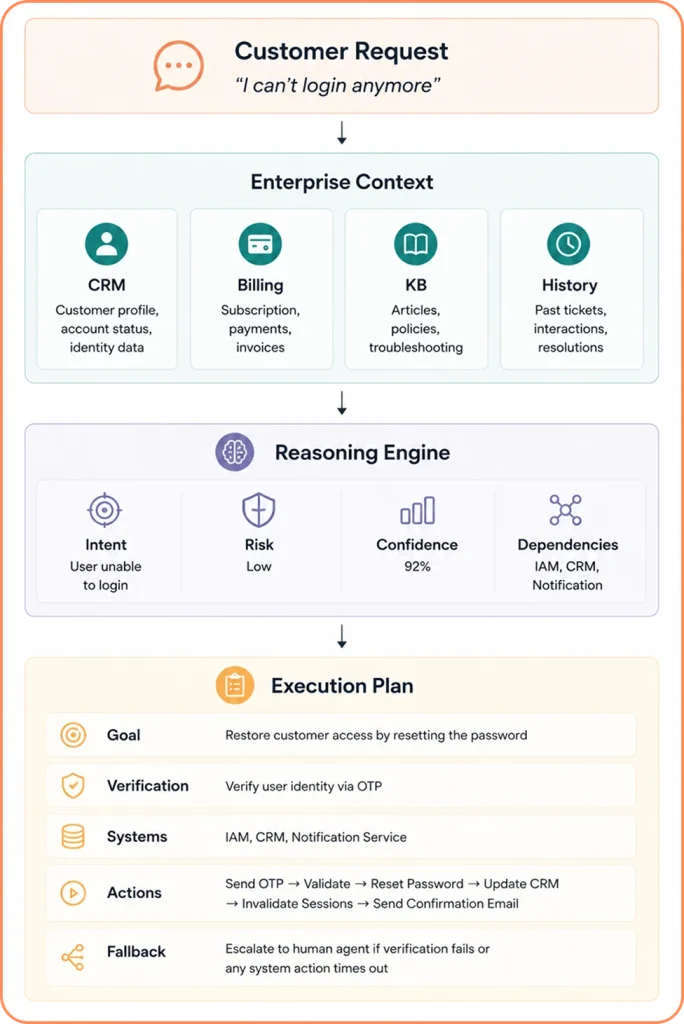
Account details live in the CRM, billing status in payment systems, product state in internal services, previous interactions in the ticketing platform, and operational procedures in the knowledge base.
Treating the customer message as the primary source of truth forced the reasoning engine to make decisions with only a partial view of the customer’s state.
Our initial approach was straightforward: retrieve everything that might be relevant and forward it to the planner.
Recall improved, but planning quality did not. Duplicate records, outdated documentation, conflicting account data, and low-value search results increased inference time while making workflow selection less reliable.
The reasoning engine spent more time deciding which information to trust than determining how to resolve the request.
To address this, we introduced a dedicated context ranking layer between retrieval and reasoning.
Retrieval fan-outs execute concurrently across connected enterprise systems to assemble customer context within the latency budget of an interactive support session.
Instead of forwarding every retrieved artifact, the platform evaluates each result using multiple ranking signals – including semantic similarity, source reliability, freshness, and customer relevance – before constructing the final context package delivered to the planner.
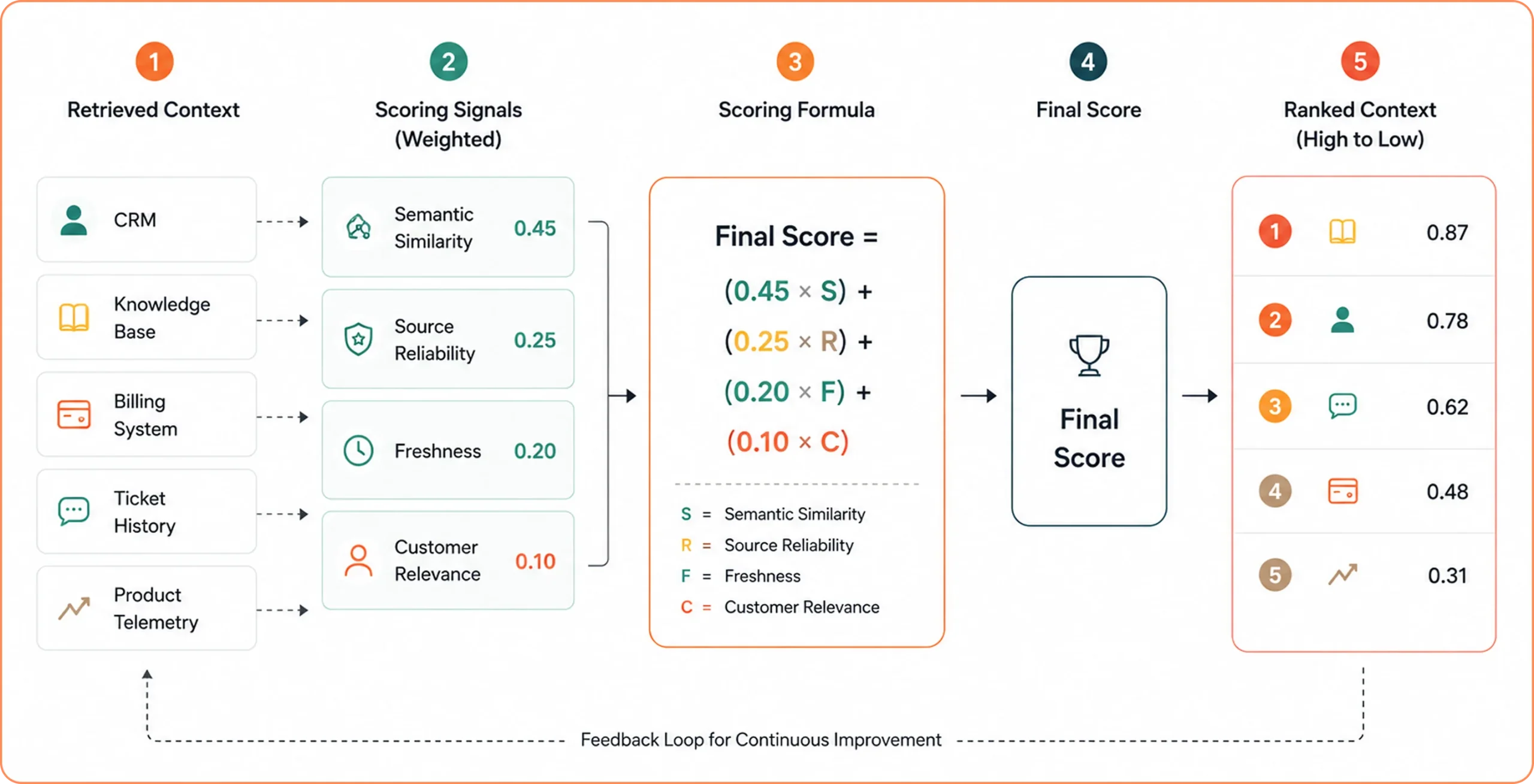
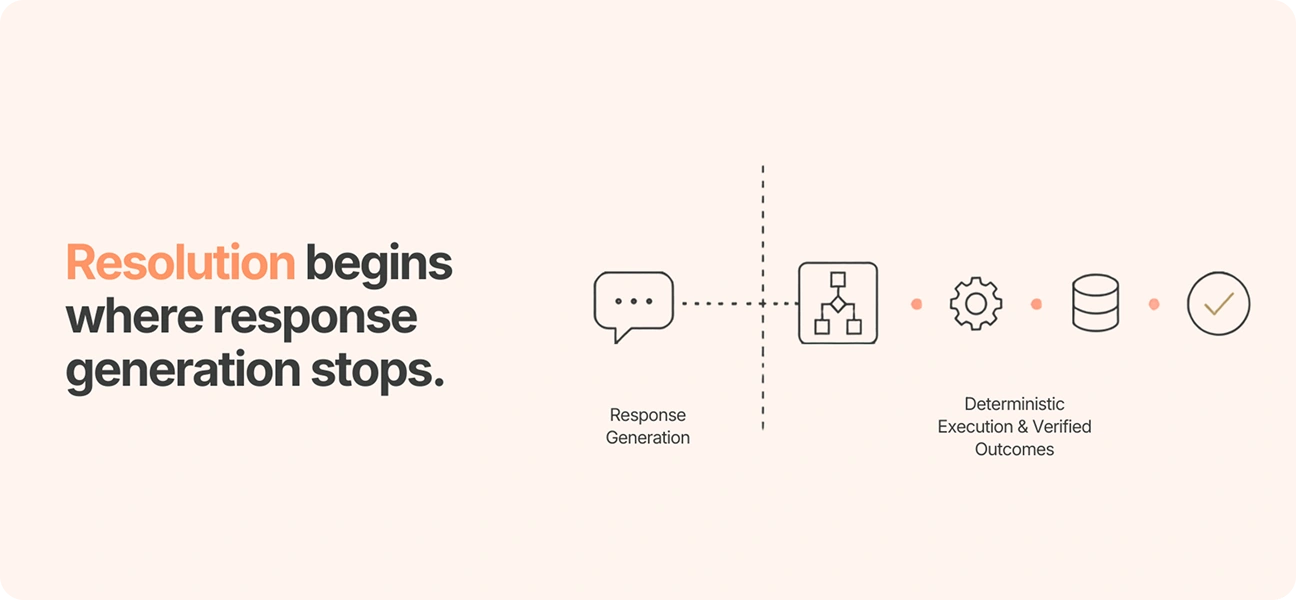
The ranking layer establishes another architectural boundary within the resolution pipeline.
By the time the reasoning engine begins planning, duplicate records have been removed, conflicting information has been prioritized, and low-confidence artifacts have been filtered out.
Rather than searching for context during inference, the planner operates on a concise representation of the customer’s current enterprise state.
Moving context evaluation ahead of reasoning changed the role of the language model.
The planner no longer resolves conflicting enterprise records or determines which data source should be trusted.
Its responsibility begins only after enterprise context has been assembled, ranked, and validated, allowing inference to focus exclusively on selecting the most appropriate execution plan.