Skip to content

Engineering Deterministic Decision Paths for Azeon’s Reasoning Engine

Engineering Deterministic Decision Paths for Azeon’s Reasoning Engine

When we started building Azeon, we discovered that reasoning accuracy wasn’t our biggest challenge – reasoning consistency was.

Modern reasoning models excel at understanding customer intent. The challenge begins when that understanding translates into execution. Two requests with identical business intent can follow different reasoning paths, resulting in variations in workflow selection, policy evaluation, and execution order.

For conversational AI, this variability is acceptable.

For an agentic support platform responsible for identity verification, compliance, workflow automation, and auditability, it isn’t.

We initially tried improving prompts and reasoning models, but the problem wasn’t the model – it was the architecture.

Defining the Architectural Boundary

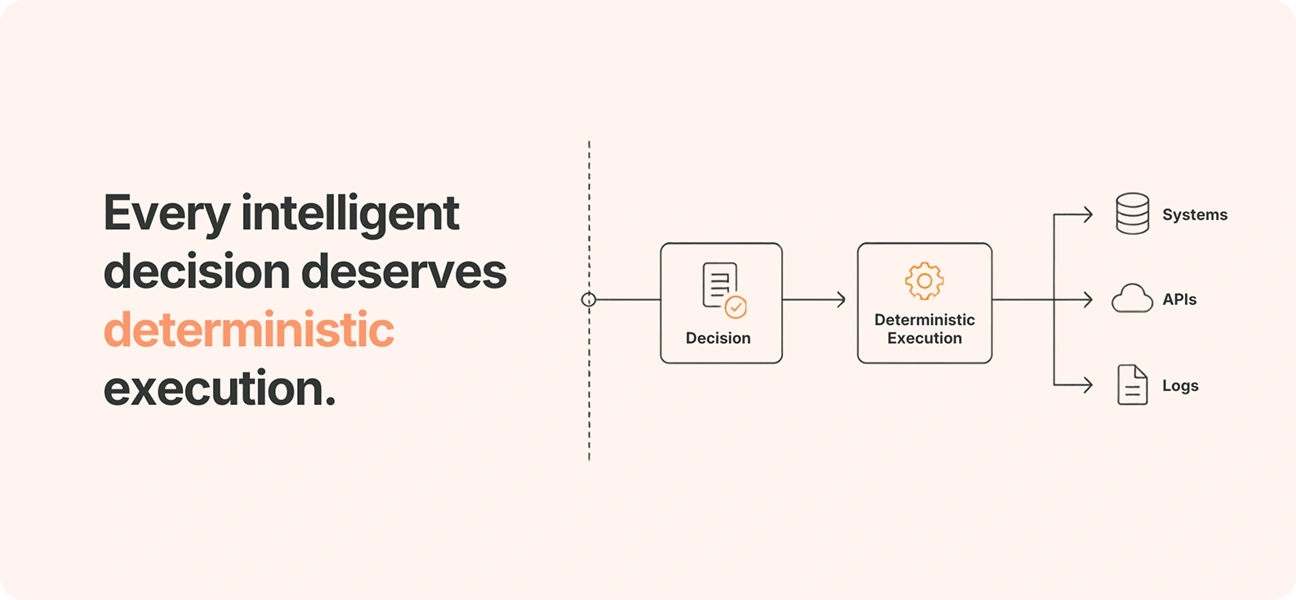
Azeon separates probabilistic reasoning from deterministic execution by enforcing a strict architectural boundary between decision inference and workflow orchestration.

In our earliest architecture, the reasoning engine interpreted customer intent and directly influenced workflow selection, policy evaluation, escalation logic, and actions. While this simplified the initial implementation, it also coupled language understanding with execution control.

As the platform matured, that coupling became increasingly difficult to manage. Every additional responsibility expanded the number of possible execution paths, making operational behavior dependent on probabilistic reasoning rather than deterministic platform logic.

Reasoning and execution solve fundamentally different problems.

Reasoning resolves ambiguity from natural language and customer context.

Execution applies deterministic business rules to produce predictable outcomes.

Combining both responsibilities within a single architectural layer introduced unnecessary variability into workflows.

To address this, we redefined the responsibility of the reasoning engine.

Instead of determining how the platform should operate, it now determines where the customer currently exists within the runtime state graph and what the next valid state transition should be.

Everything beyond that boundary – including policy enforcement, workflow orchestration, and execution – is handled by deterministic platform services.

The diagram below illustrates this architectural evolution. Rather than allowing the reasoning engine to control workflows directly, Azeon limits its responsibility to state inference.

Every downstream action is executed through deterministic infrastructure, ensuring identical execution behavior regardless of reasoning model variability.
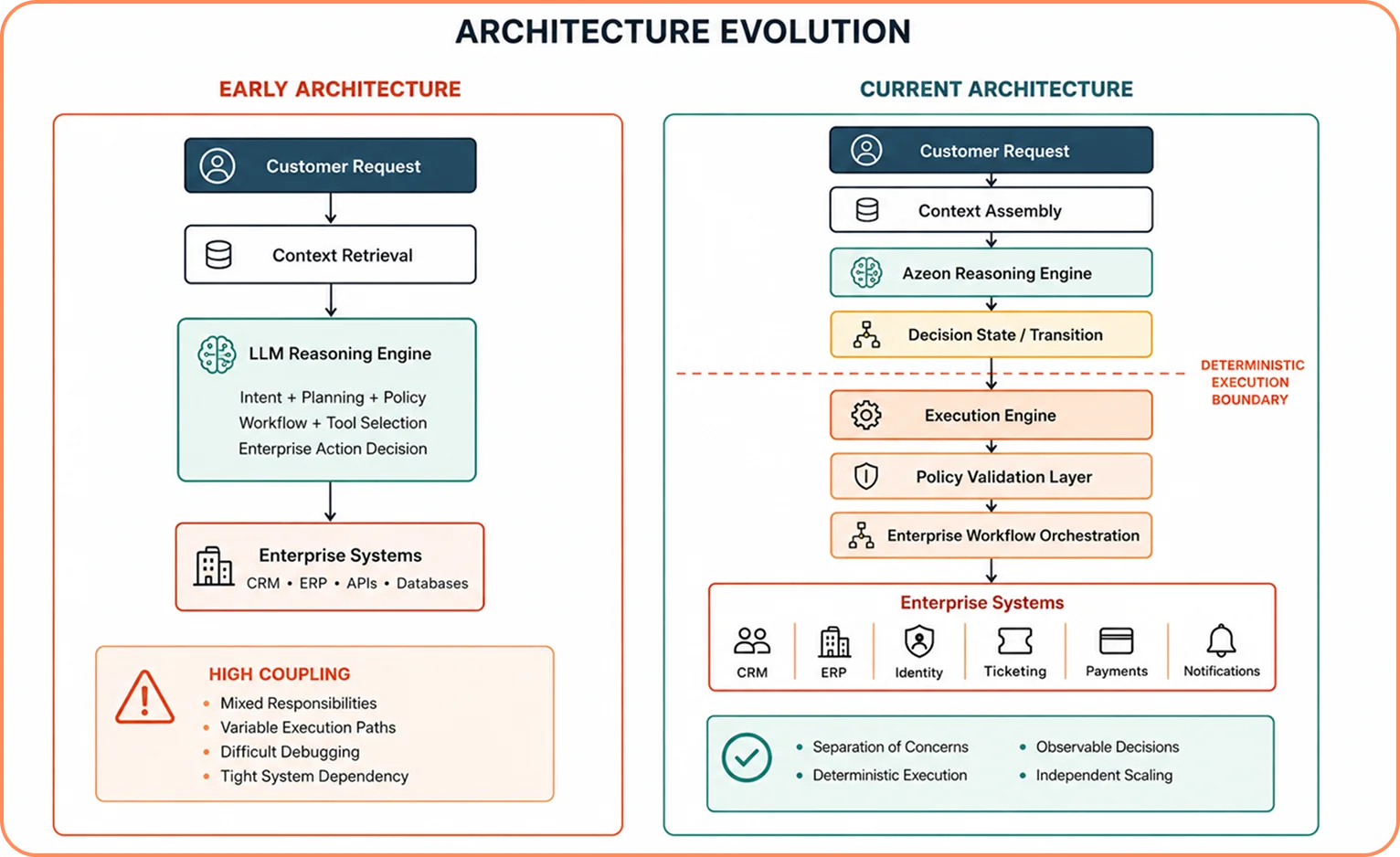
Azeon Architecture Evolution

This separation significantly reduced execution variability while simplifying the reasoning layer.

The model focuses exclusively on interpreting intent and selecting the next valid state, while the platform guarantees consistent execution through engineered infrastructure.

Engineering the Decision Graph 

Once reasoning stopped owning execution, we needed a deterministic structure capable of representing every supported customer journey.

Traditional workflow engines model business processes as linear sequences. Customer support systems rarely behave that way. A single interaction can branch based on customer identity, entitlement, account state, compliance requirements, previous conversations, or external system responses.

Representing these scenarios as sequential workflows quickly became difficult to maintain and even harder to govern.

Instead, Azeon models customer journeys as a Decision Graph.

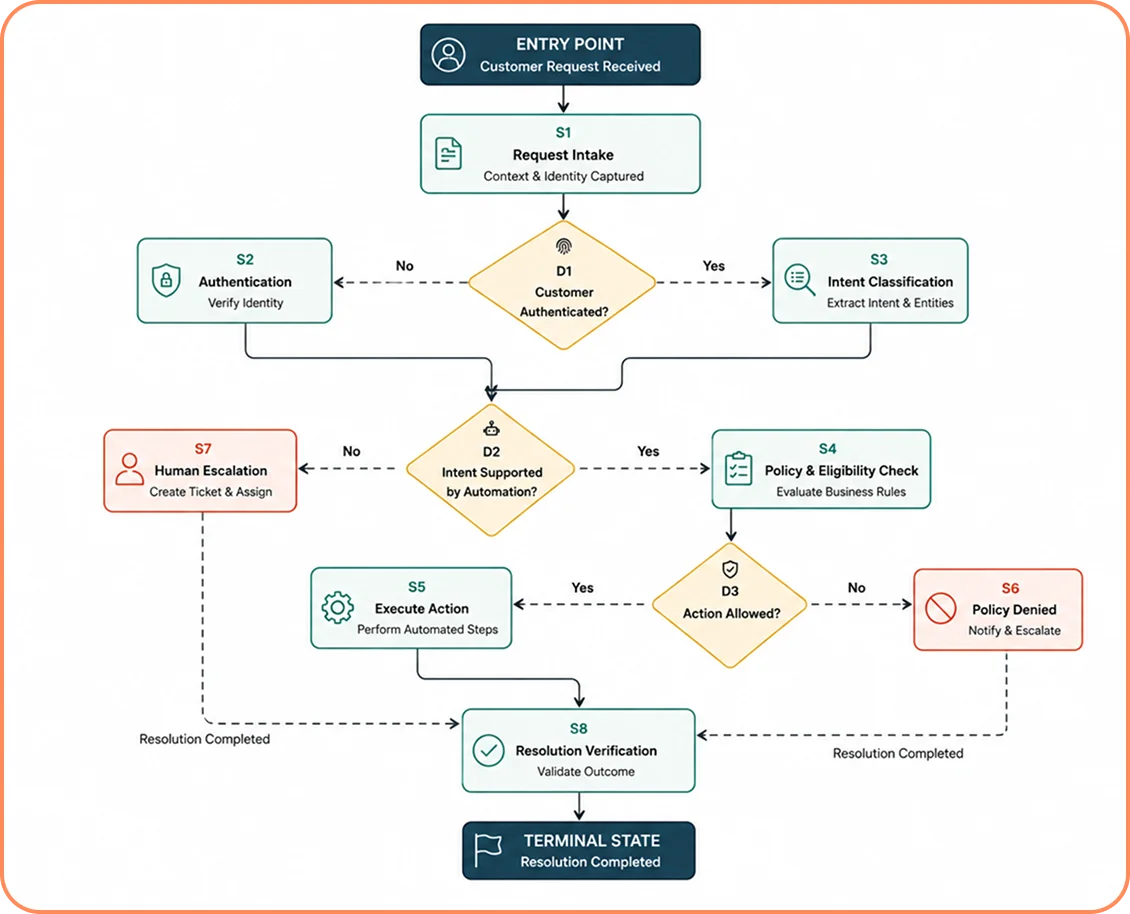
Internally, the graph behaves as a finite-state model where every node represents a business state and every directed edge represents a valid state transition.

Unlike reasoning outputs, the graph itself is fully engineered.

Business policies, compliance rules, approval logic, and operational constraints are encoded within the graph rather than generated dynamically by the reasoning model. This allows workflows to evolve independently of reasoning model behavior.

The image below shows how the Decision Graph represents customer journeys. The reasoning engine doesn’t generate workflows or APIs. Instead, it identifies the customer’s current runtime state and selects the next valid transition from a predefined set of engineered paths.

Simplified Decision Graph

This architectural model changes the role of the reasoning engine entirely.

Rather than inventing workflows, it navigates an engineered state graph whose transitions are already governed by deterministic business logic.

State-Driven Reasoning

One of the biggest architectural changes inside Azeon was redefining what the reasoning engine actually produces.

Most AI systems treat reasoning as a workflow selection problem. The model decides what should happen next, often combining interpretation, planning, and execution into a single reasoning cycle.

We deliberately separated those concerns.

Inside Azeon, reasoning produces state transitions, not actions.

Instead of asking “Which workflow should execute?” the reasoning engine answers a different question: “Given the customer’s current context, what is the next valid decision state?”

That subtle shift fundamentally changes how the platform behaves.

The reasoning engine no longer needs to understand API contracts, retry logic, downstream dependencies, or compliance requirements. It only needs sufficient context to determine the correct transition within the decision graph.

For example, after successful identity verification, the reasoning engine doesn’t decide to unlock an account, update a CRM, or send a confirmation email.

It transitions the customer from Identity Verified to Eligible for Credential Recovery.

That transition becomes a deterministic input for the execution layer, which owns every action that follows.

Reducing reasoning to state transitions allowed us to isolate probabilistic decision-making from deterministic execution without reducing the intelligence of the system.

Instead, it gave each layer a single, well-defined responsibility.

Deterministic Transition Validation

Once the reasoning engine selects the next valid state transition, its responsibility ends.

From that point onward, the platform treats the transition as an execution request rather than an AI decision.

Every proposed transition passes through a deterministic validation pipeline before any workflow is initiated. The objective isn’t to validate the reasoning model – it is to verify that the requested transition satisfies every operational, business, and compliance constraint defined by the platform.

Unlike reasoning, which operates probabilistically, this validation pipeline produces identical outcomes for identical inputs, regardless of the reasoning model or prompt used upstream.

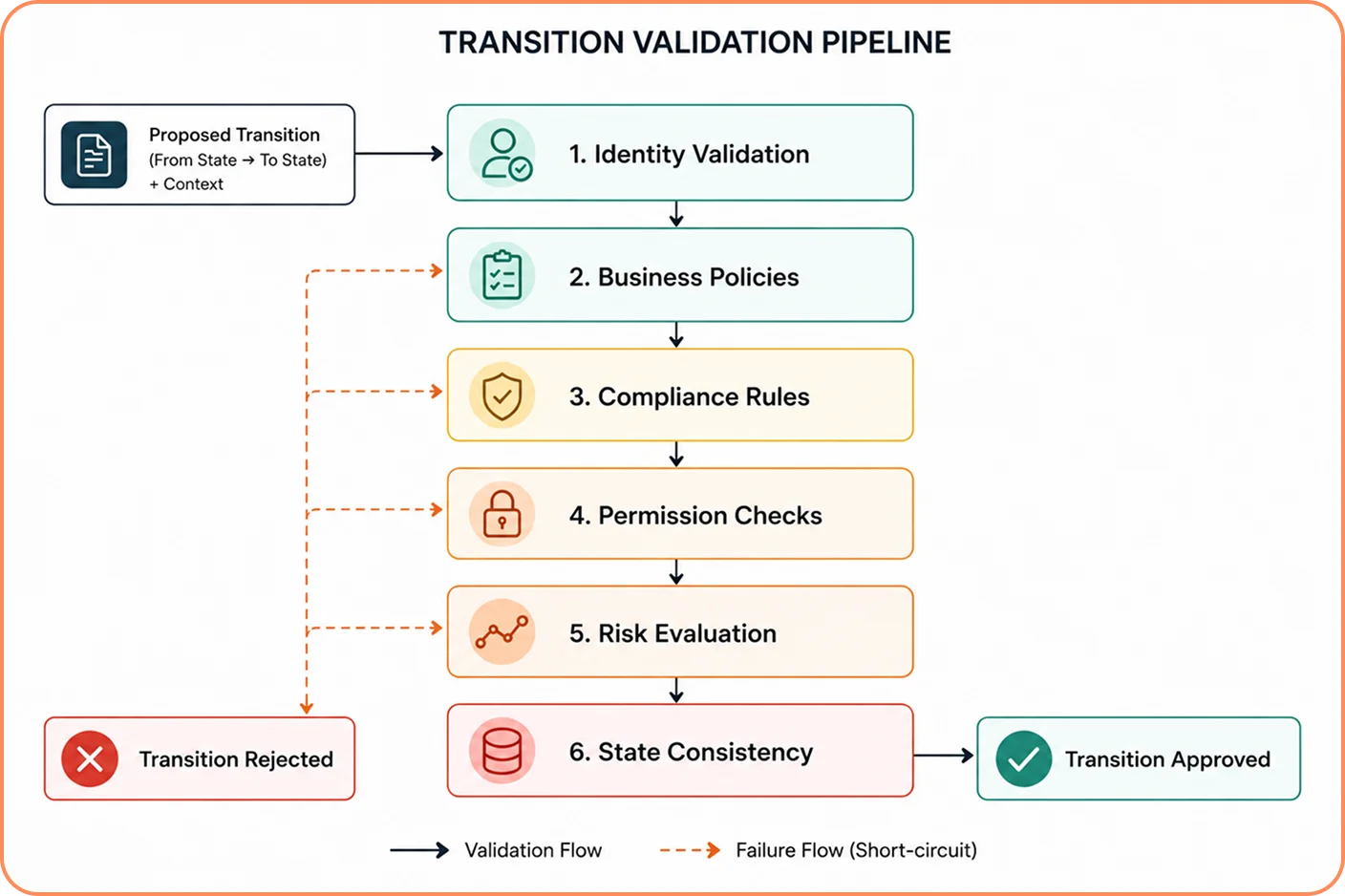
The figure below illustrates Azeon’s validation pipeline. Each state transition is evaluated independently through deterministic validation layers before it becomes eligible for execution.

Separating validation from reasoning ensures actions remain governed by platform policies rather than model confidence.

Transition Validation Pipeline

Each stage within the pipeline evaluates a different operational concern.

  • Identity Validation verifies authentication and customer identity.
  • Policy Evaluation applies entitlement rules and organizational policies.
  • Compliance Evaluation enforces regulatory and governance constraints.
  • Authorization validates access permissions for downstream operations.
  • Risk Assessment evaluates operational safeguards before execution.
  • State Consistency confirms that the requested transition preserves workflow integrity.

Only after every validation succeeds does the transition become executable.

The reasoning engine proposes a transition.

The platform authorizes it.

Separating Reasoning from Execution

One of the earliest architectural decisions in Azeon was preventing the reasoning engine from communicating directly with enterprise systems.

Many AI applications allow language models to invoke APIs, select tools, and orchestrate workflows directly. While this approach accelerates development, it tightly couples reasoning behavior with operational execution.

Azeon intentionally avoids this architecture.

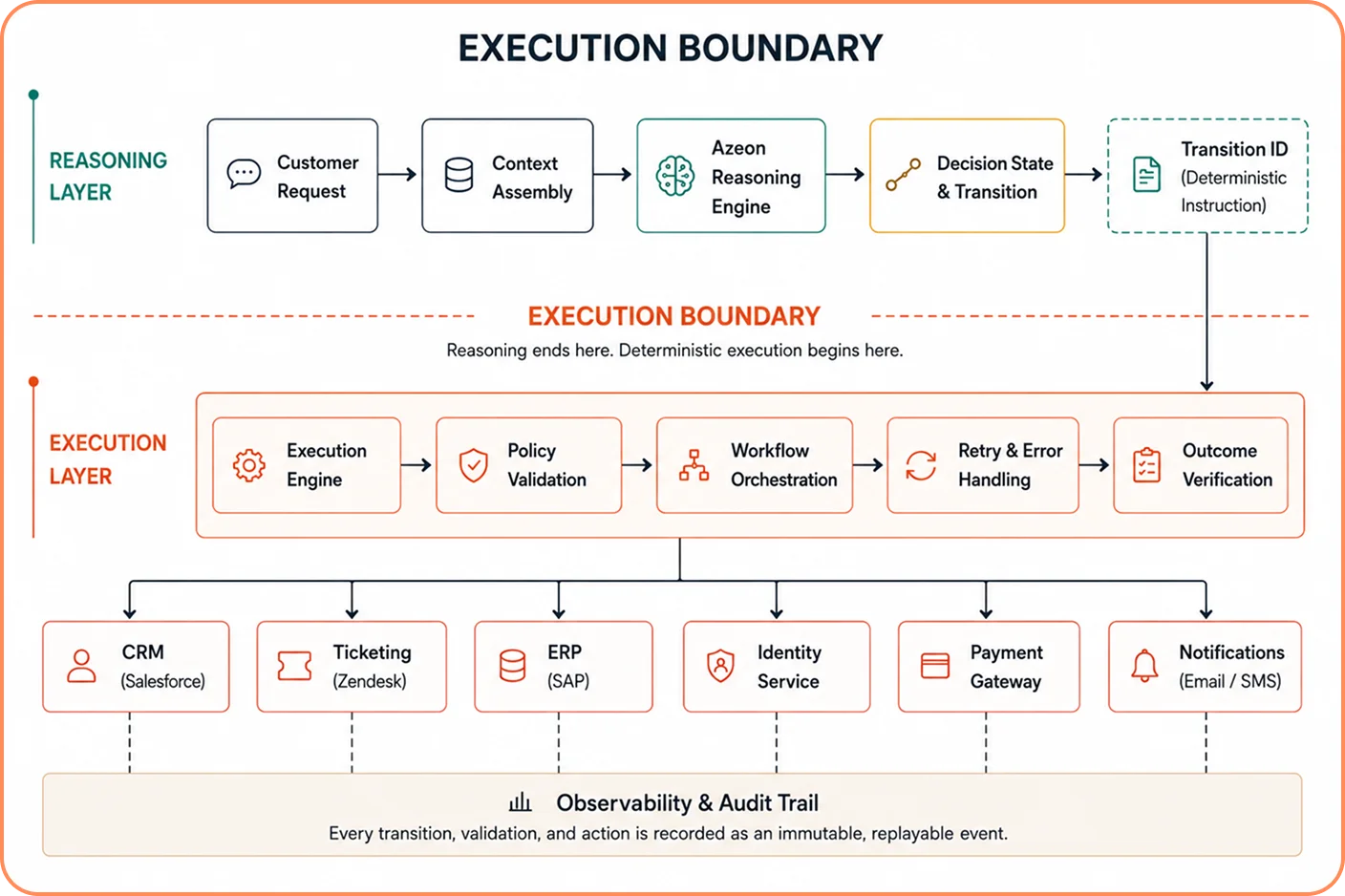
The reasoning layer has no awareness of CRM schemas, ticketing platforms, payment gateways, identity providers, or orchestration logic. Instead, it produces a Transition ID – a deterministic representation of the approved state transition.

That Transition ID becomes the only input consumed by the orchestration layer.

The image below shows the execution boundary inside Azeon. The reasoning layer terminates at the Transition ID, while every downstream responsibility – including orchestration, policy enforcement, retry handling, and integrations – is delegated to deterministic platform services.

Execution Boundary

The orchestration layer owns every enterprise operation that follows.

It resolves service dependencies, sequences API execution, manages retries, performs rollback where required, records execution metadata, and verifies successful completion before advancing the workflow.

Because reasoning and execution remain completely isolated, each subsystem evolves independently.

Reasoning models can improve without changing integrations, while workflow implementations can evolve without affecting how customer intent is interpreted.

This separation significantly reduces operational complexity while improving maintainability, observability, and long-term system scalability.

Replayability as a First-Class Design Principle

Deterministic execution solves only part of the AI problem.

The remaining challenge is explaining why every automated decision occurred.

That requirement led us to treat every approved state transition as an immutable execution event.

Rather than storing only the final outcome, Azeon persists every transition throughout the resolution lifecycle, creating a complete execution history that can be reconstructed long after the original interaction has finished.

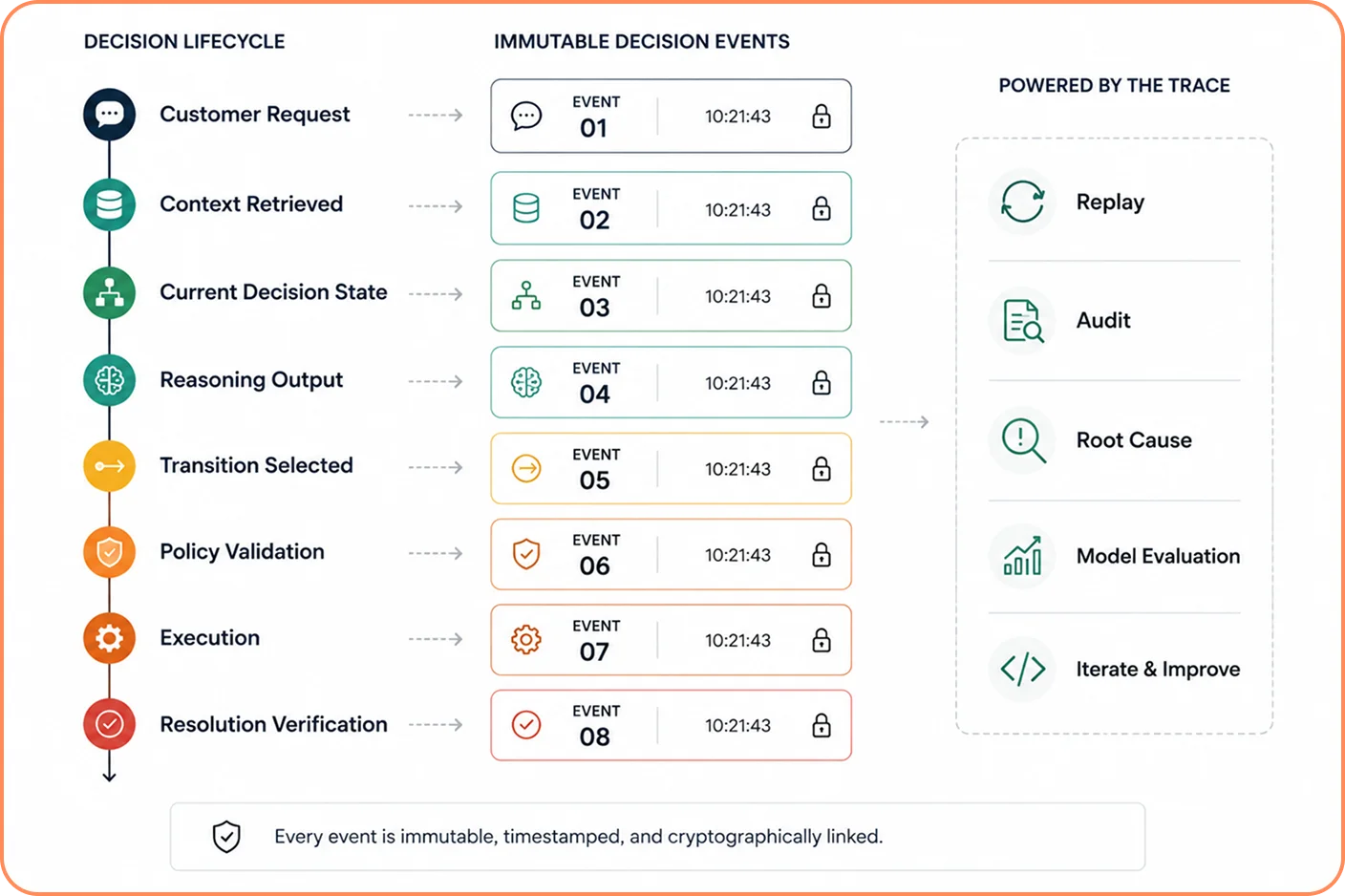
The image below illustrates how every stage in the decision lifecycle becomes an immutable event.

Instead of relying on conversational history, Azeon records a timestamped sequence of execution events that can be replayed, audited, and analyzed independently of the reasoning model.

Immutable Decision Timeline

Each transition records operational metadata, including:

  • Current and next decision states
  • Retrieved context references
  • Applied business policies
  • Validation outcomes
  • Actions executed
  • Execution latency
  • Resolution verification status

Because every transition is persisted independently, engineering teams can replay complete customer journeys, compare reasoning behavior across model versions, investigate production incidents, evaluate workflow changes, and audit decisions without reconstructing conversations.

Observability is therefore not an operational add-on – it is an architectural property of the platform itself.

Closing Thoughts

Building Agentic AI isn’t about making language models perfectly deterministic.

It’s about understanding where determinism actually belongs.

Inside Azeon, reasoning remains probabilistic because that’s where language models create value. They interpret intent, resolve ambiguity, and identify the customer’s next valid decision state.

Everything beyond that point is engineered.

Decision paths are predefined. State transitions are validated. Actions are orchestrated through deterministic infrastructure. Every execution is observable, replayable, and governed by platform policies rather than model behavior.

Looking back, this architectural boundary changed more than our reasoning engine.

It changed how we design AI systems.

Instead of asking the model to become more predictable, we built a platform where predictability naturally emerges from the architecture surrounding it. That’s the principle that continues to shape how we engineer Azeon today.

Vinus Akhediya is the Solution Architect at Azeon, where he leads the design and architecture of the platform's Agentic AI engine for customer support. His work focuses on AI reasoning, autonomous agent workflows, enterprise integrations, knowledge orchestration, workflow execution, and scalable AI infrastructure that enables Azeon to resolve customer inquiries with accuracy, speed, and governance.

Vinus Akhediya
Solution Architect

Questions about Azeon?

Connect with our team to explore use cases, workflows, and deployment possibilities.