
Skip to content

How Agentic AI in Banking Customer Service Reduces Cost per Resolution?

How Agentic AI in Banking Customer Service Reduces Cost per Resolution?

Banking support leaders track dozens of customer service metrics every month. Average handle time, service levels, call volumes, abandonment rates, and agent productivity all appear on dashboards.

Yet one number increasingly drives executive conversations: Cost per resolution.

A bank may answer a customer in 30 seconds and still spend $15 resolving the issue. Another bank may spend two minutes longer on the first interaction and resolve the issue for $4.

That difference directly affects operating costs, customer experience, and support scalability.

This shift has brought agentic AI in banking customer service into focus. Unlike traditional chatbots that answer questions or route customers, agentic AI understands intent, evaluates customer context, accesses connected systems, and determines the next action required to resolve the issue.

The objective becomes simple:

Resolve the customer’s issue with the fewest resources possible while maintaining compliance and service quality.
Why Traditional Automation Still Produces Expensive Resolutions?

Most banks have some level of automation today. Chatbots answer questions. IVRs route calls. Self-service portals provide information.

These tools improve accessibility, but many customer requests still require human involvement.

When a customer asks: “Why did my mortgage payment fail?”

A typical support journey may involve account verification, payment history reviews, policy checks, system lookups, and internal coordination.

The chatbot provides an answer. The employees complete the work.

Depending on staffing costs and operational complexity, a bank may spend anywhere from $8 to $15 resolving this type of issue. If the customer calls again, the total cost can easily exceed $15 per resolution.

Now multiply that by 50,000 payment-related inquiries annually.

A support operation may spend $500,000 to $1 million each year handling routine requests that follow predictable workflows.

As support volumes grow, these small inefficiencies become significant operational expenses. Even a $3 reduction in cost per resolution can save a mid-sized bank hundreds of thousands of dollars annually.

How Agentic AI in Banking Customer Service Works?

Agentic AI follows the same logic as an experienced banking representative.

The system understands the customer’s request, gathers context, reviews relevant information, accesses connected systems, and determines the next action.

Imagine a customer saying: “My loan payment posted twice this month.”

An agentic AI system can review payment records, verify transaction status, identify duplicate entries, apply business rules, and provide the next step based on bank policies.

If the issue requires human review, the case reaches an employee with complete context.

The agent does not spend 5-10 minutes gathering information before helping the customer.

The investigation already exists.

This approach reduces the amount of labor required to achieve a successful outcome.

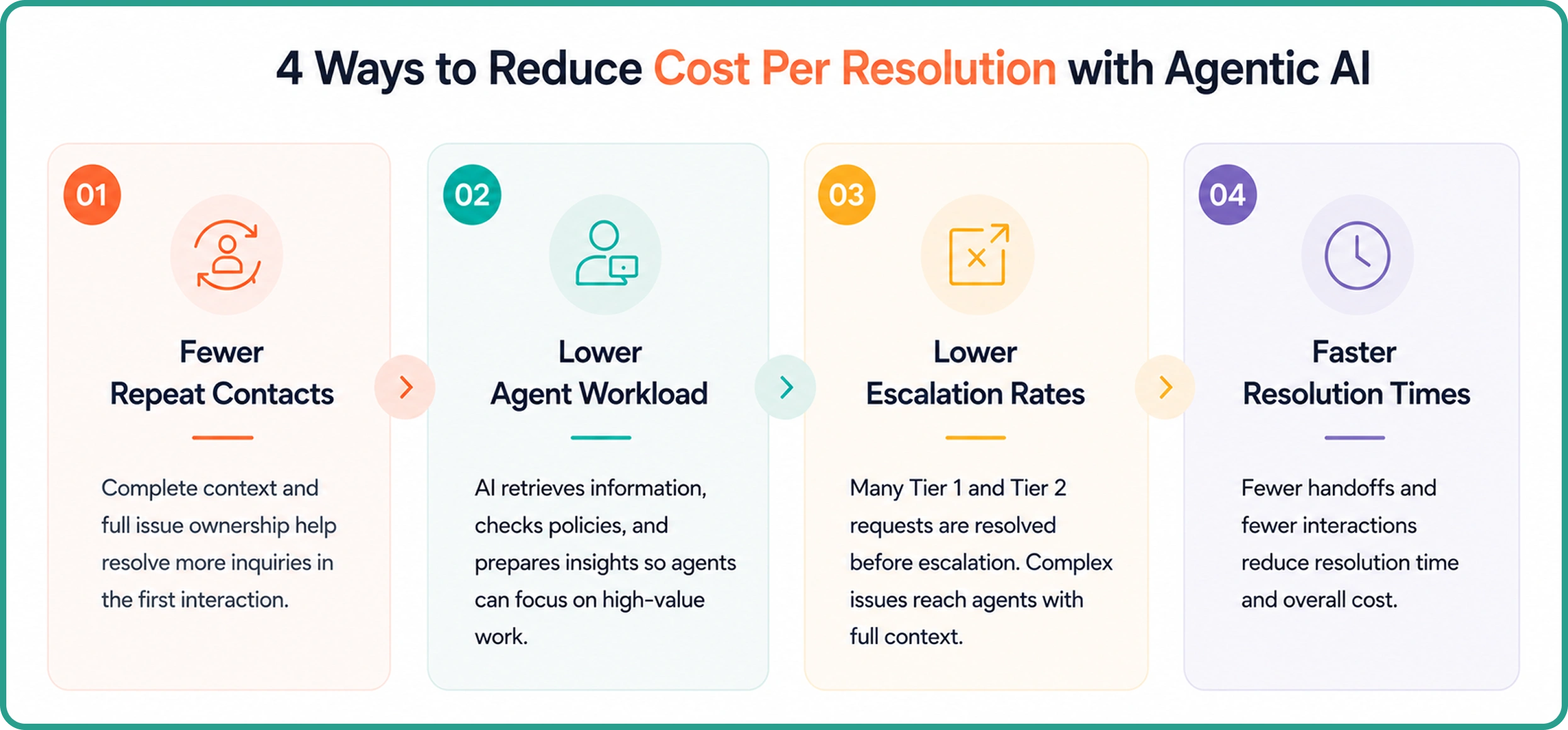
Four Areas Where Agentic AI in Banking Customer Service Reduces Cost per Resolution

The largest support costs rarely come from answering customer questions. The expense often comes from everything that happens afterward.

Reduce Cost Per Resolution in Banking Customer Support with Agentic AI

1. Fewer Repeat Contacts

Repeat contacts create major expenses.

A customer who contacts support three times may generate:

  • Three conversations
  • Three authentication steps
  • Three agents
  • Three queue positions

Agentic AI provides complete context and full issue ownership.

Many inquiries reach resolution during the first interaction.

Lower repeat volume directly reduces support costs.

2. Lower Agent Workload

Support representatives spend a significant portion of their day gathering information. They open multiple systems, search knowledge bases, review account histories, and verify policies.

Agentic AI performs much of this work automatically.

Employees receive relevant information immediately, which allows them to focus on judgment, relationships, and exception handling.

3. Lower Escalation Rates

Escalations increase resolution costs rapidly.

Every transfer introduces additional labor costs, longer resolution times, customer frustration, and operational overhead.

Agentic AI resolves many Tier 1 and Tier 2 requests before escalation becomes necessary.

When complex issues arise, it still reaches a human agent with complete context.

4. Faster Resolution Times

Resolution speed directly influences support costs.

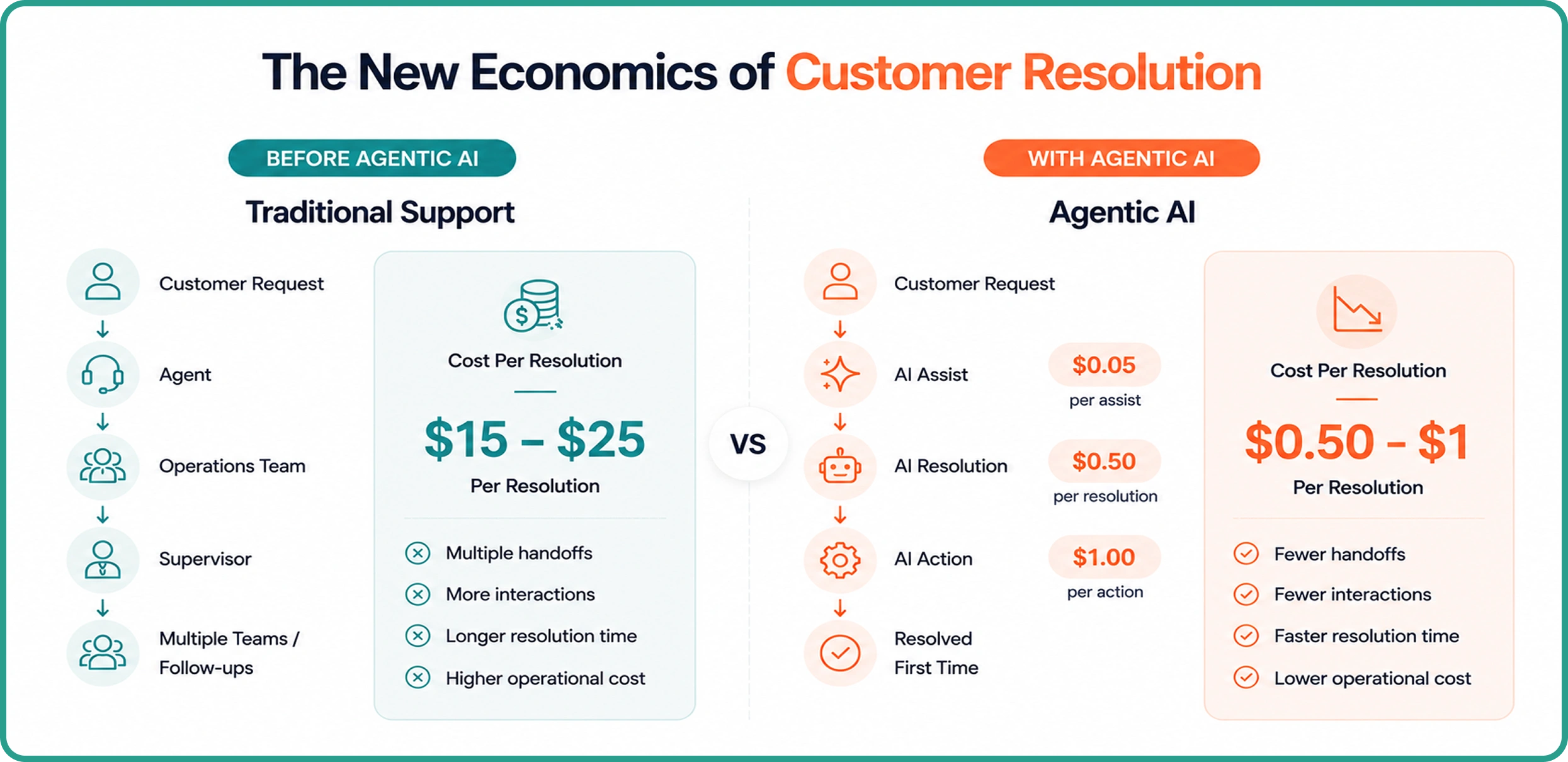
A bank may spend anywhere from $8 to $12 for a standard agent-assisted inquiry. Once a case requires multiple teams, additional investigations, or follow-up interactions, the cost may increase to $15 to $25 per resolution.

Agentic AI changes these economics because fewer people, fewer handoffs, and fewer interactions contribute to each resolution.

Faster Resolution Times with Agentic AI

Platforms such as Azeon have introduced outcome-based pricing models that align AI costs with completed work rather than seats or conversation volume.

  • AI-assisted support may start around $0.05 per assist, allowing agents to receive recommendations, knowledge retrieval, and contextual guidance during customer interactions.
  • AI-resolved inquiries can begin at approximately $0.50 per resolution, where the AI independently handles customer issues from start to finish.
  • For operational workflows that require system updates, approvals, or business actions, AI-completed tasks may start around $1 per completed action.

The economics become particularly interesting at scale.

A bank handling 100,000 customer requests annually and shifting just 40,000 routine inquiries to autonomous resolution could reduce support costs from approximately $400,000 to $20,000 for those interactions.

This shift explains why many banking leaders have started evaluating customer service AI through the lens of cost per resolution rather than interaction volume.

Cost-Saving Use Cases of Agentic AI in Banking Customer Support

Certain banking inquiries appear thousands of times each month.

These requests offer strong opportunities for agentic AI.

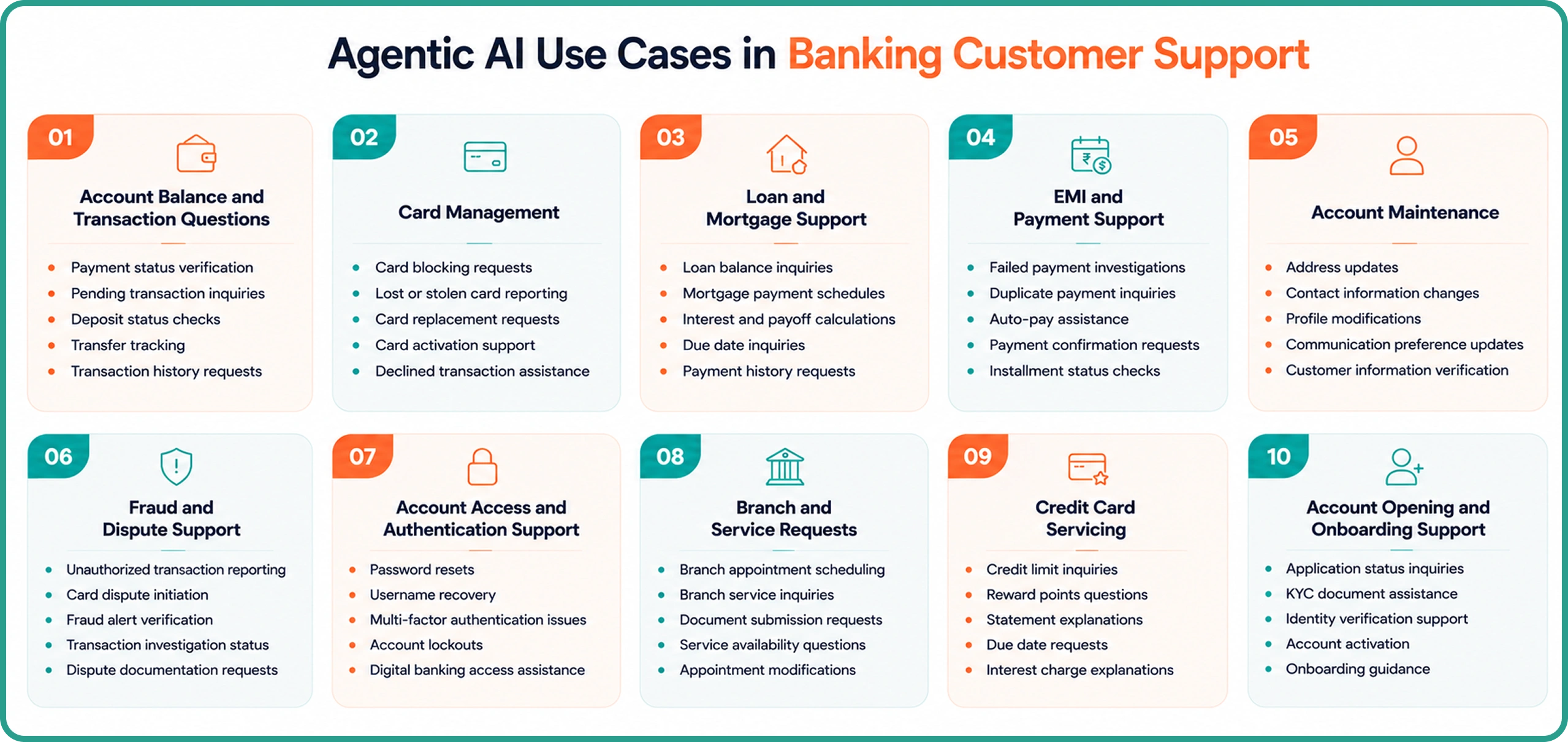
Agentic AI Use Cases in Banking Customer Support

1. Account Balance and Transaction Questions

Common use cases:

  • Payment status verification
  • Pending transaction inquiries
  • Deposit status checks
  • Transfer tracking
  • Transaction history requests

Agentic AI can review account activity, payment status, settlement timelines, and transaction records to provide accurate answers and reduce repeat contacts.

2. Card Management

Common use cases:

  • Card blocking requests
  • Lost or stolen card reporting
  • Card replacement requests
  • Card activation support
  • Declined transaction assistance

These workflows follow well-defined processes, allowing agentic AI to verify customer information, initiate actions, and guide customers toward resolution.

3. Loan and Mortgage Support

Common use cases:

  • Loan balance inquiries
  • Mortgage payment schedules
  • Interest and payoff calculations
  • Due date inquiries
  • Payment history requests

Agentic AI can access loan systems, retrieve account information, and provide immediate assistance without requiring manual investigation.

4. EMI and Payment Support

Common use cases:

  • Failed payment investigations
  • Duplicate payment inquiries
  • Auto-pay assistance
  • Payment confirmation requests
  • Installment status checks

These requests often involve predictable workflows that allow agentic AI to identify issues, explain outcomes, and support faster resolution.

5. Account Maintenance

Common use cases:

  • Address updates
  • Contact information changes
  • Profile modifications
  • Communication preference updates
  • Customer information verification

Connected systems allow agentic AI to initiate approved updates, maintain audit records, and reduce manual effort for routine account maintenance requests.

6. Fraud and Dispute Support

Common use cases:

  • Unauthorized transaction reporting
  • Card dispute initiation
  • Fraud alert verification
  • Transaction investigation status
  • Dispute documentation requests

These interactions often involve multiple teams, making them expensive to resolve. Agentic AI can collect information, validate transactions, initiate workflows, and route cases with complete context.

7. Account Access and Authentication Support

Common use cases:

  • Password resets
  • Username recovery
  • Multi-factor authentication issues
  • Account lockouts
  • Digital banking access assistance

These requests represent some of the highest support volumes in retail banking and often follow structured resolution processes.

8. Branch and Service Requests

Common use cases:

  • Branch appointment scheduling
  • Branch service inquiries
  • Document submission requests
  • Service availability questions
  • Appointment modifications

Agentic AI can handle scheduling, provide service information, and guide customers to the appropriate banking channel.

9. Credit Card Servicing

Common use cases:

  • Credit limit inquiries
  • Reward points questions
  • Statement explanations
  • Due date requests
  • Interest charge explanations

These inquiries frequently occur across both digital and voice channels and follow established policies.

10. Account Opening and Onboarding Support

Common use cases:

  • Application status inquiries
  • KYC document assistance
  • Identity verification support
  • Account activation
  • Onboarding guidance

Agentic AI can track applications, retrieve status information, and guide customers through onboarding steps.

What Banks Should Look for in an Agentic AI Platform?

Before selecting an AI platform, support leaders should look beyond response generation and keep in mind:

System Connectivity

Banking support teams work across multiple systems every day. Customer information may sit in the CRM, payment systems, core banking platforms, knowledge bases, and internal applications.

If the platform cannot access these systems, employees still need to gather information manually.

The platform should connect with the systems your agents already use so customer requests move toward resolution without additional effort.

Governance Controls

Customer service in banking requires accountability.

Every decision, action, and recommendation should remain visible through audit trails and approval mechanisms.

Policy enforcement, role-based access, and governance controls help support teams maintain compliance while allowing AI to participate in customer interactions.

Human Oversight

Certain situations require human judgment, such as fraud investigations, dispute resolutions, policy exceptions, and high-value customer requests, which often need supervisor involvement.

The platform should transfer these cases with complete context so customers do not repeat information and agents can continue the conversation immediately.

Resolution Analytics

Support leaders need visibility into business outcomes.

Customer support KPIs such as resolution rates, cost per resolution, escalation patterns, and customer outcomes provide a clearer picture of operational performance than conversation volume alone.

These insights help banks understand where AI creates measurable value.

How Azeon Supports Banking Customer Service Teams?

Azeon is an agentic AI platform for customer service that helps banks improve resolution rates while reducing support costs.

Our platform combines:

  • AI reasoning
  • Shared customer memory
  • Multi-step decision logic
  • Resolution workflows
  • Governance controls

In fact, Azeon operates across existing support systems, which allows you to improve customer service operations without large-scale replacement projects.

Executive Visibility Across Banking Operations

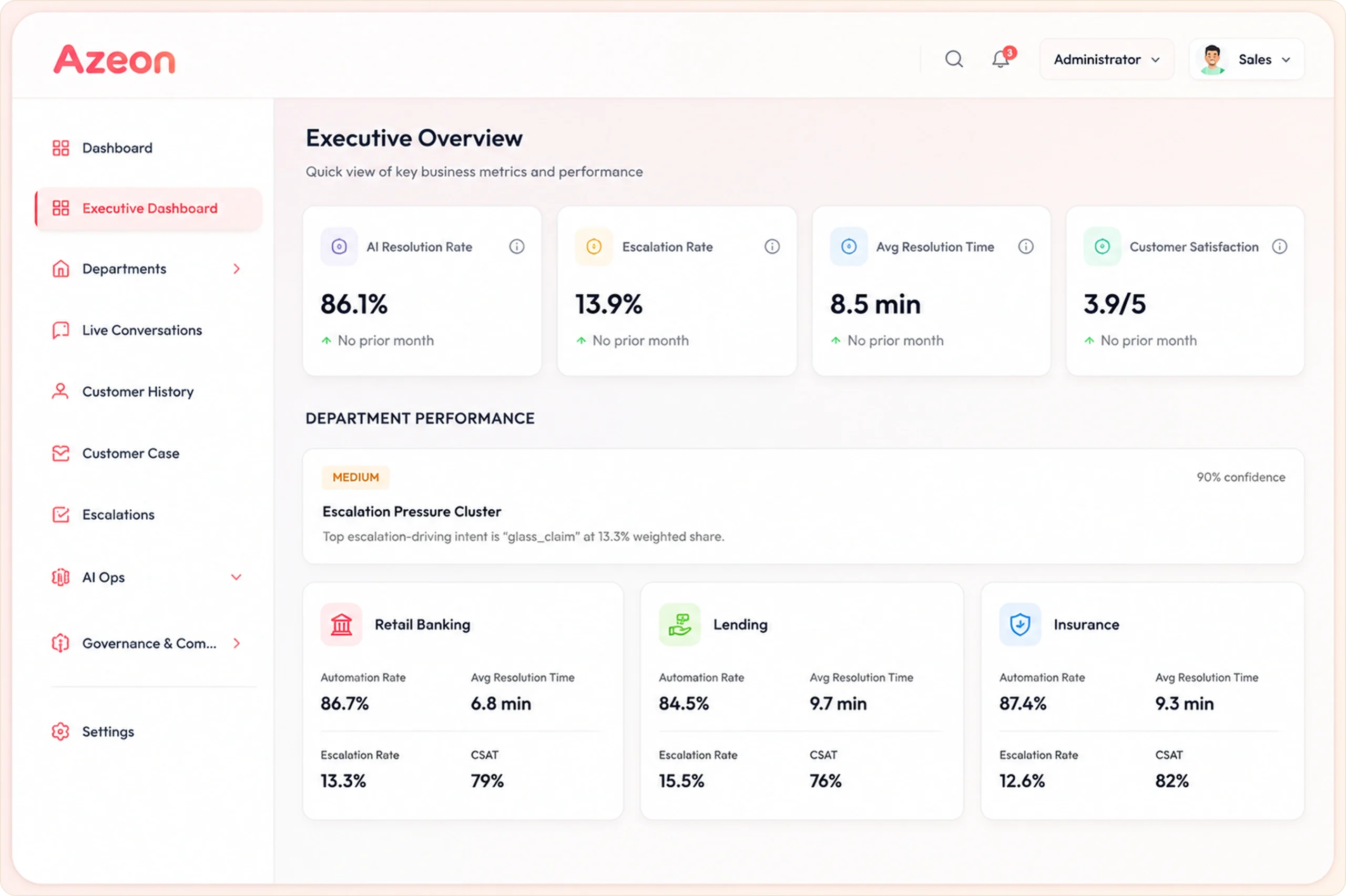
Azeon Executive Dashboard

The executive dashboard gives support leaders a clear view of the metrics that directly affect customer service costs.

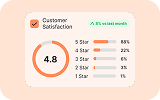
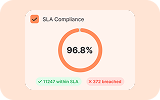
AI resolution rate, escalation rate, average resolution time, and customer satisfaction appear in a single view, helping teams understand how AI performs across the organization.

Department-Level Banking Performance

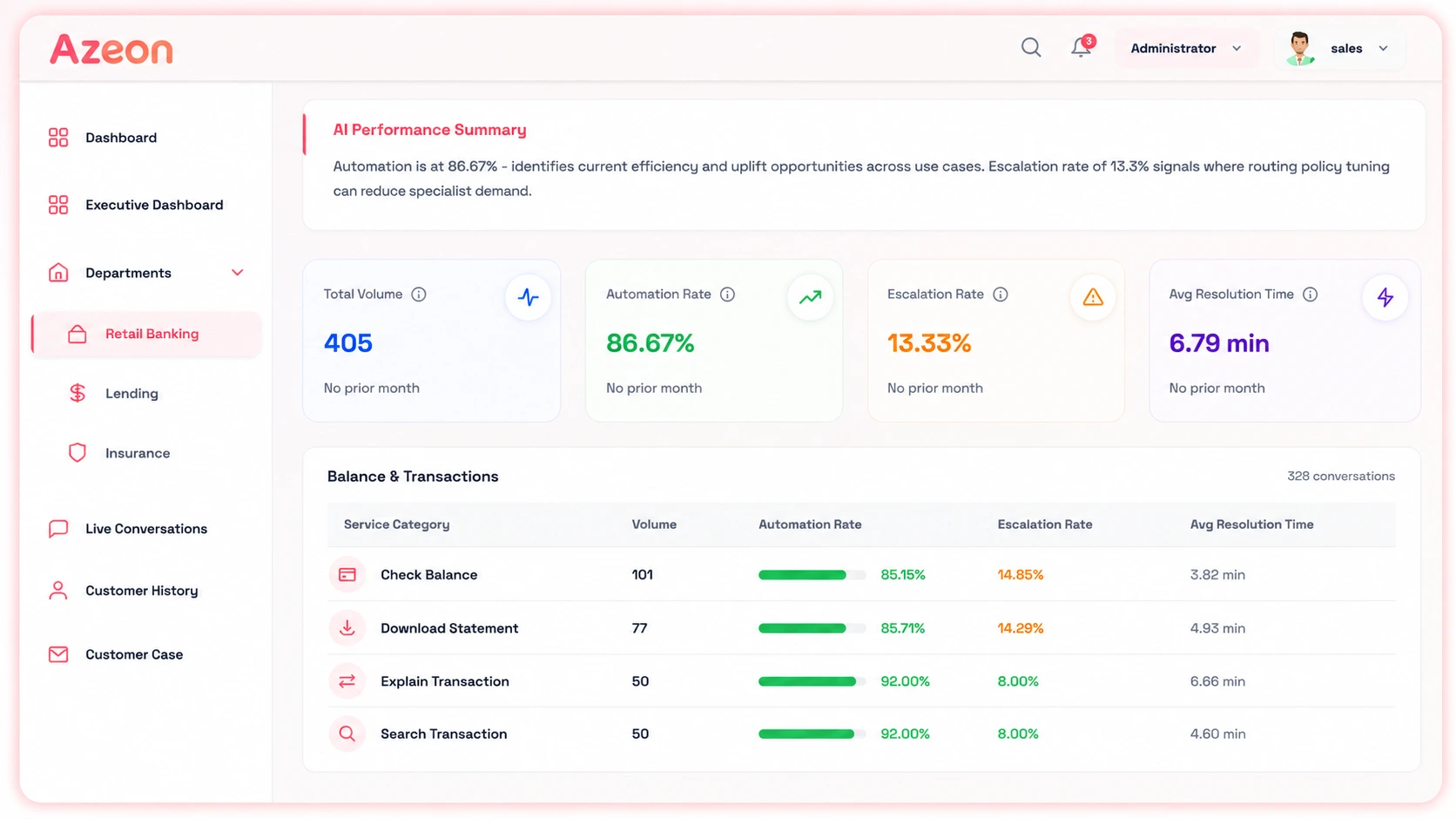
Retail Banking Operations

The dashboard provides visibility into automation rates, escalation rates, average resolution times, and service volumes for individual use cases.

Support teams can monitor high-volume services such as balance inquiries, transaction explanations, and statement requests.

Escalation Management and Human Oversight

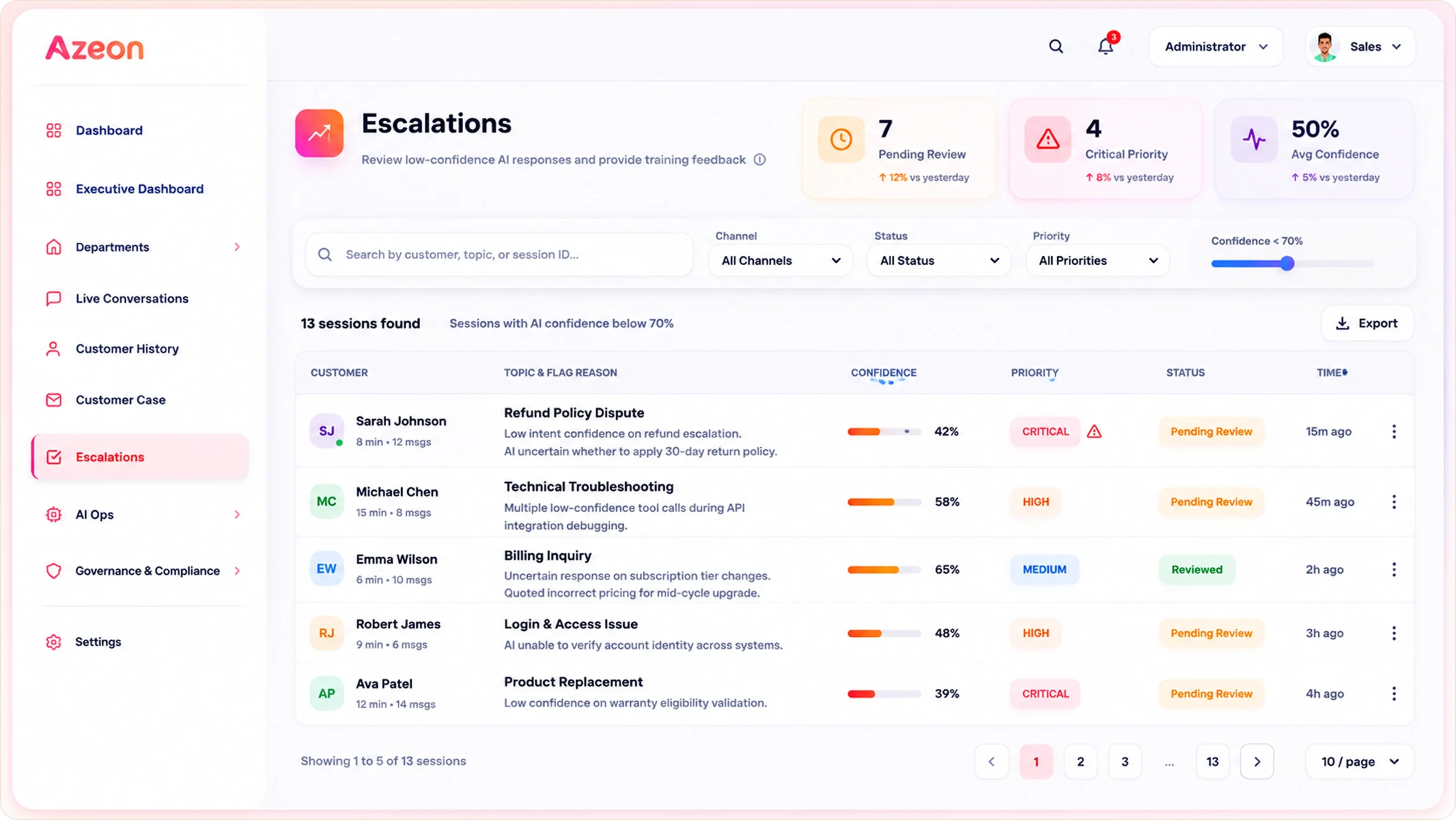
Manage Escalations

Not every customer request should be resolved automatically. The escalation dashboard surfaces low-confidence interactions, policy-related questions, and cases that require specialist review.

Support teams can review confidence scores, escalation reasons, priority levels, and customer sessions from one place.

Live Customer Conversation Monitoring

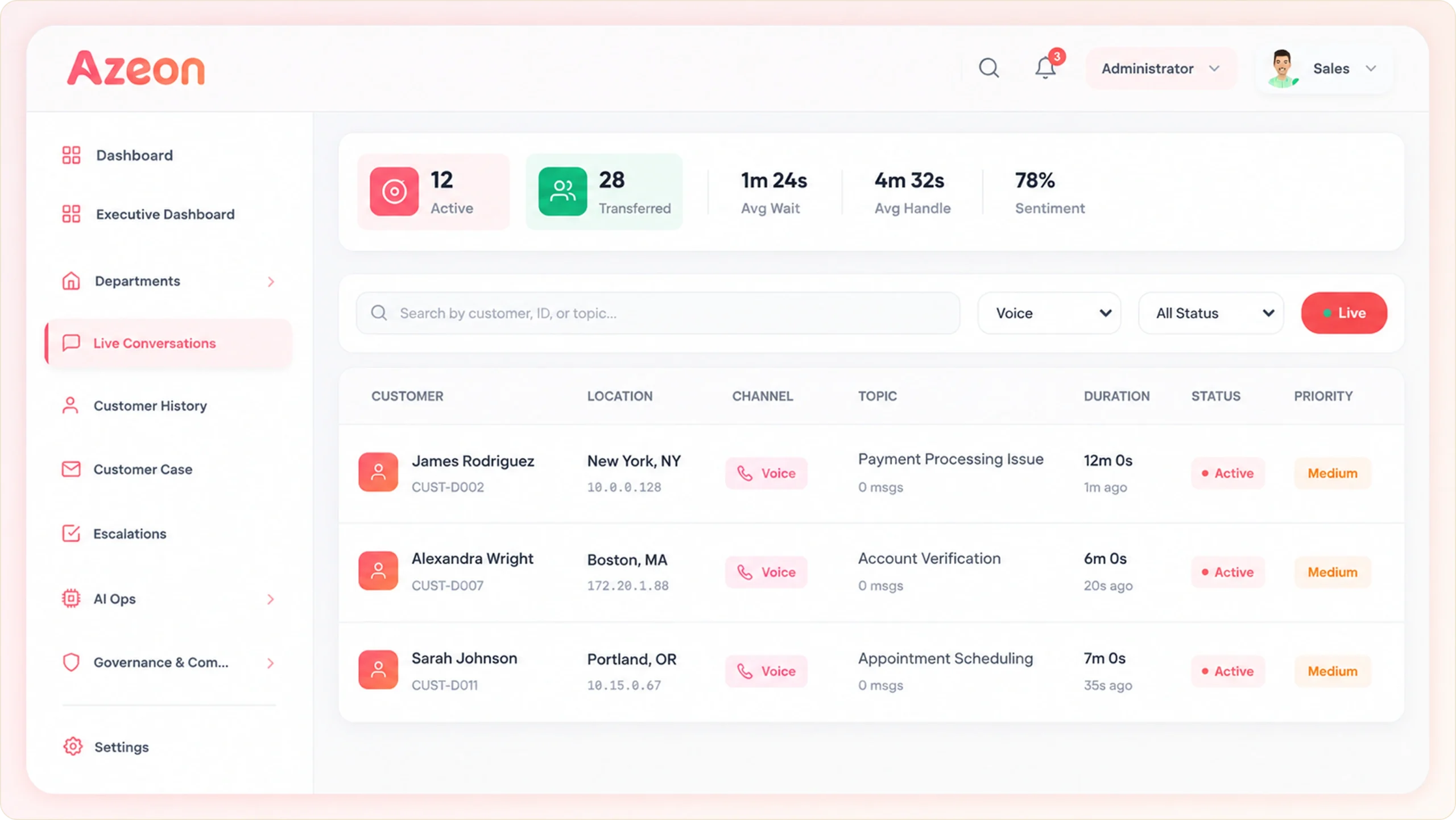
Track Live Conversations

Azeon provides real-time visibility into active customer conversations across channels. Support teams can monitor active sessions, transfer volumes, wait times, handling times, and customer sentiment from a single screen.

So, if you’re evaluating how agentic AI can reduce cost per resolution, improve support efficiency, or increase resolution rates, connect with the Azeon team to explore how these capabilities can fit within your existing customer service environment.

See What Resolution-First Support Could Save Your Bank

Estimate the financial impact of agentic AI across your customer service operations.

FAQs

What is agentic AI in banking customer service?

Agentic AI in banking customer service refers to AI systems that understand customer requests, access banking systems, apply business rules, and support issue resolution. Unlike traditional chatbots that primarily answer questions, agentic AI can assist with actions, workflows, and customer resolutions while maintaining compliance and human oversight.

How does agentic AI reduce cost per resolution in banking?

Agentic AI reduces cost per resolution by decreasing repeat contacts, lowering escalation rates, shortening resolution times, and automating routine service requests. By resolving customer issues during the first interaction, banks can reduce operational costs and improve customer service efficiency.

How is agentic AI different from banking chatbots?

Banking chatbots primarily answer questions and route conversations. Agentic AI understands customer intent, accesses multiple systems, evaluates business rules, and supports issue resolution. This allows banks to move from conversation automation toward resolution automation.

Can agentic AI integrate with existing banking systems?

Yes. Modern agentic AI platforms integrate with CRM systems, core banking platforms, payment systems, knowledge bases, and customer databases. This allows banks to improve customer service operations without replacing their existing technology stack.

Is agentic AI secure for banking customer service?

Agentic AI platforms support governance features such as audit trails, role-based access, approval workflows, policy enforcement, and human oversight. These capabilities help financial institutions maintain compliance requirements while introducing AI into customer service operations.

David works closely with enterprise organizations to help them modernize customer support operations through AI-driven automation. With experience in strategic account management, customer engagement, and technology consulting, David focuses on aligning business objectives with scalable support solutions that improve efficiency, customer experience, and operational performance.

David Pridgen
Solution Consultant

Questions about Azeon?

Connect with our team to explore use cases, workflows, and deployment possibilities.