Skip to content

State of AI Customer Service 2026: Trends, Adoption & Future Outlook

State of AI Customer Service 2026: Trends, Adoption & Future Outlook

Customer service entered a new phase in 2026.

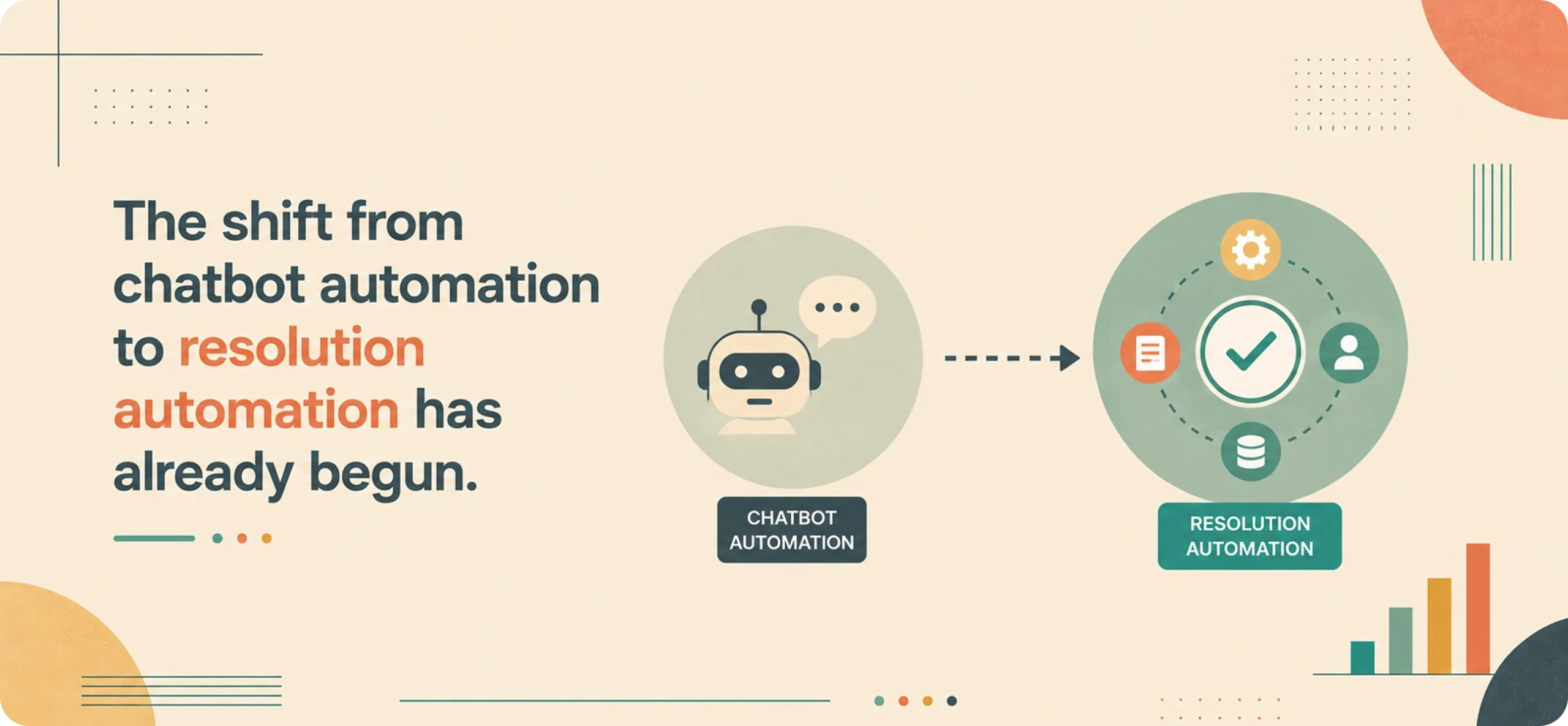
The conversation has moved beyond chatbots, ticket deflection, and proof-of-concepts. Enterprises now deploy AI agents for customer support operations, integrate them with CRM platforms, connect them to workflows, and measure them against business outcomes.

  • Salesforce reports AI service agent adoption increased from 39% of organizations in 2025 to 66% in 2026.
  • Sinch found 62% of companies already have AI agents running in production environments

At the same time, customer trust, AI governance, regulatory compliance, and operational reliability have become board-level priorities.

The result is an industry entering its second major wave:
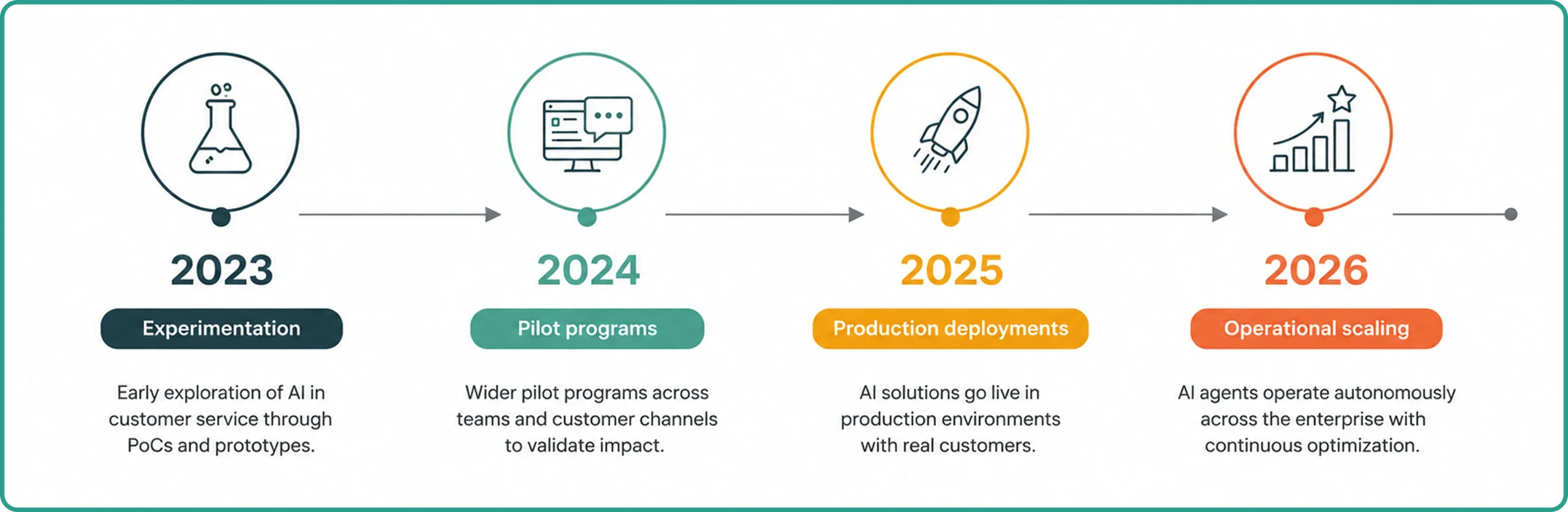
AI Customer Service Timeline

This report examines the state of AI customer service in 2026, including adoption trends, AI agent growth, customer sentiment, investment activity, governance spending, European adoption, and what organizations can expect through 2028.
The State of AI Customer Service in 2026 at a Glance

The customer service AI market has entered a rapid expansion phase. Several industry analyses estimate:

Metric 2025 2026
Organizations using AI service agents
39% 66%
AI agents live in production
62% 88% expected
Salesforce Agentforce ARR
$500M $800M
Sierra ARR
$100M $150M+
AI investment increase
98%
AI rollbacks
74%
Lloyds AI business value
£50M £100M
Fin AI ticket resolution
76%

AI Agents Became the Fastest-Growing Trend in Customer Service

AI agents – autonomous systems that can handle tasks end-to-end – became the fastest-growing category in customer service technology.

Nearly every major vendor rolled out agent platforms: for example,

  • Salesforce enhanced its Agentforce “digital labor” platform (reporting 8,000 customers signed up and $1.2B ARR in Q1 FY27)
  • Microsoft unveiled “Agent 365” and expanded Copilot Agents
  • Google deepened Gemini-based agents
  • AWS expanded Bedrock Agents
    • ServiceNow and Zendesk added AI Agent modules.

Industry research underscores this rapid uptake of agents.

A BCG/MIT Sloan survey found 35% of companies already using agentic AI and 44% planning near-term adoption.

Adoption by sector is led by telco/tech (90%), followed by retail (80%), FS (75%), and manufacturing.

In short, 2026 became “the year of agentic customer service” as agents moved from fringe experiments into mainstream deployment.

AI Resolution Has Become the New Customer Service KPI

Enterprises have shifted their KPIs from containment to outcomes.

Rather than measuring how many queries are “deflected,” firms now track:

  • First-contact resolution
  • Customer satisfaction
  • Customer effort score
  • Cost per resolution

Salesforce disclosed that AI resolves approximately 85% of its own customer service cases.

Intercom’s Fin AI reportedly resolves approximately 76% of support tickets.

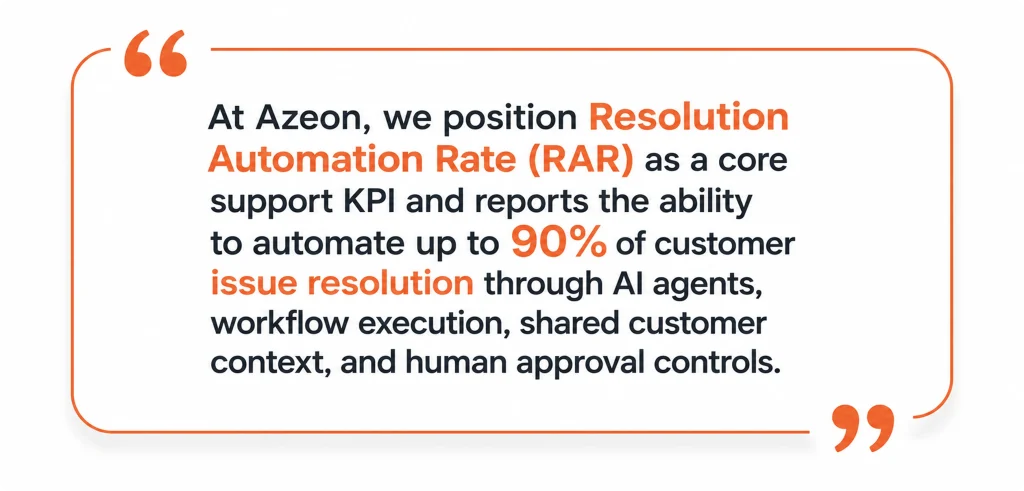
Resolution Automation Rate Quote by Azeon

These figures show that AI is not just “chatbot triage” but is resolving most cases without human handoff.

As a result, AI success is now measured by outcome improvements – e.g. higher CSAT and reduced cost per resolution – rather than by traditional metrics like average handle time or containment.

Customer Trust Has Become the Biggest Barrier in 2026

In the U.S.,

  • 86% of adults say they distrust AI-generated information unless clearly attributed.
  • 75% percent say humans are much more helpful than AI on business websites.
  • Nearly three-quarters of consumers feel the Internet is less “human” than a decade ago.

The net effect is that overt “chatbot” branding can backfire. Techradar quotes ServiceNow innovation head Brian Solis:

“No customer wakes up hoping to talk to a chatbot or AI agent”.

Firms report that heavy AI advertising leads some customers to abandon support channels out of “bot anxiety.”

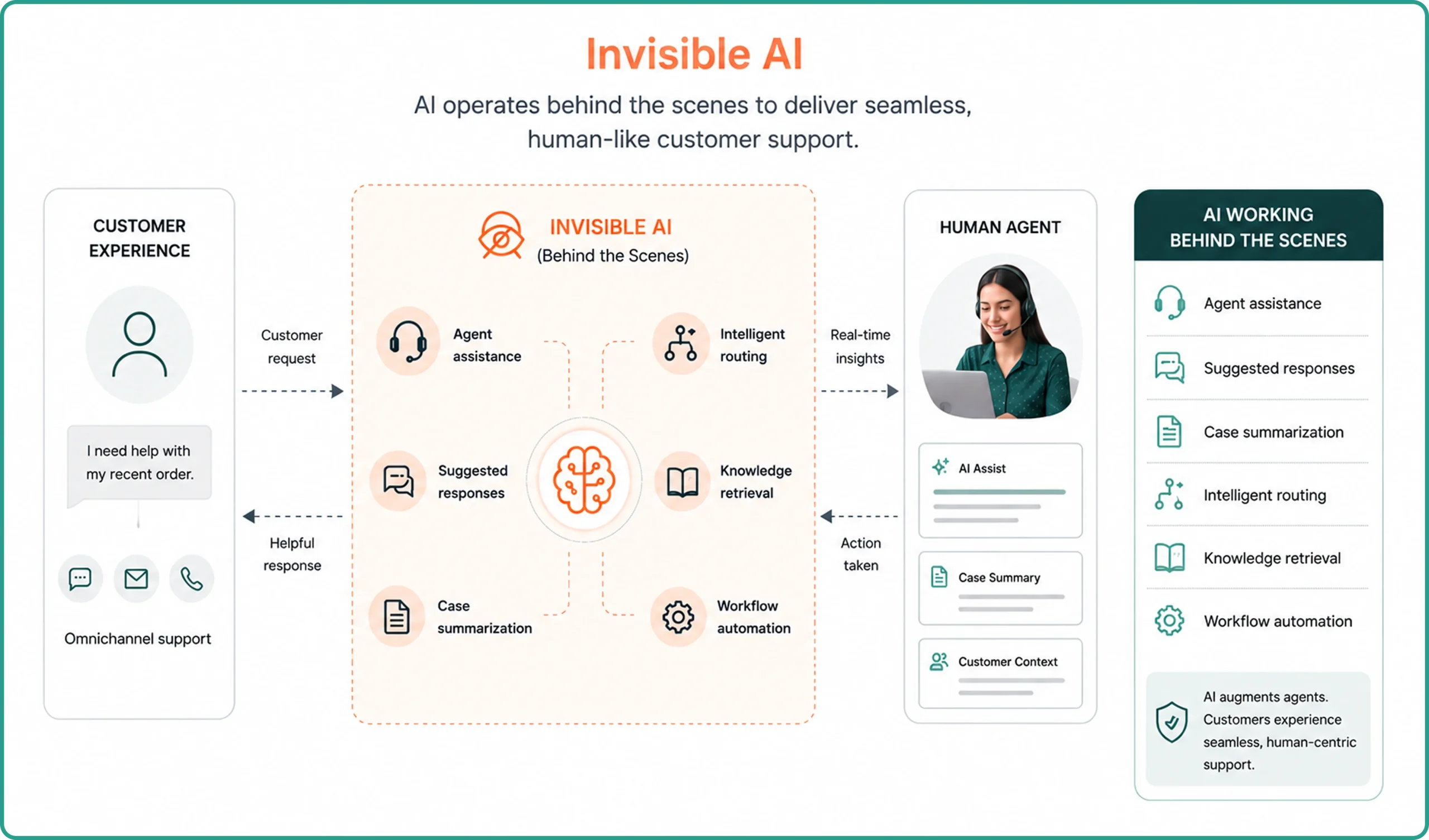
As a result, a major 2025–26 trend is Invisible AI: deploying agentic AI behind the scenes (as assistants to human agents, background automation, or in omnichannel routing) rather than in front-line. Companies focus on augmenting agents with AI tooling that remains transparent to customers.

In practice, many contact centers introduced AI-driven “agent assists,” smart routing or summarization widgets for reps in 2024, then quietly transitioned more to autonomous actions by 2025–26.

Invisible AI for Customer Support Operations

Governance Spending Has Overtaken AI Development Spending

Unexpectedly, enterprises are now budgeting more for AI governance than for raw AI features.

The media headlines around hallucinations and data leaks in 2024–25 have translated into action:

  • 75–76% of organizations now prioritize investment in AI trust, security, and compliance, whereas only ~63% prioritize AI technology development.

In other words, “governance spending > AI spending.”

For example, Sinch’s May 2026 survey reports,

  • 75% of AI programs rank trust/security in their top 3 investments (versus 63% for dev)
  • 84% of AI engineering teams spend over half their time on safety infrastructure.

European firms are especially proactive due to regulation: the EU’s AI Act (rolled out in 2025) imposes transparency and risk duties on customer-facing AI. Practical impacts include adding data logs, model vetting, and audit trails to every AI rollout – all of which cost more than the models themselves.

GDPR & AI Act

In Europe, the AI Act classifies most chatbots as “limited-risk,” requiring only basic transparency (e.g. disclosing “this is an AI assistant”). More stringent “high-risk” rules will apply if bots handle sensitive tasks (e.g. loan decisions or biometric IDs).

Many EU companies are already mapping their CS AI into Act categories in 2026.

GDPR continues to require clear user consent and data minimization for automated support systems. As a result, EU customer service teams are reinforcing anonymization, human-review checkpoints, and explainability efforts beyond what US counterparts do.

Enterprise AI CS Investment Priorities (2026)
Customer service leaders increasingly prioritize trust, security, and governance investments.
Enterprise AI CS Investment
Trust & Security
35%
AI Technology
29%
Cost Reduction
19%
Customer Experience
17%

Risk of Rollbacks

Ironically, beefed-up governance is uncovering more problems.

Sinch notes that firms with “mature guardrails” actually roll back AI agents more (81%) than less-governed ones – because they detect failures sooner.

In practice, common rollback triggers include accuracy shortfalls (hallucinations or wrong info), privacy/security issues, and customer backlash.

The upshot:

Plenty of AI pilots launch in 2025 with fanfare, but by 2026 most firms have one or more bots paused pending better controls.

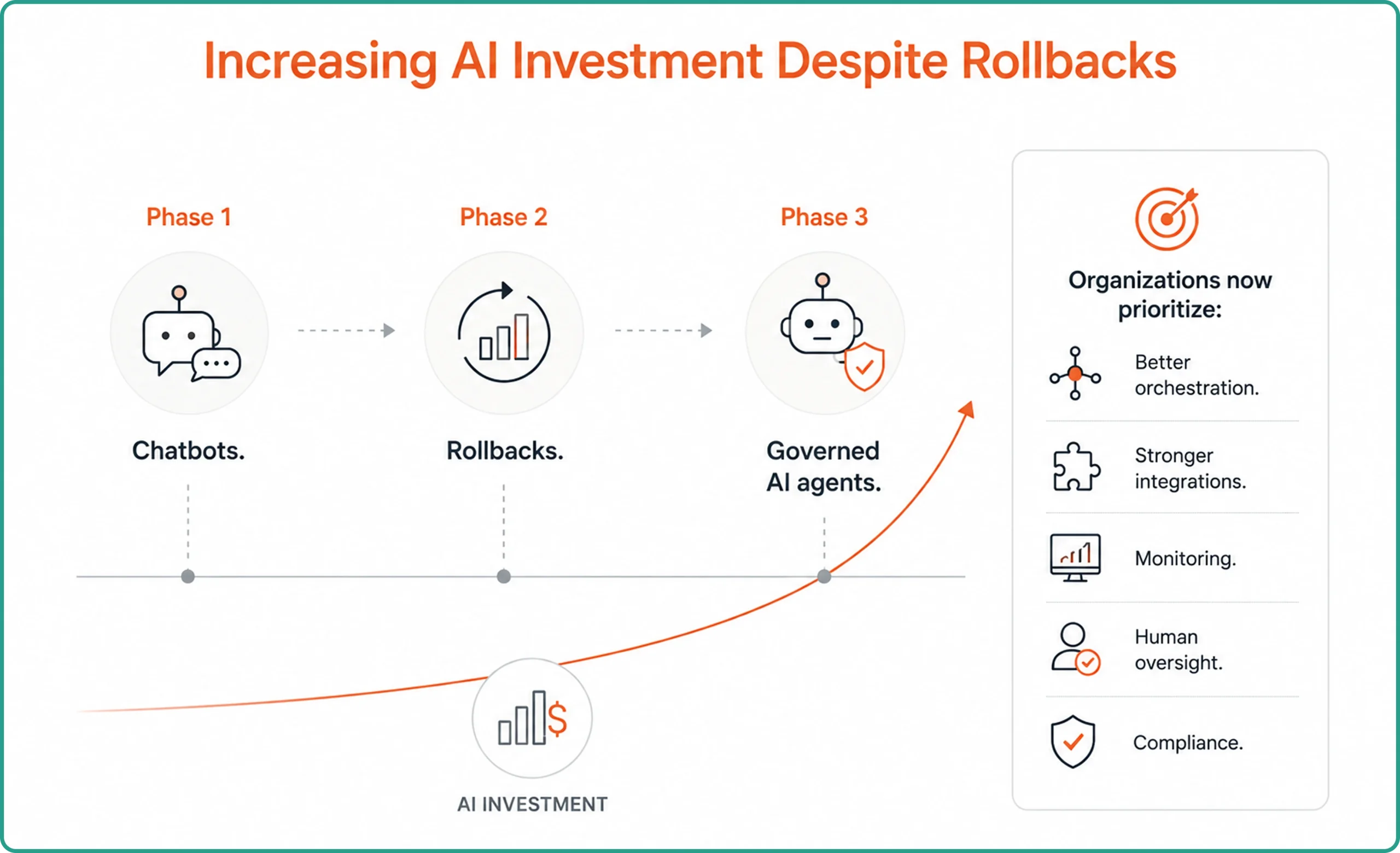
Rollbacks vs Continued Investment for AI Customer Service

Despite high rollback rates, companies remain committed.

The Sinch found 74% of enterprises have already rolled back or shut down an AI customer support agent after deployment, often multiple times. Yet paradoxically 98% of those same organizations report increasing their AI investments in 2026.

Rollbacks vs Continued Investment for AI Customer Service

Investment and Market Signals in AI Customer Service

Large sums are pouring into AI CX. Key indicators for 2025–26:

Venture Funding

Startups like Sierra attracted blockbuster rounds. Sierra’s Series D (Sept 2025) was $350M at a $10B valuation, and Series E (May 2026) $950M at $15.8B. Many other AI service startups (e.g. Capacity, Observe.AI) also raised large rounds in 2025–26.

Overall, customer service AI sector funding hit ~$4B in 2025 (per PitchBook).

M&A

Salesforce’s June 2026 agreement to buy Fin (Intercom’s AI agent) for $3.6B is a signal of market consolidation.

Other acquirers include Zendesk and ServiceNow snapping up smaller AI-tool firms, and Megacorps (Adobe, Google) building inhouse.

Vendor Revenue

  • Salesforce: Agentforce/Data360 combined ARR was ~$2.9B by Jan 2026 (growing >200% Y/Y). Per [47], Q1 FY27 Agentforce ARR hit $1.2B.
  • Sierra: Estimated $150M ARR by early 2026.
  • Zendesk: Privately, Zendesk reports 2025 ARR ~$2.0B overall (flat y/y), but notes AI features driving renewal rates.
  • Other: Freshworks, HubSpot, and Microsoft all tie major portions of their growth forecasts to AI agent revenues in 2026–27.

Financial Services

Banks are doubling down. Lloyds Banking (UK) reported ~£50M value from AI in 2025, and expects >£100M in 2026 (a roughly 2× return jump).

Morgan Stanley, Citi, etc. are publicly investing ~$1–2B each over 2025–26 in customer-facing AI (automated advisors, support).

For more information, read our guide on AI in Customer Communications for Financial Services.

AI and Human Agents Deliver the Best Results Together

Emerging studies in 2026 quantify the win of AI-assisted agents.

  • Gartner predicts agentic AI will autonomously resolve 80% of common customer service issues without human intervention by 2029.
  • As per Notch, 55-70% – first contact resolution rate on AI-native platforms.
  • Zendesk researched that two-thirds of business leaders say investments in customer service AI result in significant performance improvements.
  • Studied by Gnani, agents using AI assistants resolve cases 20–30% faster with higher CSAT.

Future Outlook of AI Customer Service (2027–2028)

Looking ahead, the trajectory points toward autonomous, integrated service ecosystems. Key anticipated developments:

Voice AI Mainstreaming

By 2027 voice AI (real-time speech agents) will be standard.

Companies like Amazon (Bedrock Agents) and startups (Verbit, UneeQ) are rolling out voice bots that link to backend data. Expect 50% of call center volume handled by AI voice agents in 2 years.

Resolution-based Pricing

Vendors may shift from seat-based to outcome-based pricing.

For example, Azeon already offers per-resolution contracts, and others will follow. CIOs demand pay-per-resolution models that align cost to value.

Full Systems Access

AI agents will gain secure API access to CRM, ticketing, billing and ERP systems.

In 2025–26 many bots still lacked payment or CRM write-back capabilities.

By 2027, “fully-autonomous” agents will be common: able to update orders, issue refunds, or schedule appointments without human handoff just like Azeon.

Shared Customer Memory

Persistent customer context across channels will become standard.

Data platforms (like Agent Data Fabric) will allow any AI interaction to recall past chats, purchase history, and even previous agent notes. This “memory” will enable true personalization and continuity.

AI “Hallway Help” (Human escalation as premium)

Ironically, human agents will be reserved for critical issues.

Some enterprises will offer “human escalations” as an upsell: e.g. immediate live agent access for priority customers, while AI handles the rest.

Governance Platforms Mandatory

By 2028, best-practice AI governance tools (version control, monitoring dashboards) will be as ubiquitous as CRM.

Standards bodies and auditors will require evidence of compliance (explainability, audit logs) before approving high-risk AI features.

What High-Performing Support Organizations Look Like in 2026

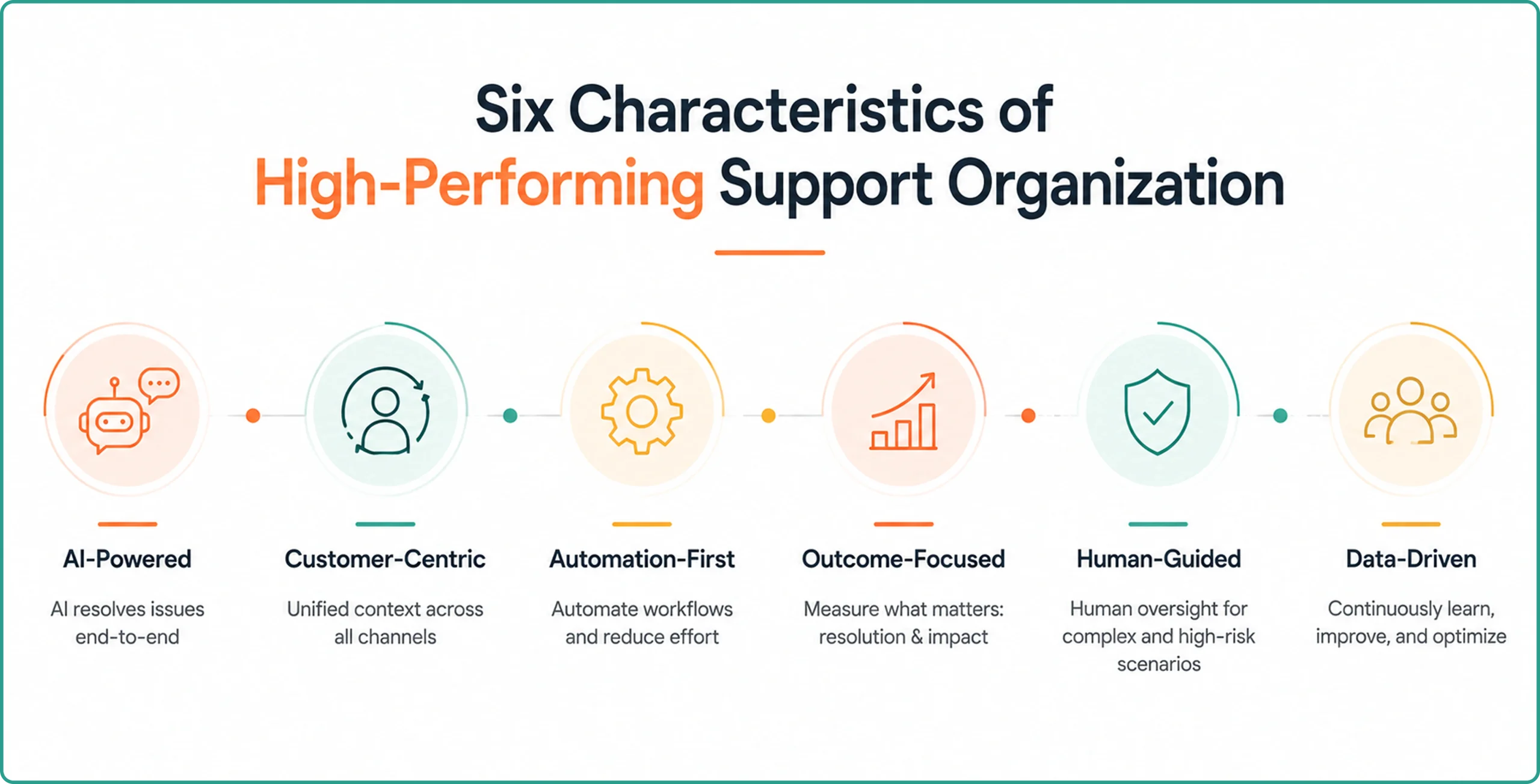
The most advanced organizations share six characteristics:

Six Characteristics of High-Performing Support Organizations

1. AI Handles Tier-1 Resolution

AI resolves routine customer requests such as account updates, order tracking, and billing inquiries, freeing support teams to focus on complex cases.

2. Unified Customer Memory

Customer history, preferences, and previous interactions remain accessible across channels, creating seamless support experiences.

3. Workflow Automation

AI executes actions across CRM, billing, ticketing, and business systems to complete requests without manual intervention.

4. Human Approval Controls

Sensitive decisions and high-risk actions follow human review workflows to maintain trust, governance, and accountability.

5. Continuous Evaluation

Every interaction contributes to ongoing measurement of AI accuracy, resolution quality, customer satisfaction, and operational performance.

6. Outcome-Based Metrics

Success is measured through resolution rates, customer satisfaction, cost efficiency, and time to resolution rather than conversation volume.

The Current Challenge of AI-Powered Customer Support in 2026

Most AI support platforms stop at conversations.

Many organizations have deployed chatbots, copilots, and AI assistants over the last few years. Yet a significant gap remains between answering customer questions and actually resolving customer issues.

Support teams often struggle with disconnected customer data, fragmented workflows, limited automation capabilities, and AI systems that require human agents to complete the final steps of resolution.

As customer expectations continue to rise, enterprises need AI that can understand intent, access business context, execute actions, and close the loop across their existing support ecosystem.

This is where the next generation of customer service platforms is beginning to differentiate itself.

How Azeon Aligns with the Future of Customer Service

Azeon is an Agentic AI customer support platform designed for organizations that want to move beyond conversational automation and toward resolution automation.

It combines AI agents, shared customer memory, workflow orchestration, and human oversight within a single platform that works alongside existing CRM, ticketing, and business systems.

Instead of simply generating responses, Azeon understands customer intent, accesses relevant business context, executes workflows, updates systems, and drives issues toward resolution.

The platform supports the six characteristics of high-performing support organizations in 2026 – from Tier-1 automation and unified customer memory to workflow execution, governance controls, continuous evaluation, and outcome-based operations.

As enterprises increasingly measure success through Resolution Automation Rate (RAR), customer satisfaction, and cost per resolution, platforms such as Azeon help support teams build the operational foundation required to achieve those outcomes at scale.

See How Azeon Delivers Resolution Automation

Experience AI-powered resolution, workflow execution, and seamless customer experiences from a single platform.

FAQs

What is AI customer service?

AI customer service uses artificial intelligence technologies such as machine learning, natural language processing, and AI agents to understand customer requests, provide support, automate workflows, and resolve issues across multiple channels.

How is AI transforming customer service in 2026?

AI is transforming customer service by moving beyond chatbot interactions toward resolution automation. Modern AI systems can access customer data, execute workflows, update business systems, and resolve common support issues with minimal human intervention.

What is Agentic AI in customer service?

Agentic AI refers to AI systems that can understand customer intent, make decisions, execute actions, and complete support tasks across business applications. Unlike traditional chatbots, Agentic AI focuses on issue resolution rather than conversation management.

What are the benefits of AI in customer support?

AI helps organizations reduce response times, automate repetitive tasks, improve customer satisfaction, lower support costs, increase agent productivity, and provide 24/7 support across digital channels.

What industries are adopting AI customer service solutions?

Industries with strong AI customer service adoption include financial services, insurance, healthcare, retail, eCommerce, telecommunications, travel, SaaS, and technology companies.

David works closely with enterprise organizations to help them modernize customer support operations through AI-driven automation. With experience in strategic account management, customer engagement, and technology consulting, David focuses on aligning business objectives with scalable support solutions that improve efficiency, customer experience, and operational performance.

David Pridgen
Solution Consultant

Questions about Azeon?

Connect with our team to explore use cases, workflows, and deployment possibilities.