Skip to content

Top 10 Ada Alternatives & Competitors in 2026

Top 10 Ada Alternatives & Competitors in 2026

You don’t usually search for Ada alternatives because Ada lacks AI capabilities.

In fact, Ada is one of the most capable AI customer service platforms available today. Its reasoning engine, multilingual support, and enterprise workflow capabilities make it a strong choice for organizations that want to build sophisticated AI experiences.

The question many buyers eventually ask is a different one: How much time, expertise, and ongoing effort will it take to get there?

That question appears repeatedly across community discussions from teams evaluating enterprise AI platforms.

One support leader managing nearly 9,000 customer tickets every month shared on Reddit that while Ada impressed them with its capabilities, they realized the platform would require someone almost full-time to build, configure, and continuously maintain workflows inside its low-code environment.
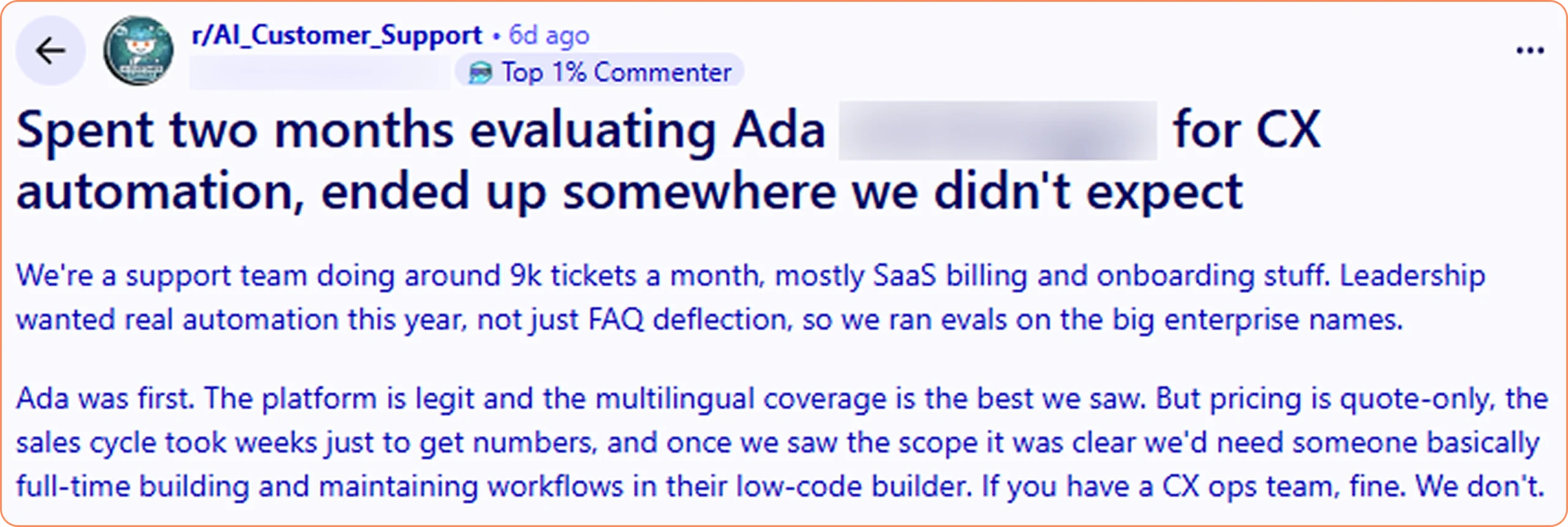
Ada Evaluation and Review on Reddit

This reflects a common evaluation pattern among enterprise support teams. Ada gives organizations extensive flexibility to design AI experiences around their own processes. For businesses with dedicated CX operations, automation engineers, or conversational AI specialists, that level of control can be a significant advantage.

However, many organizations prefer a different deployment model. Instead of building AI workflows internally, they look for platforms that provide implementation expertise, enterprise integrations, workflow engineering, and continuous optimization as part of the engagement. Their priority is accelerating time-to-value while allowing internal teams to stay focused on customer operations rather than AI configuration.

If that sounds familiar, this guide compares the best Ada alternatives for enterprises seeking AI customer service platforms with a more implementation-led approach.

From financial services and SaaS to retail and digital products, these solutions help organizations automate customer support without placing the entire responsibility for designing and maintaining AI agents on internal teams.
10 Best Ada Alternatives in 2026

Platform Best For Deployment Model Human-in-the-Loop Pricing
Azeon Enterprises seeking implementation-led AI customer support with enterprise integrations and workflow automation. Guided implementation with enterprise onboarding. Yes Custom (Resolution-based pricing)
Sierra Large enterprises focused on premium AI-powered customer experiences. White-glove implementation. Yes Custom
Decagon High-volume customer support teams looking for enterprise AI automation. Guided deployment. Yes Custom
Forethought Organizations automating ticket resolution and agent assistance. Implementation-assisted. Yes Custom
Cognigy Enterprise contact centers with complex customer service workflows. Professional services implementation. Yes Custom
Kore.ai Regulated enterprises requiring AI-powered customer service. Enterprise implementation. Yes Custom
Amelia Banking, healthcare, and IT service organizations. Consulting-led deployment. Yes Custom
Yellow.ai Global enterprises needing multilingual customer support automation. Managed onboarding. Yes Custom
Aisera Enterprise ITSM and customer service automation. Enterprise rollout. Yes Custom
boost.ai Organizations deploying conversational AI with implementation support. Guided implementation. Yes Custom

1. Azeon

Best for: Enterprises looking for an implementation-led AI agent that delivers end-to-end automation without requiring an internal AI operations team.

Overview:

Azeon is one of the strongest Ada alternatives for organizations that want enterprise AI without spending months designing workflows, configuring automation, and maintaining conversational experiences internally.

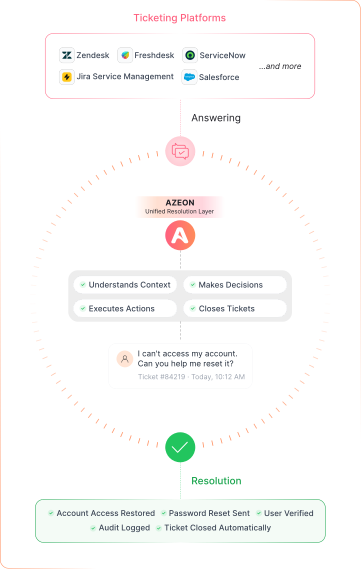
Instead of functioning as a self-service AI builder, Azeon works as an AI agent-driven resolution layer that integrates with your existing customer support ecosystem, allowing businesses to modernize operations without replacing their CRM, help desk, or business applications.

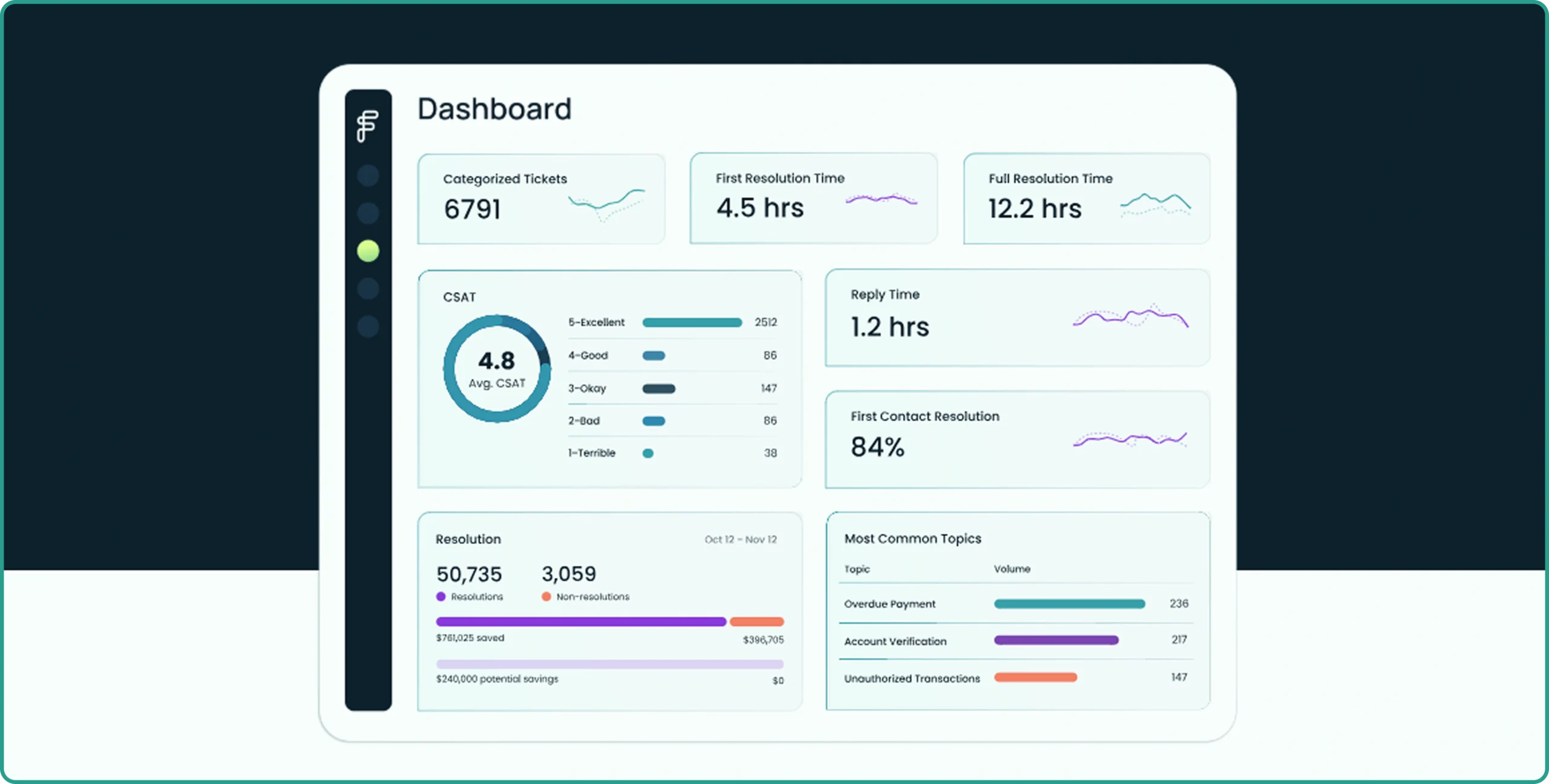
Azeon Supercharge Your Existing Support Operations

Its agentic AI architecture combines advanced reasoning with deterministic workflow execution, enabling AI agents to understand customer intent, access enterprise data, execute approved workflows, and resolve customer issues while maintaining complete governance.

Shared customer memory preserves context across every interaction, while human-in-the-loop approvals ensure sensitive actions remain under organizational control.

This makes Azeon particularly suitable for industries such as financial services, insurance, retail, consumer goods, and SaaS where compliance, accuracy, and operational efficiency are equally important.

Key Features:

  • Omnichannel Support: Deliver consistent customer experiences across chat, email, voice, messaging apps, and help desk channels while preserving conversation continuity.
  • Shared Customer Memory: Maintain a unified customer profile with conversation history, account information, previous cases, and interaction context across every channel.
  • Human-in-the-Loop Governance: Keep business-critical decisions under control with approval workflows, manual intervention, and configurable oversight for sensitive customer actions.
  • Context-Aware Escalations: Transfer complete conversation summaries, customer history, sentiment, and recommended next steps to human agents for smooth handoffs.
  • Workflow Automation & Execution: Resolve customer requests by executing workflows across CRM, billing, ERP, payment, and operational systems from a single AI platform.
  • AI Reasoning Engine: Analyze customer intent, urgency, sentiment, historical interactions, and business context before determining the best course of action.
  • Knowledge Integration: Connect internal documentation, knowledge bases, FAQs, product manuals, policies, and enterprise content to deliver accurate, context-aware responses.
  • Root Cause Analytics: Detect recurring support issues, product defects, operational inefficiencies, and customer behavior trends to reduce future ticket volumes.
  • Auditability & Traceability: Maintain detailed logs of AI decisions, workflow execution, approvals, and customer interactions to support governance, compliance, and operational transparency.
  • Flexible Deployment Options: Deploy securely across cloud, private cloud, hybrid infrastructure, or on-premises environments.
  • Extensive Enterprise Integrations: Connect seamlessly with CRM platforms, help desks, communication tools, ERP systems, identity providers, payment platforms, and custom business applications without replacing your existing support stack.
| Proven Results from Live Environments |

Measured Outcomes Across Production Deployments

Metric
Outcome
CSAT improvement (Retail case study)
3.7 → 4.8
Reduction in repeat contact rate
35%
Reduction in Average Handle Time (Logistics)
32%
Common queries resolved annually
250,000+
Ticket automation without SLA risk (SaaS)
96%
Customer Lifetime Value improvement
2X
Goal Completion Rate (GCR)
95%+
Semantic Accuracy
>92%
Guardrail Adherence
99.999%
Annual OpEx Reduction
Up to $250K

Pros:

  • Faster deployment through implementation-led onboarding
  • No rip-and-replace of existing customer support infrastructure
  • Excellent fit for highly regulated industries
  • Enterprise-grade governance, auditability, and compliance
  • Resolves customer requests instead of only generating responses
  • Outcome-based pricing offers predictable enterprise value

Cons:

  • Enterprise deployments may require implementation planning and stakeholder alignment.

Pricing:

Azeon follows a Result-as-a-Service pricing model where organizations pay based on successfully resolved customer issues rather than seats, AI tokens, API calls, or conversation volume.

Ready to Explore a Better Alternative to Ada?

Learn how Azeon reduces repeat contacts, improves CSAT, and automates support operations.

Book Your Demo →

2. Sierra

Sierra

Best for: Large enterprises that want premium AI-powered customer experiences backed by a high-touch implementation model.

Overview:

Sierra has quickly become one of the most recognized enterprise AI customer service platforms for organizations focused on delivering highly personalized customer interactions. Rather than offering a traditional self-service chatbot builder, Sierra partners closely with enterprise customers throughout deployment, helping teams design AI experiences that align with business processes, brand voice, and customer expectations.

Its conversational AI emphasizes natural interactions, enterprise integrations, and continuous optimization after deployment. Sierra is often evaluated by organizations that want a strategic AI implementation partner rather than simply licensing AI software. For companies comparing top Ada alternatives, Sierra provides a strong option when customer experience quality and enterprise collaboration are top priorities.

Key Features:

  • Enterprise AI agents for customer service
  • White-glove implementation and onboarding
  • Natural language understanding with contextual conversations
  • CRM and enterprise application integrations
  • Omnichannel customer engagement
  • Human handoff and escalation workflows
  • AI performance analytics and reporting
  • Continuous optimization and platform improvements

Pros:

  • Premium implementation experience
  • Strong conversational AI capabilities
  • Excellent enterprise integration ecosystem
  • Designed for complex customer journeys
  • Dedicated onboarding and deployment support
  • Scales well for global enterprises

Cons:

  • Best suited for larger organizations
  • Limited public pricing transparency
  • Enterprise implementation may require longer deployment timelines

Pricing:

Custom enterprise pricing available upon request.

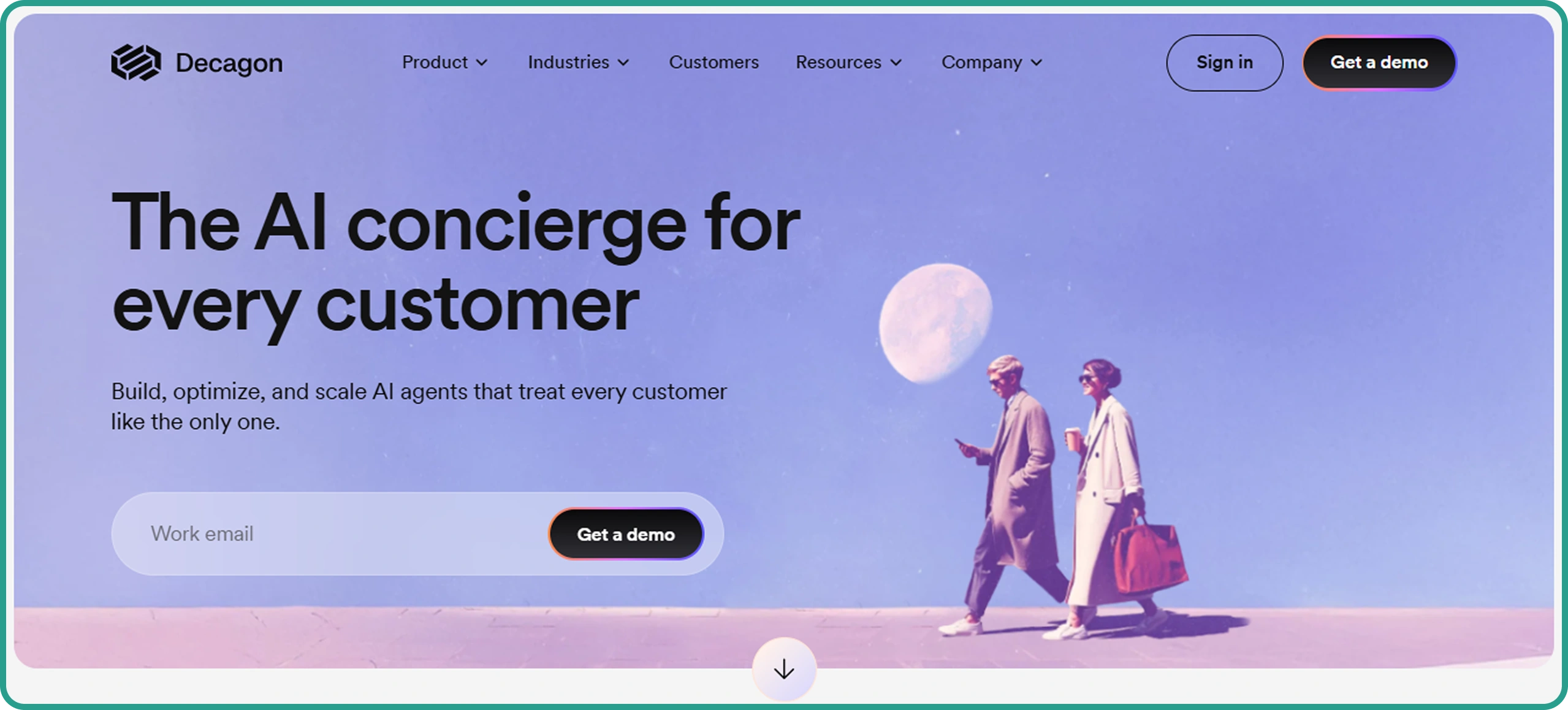
3. Decagon

Decagon

Best for: High-volume support organizations seeking enterprise AI agents with guided implementation and operational automation.

Overview:

Decagon focuses on helping enterprises automate customer service through AI agents capable of handling complete customer interactions instead of simply answering questions. The platform supports organizations throughout deployment, making it a compelling option for businesses that want implementation guidance alongside modern AI technology.

Beyond conversational AI, Decagon integrates with enterprise systems to retrieve customer information, execute support workflows, and assist human agents with contextual recommendations. Its operational approach makes it one of the more capable Ada competitors for companies looking to improve customer support efficiency while reducing manual workloads across large support operations.

Key Features:

  • AI agents for enterprise customer support
  • Guided deployment and implementation
  • Workflow automation across business systems
  • Omnichannel customer support
  • CRM and help desk integrations
  • Enterprise knowledge retrieval
  • Customer context management
  • Operational analytics and reporting

Pros:

  • Strong workflow automation capabilities
  • Guided enterprise implementation
  • Supports high-volume customer support operations
  • Broad integration ecosystem
  • Modern AI architecture
  • Continuous product innovation

Cons:

  • Enterprise pricing requires consultation
  • Advanced implementations may require customization
  • Best suited for mid-market and enterprise businesses

Pricing:

Custom pricing based on deployment size and enterprise requirements.

4. Forethought

Forethought

Best for: Customer support teams looking to automate repetitive tickets while equipping agents with AI-powered assistance.

Overview:

Forethought is an enterprise AI platform that combines customer-facing automation with AI tools for support agents. Rather than replacing human support, it focuses on resolving repetitive requests automatically while surfacing relevant knowledge and suggested responses for agents handling more complex conversations. This balanced approach has made Forethought a popular choice among SaaS companies, eCommerce brands, and enterprise support organizations.

As one of the well-known Ada alternatives, Forethought emphasizes faster ticket resolution through AI-driven workflows and knowledge retrieval. Organizations can integrate the platform with their existing help desk and CRM systems to automate common requests while maintaining visibility into customer interactions and operational performance.

Key Features:

  • AI-powered customer support automation
  • Agent assist with contextual recommendations
  • Intelligent knowledge retrieval
  • Workflow automation for repetitive tickets
  • Integrations with major help desk platforms
  • Omnichannel customer engagement
  • AI performance analytics
  • Continuous model optimization

Pros:

  • Strong balance between customer automation and agent productivity
  • Easy integration with existing support platforms
  • Reduces repetitive support workload
  • Good reporting and operational insights
  • Suitable for growing support organizations
  • Regular product enhancements

Cons:

  • Advanced automation may require workflow customization
  • Enterprise pricing isn’t publicly available
  • Some capabilities depend on existing knowledge quality

Pricing:

Custom pricing available upon request.

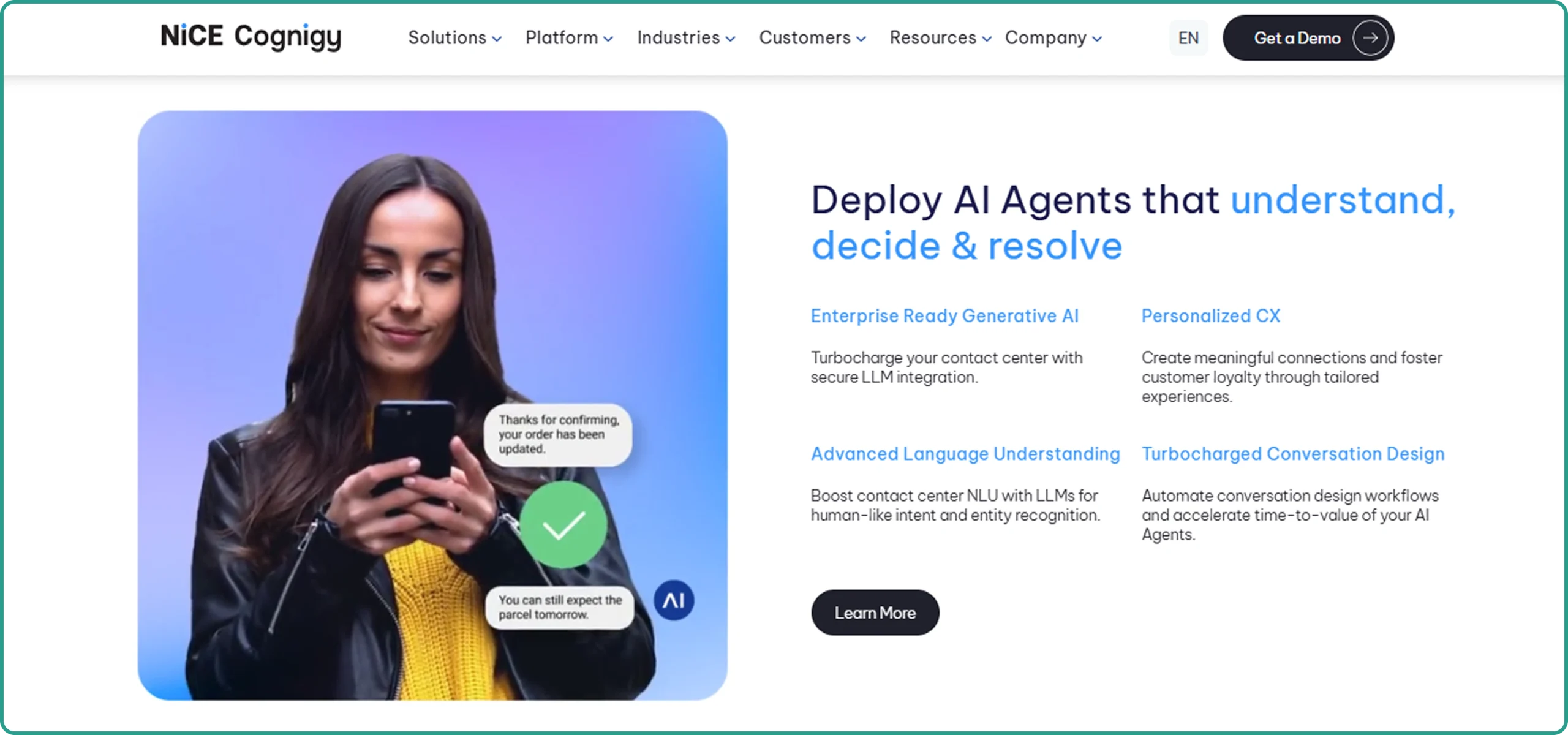
5. Cognigy

Cognigy

Best for: Enterprise contact centers requiring AI-powered conversations across customer service, voice, and contact center operations.

Overview:

Cognigy is a mature conversational AI platform designed for enterprises with complex customer support environments. It enables organizations to build AI agents capable of managing customer conversations across voice, chat, messaging applications, and contact center platforms. With strong workflow capabilities and enterprise integrations, Cognigy is frequently selected by organizations operating large-scale customer service operations.

Compared to many Ada competitors, Cognigy provides extensive flexibility for enterprises that require sophisticated conversational experiences, multilingual support, and integrations with enterprise business applications. It also offers professional services to help organizations deploy AI across complex environments.

Key Features:

  • Enterprise conversational AI platform
  • Voice and chat automation
  • Omnichannel customer engagement
  • CRM and enterprise system integrations
  • Human agent escalation
  • Workflow automation
  • Analytics and conversation reporting
  • Multilingual AI capabilities

Pros:

  • Excellent for enterprise contact centers
  • Strong omnichannel support
  • Flexible workflow capabilities
  • Extensive enterprise integrations
  • Professional implementation services
  • Mature conversational AI platform

Cons:

  • Better suited for larger enterprises than SMBs
  • Enterprise implementation can take time
  • Public pricing information is limited

Pricing:

Enterprise pricing available through consultation.

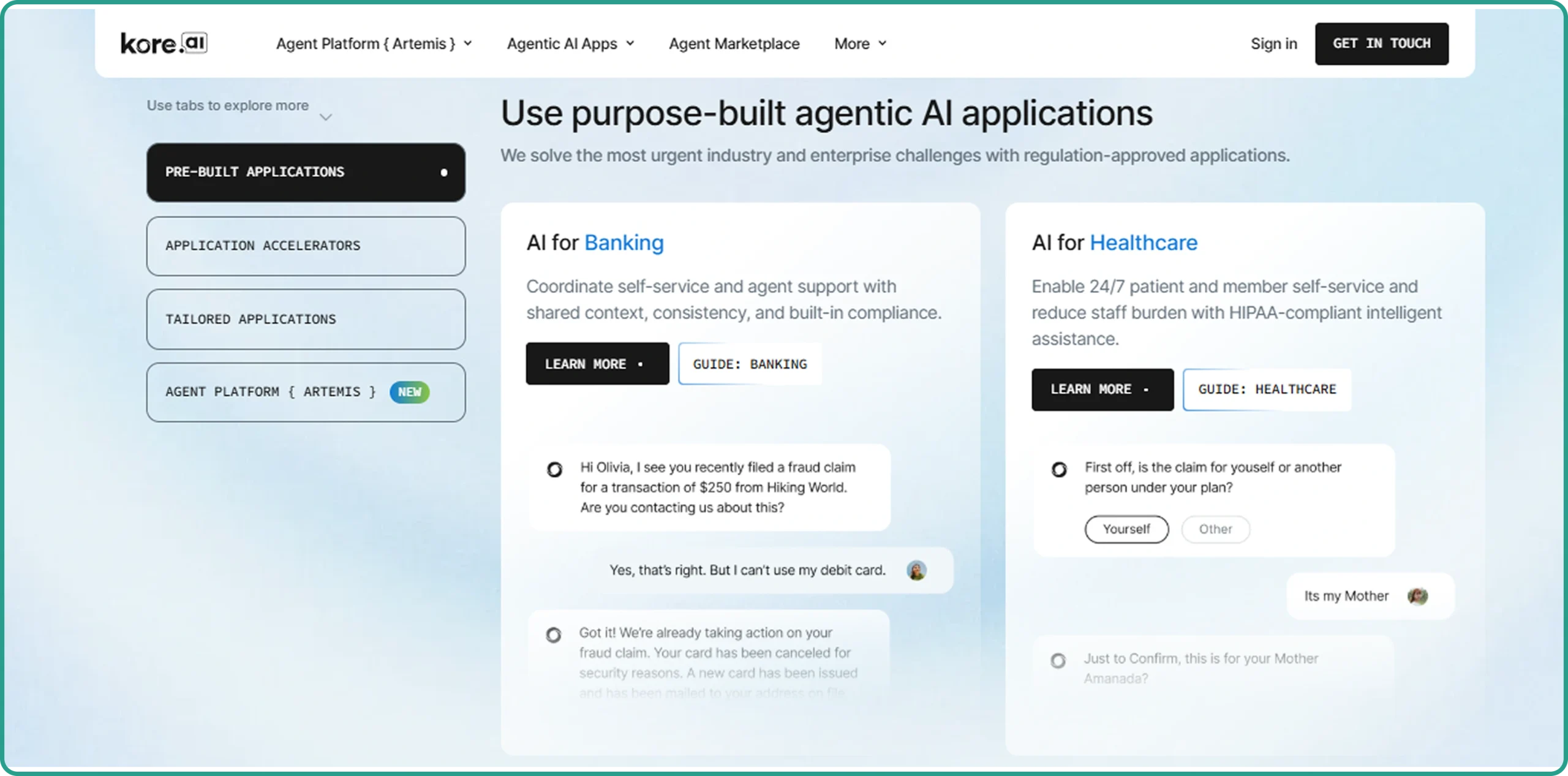
6. Kore.ai

Kore AI

Best for: Enterprises in regulated industries looking for AI-powered customer service with enterprise governance.

Overview:

Kore.ai provides conversational AI solutions for customer service, employee support, and contact center automation. Its platform is widely used across industries such as banking, insurance, healthcare, and telecommunications, where security, governance, and compliance play a significant role in AI adoption.

Among the best Ada alternatives, Kore.ai stands out for its enterprise governance framework and extensive integration ecosystem. Organizations can automate customer interactions, connect AI agents with enterprise systems, and maintain visibility over AI-driven decisions through centralized management capabilities.

Key Features:

  • Enterprise conversational AI platform
  • AI agents for customer service
  • Enterprise workflow automation
  • Human agent collaboration
  • Omnichannel support
  • Banking and enterprise integrations
  • AI governance and compliance controls
  • Analytics and performance monitoring

Pros:

  • Strong governance capabilities
  • Suitable for highly regulated industries
  • Extensive enterprise integrations
  • Supports complex business workflows
  • Scalable enterprise architecture
  • Mature AI platform

Cons:

  • Enterprise deployments require planning
  • Limited pricing transparency
  • Smaller businesses may find the platform extensive for their needs

Pricing:

Kore.ai offers custom enterprise pricing based on usage, integrations, and deployment needs.

7. Amelia

Amelia

Best for: Financial services, healthcare, and IT organizations automating customer and employee support.

Overview:

Amelia is an enterprise AI platform focused on conversational automation for customer service and internal operations. It combines conversational AI with workflow execution, allowing organizations to automate customer requests while integrating with business systems behind the scenes. Amelia has established a strong presence in industries where compliance, accuracy, and process automation are critical.

For enterprises comparing top Ada alternatives, Amelia provides an implementation-led approach supported by consulting and deployment expertise. Its AI agents can assist customers across multiple channels while helping organizations automate repetitive operational tasks.

Key Features:

  • Conversational AI for customer service
  • Workflow automation
  • Enterprise system integrations
  • Human handoff capabilities
  • Voice and chat support
  • Compliance-ready architecture
  • AI analytics and reporting
  • Intelligent process automation

Pros:

  • Strong enterprise consulting support
  • Well suited for banking and healthcare
  • Combines AI with workflow automation
  • Enterprise-grade integrations
  • Reliable governance capabilities
  • Scalable deployment model

Cons:

  • Enterprise implementation may take several weeks
  • Pricing is quote-based
  • Better suited for larger organizations

Pricing:

Custom pricing available upon request.

8. Yellow.ai

Yellow AI

Best for: Global organizations managing multilingual customer support across multiple communication channels.

Overview:

Yellow.ai helps enterprises automate customer interactions through AI agents capable of handling conversations across chat, voice, email, and messaging applications. The platform is particularly known for multilingual support and customer engagement across international markets, making it popular among retail, travel, banking, and consumer-facing businesses.

When evaluating Ada alternatives, organizations often consider Yellow.ai for its global deployment capabilities, enterprise onboarding services, and broad channel support. Its AI agents help reduce repetitive customer interactions while improving response consistency across different languages.

Key Features:

  • AI customer service agents
  • Multilingual support
  • Voice and chat automation
  • CRM integrations
  • Workflow automation
  • Omnichannel customer engagement
  • Analytics dashboard

Pros:

  • Excellent multilingual capabilities
  • Supports numerous communication channels
  • Good enterprise scalability
  • Strong automation features
  • Suitable for international operations
  • Managed onboarding experience

Cons:

  • Advanced implementations require planning
  • Public pricing isn’t available
  • Enterprise deployments may involve customization

Pricing:

Custom enterprise pricing.

9. Aisera

Aisera

Best for: Enterprises automating both customer service and IT service management.

Overview:

Aisera combines conversational AI with enterprise automation across customer support, IT service management, HR, and employee support. The platform enables organizations to automate repetitive requests while integrating with business applications to complete customer and employee workflows efficiently.

As one of the more comprehensive Ada competitors, Aisera appeals to enterprises seeking a unified AI platform capable of supporting multiple departments. Its implementation services help organizations accelerate AI adoption without requiring extensive internal development resources.

Key Features:

  • AI customer service platform
  • IT service management automation
  • Enterprise workflow execution
  • CRM and ServiceNow integrations
  • AI knowledge management
  • Human escalation
  • Omnichannel support
  • Analytics and reporting

Pros:

  • Supports multiple enterprise functions
  • Strong ITSM capabilities
  • Enterprise integration ecosystem
  • Good workflow automation
  • Guided implementation support
  • Scalable architecture

Cons:

  • Enterprise-focused platform
  • Pricing requires consultation
  • Advanced capabilities may require configuration

Pricing:

Aisera provides custom pricing based on organization size and deployment requirements.

10. Boost.ai

Boost AI

Best for: Enterprises looking for conversational AI with guided deployment and long-term optimization.

Overview:

Boost.ai specializes in conversational AI for enterprises operating in banking, insurance, telecom, and the public sector. Rather than focusing solely on chatbot deployment, the platform supports organizations throughout implementation and optimization, helping enterprises continuously improve AI performance after launch.

Among the best Ada alternatives, boost.ai offers a practical balance between conversational intelligence and enterprise support. Organizations benefit from implementation guidance while maintaining flexibility to expand AI capabilities as customer support requirements evolve.

Key Features:

  • Enterprise conversational AI
  • Guided implementation
  • Multilingual support
  • CRM integrations
  • Human handoff workflows
  • AI analytics
  • Knowledge management
  • Continuous optimization

Pros:

  • Strong enterprise deployment support
  • Suitable for regulated industries
  • Good multilingual capabilities
  • Reliable conversational AI
  • Continuous optimization services
  • Scalable for large organizations

Cons:

  • Primarily focused on enterprise customers
  • Deployment timelines vary based on implementation scope

Pricing:

Boost.ai offers custom enterprise pricing based on contact center size and feature requirements.

How to Choose the Right Ada Alternative?

Here are the key factors to consider when evaluating Ada alternatives.

1. Evaluate Your Internal AI Resources

Some AI platforms require dedicated conversational AI specialists, solution architects, or CX operations teams to build workflows, maintain automations, and continuously optimize AI performance.

If your organization has these capabilities, a self-service platform may provide greater flexibility. If your primary goal is improving customer support without building an internal AI practice, an implementation-led platform can significantly reduce deployment effort.

2. Look Beyond Conversational AI

Many AI platforms excel at generating responses but still rely on human agents to complete customer requests.

Look for platforms that can:

  • Verify customer information
  • Retrieve data from enterprise systems
  • Execute workflows
  • Process refunds or account updates
  • Trigger backend business actions
  • Resolve customer issues end-to-end

The more actions an AI agent can complete, the greater the operational impact.

3. Consider Enterprise Integration Capabilities

Your AI platform should work with the systems your teams already use instead of requiring major infrastructure changes.

Prioritize platforms that integrate with:

  • CRM systems
  • Help desk platforms
  • ERP solutions
  • Payment systems
  • Identity providers
  • Internal APIs
  • Business applications

This helps accelerate deployment while preserving existing workflows.

4. Prioritize Governance and Human Oversight

Enterprise AI should balance automation with business control.

Look for capabilities such as:

  • Human approvals
  • Role-based permissions
  • Audit trails
  • Explainable AI decisions
  • Escalation workflows
  • Compliance controls

These features become increasingly important for industries such as financial services, insurance, healthcare, and telecommunications.

5. Compare Pricing Models Carefully

Pricing structures vary significantly across AI customer service platforms.

Some vendors charge based on platform licenses, seats, AI usage, tokens, conversations, and add-on features.

Others (like Azeon) align pricing with successful resolution.

Understanding how pricing scales with customer volume helps avoid unexpected operational costs as adoption grows.

Final Verdict

Ada continues to be a strong enterprise AI platform for organizations that want maximum flexibility to build, configure, and manage conversational AI experiences internally.

For many enterprises, however, the biggest challenge isn’t finding sophisticated AI technology. It’s deploying that technology efficiently, integrating it with existing business systems, and achieving measurable customer support improvements without creating another platform to manage.

If your organization is looking for an implementation-led AI customer service platform that combines enterprise integrations, workflow automation, human oversight, and outcome-focused pricing, Azeon stands out as one of the strongest Ada alternatives available today.

Its agentic AI architecture, deterministic execution model, and guided deployment approach enable organizations to automate customer support while allowing internal teams to stay focused on delivering exceptional customer experiences instead of managing AI infrastructure.

Ready to Modernize Your Customer Support with Agentic AI?

Discover how implementation-led AI can accelerate customer support transformation.

Book a Personalized Demo →

FAQs

What are the best Ada alternatives?

Some of the best Ada alternatives include Azeon, Sierra, Decagon, Forethought, Cognigy, Kore.ai, Amelia, Yellow.ai, Aisera, and boost.ai. Each platform offers different strengths, from implementation-led deployment to enterprise workflow automation and multilingual customer support.

Why do companies look for Ada alternatives?

Organizations typically evaluate Ada alternatives when they want a different deployment model, implementation support, enterprise workflow automation, pricing flexibility, or AI platforms that require less internal configuration and ongoing maintenance.

Which Ada alternative is best for financial services?

Azeon, Kore.ai, and Amelia are well suited for financial services because they support enterprise integrations, governance, workflow automation, compliance, and human-in-the-loop approvals required by regulated industries.

Which Ada alternative offers guided implementation?

Platforms such as Azeon, Sierra, Decagon, Amelia, and boost.ai provide implementation support alongside their technology, helping organizations deploy AI customer service solutions with greater confidence and reduced operational effort.

What should I consider before choosing an Ada alternative?

Consider your internal AI expertise, integration requirements, workflow automation capabilities, governance features, scalability, deployment model, and pricing structure. The right platform should align with both your technical environment and long-term customer support strategy.

David works closely with enterprise organizations to help them modernize customer support operations through AI-driven automation. With experience in strategic account management, customer engagement, and technology consulting, David focuses on aligning business objectives with scalable support solutions that improve efficiency, customer experience, and operational performance.

David Pridgen
Solution Consultant

Questions about Azeon?

Connect with our team to explore use cases, workflows, and deployment possibilities.