Skip to content

How Azeon Retrieves Only the Context That Matters?

How Azeon Retrieves Only the Context That Matters?

Customer support decisions depend on context assembled from dozens of enterprise systems.

Our initial architecture approached retrieval with a simple objective: collect everything that could be relevant and let the reasoning engine determine what mattered.

Retrieval executed across connected systems, assembled data, and forwarded the resulting context directly to the planner.

The assumption was straightforward. More context would produce better decisions.

However, it didn’t.

Planning quality stopped improving long before retrieval coverage did. As more enterprise systems became connected, the planner received duplicate records, outdated documentation, conflicting customer state, and historical information unrelated to the active request.

Instead of reasoning about resolution, the planner spent an increasing portion of its inference budget identifying which information could actually be trusted.

That observation changed how we designed context retrieval inside Azeon.

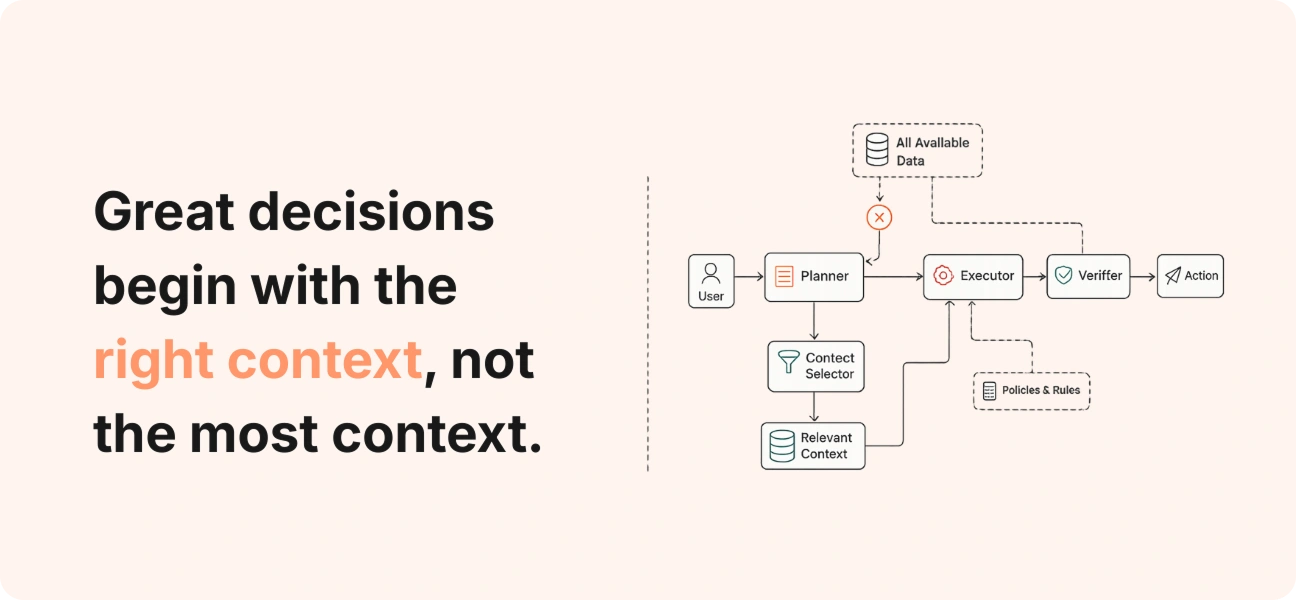
Rather than optimizing retrieval volume, we focused on reducing uncertainty before reasoning begins.

Today, every customer request passes through a dedicated Context Assembly Pipeline that determines what information deserves the planner’s attention and filters everything else before planning starts.
We Started by Retrieving Everything

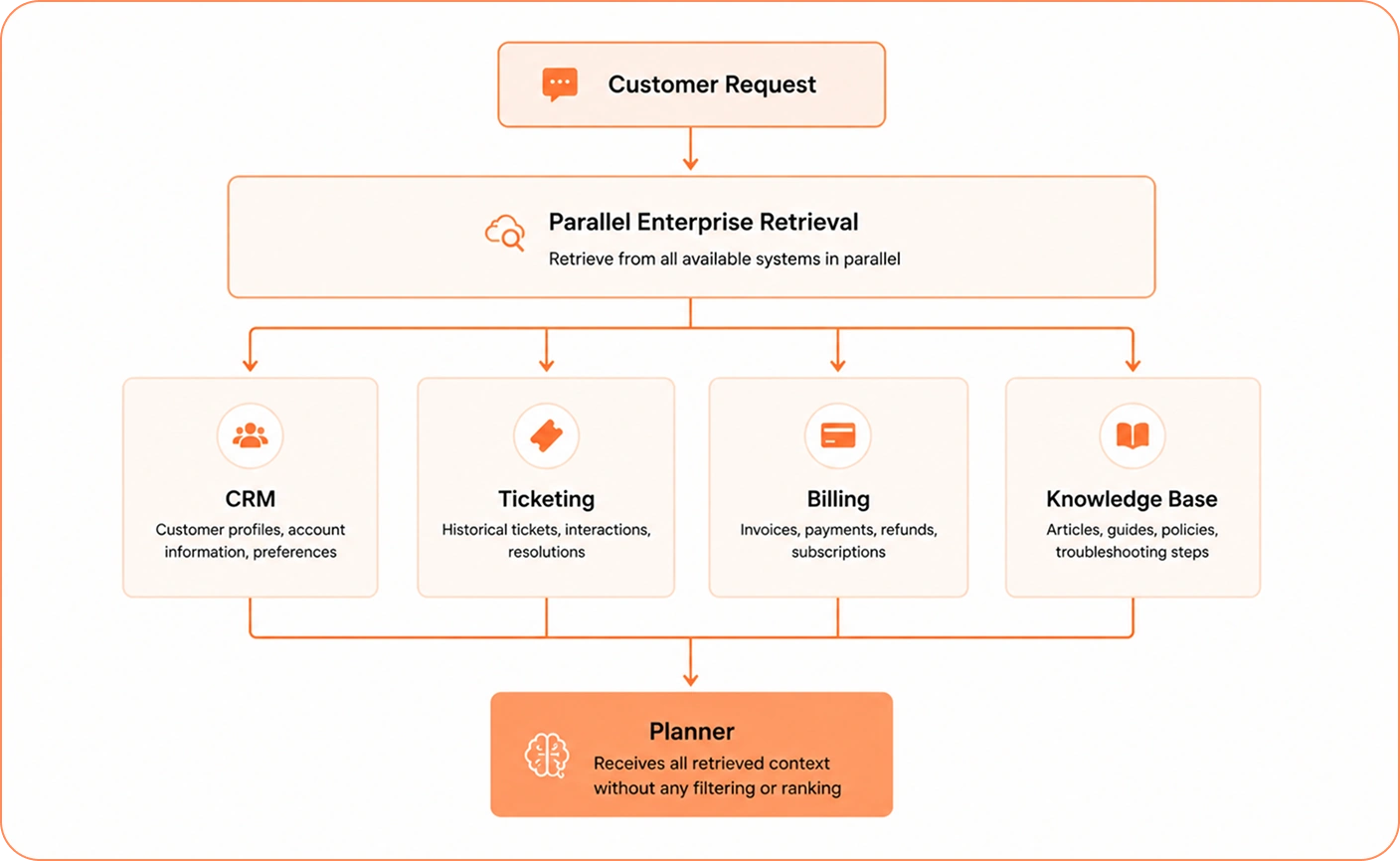
The first generation of Azeon’s retrieval pipeline prioritized coverage.

Every connected system participated in context retrieval simultaneously, ensuring the planner had access to as much customer information as possible within the latency budget of an interactive support session.

The architecture looked similar to this.

Context Retrieval Architecture

The retrieval layer performed exactly as expected. Enterprise systems responded correctly, relevant documents were successfully retrieved, and coverage improved as additional integrations were introduced. From a retrieval perspective, the architecture was functioning well.

However, planning told a different story.

The planner frequently received multiple versions of the same knowledge article, historical tickets that no longer reflected the customer’s current issue, duplicate customer records originating from synchronized systems, and operational procedures that had already been replaced by newer documentation.

Individual artifacts remained technically relevant, but collectively they introduced ambiguity into the planning process.

We also observed another pattern. As retrieval volume increased, the planner spent more effort evaluating enterprise context before it could begin constructing an execution strategy. Larger context packages increased inference cost without producing proportional improvements in planning quality.

The problem wasn’t retrieval coverage.

The problem was that retrieval had no opinion about which context actually mattered.

Building Azeon’s Context Assembly Pipeline

Instead of forwarding every retrieved artifact to the planner, we introduced a dedicated Context Assembly Pipeline between retrieval and reasoning.

Its responsibility is simple: assemble the smallest possible context required for reliable planning.

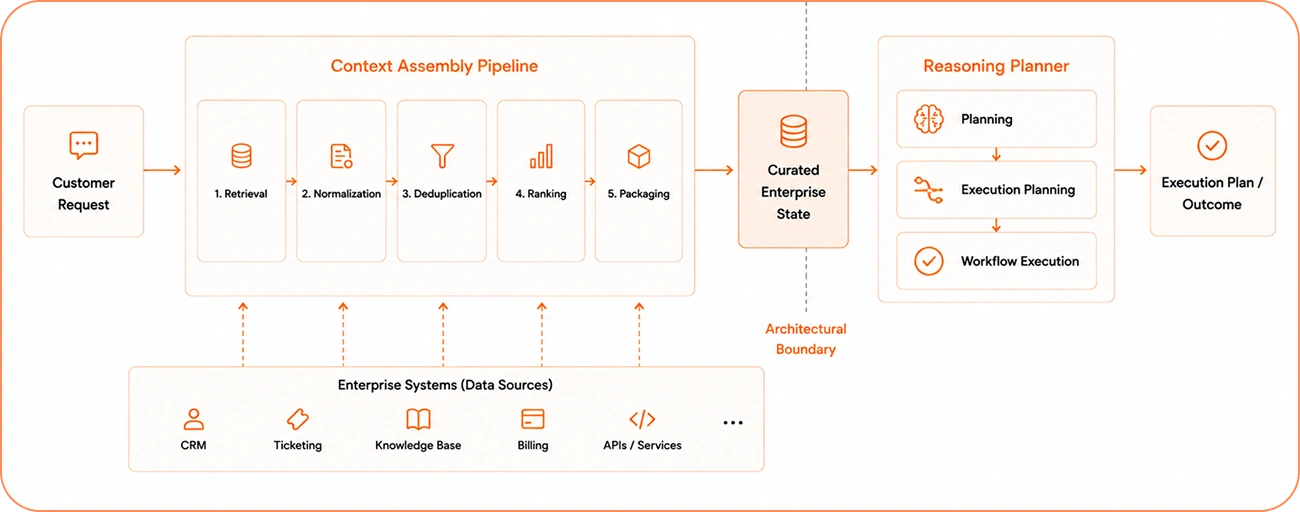
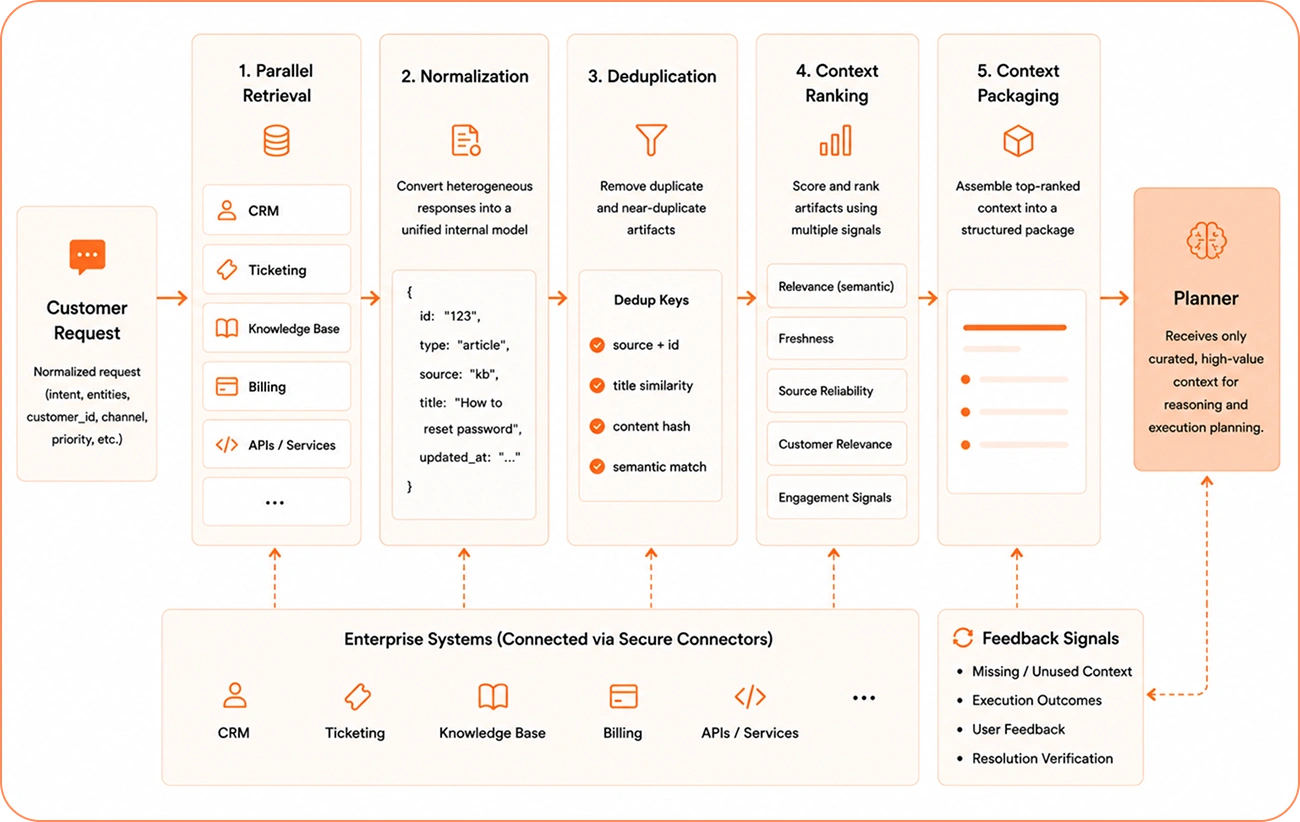
Every customer request now follows the same processing pipeline before reaching the reasoning engine.

Context Assembly Pipeline Architecture

Each stage removes a different source of uncertainty before reasoning begins.

The normalization layer converts heterogeneous responses into a consistent internal representation. CRM records, knowledge articles, ticket history, billing events, and operational metadata arrive in different formats, but downstream systems consume a unified context model regardless of the original source.

Once normalized, retrieved artifacts pass through deduplication.

Enterprise systems frequently contain replicated information because multiple systems synchronize customer records, documentation, or support history. Removing redundant context prevents the planner from evaluating identical information multiple times while reducing unnecessary token consumption.

The remaining context enters Azeon’s Context Ranking Engine.

Rather than treating every retrieved artifact equally, the ranking engine evaluates multiple signals simultaneously.

  • Semantic relevance measures how closely the information aligns with the customer’s active request.
  • Freshness identifies whether operational documentation or enterprise records remain current.
  • Source reliability prioritizes authoritative systems over replicated or secondary data sources.

Customer relevance determines whether retrieved information reflects the customer’s present operational state instead of historical interactions that no longer influence resolution.

These signals work together to reduce ambiguity before planning begins.

The final stage packages only the highest-value context into a structured representation consumed by the planner.

By the time reasoning starts, duplicate records have already been removed, outdated information has already been filtered, and competing signals have already been prioritized.

The planner never receives raw retrieval results. It receives an enterprise state that has already been assembled, evaluated, and prepared for decision-making.

The Planner Never Sees Raw Enterprise Data

One of the architectural decisions we made early in the evolution of the Context Assembly Pipeline was separating context preparation from reasoning.

The planner never performs retrieval, ranks enterprise records, compares conflicting documents, or evaluates which system should be trusted. Those responsibilities belong entirely to the Context Assembly Pipeline. By the time planning begins, context has already been assembled into a curated representation optimized for decision-making.

This separation significantly simplifies the reasoning engine.

Instead of spending inference cycles interpreting enterprise data, the planner focuses on a single responsibility: determining the most appropriate execution strategy for the customer’s request. Every reasoning cycle starts from the same structured enterprise state, regardless of which systems contributed to it.

The architectural boundary also allows both subsystems to evolve independently.

As additional integrations are introduced, retrieval logic expands without affecting planning behavior.

Improvements to ranking algorithms, deduplication strategies, or context packaging immediately benefit every reasoning workflow without requiring changes to the planner itself.

The architecture now resembles two independent systems connected through a stable interface.

Reasoning Architecture with Context Assembly Boundary

This architectural boundary also improves observability.

When planning quality changes, we can determine whether the root cause originated from context assembly or reasoning without treating the entire pipeline as a single system.

Each subsystem exposes independent metrics, making performance optimization significantly more predictable.

Most importantly, the planner operates on information that has already been validated for relevance instead of discovering relevance during inference. Every reasoning cycle begins with a concise enterprise state rather than a collection of raw retrieval results.

Context Retrieval is Continuously Evaluated

Building the Context Assembly Pipeline wasn’t the final step. Like every subsystem inside Azeon, retrieval continuously improves through production feedback.

We don’t evaluate retrieval based on the number of documents returned or the percentage of successful searches. Those metrics describe retrieval activity rather than retrieval quality.

Instead, we measure whether the assembled context helped the planner reach the correct execution decision.

Every completed resolution generates signals that feed back into the Context Assembly Pipeline.

If the planner requests additional information during execution, it indicates missing context.

If retrieved artifacts remain unused throughout planning, it suggests unnecessary context entered the reasoning process.

Failed workflow execution caused by incomplete enterprise state exposes retrieval gaps that coverage metrics alone cannot identify.

Verified resolution outcomes provide the strongest feedback signal.

When a customer issue reaches a verified resolution, the platform records the context package that contributed to the planning decision.

When verification fails, the same pipeline helps identify whether missing, outdated, duplicated, or incorrectly prioritized information influenced the outcome.

This continuous feedback loop allows context assembly to evolve alongside the platform.

As new enterprise systems, workflows, and customer scenarios are introduced, retrieval strategies adapt using operational evidence instead of static configuration.

Rather than treating retrieval as a fixed component, Azeon continuously refines how context is assembled before every reasoning cycle.

Closing Thoughts

Retrieving information is only one part of building reliable AI systems.

Determining which information deserves the planner’s attention has a much greater impact on decision quality than simply expanding retrieval coverage.

The Context Assembly Pipeline reflects that philosophy throughout Azeon’s architecture.

Every stage, from normalization and deduplication to ranking and context packaging, exists to remove uncertainty before reasoning begins.

The planner receives only the enterprise state required to make an execution decision, while retrieval complexity remains isolated behind a dedicated architectural boundary.

This approach has fundamentally changed how we build reasoning systems.

We no longer optimize retrieval for volume or maximize the amount of information entering the model. We optimize the quality of the context that reaches it.

At Azeon, better planning begins long before the reasoning engine generates its first decision. It begins with ensuring the planner receives only the context that matters.

Vinus Akhediya is the Solution Architect at Azeon, where he leads the design and architecture of the platform's Agentic AI engine for customer support. His work focuses on AI reasoning, autonomous agent workflows, enterprise integrations, knowledge orchestration, workflow execution, and scalable AI infrastructure that enables Azeon to resolve customer inquiries with accuracy, speed, and governance.

Vinus Akhediya
Solution Architect

Questions about Azeon?

Connect with our team to explore use cases, workflows, and deployment possibilities.