


Skip to content

Conversational AI in Retail: How it Reduces Customer Support Costs

Conversational AI in Retail: How it Reduces Customer Support Costs

Retailers have spent years investing in faster customer support, yet operational costs continue to rise.

More channels, higher order volumes, longer shopping seasons, and increasing customer expectations have created a support environment where simply hiring more agents is no longer sustainable.

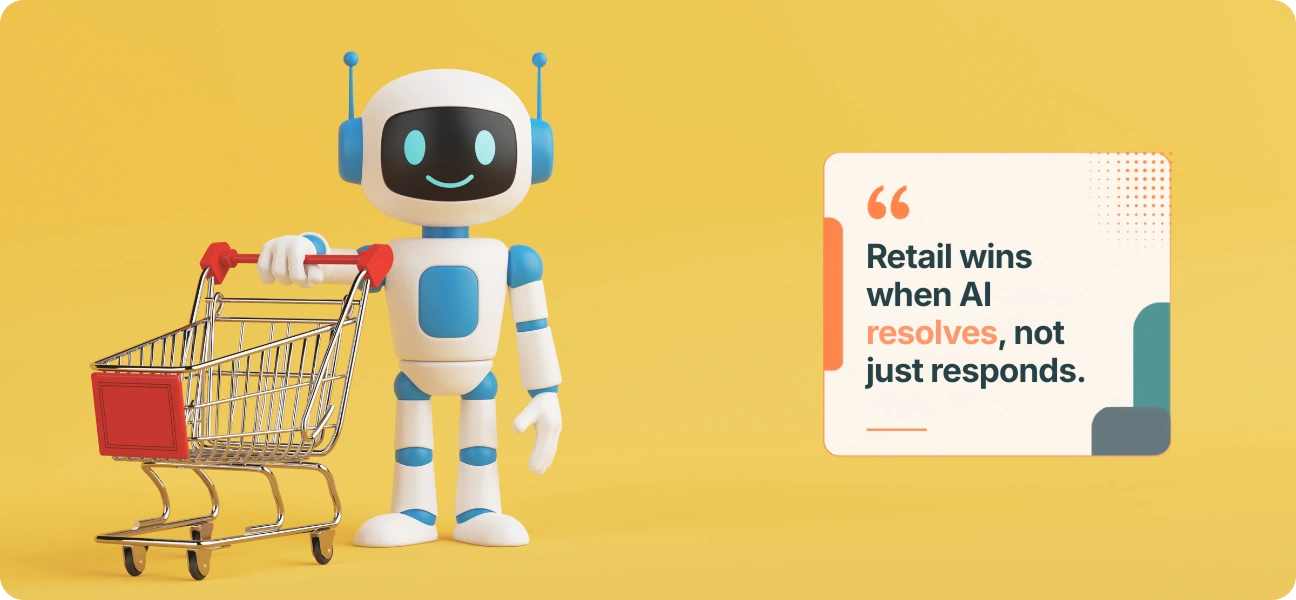
Conversational AI has emerged as one of the most effective ways to improve efficiency, but the biggest gains don’t come from deploying another chatbot.

Leading retailers reduce customer support costs by identifying repetitive, high-volume interactions and redesigning those journeys with AI that understands customer intent, retrieves business information, and completes tasks with minimal human intervention.

This article explores the practical ways conversational AI reduces customer support costs in retail, where the biggest savings come from, and what separates high-performing AI implementations from those that struggle to deliver meaningful ROI.

The 20% of Customer Requests That Drive 80% of Support Costs

One of the biggest misconceptions about AI adoption is the idea that every customer interaction should be automated.

Successful retailers take a different approach. They begin with customer requests that are repetitive, predictable, and operationally expensive. These interactions account for a significant share of ticket volumes while offering limited value for human agents.

Customer Request Typical Support Scenario Automation Potential Cost Impact Business Outcome
Order Tracking Customers check shipment status, delivery ETA, or courier updates after placing an order. Very High High Reduces repetitive inquiries while lowering cost per contact and improving response speed.
Return Requests Customers initiate returns, verify eligibility, or request prepaid return labels. High High Automates return journeys, reducing agent workload and accelerating processing.
Delivery Issues Customers report delayed, missing, or partially delivered orders. High High Provides proactive delivery updates, reducing repeat contacts and escalations.
Product Availability Customers check inventory across online stores, nearby locations, or upcoming stock arrivals. Very High Medium Instant inventory lookup improves self-service while reducing inbound support volume.
Exchange Requests Customers request product exchanges due to size, color, or damaged items. High Medium Accelerates exchange workflows and shortens average handling time.
Loyalty & Rewards Customers ask about reward points, membership tiers, or redemption eligibility. High Medium Delivers instant account insights without requiring manual verification.
Account Management Customers update shipping addresses, phone numbers, passwords, or communication preferences. High Medium Automates routine profile updates, allowing agents to focus on higher-value interactions.

Consider a retailer receiving 150,000 support requests every month. If nearly 60% of those requests involve order tracking, shipping updates, or return policies, thousands of agent hours are consumed by interactions that follow the same workflow every time.

Conversational AI in retail handles these requests instantly by retrieving order information, accessing customer history, checking inventory, or presenting return options without requiring manual effort from an agent.

5 Ways Conversational in Retail Reduces Customer Support Costs

The value of conversational AI for retail customer support isn’t measured by the number of conversations it starts. It’s measured by the operational costs it removes from the end-to-end lifecycle.

1. Lower Cost Per Customer Interaction

Every customer conversation has an associated cost, whether it’s handled through chat, email, or voice support.

When customers ask questions like:

  • Where is my order?
  • Can I return this product?
  • Is this item available in my nearest store?
  • When will my refund arrive?

Human agents spend time retrieving information that already exists across order management systems, inventory platforms, CRMs, and knowledge bases.

Conversational AI in retail connects with these systems and delivers accurate answers within seconds.

Reducing thousands of repetitive interactions each week directly lowers staffing requirements while improving customer response times.

2. Improve First-Contact Resolution

A customer who contacts support three times about the same issue costs significantly more than someone whose request is resolved during the first conversation.

Conversational AI improves first-contact resolution by understanding customer intent, gathering relevant context, and retrieving information from connected business systems before responding.

Instead of asking customers to repeat order numbers or explain their issue multiple times, AI provides personalized assistance based on existing customer data.

3. Reduce Ticket Escalations

Escalations often occur because frontline agents don’t have immediate access to the information required to resolve a request.

For example, warranty eligibility, return policy exceptions, order modifications, inventory availability, loyalty program balances, etc.

Conversational AI surfaces this information instantly, which allows many customer issues to be resolved without involving senior support teams.

Reducing unnecessary escalations lowers labor costs while allowing experienced agents to focus on genuinely complex cases.

4. Shorten Average Handling Time

Average Handling Time (AHT) remains one of the most closely monitored customer support metrics.

Even when AI doesn’t fully resolve a customer issue, it can significantly reduce handling time by:

  • Collecting customer information before handoff
  • Summarizing previous conversations
  • Retrieving order history
  • Identifying customer intent
  • Suggesting relevant knowledge articles

Instead of spending the first several minutes gathering context, human agents can begin solving the problem immediately.

Across thousands of monthly interactions, saving even one or two minutes per ticket creates substantial operational savings.

5. Reduce Seasonal Staffing Requirements

Retail support demand fluctuates throughout the year.

Events such as Black Friday, Cyber Monday, holiday shopping seasons, and major product launches often force retailers to increase support capacity for relatively short periods.

Conversational AI in retail customer support provides additional capacity without requiring proportional increases in headcount.

During peak shopping periods, AI can simultaneously manage thousands of customer conversations related to shipping updates, order confirmations, return policies, delivery timelines, product availability, etc.

Support teams maintain service quality while avoiding the operational costs associated with temporary hiring and training.

Which Conversational AI Type Delivers the Greatest Cost Savings?

Not every conversational AI platform is designed to solve the same business problems.

Some solutions are built to answer frequently asked questions, while others help agents work more efficiently. The latest generation goes a step further by understanding customer intent, interacting with business systems, and supporting end-to-end resolution.

Understanding these different approaches helps retailers choose a platform that aligns with their customer support goals, operational complexity, and long-term AI strategy.

Conversational AI Type Primary Purpose Best For Operational Limitations
Rule-Based Conversational AI Automates repetitive customer inquiries using predefined rules, workflows, and decision trees. FAQs, store hours, shipping policies, return policies, and basic self-service. Cannot understand complex intent or adapt beyond predefined flows. Most operational requests require human intervention.
Generative Conversational AI Uses large language models (LLMs) to understand customer intent and deliver natural, context-aware conversations. Product recommendations, personalized support, policy explanations, shopping assistance, and knowledge retrieval. Produces better conversations but often relies on agents to complete operational tasks like refunds, exchanges, or account updates.
Agentic Conversational AI Combines reasoning, enterprise context, system integrations, and workflow execution to help resolve customer requests. Enterprise customer support, returns, refunds, order modifications, account management, and end-to-end service automation. Requires well-defined governance, enterprise integrations, and business workflows to maximize operational value.

Rule-Based Conversational AI

Rule-based conversational AI follows predefined conversation paths and decision trees. It works well for answering common customer questions that have predictable responses.

While effective for simple interactions, rule-based systems depend on predefined logic. When customers ask questions outside those flows or require operational actions, the conversation usually transfers to a human agent.

For retailers handling high support volumes, this limits the overall impact on operational costs.

Generative Conversational AI

Generative conversational AI uses large language models to understand customer intent and generate context-aware responses.

Compared to rule-based systems, it delivers a more natural customer experience by understanding different ways customers ask questions and retrieving information from connected knowledge sources.

However, many generative AI implementations still stop at the conversation. Once a customer needs a refund processed, an exchange initiated, or an account updated, the remaining work often shifts back to the support team.

Agentic Conversational AI

Agentic conversational AI in retail builds on conversational capabilities by combining reasoning, business context, enterprise integrations, and workflow execution.

Instead of simply responding to customer requests, it can support actions such as:

  • Retrieving order history across commerce platforms
  • Verifying return or warranty eligibility
  • Checking live inventory availability
  • Updating customer information
  • Initiating approved refund or exchange workflows
  • Escalating complex requests with complete customer context
  • Coordinating tasks across CRM, OMS, ERP, and support platforms

This allows support teams to spend less time navigating systems and more time resolving situations that genuinely require human expertise.

For retailers, these capabilities create a larger opportunity to reduce operational costs because AI contributes throughout the resolution process rather than only at the beginning of the conversation.

Why More Retailers are Moving Toward Agentic Conversational AI?

Customer support success is increasingly measured by outcomes rather than interactions.

Retailers are looking beyond metrics such as chat volume and response time to focus on business outcomes like first-contact resolution, cost per resolution, average handling time, and customer satisfaction.

This shift is driving growing interest in conversational AI platforms that combine intelligent conversations with enterprise workflows.

Capability Rule-Based AI Generative AI Agentic AI
Answer Frequently Asked Questions
Natural, Context-Aware Conversations
Understand Customer Intent Limited
Retrieve Information from Business Systems Limited
Execute Customer Support Workflows Limited
Maintain Shared Customer Memory Limited
Support Human-in-the-Loop Governance Limited
Resolve End-to-End Customer Requests Limited

Key Capabilities to Look for in Conversational AI for Retail Customer Support

As you evaluate conversational AI platforms, prioritize capabilities that directly influence customer experience, operational efficiency, and long-term scalability.

Omnichannel Customer Support

Retail customers interact with brands across multiple channels, including websites, mobile apps, email, social media, messaging platforms, and voice support.

A conversational AI platform should maintain context across these channels so customers don’t have to restart conversations every time they switch devices or communication methods.

Enterprise System Integrations

Customer support depends on accurate, real-time business data.

Look for platforms that integrate with CRM, Order Management Systems (OMS), Inventory Management Systems (IMS), ERP platforms, payment gateways, and customer support tools.

These integrations allow AI to retrieve information, perform approved actions, and reduce manual work for support agents.

Shared Customer Memory

Every customer interaction should build on previous conversations.

Shared customer memory enables AI to remember purchase history, previous support requests, preferences, and ongoing cases, resulting in faster resolutions and more personalized support experiences.

Workflow Execution

The ability to execute workflows separates enterprise conversational AI from traditional chatbots.

Instead of stopping at answers, the platform should support actions such as processing returns, initiating refunds, updating customer information, creating support tickets, checking inventory, and triggering internal approval workflows.

AI Reasoning

Modern conversational AI should understand customer intent, evaluate context, and determine the most appropriate next action.

Whether it’s resolving a delivery issue or routing a complex request to a specialist, reasoning capabilities help reduce unnecessary escalations and improve first-contact resolution.

Security and Governance

As AI gains access to customer data and business systems, governance becomes essential.

Features such as role-based access controls, audit logs, human approval workflows, and compliance with standards like GDPR and SOC 2 help organizations deploy AI responsibly while maintaining operational control.

Why Azeon is Built for the Next Generation of Retail Customer Support

Azeon is a resolution-first AI agent for customer support that helps retailers move beyond conversation automation to resolution automation.

Instead of simply answering customer questions, Azeon understands customer intent, reasons through requests, retrieves business context, and executes approved workflows across your existing support ecosystem.

Built as an intelligence layer, Azeon integrates with your current CRM, help desk, eCommerce platform, Order Management System (OMS), ERP, and knowledge base to deliver faster, more efficient customer support.

Key capabilities include:

  • Understands customer intent, analyzes context, and determines the next best action to resolve requests efficiently.
  • Maintains conversation history and customer context across channels for personalized, seamless support.
  • Executes approved actions such as refunds, returns, exchanges, order updates, and ticket creation.
  • Delivers consistent support experiences across chat, email, voice, messaging apps, and social channels.
  • Connects with CRM, OMS, ERP, eCommerce platforms, payment systems, and knowledge bases without replacing your existing stack.
  • Automates routine work while routing exceptions to human agents with complete context and approval controls.
  • Supports role-based access, audit logs, and enterprise-grade governance for secure AI deployment.
  • Tracks operational KPIs such as resolution rate, first-contact resolution, automation rate, and cost savings.

What sets Azeon apart is its resolution-based pricing.

Rather than paying for seats, tokens, or idle AI capacity, you pay only for verified customer resolutions, aligning AI costs directly with business outcomes.

So, whether you’re looking to reduce customer support costs, improve resolution rates, or deliver faster and more personalized customer experiences, Azeon helps your team achieve measurable outcomes with enterprise-ready Agentic AI.

Curious How Azeon Reduces Customer Support Costs?

Experience a live demo of Azeon's Agentic AI platform tailored to your retail support operations.

Schedule a Demo →

Tarak Joshi leads growth strategy and market expansion for agentic AI-powered customer support solutions. With 20+ years of experience in business strategy, IT consulting, and operational excellence, he focuses on helping enterprises improve support outcomes, reduce operational costs, and adopt AI with measurable business impact. His expertise spans customer experience transformation, AI-led service operations, and aligning technology investments with business goals.

Tarak Joshi
VP - Sales

Questions about Azeon?

Connect with our team to explore use cases, workflows, and deployment possibilities.