
Skip to content

Agentic AI for Help Desk Automation: 15 Workflows You Can Automate

Agentic AI for Help Desk Automation: 15 Workflows You Can Automate

What is Agentic AI for Help Desk Automation?

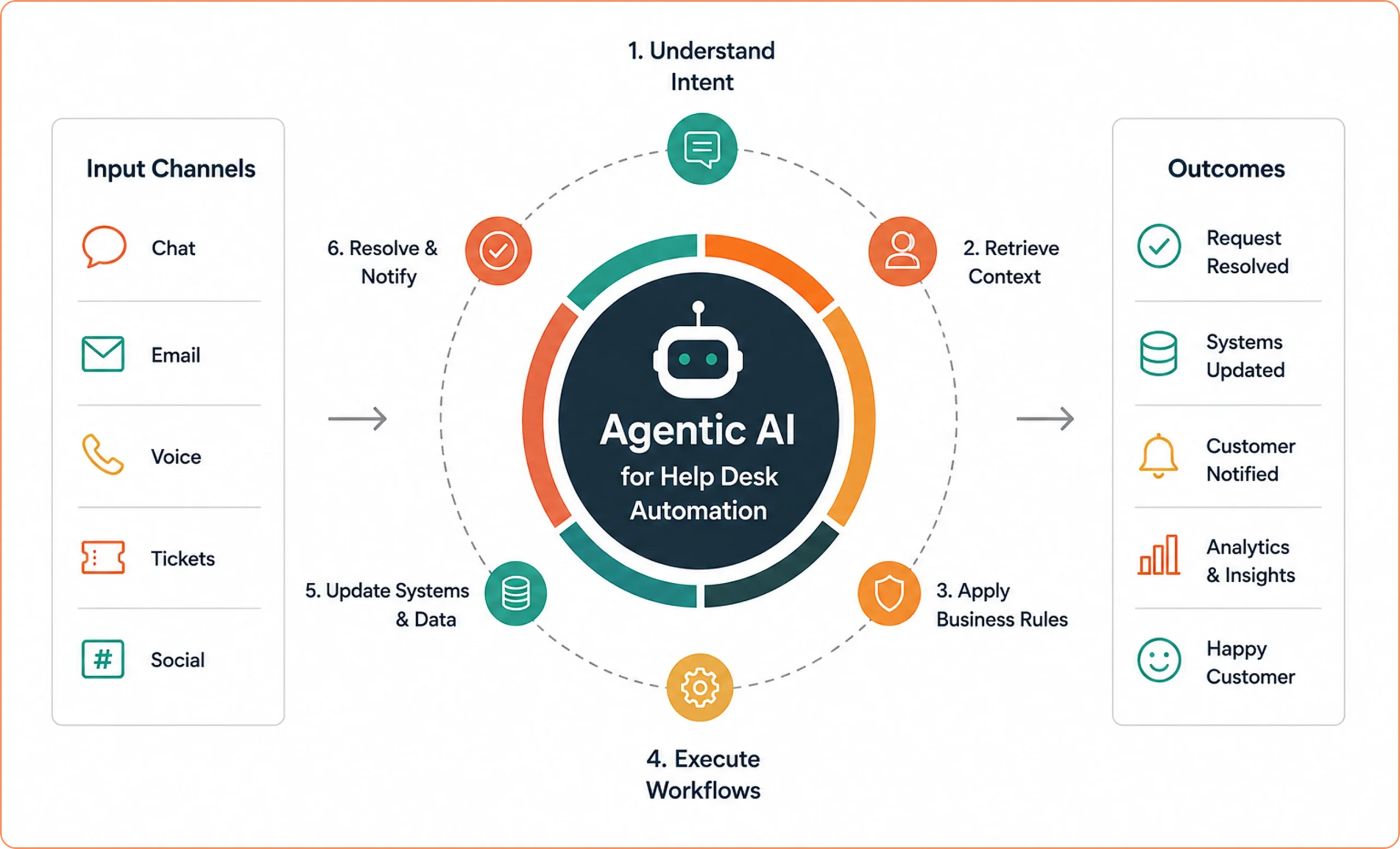
Agentic AI for help desk automation refers to AI systems that can understand customer requests, reason through the appropriate course of action, interact with multiple business applications, execute approved workflows, and complete service requests with minimal human involvement.
What is Agentic AI for Help Desk Automation

Unlike traditional automation, agentic AI doesn’t rely solely on predefined decision trees or static scripts.

Instead, it combines several capabilities into a unified workflow:

  • Natural language understanding to interpret customer intent
  • Context retrieval from CRMs, support platforms, billing systems, and knowledge bases
  • Business rule evaluation to ensure every action follows organizational policies
  • Workflow orchestration across connected enterprise applications
  • Intelligent decision-making with human approval where required
  • Automatic documentation, record updates, and customer communication

Think of it as moving from an assistant that provides information to an autonomous support colleague capable of completing operational tasks.

For enterprise support teams, this distinction matters because most customer requests involve more than conversation. They require coordination across multiple systems, adherence to business policies, and accurate execution.

Agentic AI brings these capabilities together in a single operational flow.
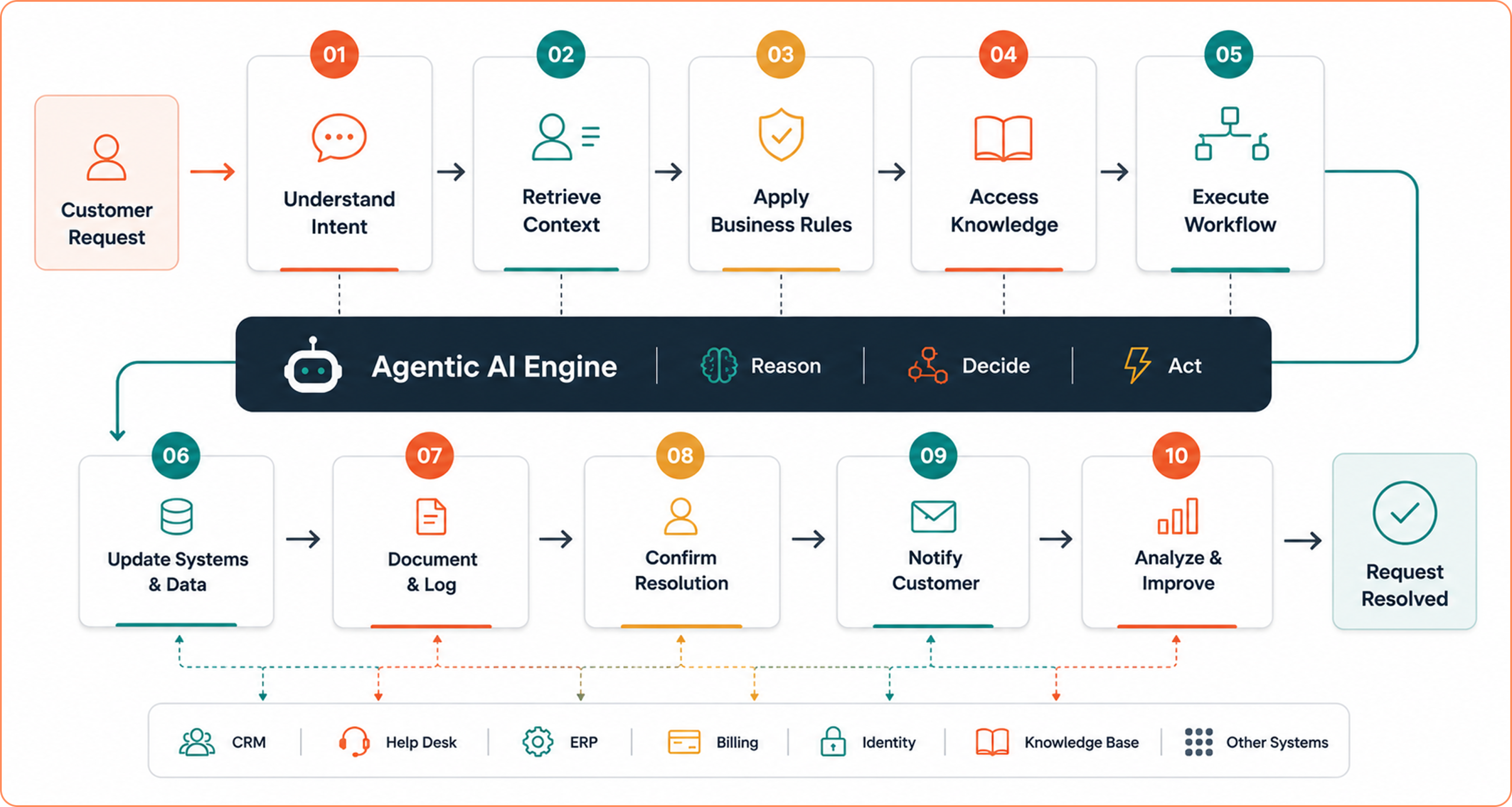
How Agentic AI Automates Help Desk Workflows?

Every customer interaction follows a series of operational steps.

The customer may only see the conversation, but behind every resolved ticket lies a sequence of business processes.

An effective Agentic AI for help desk automation platform coordinates each of these steps automatically.

How Agentic AI Automates Help Desk Workflows

Step 1: Understand Customer Intent

The AI analyzes the customer’s request regardless of channel – chat, email, voice, or messaging.

Rather than searching for keywords, it identifies the customer’s objective.

Examples include:

  • Reset my password
  • Cancel my subscription
  • Update my shipping address

Understanding intent establishes the foundation for every subsequent decision.

Step 2: Retrieve Customer Context

Next, the AI gathers relevant information from connected systems.

This may include customer profile, previous interactions, purchase history, subscription status, account permissions, billing information, etc.

Instead of asking customers to repeat information, the AI builds a complete understanding of the situation before taking action.

Step 3: Apply Business Rules

Every organization operates according to policies.

For example:

  • Is the customer eligible for a refund?
  • Has the warranty expired?
  • Does this request require manager approval?
  • Is identity verification complete?
  • Does the customer’s subscription plan allow this change?

Rather than making assumptions, agentic AI evaluates these rules before proceeding.

This ensures every action aligns with compliance requirements and operational standards.

Step 4: Execute the Workflow

Once eligibility is confirmed, the AI interacts with enterprise systems to complete the requested task.

Depending on the scenario, it can:

  • Update CRM records
  • Process refunds
  • Reset credentials
  • Schedule appointments

This is where Agentic AI help desk automation extends beyond conversation and into operational execution.

Step 5: Update Every Connected System

Completing the task is only part of the process.

The AI also synchronizes every connected platform by updating:

  • CRM records
  • Help desk tickets
  • Billing platforms
  • Customer timelines
  • Audit logs
  • Reporting dashboards

Maintaining consistent data across systems reduces administrative work while improving reporting accuracy.

Step 6: Confirm Resolution

Finally, the AI communicates the outcome to the customer.

Instead of simply acknowledging the request, it confirms the completed action, explains any next steps, shares reference details where applicable, and closes the interaction.

This creates a seamless support experience while freeing human agents to focus on complex, high-value cases that require judgment, empathy, or specialized expertise.

15 Help Desk Workflows You Can Fully Automate with Agentic AI

Below are fifteen high-impact workflows that organizations across banking, SaaS, retail, eCommerce, telecommunications, insurance, and enterprise IT are increasingly automating.

1. Password Reset

Password resets remain one of the most common help desk requests. Although the process appears simple, agents often spend several minutes verifying identities, initiating reset procedures, documenting the interaction, and confirming completion.

When hundreds of requests arrive daily, these repetitive tasks quickly consume valuable support resources.

An AI support agent can:

  • Verify customer identity using approved authentication methods
  • Validate security policies
  • Generate a secure password reset workflow
  • Trigger reset services within identity management platforms
  • Update customer records
  • Notify the customer once the password has been successfully reset

Business Impact

  • Faster first-contact resolution
  • Lower authentication effort
  • Reduced ticket volume
  • More availability for complex support cases

2. Account Unlock Requests

Customers frequently become locked out after multiple failed login attempts or security policy violations. Traditionally, agents manually verify identities before restoring access.

Agentic AI:

  • Reviews account status
  • Confirms identity verification
  • Applies security policies
  • Unlocks the account through connected identity systems
  • Records the activity for compliance
  • Sends confirmation to the customer

Business Impact

  • Reduced login-related support tickets
  • Faster account recovery
  • Improved customer experience
  • Consistent security enforcement

3. Order Status Inquiries

“Where is my order?” remains one of the highest-volume customer support requests for retailers and eCommerce companies.

Agents often switch between CRM, ERP, warehouse management, and logistics platforms to locate shipment information.

Agentic AI retrieves:

  • Order information
  • Warehouse status
  • Shipping carrier updates
  • Delivery estimates
  • Tracking details

It then delivers an accurate, personalized update without requiring agent involvement.

Business Impact

  • Higher self-service resolution
  • Lower inquiry volume
  • Reduced average handling time (AHT)
  • Improved customer satisfaction

4. Refund Requests

Refund processing typically involves reviewing purchase history, validating return policies, checking payment methods, and updating multiple business systems.

Even routine refunds can take considerable agent time.

The Agentic AI:

  • Validates purchase eligibility
  • Reviews refund policies
  • Confirms payment details
  • Initiates the refund
  • Updates financial systems
  • Closes the support ticket
  • Notifies the customer

Business Impact

  • Faster refund processing
  • Reduced operational workload
  • Consistent policy enforcement
  • Better customer trust

5. Subscription Changes

Customers regularly request plan upgrades, downgrades, renewals, cancellations, or billing cycle modifications.

These requests often require coordination across CRM, billing, and subscription management platforms.

The Agentic AI:

  • Reviews the customer’s current subscription
  • Checks eligibility rules
  • Calculates pricing changes
  • Updates the subscription
  • Synchronizes billing systems
  • Confirms the modification

Business Impact

  • Shorter resolution times
  • Accurate billing updates
  • Fewer manual errors
  • Improved customer retention

6. Customer Profile Updates

Updating addresses, phone numbers, email addresses, or communication preferences appears straightforward, yet these changes often require updates across multiple systems.

Incomplete synchronization leads to inconsistent customer records.

The Agentic AI:

  • Verifies customer identity
  • Validates requested changes
  • Updates every connected business application
  • Synchronizes customer records
  • Logs all modifications

Business Impact

  • Cleaner customer data
  • Reduced administrative effort
  • Consistent customer profiles
  • Better compliance with data governance policies

7. Invoice and Billing Requests

Customers frequently request copies of invoices, payment confirmations, billing explanations, or outstanding balance information.

Agents often spend unnecessary time retrieving documents and answering repetitive billing questions.

The Agentic AI:

  • Retrieves invoice records
  • Explains billing details
  • Generates payment summaries
  • Shares invoices securely
  • Updates interaction history

Business Impact

  • Reduced billing inquiries
  • Faster customer responses
  • Lower support costs
  • Improved financial transparency

8. Warranty Claims

Warranty requests require agents to validate product registrations, purchase dates, warranty terms, and service eligibility before initiating the claims process.

The Agentic AI:

  • Verifies warranty coverage
  • Reviews purchase records
  • Confirms eligibility
  • Creates warranty claims
  • Initiates repair or replacement workflows
  • Keeps customers informed throughout the process

Business Impact

  • Faster claims processing
  • Reduced manual validation
  • Better service consistency
  • Higher customer confidence

9. Returns and Exchanges

Return requests often involve several disconnected processes, including policy validation, return authorization, shipping instructions, inventory updates, and refund coordination.

The Agentic AI:

  • Confirms return eligibility
  • Generates return authorization
  • Creates shipping labels
  • Updates inventory systems
  • Coordinates refunds or exchanges
  • Tracks the complete workflow until completion

Business Impact

  • Faster returns
  • Lower processing costs
  • Improved inventory accuracy
  • Better customer experience

10. Appointment Scheduling

Organizations in healthcare, financial services, field services, and professional services frequently manage appointment scheduling requests.

Manual coordination slows response times and increases scheduling conflicts.

The Agentic AI:

  • Reviews calendar availability
  • Applies scheduling policies
  • Books appointments
  • Sends confirmations
  • Handles rescheduling requests
  • Updates connected scheduling platforms automatically

Business Impact

  • Fewer scheduling conflicts
  • Reduced administrative effort
  • Higher appointment utilization
  • Improved customer convenience

11. Technical Troubleshooting

Support agents spend significant time collecting diagnostic information before they can begin resolving technical issues.

Instead of immediately escalating, the Agentic AI:

  • Identifies the reported issue
  • Collects diagnostic information
  • Searches enterprise knowledge sources
  • Walks customers through guided troubleshooting
  • Resolves common technical problems automatically
  • Escalates only when advanced expertise is required

Business Impact

  • Higher self-service success
  • Improved containment rates
  • Lower escalation volume
  • Faster issue resolution

12. Employee Access Requests

Internal IT help desks receive constant requests for application access, role changes, software permissions, and account provisioning.

These requests require security validation and policy enforcement.

The Agentic AI:

  • Verifies employee identity
  • Checks role-based access policies
  • Obtains approvals when required
  • Provisions access
  • Updates identity management systems
  • Records the activity for auditing

Business Impact

  • Faster employee onboarding
  • Improved governance
  • Reduced IT workload
  • Better compliance

13. Intelligent Case Routing

Traditional routing rules often classify tickets using keywords or predefined categories.

As a result, customers may be transferred multiple times before reaching the appropriate team.

Rather than simply assigning a queue, the Agentic AI:

  • Understands customer intent
  • Identifies urgency
  • Reviews customer history
  • Determines business priority
  • Enriches the ticket with relevant context
  • Routes it directly to the most appropriate specialist when escalation is necessary

Business Impact

  • Fewer transfers
  • Higher first-contact resolution
  • Faster agent productivity
  • Better SLA performance

14. Customer Verification Across Multiple Systems

Support teams often switch between CRM platforms, billing systems, identity providers, and customer databases to verify account information.

This repetitive work increases handling time and introduces opportunities for error.

The Agentic AI simultaneously:

  • Retrieves customer information from multiple systems
  • Cross-validates account details
  • Detects inconsistencies
  • Confirms identity
  • Builds a complete customer profile before any action begins

Business Impact

  • Shorter verification times
  • Reduced agent effort
  • More accurate customer records
  • Stronger security controls

15. End-to-End Case Resolution

Resolving the customer’s issue is only one part of the support process.

Agents still need to document the interaction, update CRM records, close tickets, notify customers, and trigger downstream workflows.

These post-resolution activities consume valuable time.

Once the issue has been resolved, the Agentic AI automatically:

  • Updates CRM records
  • Documents the interaction
  • Closes the ticket
  • Synchronizes enterprise systems
  • Creates audit logs
  • Updates analytics dashboards
  • Sends confirmation messages
  • Triggers any follow-up workflows

Instead of leaving the final administrative work to agents, the AI completes the entire support lifecycle.

Business Impact

  • Complete workflow automation
  • Improved reporting accuracy
  • Reduced after-call work (ACW)
  • Lower operational costs
  • Consistent customer experiences

Benefits of Agentic AI for Help Desk Automation

Here are the business outcomes organizations can expect from implementing Agentic AI for help desk automation.

Faster First Contact Resolution (FCR)

Agentic AI resolves requests within the first interaction by combining intent understanding, customer context, business rules, and workflow execution.

Instead of collecting information for an agent to process later, it completes approved actions immediately, reducing transfers, repeat contacts, and unresolved tickets.

Lower Cost per Resolution

Automating repetitive operational workflows reduces the amount of manual work required for each customer request.

This helps organizations lower their overall cost per resolution while maintaining service quality.

For more insight, explore How AI Automation Reduces Repetitive Help Desk Tickets.

Improved Agent Productivity

Agentic AI handles repetitive operational tasks such as verification, data retrieval, workflow execution, documentation, and system updates.

This allows agents to focus on conversations that require experience, empathy, and judgment.

Reduced Average Handle Time (AHT)

A significant portion of handling time is spent navigating multiple systems rather than interacting with customers.

Agentic AI retrieves information, executes workflows, and updates enterprise applications in parallel, reducing system-switching and eliminating repetitive administrative tasks during the support process.

Higher Customer Satisfaction (CSAT)

Customers receive completed outcomes instead of progress updates.

Requests such as refunds, subscription changes, order tracking, or password resets are resolved during the interaction, creating a faster and more consistent support experience with minimal customer effort.

Consistent Policy Enforcement

Every workflow follows predefined business rules before execution, including eligibility checks, approval requirements, compliance validations, and authorization controls.

This ensures operational consistency while reducing manual errors across large support organizations.

Better SLA Performance

Agentic AI prioritizes requests using intent, urgency, customer history, and business impact instead of static routing rules.

Routine requests are resolved autonomously, allowing support teams to dedicate resources to priority incidents and consistently meet response and resolution targets.

Scalable Customer Support Operations

Agentic AI executes thousands of concurrent workflows without being constrained by agent availability or business hours.

As support demand increases, the platform scales operational capacity while maintaining consistent execution quality, governance, and customer experience across every interaction.

What to Look for in an Agentic AI Help Desk Platform?

When evaluating Agentic AI for help desk automation, look beyond conversational capabilities and assess the below functionalities.

Existing System Integrations

The platform should connect natively with help desk software, CRM, ERP, billing, identity management, knowledge bases, and communication channels.

This allows AI agents to retrieve context, execute workflows, and synchronize updates across every system involved in the resolution process without creating data silos.

Workflow Execution

Look for a platform that can perform operational tasks rather than stopping at recommendations.

It should execute approved workflows such as refunds, account updates, access provisioning, subscription changes, and case closures while maintaining transactional consistency across connected systems.

Shared Customer Context

Effective agentic AI maintains a unified customer profile by combining interaction history, account information, purchase records, previous cases, and business data from multiple applications.

This enables accurate decision-making without requiring customers to repeat information across channels.

Business Rule Enforcement

Every workflow should pass through configurable business logic before execution.

The platform should validate eligibility, approval requirements, compliance policies, SLA conditions, and operational constraints so automated actions remain aligned with organizational governance.

Human-in-the-Loop Controls

Not every workflow should execute autonomously.

The platform should intelligently identify scenarios requiring human approval based on workflow risk, transaction value, customer impact, or compliance requirements while allowing low-risk requests to complete automatically.

Security and Compliance

Enterprise deployments should include role-based access control (RBAC), secure authentication, encryption, audit logs, and policy-based permissions.

Every automated action should be traceable with complete visibility into the decision path, executed workflow, and resulting system updates.

Analytics and Operational Visibility

The platform should provide visibility into operational performance beyond ticket volume.

Metrics such as Resolution Rate, First Contact Resolution (FCR), Automation Rate, Cost per Resolution, Escalation Rate, SLA Compliance, Customer Satisfaction (CSAT), and workflow completion time help measure the business impact of AI-driven support.

How Azeon Powers Agentic AI for Help Desk Automation?

Azeon is an AI agent for customer support that acts as an intelligent resolution layer on top of your existing help desk ecosystem.

It connects with your CRM, ticketing platform, communication channels, and business applications to automate support workflows without requiring migrations or disrupting established operations.

Key capabilities of Azeon includes:

  • Omnichannel support for chat, email, calls, and ticketing within one unified experience.
  • System of Action architecture that executes workflows instead of only recording customer interactions.
  • End-to-end workflow orchestration across CRM, ERP, billing, identity, and business applications.
  • Human-in-the-loop governance with configurable approvals for sensitive workflows.
  • Live monitoring, operational analytics, and root cause insights to continuously improve support performance.
  • Compliance support for SOC 2, GDPR, HIPAA, and ISO 27001.
  • No migration required – deploy on your existing support stack without rebuilding workflows.
  • Pay per resolved ticket, with no per-seat fees, and no LLM costs.

Connect with our team to explore how Agentic AI can fit into help desk automation and identify the workflows with the highest automation potential.

See Azeon in a Live Demo

Experience autonomous help desk workflows from intent to resolution.

Schedule a Demo →

FAQs

How is Agentic AI different from a traditional chatbot?

Traditional chatbots primarily answer questions or guide customers through predefined conversation paths. Agentic AI goes further by completing operational tasks such as processing refunds, updating customer accounts, resetting passwords, scheduling appointments, and synchronizing enterprise systems.

Which help desk workflows can Agentic AI automate?

Organizations commonly automate password resets, account unlocks, refund processing, order tracking, subscription changes, billing inquiries, returns, warranty claims, customer profile updates, appointment scheduling, technical troubleshooting, employee access requests, intelligent case routing, and post-resolution documentation.

Can Agentic AI integrate with existing help desk software?

Yes. Modern agentic AI platforms integrate with existing help desk software, CRM platforms, knowledge bases, billing applications, identity management systems, and enterprise applications to automate workflows without requiring organizations to replace their current support ecosystem.

How does Agentic AI improve First Contact Resolution?

By retrieving customer context, evaluating business rules, and executing workflows during the initial interaction, agentic AI can resolve many requests immediately rather than escalating them to support agents.

How does Agentic AI reduce support costs?

Agentic AI automates repetitive operational work such as data retrieval, customer verification, workflow execution, documentation, and post-resolution updates. This reduces manual effort, increases automation rates, improves agent productivity, and lowers the overall Cost per Resolution.

Tarak Joshi leads growth strategy and market expansion for agentic AI-powered customer support solutions. With 20+ years of experience in business strategy, IT consulting, and operational excellence, he focuses on helping enterprises improve support outcomes, reduce operational costs, and adopt AI with measurable business impact. His expertise spans customer experience transformation, AI-led service operations, and aligning technology investments with business goals.

Tarak Joshi
VP - Sales

Questions about Azeon?

Connect with our team to explore use cases, workflows, and deployment possibilities.