Skip to content

6 Key Takeaways from CCW 2026 That Reveal Where Customer Support is Heading

6 Key Takeaways from CCW 2026 That Reveal Where Customer Support is Heading

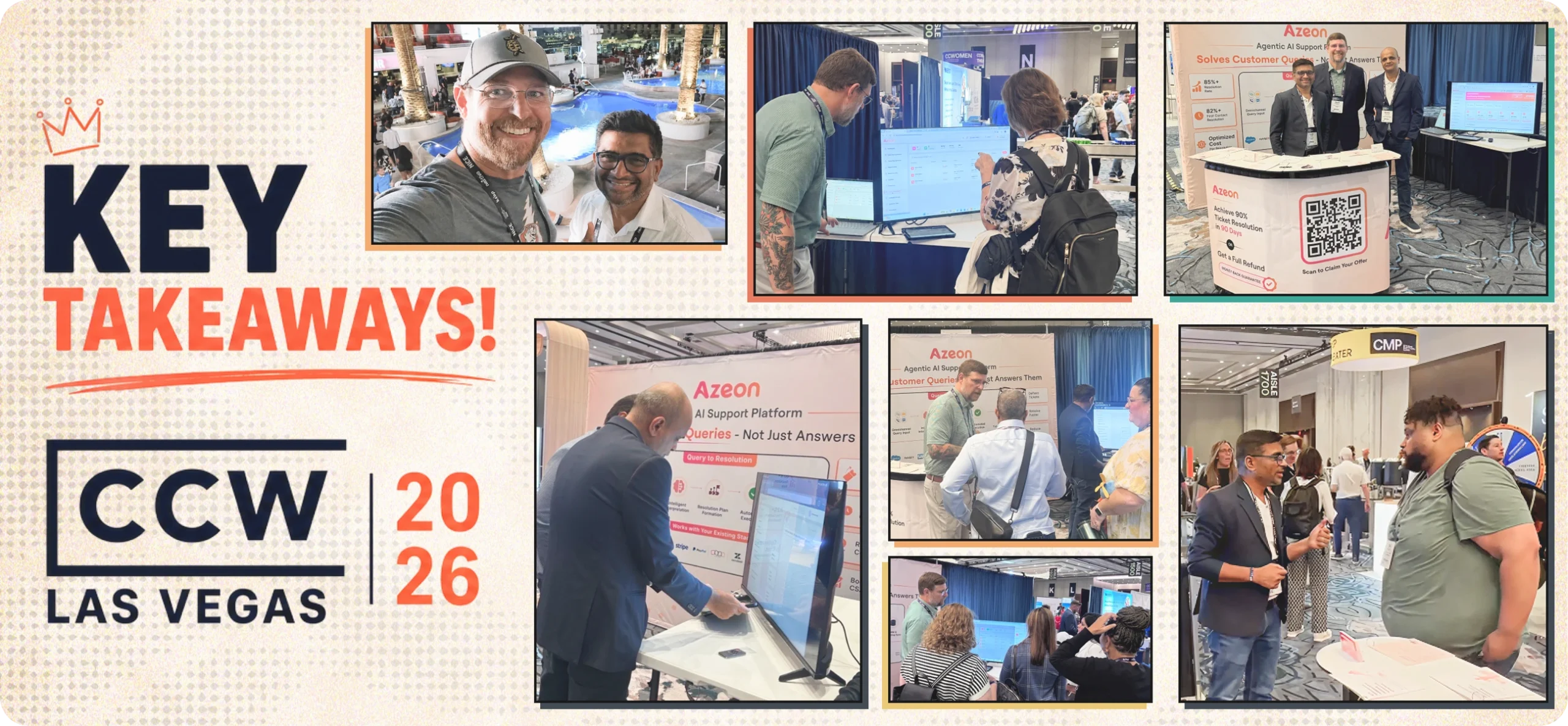
Over the past few months, we have exhibited at FinTech Meetup 2026, FS Technology Summit, and now CCW Las Vegas 2026, the largest customer service and contact center event in the world.

Going into CCW 2026, we expected the discussion to shift toward outcomes, resolution, and business impact rather than adoption, chatbots, and automation.

After three days of conversations with support leaders, operations teams, and AI buyers, that expectation proved right.

The conversations were no longer about how many tickets AI can deflect. They were about how many issues it can solve, how many workflows it can complete, and how quickly it can deliver value.

Here are the six lessons that, in our opinion, will shape the next chapter of customer support.
Takeaway #1: Resolution Has Become the New Measure of Success

One of the clearest changes we noticed at CCW was how support leaders are measuring success.

Traditional KPIs such as AHT (Average Handling Time), response time, agent productivity, and ticket volume still matter. However, they no longer provide the complete picture of customer support performance.

With AI becoming part of the support stack, the conversation is shifting toward KPIs such as:

  • Resolution rate
  • First-contact resolution
  • Task completion rate
  • Cost per resolution
  • Repeat contact reduction
  • Escalation rate

These metrics matter because they show whether AI is actually solving customer problems rather than simply participating in conversations.

In our opinion, customer support is moving from activity metrics to outcome metrics.

Takeaway #2: Agentic AI is Shaping the Next Generation of Customer Service

Agentic AI was undoubtedly one of the biggest topics at CCW 2026.

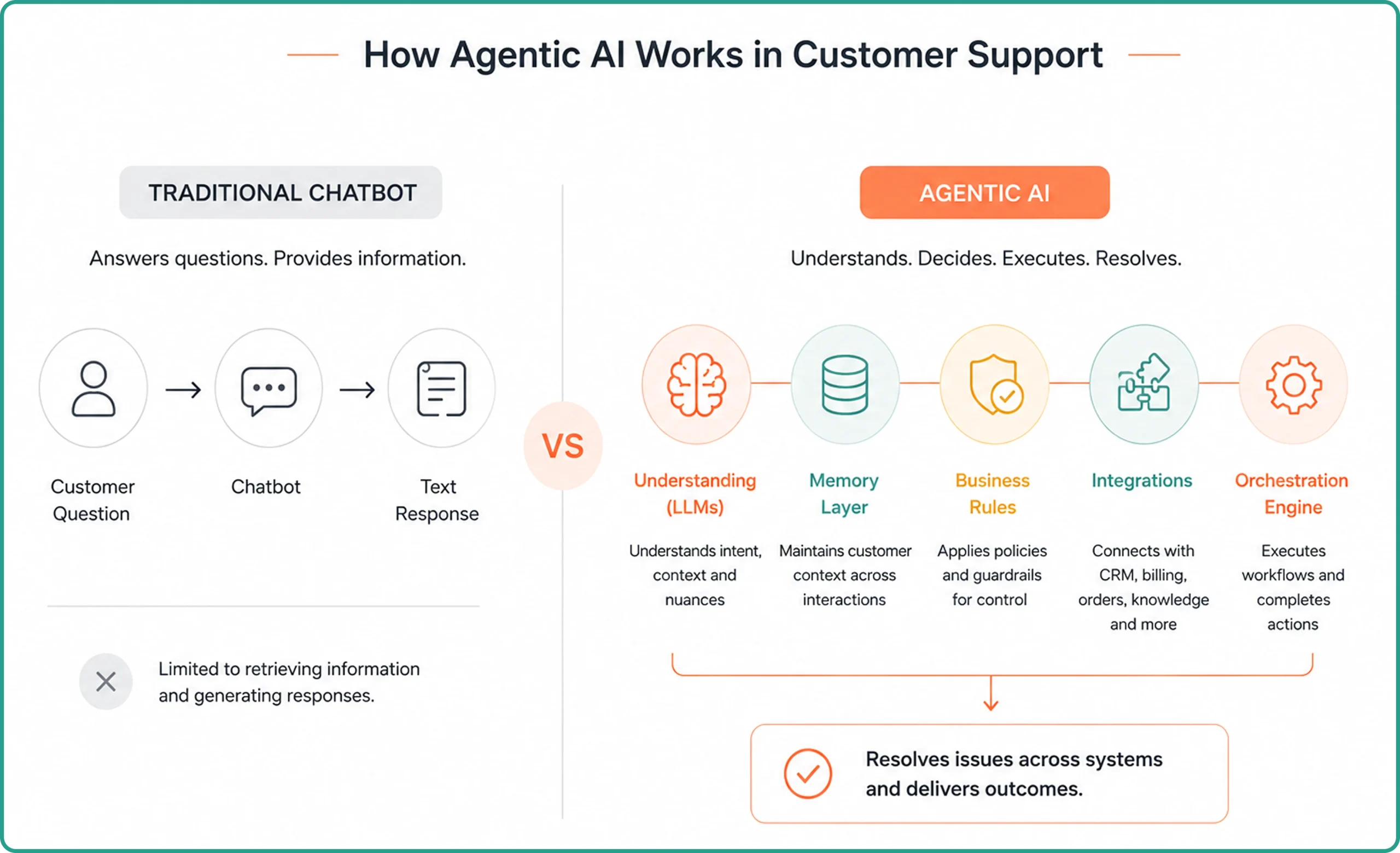
Because it combines multiple capabilities into a single workflow. For example:

  • Large language models provide reasoning and understanding
  • Memory layers maintain customer context
  • Business rules provide control
  • Integrations connect enterprise systems
  • Orchestration engines execute actions across those systems

This is very different from traditional chatbots that primarily retrieve information or generate responses.

For better understanding, here’s a visual representation.

Agentic AI vs Chatbot

This means:

Agentic AI is becoming the operational layer of customer support, where AI moves beyond conversations and starts participating in the actual resolution process.

Takeaway #3: Organizations Prefer AI That Works Across Existing Systems

Almost every company we spoke with already has a mature support environment.

There are CRMs, ticketing platforms, knowledge bases, communication tools, internal applications, and operational systems.

Nobody told us they wanted another isolated AI tool.

Instead, they want AI that can work with what they already have, with:

  • Faster time to value
  • No migration effort
  • Existing workflow continuity
  • Minimal disruption

This shows organizations want the confidence that their existing investments remain valuable while AI adds a new layer of intelligence on top of those systems.

Takeaway #4: Responsible AI Governance Has Become Non-Negotiable

Another topic that came up repeatedly was trust.

Many organizations are moving carefully because they need answers to questions like:

  • Why did AI make this decision?
  • When does AI escalate?
  • Who reviews the actions?
  • What gets logged?

Many businesses are also preparing for evolving AI governance requirements across the United States.

But governance alone is not enough.

Human-in-the-loop models received significant attention at CCW.

Organizations want AI to operate autonomously when confidence is high and involve human agents when risk increases.

This gives businesses both speed and control.

Takeaway #5: Human Expertise Combined with AI Creates More Trusted Experiences

Nobody we spoke with expects AI to solve every support issue.

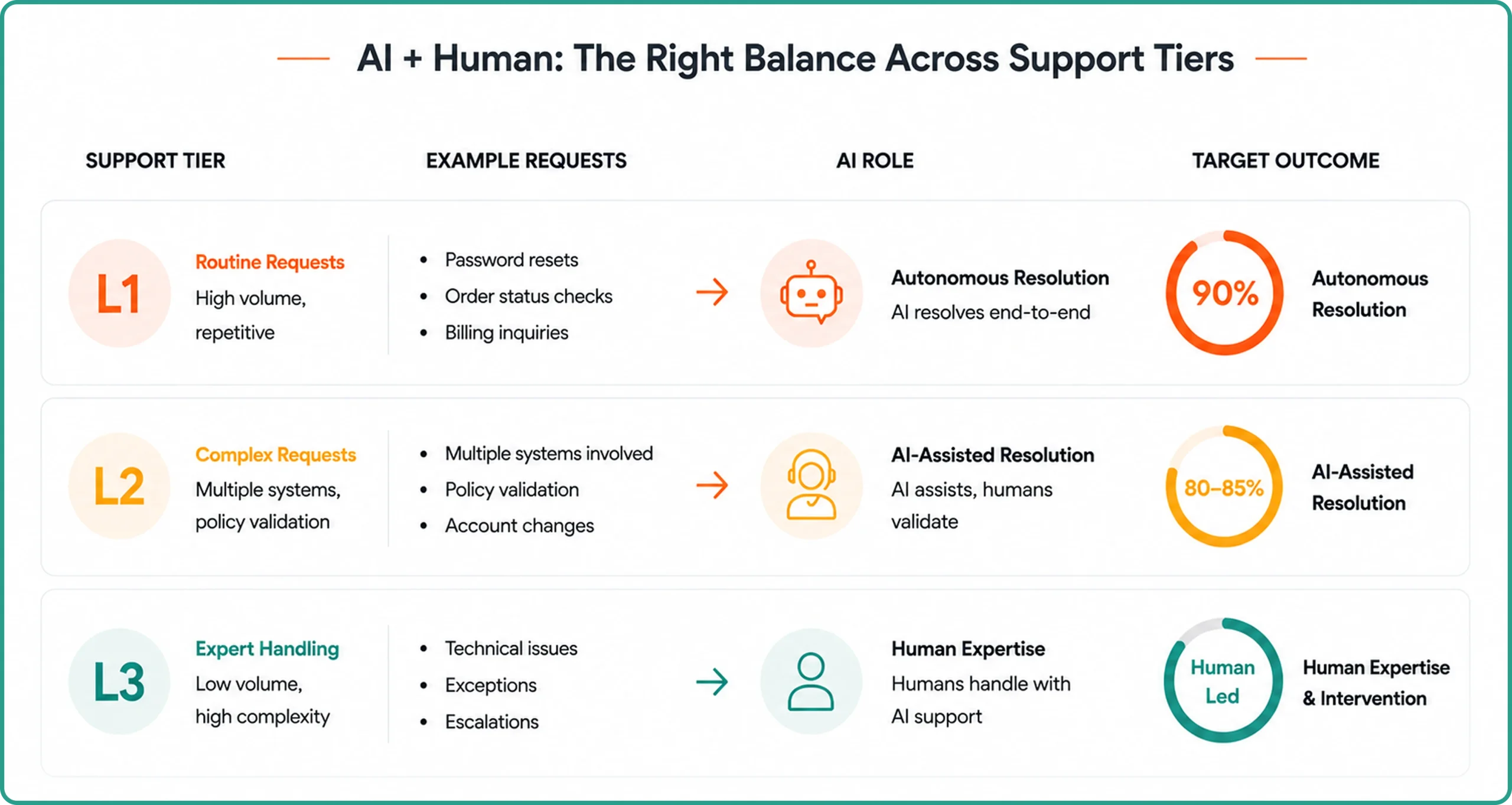
Instead, support leaders are thinking in terms of support tiers.

For example:

  • L1 requests (password resets, order status checks, billing inquiries) may achieve 90% autonomous resolution.
  • L2 issues (multiple systems, policy validation) may achieve 80–85% AI-assisted resolution.
  • L3 cases (technical issues, exceptions) often require human expertise and direct intervention.

Agentic AI + Human in Customer Support

This creates a very practical operating model.

AI handles repetitive tasks.

Human agents focus on complex investigations, exceptions, and high-value customers.

Takeaway #6: Native Agentic AI Platforms Are Emerging Alongside Existing Support Systems

Companies like Zendesk, ServiceNow and other established support platforms have built incredible products over many years.

Those platforms were designed during a different era of customer service.

Today’s support teams want:

  • Shared customer memory
  • Workflow execution
  • Root cause analysis
  • Cross-system actions
  • Agentic workflows

This is why native agentic AI platforms like Azeon are beginning to emerge.

We do not see this as a replacement story.

We see it as an additional intelligence layer that works alongside existing systems.

The future support stack may still include ticketing platforms, CRMs, and knowledge bases.

What changes is the layer that connects them, reasons across them, and executes work across them.

That is where we believe customer support is heading.

Our Biggest Takeaway

Customer support is entering a new chapter.

The industry is moving:

  • From responses to resolutions.
  • From chatbots to agentic AI.
  • From isolated tools to connected workflows.
  • From automation to governance.
  • From AI-only experiences to human-AI collaboration.

The support organizations that embrace these shifts will be better positioned to deliver faster resolutions, lower operational costs, and stronger customer experiences.

CCW Las Vegas 2026 showed that the future of customer support will not be defined by the number of tickets handled.

It will be defined by the number of customer problems solved.

Tarak Joshi leads growth strategy and market expansion for agentic AI-powered customer support solutions. With 20+ years of experience in business strategy, IT consulting, and operational excellence, he focuses on helping enterprises improve support outcomes, reduce operational costs, and adopt AI with measurable business impact. His expertise spans customer experience transformation, AI-led service operations, and aligning technology investments with business goals.

Tarak Joshi
VP - Sales

Questions about Azeon?

Connect with our team to explore use cases, workflows, and deployment possibilities.