

Skip to content

Best Chatbase Alternatives in 2026: Top 5 Platforms Compared

Best Chatbase Alternatives in 2026: Top 5 Platforms Compared

Chatbase can build an AI agent that answers customers using your business knowledge. But customer support rarely ends with an answer.

A customer may ask for a refund, dispute a charge, change an account detail, track an order, or report a product issue. The AI needs to understand the situation, access the right systems, take action, and confirm that the issue is resolved.

That is where choosing the right Chatbase alternative gets interesting.

In this guide, we compare five AI customer service platforms based on what they can actually do: build agents, understand context, execute workflows, automate resolutions, involve human agents, integrate with existing systems, and scale economically.
Quick Comparison: Best Chatbase Alternatives

Platform Best Suited For Core AI Capability Key Strength Starting Price
Azeon High-volume customer support AI agents built for automated resolution Resolution + Agent Studio + workflow execution From $0.05/assist
Botpress Developer-led agent building AI agents + visual workflows Deep customization and developer control Free; $150/mo Plus
Voiceflow Enterprise AI agent development Agentic + deterministic workflows Design, deployment, and observability Usage-based / custom
Tidio Lyro SMB and ecommerce support AI customer-service agent AI + live chat + ticketing From $32.50/mo
Ada Enterprise customer service AI agents for automated resolution Omnichannel enterprise CX Custom pricing

Top 5 Chatbase Alternatives in 2026

These platforms solve different versions of the same problem.

A platform can be excellent for building an agent while another may be better suited to operating automated support at scale.

1. Azeon – AI Agent Built to Resolve Customer Issues

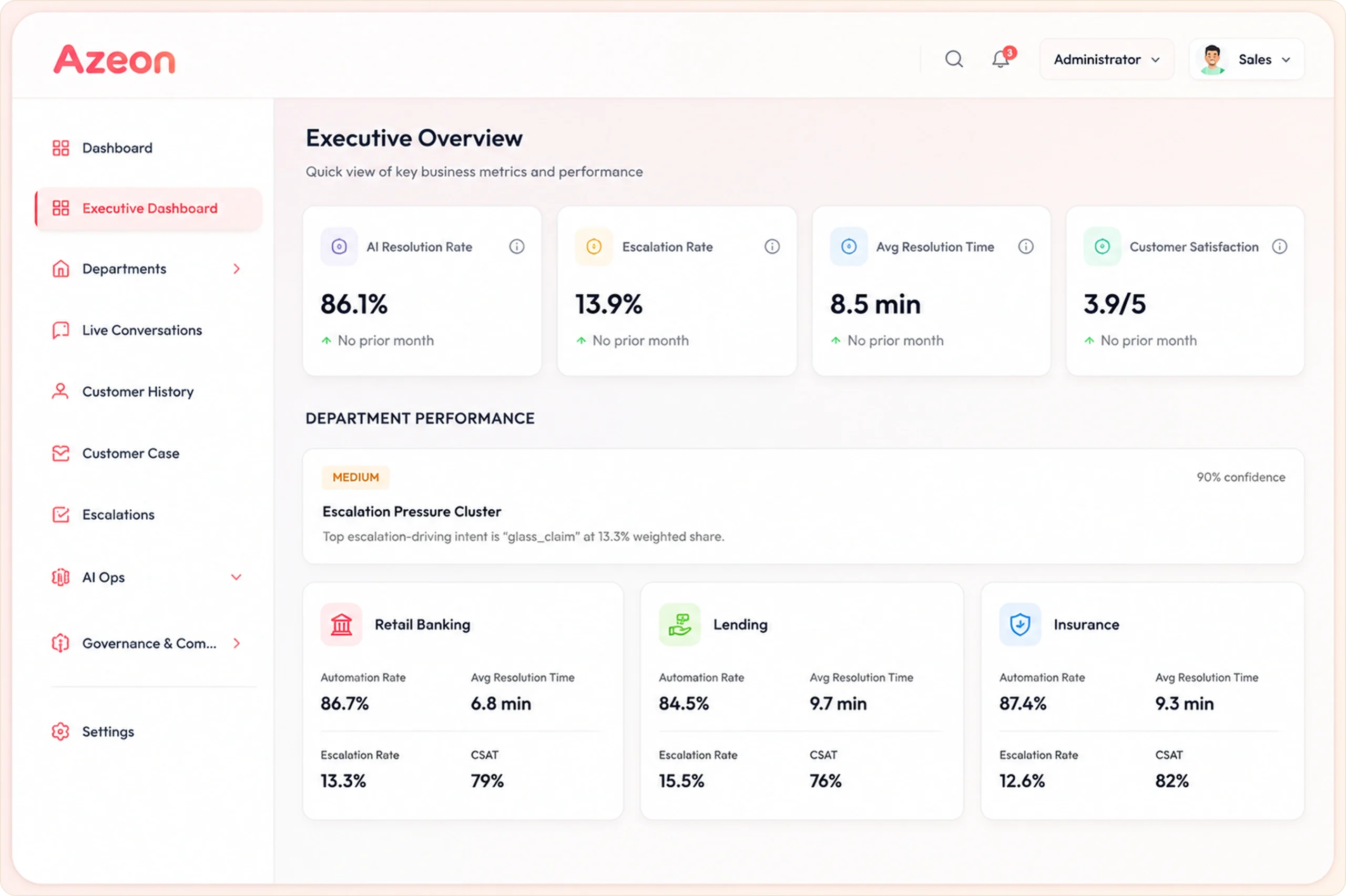
Azeon Executive Dashboard

Azeon is an AI agent for customer service. Its core objective is automated resolution, rather than simply generating answers.

Azeon connects customer knowledge, context, workflows, and business systems so AI agents can understand a request, reason through it, take the required action, and complete the support process.

Its current platform targets 90%+ autonomous ticket resolution with an existing ticketing platform, while maintaining a deterministic execution layer for business rules and workflows.

Key Capabilities of Azeon

Azeon’s current platform includes:

  • Agent Studio for building custom AI agents
  • Intelligence and reasoning
  • Shared customer memory
  • Knowledge integration
  • Workflow automation
  • Business-system actions
  • Omnichannel support
  • Human-in-the-loop workflows
  • Context-aware escalation
  • Governance controls
  • Custom AI skills

Why Azeon Stands Out

The strongest distinction is resolution-first architecture.

Azeon separates conversational intelligence from operational execution. LLMs handle interpretation and interaction, while deterministic systems govern business rules, workflows, execution continuity, and operational decisions.

Azeon describes this as a 100% deterministic core with traceable execution and no uncontrolled hallucinations in the execution layer.

That architecture becomes particularly relevant when an AI agent needs to do something consequential.

Pros

  • Purpose-built for customer-service resolution
  • Targets 90%+ autonomous ticket resolution
  • Agent Studio for custom AI agents
  • Shared customer memory across interactions
  • Workflow and business-system execution
  • Deterministic execution architecture
  • Human approval and escalation controls
  • Existing-stack deployment
  • Omnichannel support
  • Enterprise governance and auditability
  • Outcome-oriented pricing options

Cons

Its broader resolution and workflow capabilities can be unnecessary for businesses looking only for a lightweight website FAQ agent.

Pricing

Azeon takes a different approach from conventional per-seat support software.

Its current published pricing includes:

  • Copilot: starting at $0.05 per assist
  • AI-Resolved Queries: starting at $0.50 per resolution
  • AI-Completed Actions: starting at $1 per completed action

2. Botpress – AI Agent Building With Deep Developer Control

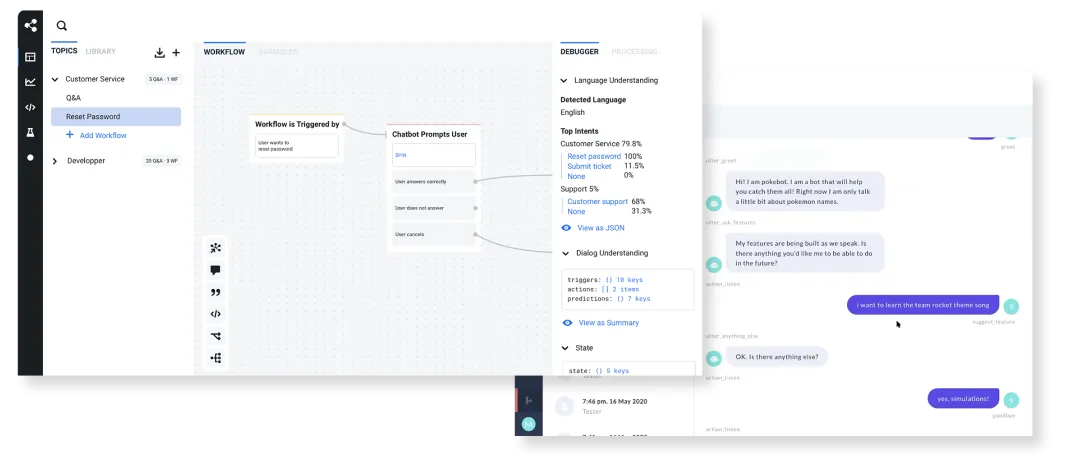
Botpress

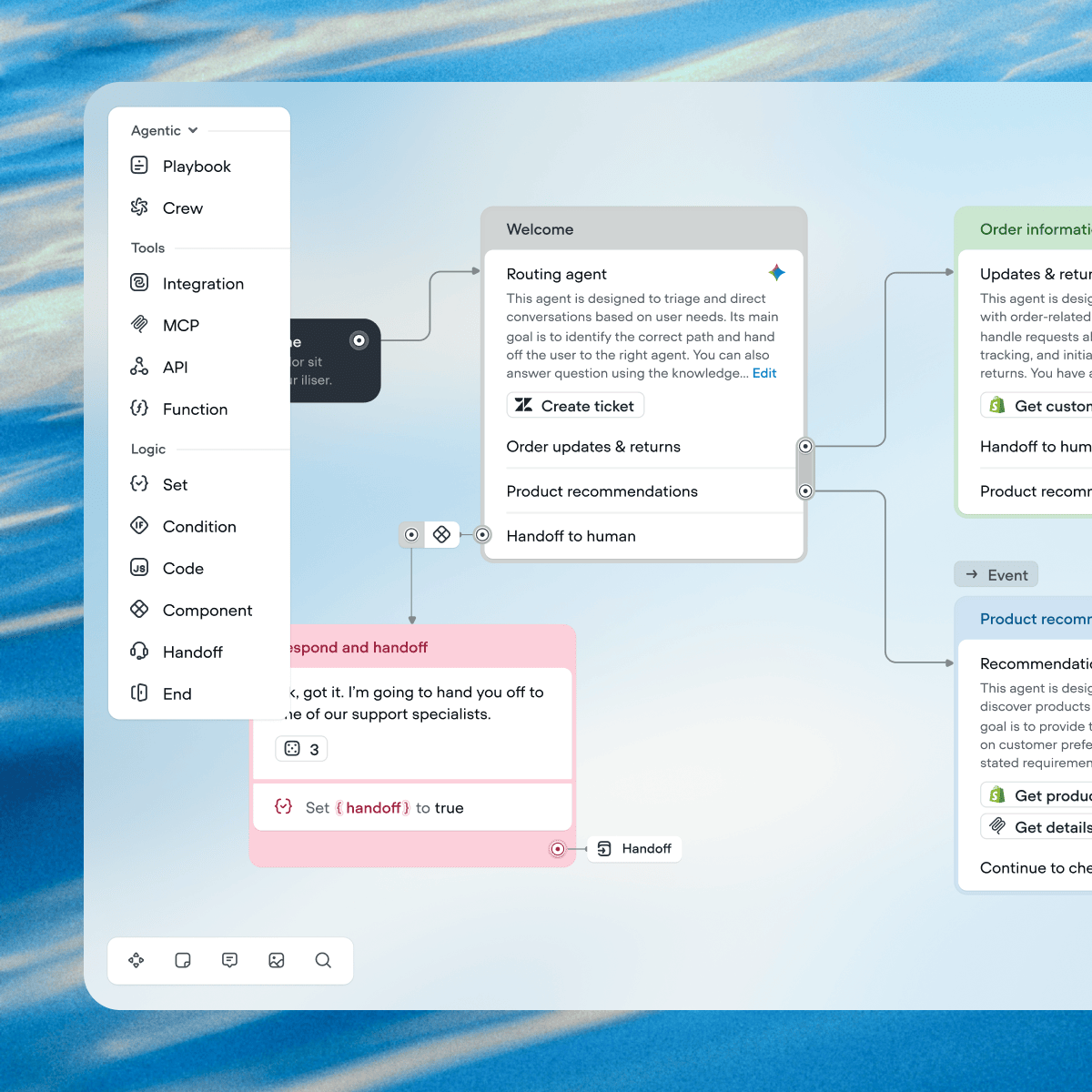
Botpress is an AI agent development platform centered on building, testing, deploying, and managing AI agents for customer service.

Its current Studio combines visual agent design with knowledge, structured data, custom code, APIs, workflows, and an autonomous reasoning engine. Botpress explicitly positions Studio for agents that can handle multi-step workflows and connect to external systems.

For companies evaluating a Chatbase competitor, Botpress is particularly relevant when customization and developer control sit high on the requirements list.

Key Capabilities of Botpress

  • Visual agent builder
  • Drag-and-drop workflows
  • Autonomous reasoning
  • Knowledge bases
  • Structured tables
  • Custom code actions
  • External-system integrations
  • Multi-LLM strategy
  • Conversation emulator
  • Agent analytics
  • Team collaboration
  • RBAC and routing

Why Botpress Stands Out

Botpress gives technical teams considerable control over how an agent reasons and operates.

Its Studio lets teams combine visual workflow design with code when a workflow becomes too specialized for purely visual configuration.

That makes Botpress a strong Chatbase alternative for organizations that want to build deeply customized agents rather than rely primarily on preconfigured support automation.

Pros

  • Powerful visual agent builder
  • Strong developer extensibility
  • Custom code actions
  • API support
  • Multi-step workflow capabilities
  • Knowledge and structured data layers
  • Multi-LLM flexibility
  • Team and enterprise controls

Cons

  • Greater flexibility can also mean greater implementation responsibility.
  • Teams may need more technical resources to design and maintain complex workflows.
  • Conversation-based pricing means costs scale with conversation volume rather than being tied directly to verified resolutions.

Pricing

Botpress currently offers:

  • Free: $0 with 25 conversations
  • Plus: $150/month when billed annually, with 250 conversations included
  • Team: $750/month when billed annually, with 1,500 conversations included
  • Enterprise: custom pricing

Additional conversation packs and AI usage apply according to the plan.

3. Voiceflow – Enterprise AI Agent Design and Orchestration

Voiceflow

Voiceflow has evolved into an enterprise conversational AI platform covering agent design, workflow orchestration, deployment, testing, observability, and production operations.

Its current positioning spans customer-support resolution, voice, chat, WhatsApp, SMS, APIs, integrations, model selection, and enterprise governance.

Key Capabilities of Voiceflow

  • AI agent builder
  • Agentic playbooks
  • Deterministic workflows
  • Knowledge and APIs
  • Enterprise integrations
  • Voice and chat
  • WhatsApp and SMS
  • Agent observability
  • LLM-powered evaluations
  • Production environments
  • Multi-model support
  • Bring-your-own-model capabilities

Why Voiceflow Stands Out

Voiceflow’s strength is the full agent production lifecycle.

The platform is structured around: Build → Launch → Iterate

Teams can design an agent, connect it to their technology stack, test it, deploy it, monitor performance, and iterate without rebuilding the entire experience.

It also combines agentic playbooks with deterministic workflows, giving teams a way to mix AI-driven behavior with explicitly defined business logic.

For organizations looking for a Chatbase alternative focused heavily on agent design, orchestration, and production control, Voiceflow is a serious candidate.

Pros

  • Strong visual agent-building environment
  • Agentic and deterministic workflow support
  • Strong API capabilities
  • Multi-channel deployment
  • Voice support
  • Multi-LLM strategy
  • Observability and evaluations
  • Enterprise security certifications
  • Production environments

Cons

  • Its breadth makes it particularly attractive to organizations that have teams capable of owning agent design and ongoing optimization.
  • Companies seeking a highly opinionated, purpose-built customer-service resolution platform may prefer a platform with more support-specific architecture.
  • Pricing is structured around platform and usage economics, so buyers need to model their expected AI activity carefully.

Pricing

Voiceflow’s current public site emphasizes its enterprise platform and production capabilities, while pricing details can vary by deployment and usage requirements. Its current platform supports production-scale agent deployment, multiple LLM providers, integrations, observability, and enterprise security.

For larger deployments, buyers should request a current quote based on expected agent volume, channels, models, and enterprise requirements.

4. Tidio Lyro – Accessible AI Support for SMBs and Ecommerce

Tidio

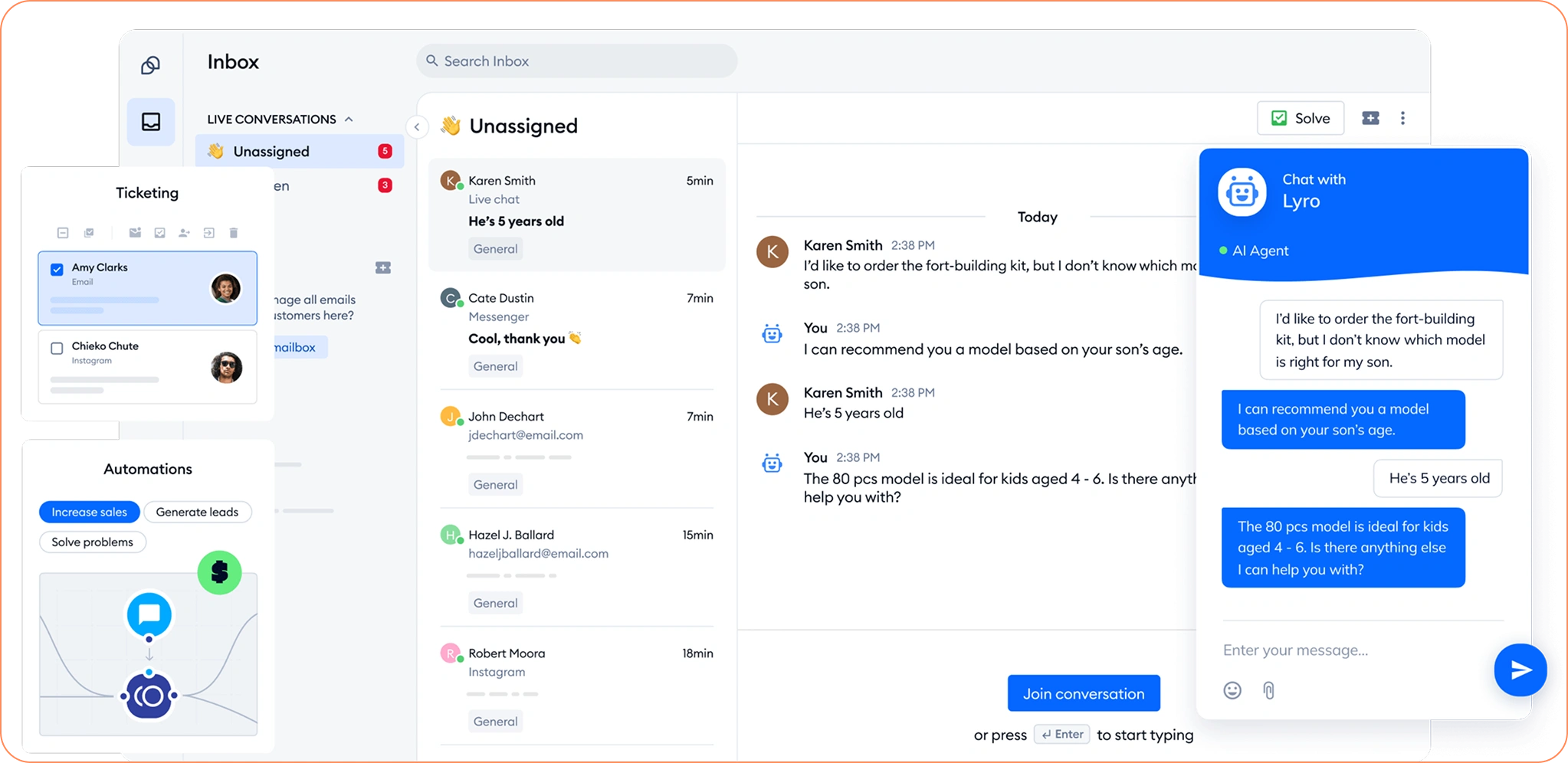
Tidio combines customer-service software with Lyro, its AI Agent.

Lyro is designed to answer customer questions automatically, use support content, perform recurring tasks, and hand conversations to human agents when needed. Tidio currently states that Lyro can solve up to 67% of customer problems automatically.

This makes Tidio a relevant Chatbase alternative for smaller support operations and ecommerce teams.

Key Capabilities of Tidio

  • AI customer-service agent
  • Knowledge-based responses
  • Human handoff
  • Product recommendations
  • Website and FAQ ingestion
  • Ecommerce support
  • Live chat
  • Analytics
  • Managed AI deployment

Why Tidio Stands Out

Tidio’s biggest strength is accessibility.

Teams can combine human support, live chat, ticketing, automation, and Lyro within the same broader customer-service environment.

For a smaller ecommerce operation, that can be a practical alternative to adopting a more extensive enterprise agent platform.

Pros

  • Accessible customer-service platform
  • AI + human support in one environment
  • Ecommerce-friendly
  • Knowledge ingestion
  • Human handoff
  • Multiple support channels
  • Managed AI option

Cons

  • Its published automation target is lower than platforms positioned around highly autonomous enterprise resolution.
  • Teams with complex multi-system workflows may require more advanced integration architecture.
  • Pricing combines platform usage with AI-agent usage, which requires careful modeling as support volume grows.

Pricing

Current Tidio pricing includes:

  • Starter: from $24.17/month
  • Growth: from $49.17/month
  • Plus: from $300/month plus monthly usage
  • Premium: custom pricing

Lyro can also be purchased separately, starting from $32.50/month for 50 AI conversations, with higher-volume options available.

5. Ada – Enterprise AI Customer Service at Scale

Ada

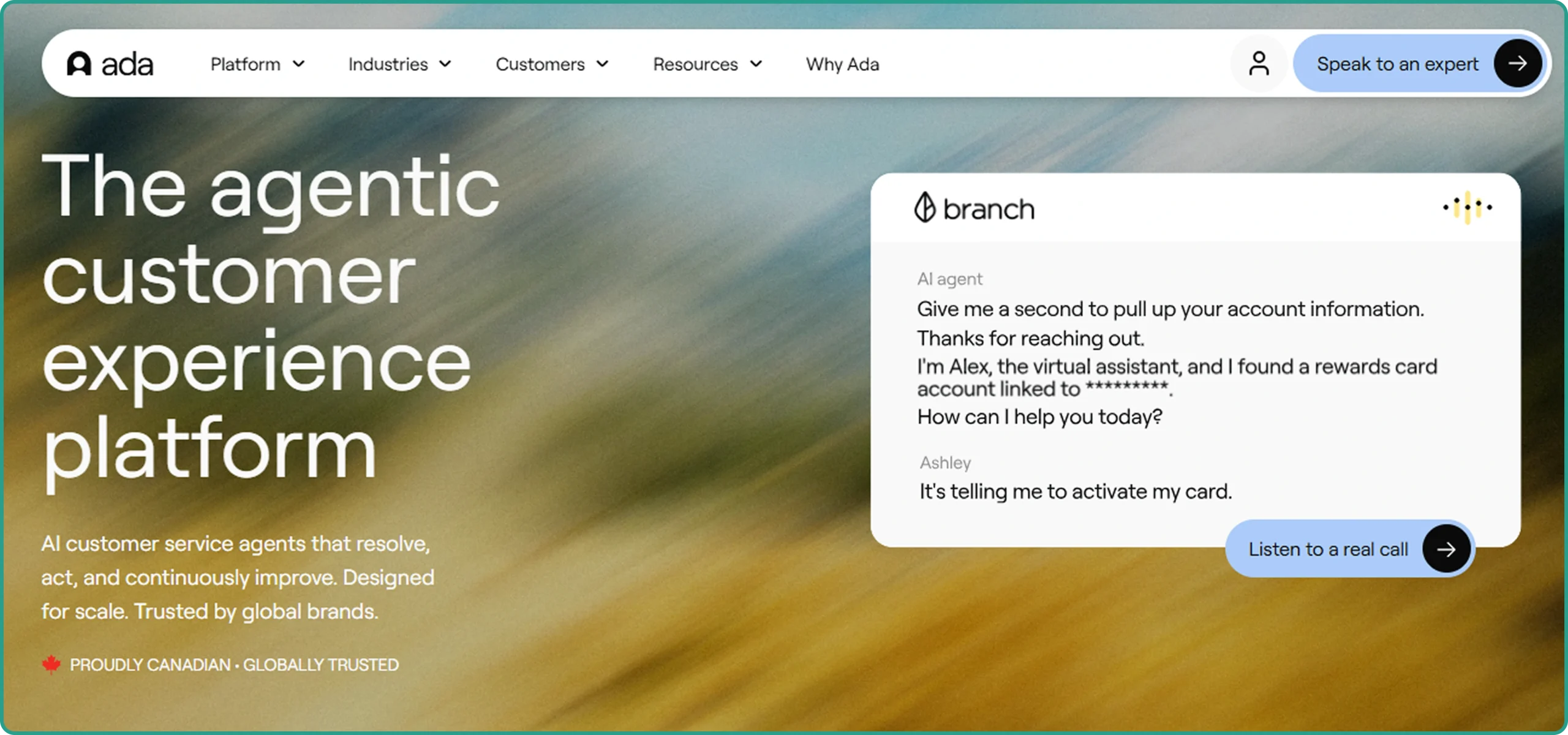
Ada is an enterprise AI customer-service platform focused on automated resolution across voice, email, chat, SMS, and social channels.

Its current platform combines AI agents, playbooks for complex workflows, a performance center, APIs and SDKs, omnichannel deployment, multilingual support, and enterprise governance.

Key Capabilities of Ada

  • Omnichannel support
  • Multi-step playbooks
  • APIs and SDKs
  • Performance analytics
  • Automated resolution tracking
  • Multilingual support
  • Compliance controls

Why Ada Stands Out

Ada is firmly aimed at enterprise CX.

Its platform emphasizes the complete lifecycle: Build → deploy → measure → coach → optimize

Ada reports an 84% automated resolution rate across its platform and says its AI agents operate across more than 4,000,000,000 customer conversations to date. Those figures are company-reported platform metrics rather than independently verified benchmarks.

Pros

  • Strong omnichannel coverage
  • Complex workflow automation
  • Voice support
  • Multilingual support
  • Enterprise integrations
  • Performance management
  • Strong compliance positioning
  • AI agent optimization

Cons

  • Enterprise orientation can make it less suitable for organizations looking for a lightweight AI support tool.
  • Larger implementations require careful integration and operational planning.
  • Public pricing is limited, so buyers need to engage sales to understand the commercial structure.

Pricing

Ada does not publish standard plan pricing on its current public site. Enterprise pricing is customized around the organization’s deployment requirements, channels, scale, integrations, and AI customer-service scope.

What Should You Look for in a Chatbase Alternative?

Comparing five products by feature count can create a misleading picture.

The more useful question is: What exactly do you expect the AI agent to accomplish?

A customer-support agent can sit at several levels of automation.

Level 1: Answer

The customer asks a question.

The AI retrieves information and responds.

Level 2: Understand

The AI interprets intent, sentiment, urgency, customer history, and context.

Level 3: Recommend

The AI determines the appropriate next step.

Level 4: Act

The AI accesses systems and executes a permitted workflow.

Level 5: Resolve

The AI completes the required work and confirms the outcome.

Level 6: Improve

The platform identifies recurring issues and operational patterns that can reduce future support demand.

That progression is the key to evaluating any Chatbase alternative.

Which Chatbase Alternative Fits Your Use Case?

There is no single platform that fits every support operation.

The better approach is to match the platform to the job you need the AI to perform.

If You Need... Platform to Consider Why
Automated customer-service resolution
Azeon
Purpose-built AI agents for resolving support issues, with Agent Studio for custom agents.
Developer-controlled AI agents
Botpress
Strong workflow customization, APIs, and custom code capabilities.
AI agent design and orchestration
Voiceflow
Visual agent development, workflows, deployment, and observability.
SMB or ecommerce support automation
Tidio Lyro
Combines AI support with live chat, ticketing, and ecommerce workflows.
Enterprise omnichannel customer service
Ada
AI-powered resolution across chat, voice, email, SMS, and other channels.

For teams evaluating a top Chatbase alternative, the deciding factor should therefore be the operational problem you are solving.

If the requirement is a knowledge-grounded agent that answers customer questions, a broad set of platforms can fit.

If the requirement is an AI agent that can understand a customer issue, access the required context, execute a workflow, complete the resolution, and escalate exceptions, the evaluation becomes much narrower.

Why Azeon is the Best Chatbase Alternative?

The easiest way to compare Chatbase and Azeon is to look at what happens when the conversation gets complicated.

Chatbase gives you the tools to build an AI agent.

Azeon gives that agent a customer-service operating layer built around resolution.

It can understand the request, pull customer context from connected systems, reason through the issue, execute the required workflow, bring in a human when approval is needed, and verify the outcome. And when a standard agent doesn’t fit your process, Agent Studio lets your team build one that does.

That combination matters because support teams ultimately have one number they care about: how many customer issues were actually resolved without human intervention.

Azeon is built around that number, with a target of up to 90% automated ticket resolution.

So if you’re searching for a Chatbase competitor because you want another place to build an AI agent, there are several options.

If you’re searching because you want AI to take responsibility for the support work itself, Azeon deserves a closer look.

See Azeon Resolve a Customer Issue Live

In a personalized demo, watch Azeon understand a request, access customer context, execute the right workflow, and verify the resolution.

Schedule a Demo →

FAQs

What is the best Chatbase alternative for customer support?

The answer depends on the support model. Azeon is designed specifically around automated customer-service resolution and also provides Agent Studio for custom AI agents. Botpress emphasizes developer-controlled agent building, Voiceflow emphasizes agent design and production orchestration, Tidio Lyro targets accessible AI support, and Ada focuses heavily on enterprise customer-service automation.

What is the top Chatbase alternative for automated resolution?

Azeon is specifically designed around automated customer-service resolution, with its current platform targeting 90%+ autonomous ticket resolution for suitable workloads and existing ticketing environments.

Is there a Chatbase alternative that can build custom AI agents?

Yes. Azeon provides Agent Studio for building specialized AI agents around customer-service requirements. Botpress and Voiceflow also provide extensive agent-building environments.

What is the difference between Chatbase and Azeon?

Both provide customer-facing AI agents, knowledge capabilities, integrations, actions, and human-in-the-loop functionality. Azeon places greater emphasis on automated customer-service resolution, deterministic workflow execution, shared customer memory, and outcome-oriented pricing. Chatbase emphasizes its broader agentic harness for building, deploying, and optimizing customer-facing agents.

What should you look for in a Chatbase competitor?

Look beyond the chatbot interface. Evaluate agent reasoning, customer memory, integrations, workflow execution, action controls, human escalation, observability, security, deployment requirements, pricing economics, and the platform’s ability to improve resolution rates over time.

Tarak Joshi leads growth strategy and market expansion for agentic AI-powered customer support solutions. With 20+ years of experience in business strategy, IT consulting, and operational excellence, he focuses on helping enterprises improve support outcomes, reduce operational costs, and adopt AI with measurable business impact. His expertise spans customer experience transformation, AI-led service operations, and aligning technology investments with business goals.

Tarak Joshi
VP - Sales

Questions about Azeon?

Connect with our team to explore use cases, workflows, and deployment possibilities.