


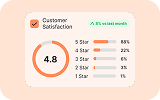

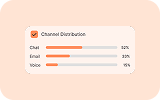
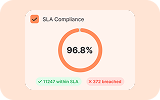
Our client is a fast-scaling B2B SaaS company providing workflow automation tools to mid-market and enterprise clients. The platform operates on a subscription model with tiered plans and strict SLA commitments for uptime and support responsiveness.
A SaaS Company Doubled CLV and 96%+ SLA Adherence with Azeon AI Agent
Client’s Story
Active subscriptions
8,000+
paying accounts across plans, each with distinct onboarding and support needs
8KMonthly ticket inflow
5,000+
support requests every month spanning three distinct query types
5KThis fast-growing SaaS company serves thousands of active subscriptions across mid-market and enterprise clients. As product adoption expanded and new features rolled out frequently, onboarding and integration questions increased.
With enterprise accounts tied to strict SLA commitments, even minor support delays began affecting renewal confidence and expansion opportunities.
Our strategic approach
01 — The real problem
Volume wasn't the issue. Response time and retention were.
"Ticket volume isn't the real issue. The problem is how it impacts response time and retention."
— VP of Customer Support Operations
02 — The reframe
Not ticket deflection. Friction reduction in the customer lifecycle.
"Support in SaaS isn't about ticket deflection. It's about reducing friction in the customer lifecycle."
Problem: response latency
Risk: churn at renewal
Fix: lifecycle-aware support
03 — The strategy
Three pillars. One goal: protect the customer relationship.
Our strategy focused on three interconnected principles, each designed to make support work with the SaaS business model — not against it.
Pillar 01
Align automation with subscription economics
We aligned support automation with revenue tiers and renewal cycles to protect high-value accounts. Enterprise and near-renewal customers received prioritised routing and human-first handling — because a delayed response at the wrong moment costs far more than a resolved ticket.
Pillar 02
Embed context into every interaction
Azeon connected directly with product usage data and account details to deliver context-aware responses. When a user raised a ticket, Azeon already knew their plan tier, feature adoption, recent activity, and integration setup — allowing it to respond with precision rather than generic answers.
Pillar 03
Introduce confidence-governed automation
Tickets were automated only when the AI was confident in the resolution. Ambiguous queries, critical account issues, and enterprise escalations were routed immediately to human agents — ensuring automation never came at the cost of customer trust or account health.
Solution
We implemented Azeon AI as a policy-governed automation layer — embedded directly into the company's CRM, ticketing system, knowledge base, and product telemetry stack. No migration. No system replacement. Azeon plugged into what already existed and immediately began reducing friction across the customer lifecycle.
CRM
Account & plan data
Ticketing System
Inflow & routing
Knowledge Base
Docs & resolution logic
Product Telemetry
Usage & feature signals
Live Data
Real-time integration with user account data
Azeon pulled live account data — subscription plan, billing status, seat count, renewal date, and assigned CSM — before formulating any response. Every interaction was grounded in the customer's actual account state, not a generic snapshot, so answers were accurate and immediately actionable without an agent needing to look anything up.
Tier Logic
Plan-aware support workflows
Support workflows were configured by plan tier. Starter accounts received fast, self-serve resolutions. Growth accounts got guided walkthroughs with contextual documentation. Enterprise accounts triggered immediate human routing with a full context brief — protecting the accounts that carry the most revenue and renewal risk.
Proactive
Product-usage-triggered assistance
Azeon monitored product telemetry signals — features accessed, integrations attempted, error events fired — and used that data to anticipate support needs before a ticket was even raised. A user stuck on an integration step received a proactive nudge. A team that hadn't adopted a key feature got a targeted walkthrough. Support became predictive, not just reactive.
Governance
Confidence-based ticket automation thresholds
Every ticket passed through a confidence scoring layer before automation was applied. Routine queries — password resets, plan FAQs, integration how-tos — were resolved autonomously when confidence was high. Anything ambiguous, account-critical, or enterprise-flagged bypassed automation entirely and reached a human agent with a pre-built context summary ready to act on.
The result was a support system that understood the SaaS business model. Automation handled volume. Context handled precision. Governance handled trust. Together they created a support experience that reduced churn risk instead of just closing tickets.
Results
Verified outcomes — 90 days post-deployment
60%
Tickets resolved
autonomously
no agent needed
autonomously
no agent needed
35%
Engineering
bandwidth reclaimed
redirected to product
bandwidth reclaimed
redirected to product
100%
SLA-critical cases
correctly routed
zero missed
correctly routed
zero missed
2x
Support capacity
without added
headcount or cost
without added
headcount or cost
Manual ticket handling reduced significantly 60% automated
Routine queries — onboarding steps, plan FAQs, integration how-tos, feature walkthroughs — were resolved by Azeon autonomously. Agents stopped spending half their day on repeatable questions and started focusing on complex, high-value interactions that actually required human judgment.
Engineering bandwidth reclaimed via automation 35% time saved
Integration and feature-usage tickets that previously required developer involvement were resolved through Azeon's product telemetry-aware responses. Engineers were pulled out of support queues and returned to the product roadmap — a shift that directly accelerated development velocity.
SLA-critical cases protected through structured routing 0 missed SLAs
Confidence-governed thresholds ensured that enterprise accounts, near-renewal cases, and high-severity issues bypassed automation entirely. Every SLA-critical ticket was flagged, prioritised, and delivered to a human agent with a full context brief — with zero cases falling through the cracks.
Support transformed from cost center to revenue lever 2x capacity
By proactively addressing friction points in onboarding and feature adoption, Azeon directly contributed to lower churn and higher expansion revenue. Support stopped being a reactive function absorbing cost and started functioning as a retention and growth driver embedded in the customer lifecycle.
"Support used to be a bottleneck as we scaled. Now it runs quietly in the background while still meeting every SLA."
Questions about Azeon?
Connect with our team to explore use cases, workflows, and deployment possibilities.